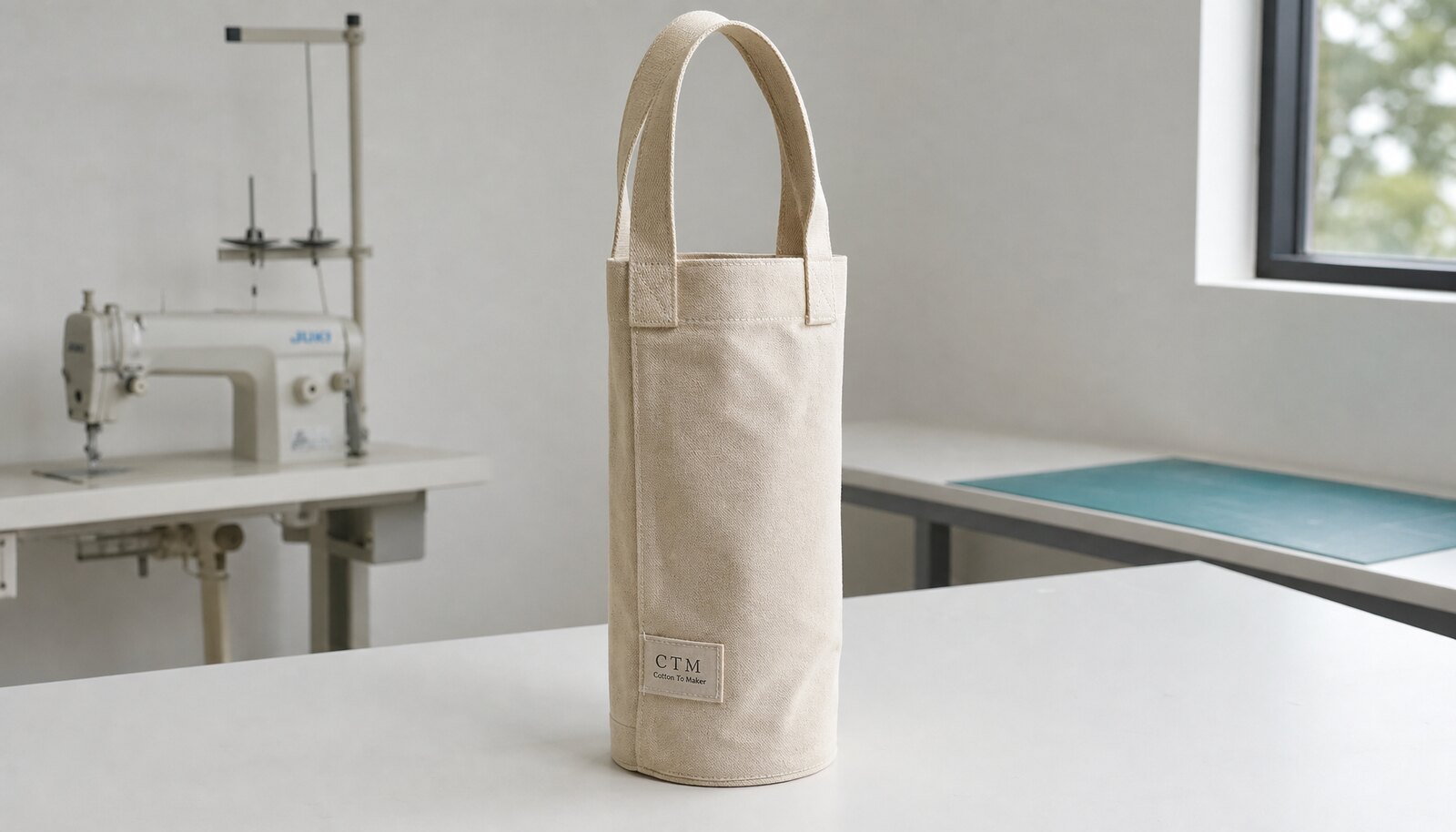
Why lead time planning matters for canvas wine carriers
Corporate gifting buyers usually lose time in two places: they approve artwork too late, and they underestimate how long it takes to move a simple canvas carrier from sample room to finished export cartons. A canvas wine carrier looks like a small item, but it still needs fabric reservation, cutting, sewing, print setup, inspection, packing, and dispatch. If the program is tied to an event date, the real risk is not only factory lead time; it is the time lost on unclear specs and repeat approvals.
For wholesale canvas wine carriers used in gifting, a reliable schedule starts with defining the product as a production item, not a general promotional bag. The buyer should decide early whether the carrier is for one bottle only, whether the bottle will be champagne size or standard 750 ml, whether it needs a divider, and whether the branding is a single-color logo or a higher-value decoration method. These choices directly affect sewing time, print setup, and the chance of a revised sample.
- Treat the wine carrier as a functional container, not just a printed gift accessory.
- Lead time extends when bottle type, artwork, and packaging are decided late.
- A simple spec sheet is faster than a long email chain with missing dimensions.
Start with the bottle and the use case, not the artwork
The first production question is what bottle the carrier must hold. A standard 750 ml wine bottle is different from a Burgundy bottle with a wider body, and both are different from a Champagne bottle with a taller shoulder and heavier weight. If the carrier is designed around the wrong bottle profile, the bag may still look fine in photos but fail in real use because the neck opening, base depth, or side seam position is off.
For corporate gifting, the use case matters as much as the bottle. A carrier handed out at a holiday event can be lighter and simpler than a retail-ready carrier that sits on a store shelf. If the bag will be inserted into a hamper, basket, or gift box, the buyer may want a flatter build and lower fabric weight. If it will be carried alone, the handle reinforcement and base support become more important than decorative stitching.
- Define bottle size range in millimeters, not only as “wine bottle.”
- State whether the carrier must fit with capsule, cork collar, or gift tag attached.
- Note if the item will be carried alone, packed inside another gift, or displayed on shelf.
Fabric weight, structure, and the cost of getting it wrong
Canvas weight is one of the clearest levers on both price and lead time. For most wholesale canvas wine carriers, 12 oz canvas is a practical starting point because it balances structure and cost. It usually gives enough body for a single bottle without excessive bulk. If the buyer wants a more premium hand feel, better shape retention, or a stronger retail impression, 14 oz canvas is often the next step. Heavier fabrics can improve perceived value, but they also raise cutting resistance, sewing load, and freight weight.
The buyer should also ask whether the fabric is natural, bleached, dyed, or washed. Natural canvas is generally easier to source and produces a straightforward lead time. Dyed canvas may need extra pre-production coordination for shade approval, especially if the brand needs an exact neutral, black, or seasonal color. Washed or softened canvas can look better for gifting but adds process time and can slightly change final dimensions after finishing.
- 12 oz canvas: common balance of structure, cost, and sewing efficiency.
- 14 oz canvas: better premium feel, but higher fabric and freight cost.
- Dyed or washed fabric should be confirmed early because it can extend the schedule.
Print method selection changes both quote and schedule
For wine carriers, the simplest and most stable branding is usually one-color screen print or a woven/printed side label. This is the safest route when the logo is bold, the quantity is high enough to spread setup cost, and the buyer wants consistent repeatability across production. Screen print is efficient for corporate gifting because it is easy to approve, easy to inspect, and usually robust enough for handling if cured correctly.
Complex artwork slows everything down. Gradients, small text, thin strokes, or multi-color register work increase the chance of sample revisions and production waste. If the brand team is asking for a detailed logo on textured canvas, the buyer should compare a few routes: screen print, heat transfer, embroidery, woven label, or a sewn-on badge. The best option is the one that survives production and packing, not just the one that looks best on a screen.
- One-color screen print is usually fastest and most quote-friendly.
- Woven or sewn labels are useful when the logo needs a clean premium look.
- Embroidery may look strong but can distort light canvas and add extra setup time.
MOQ logic: how quantity affects fabric reservation, sewing, and carton plan
MOQ for wholesale canvas wine carriers is not only a factory number; it is also a production logic number. If the item uses one standard size, one fabric color, and one artwork version, the MOQ can usually stay relatively efficient because cutting and sewing are repetitive. Once the buyer wants multiple colors, multiple bottle fits, or different print versions, each change creates new setup time and more packing complexity. That is why a low-looking MOQ on paper can still generate a higher unit cost than expected.
A useful buying rule is to separate the MOQ by material, artwork, and packing method. A supplier may quote a low fabric MOQ but require a higher minimum for a printed logo or custom carton. If the buyer needs mixed cartons, barcode labels, or retail wrap, those details should be stated before price comparison. Otherwise, the buyer compares quotes that are not built on the same production assumptions.
- Ask for MOQ by fabric color, print version, and packing style separately.
- One SKU with stable specs is usually cheaper than several small variations.
- Mixed cartons need an explicit packing map to avoid shortages during final count.
Supplier route comparison for corporate gifting programs
Not every sourcing route gives the same control over lead time. A direct factory with its own sewing and sample room is usually the most practical choice for repeat corporate gifting because the buyer can lock fabric, sample, print, and packing under one production owner. A trading company can be useful when the buyer needs broader sourcing support, but the schedule often depends on how clearly the factory behind them is managed. If the buyer needs a rush correction, the direct line of accountability matters.
For branded programs, the best supplier is not the one that gives the lowest unit quote on day one. It is the one that can prove how samples are approved, how defects are handled, and how shipping cartons are built. If the supplier cannot explain who controls print strike-off, who signs the production sample, and who reviews carton counts, the buyer should expect hidden delays later.
- Direct factory: stronger control on sample sign-off, sewing, and packing sequence.
- Trading route: may help with sourcing options but can add coordination layers.
- A quote should identify who owns the production risk, not only who sends the email.
Comparison table: sourcing routes for wholesale canvas wine carriers
The right sourcing route depends on how much control the buyer needs over artwork, sample timing, and packing consistency. Use the table below to compare practical options for corporate gifting, not just price tags. The real decision is usually between speed, accountability, and how much variation the buyer can tolerate.
Packing rules should cover upright or flat packing, bottle-protection insert, carton count, moisture control, and retail display orientation. These details affect cost, damage rate, receiving speed, and whether the goods can move directly into retail or distribution.
- Write decisions in measurable language, not only descriptive wording.
- Ask for sample photos plus one physical approval sample for important orders.
- Keep quotation, sample approval, and inspection notes tied to the same spec version.
Sample approval: the fastest way to prevent a bad bulk order
A sample is not just a formality. For canvas wine carriers, it is the only stage where the buyer can still change handle length, print placement, seam reinforcement, and bottle fit without wasting bulk material. A prototype sample shows construction logic, but a pre-production sample with final fabric and final print is the one that should be signed off before mass sewing begins. If the buyer skips this step, the most common failure is not dramatic damage; it is a product that looks acceptable but does not fit the bottle cleanly or sit straight on a shelf.
The sample should be evaluated under practical conditions. Insert the actual bottle, check how the base supports the weight, lift it several times, and see whether the print remains centered when the bag is full. Also inspect the seam finish inside the bag. Loose threads, uneven topstitching, or twisted handles may seem minor, but they often become bigger once the bag is packed flat and compressed into cartons.
- Use the actual bottle or a bottle dummy in the sample review.
- Approve only the final fabric, final print, and final trim combination.
- Record measurements: body width, base depth, handle drop, and total height.
Packing and carton decisions that protect the quote
Packing has a real cost effect on wholesale canvas wine carriers because the bag shape is narrow and can crease under pressure. Bulk packing is usually the cheapest route, but it requires a clean carton structure and enough protection to keep the handles from deforming. Tissue wrap or a simple inner polybag may be enough for internal corporate distribution. If the buyer needs the carrier to reach end users in good visual condition, the pack plan should include abrasion protection around the print area.
Carton selection also changes the shipment result. A light carton may save a little on unit cost but can fail in stacking or transit. Buyers shipping export orders should ask for master carton size, gross weight, quantity per carton, and carton marking format. If the packing list does not match warehouse receiving expectations, the program can lose time at destination even when the factory shipped on schedule.
- Bulk pack is efficient but must still protect handles and print areas.
- Tissue wrap or polybag can reduce scuffing during transport.
- Carton marking should match the buyer’s warehouse or 3PL receiving rules.
Lead time planning and schedule risk by production stage
A realistic schedule starts from sample approval, not from the day the first email is sent. For a straightforward canvas wine carrier, the production sequence usually includes artwork confirmation, fabric reservation, sample making, sample approval, bulk cutting, sewing, printing, packing, and final inspection. Each stage has a different failure point. Artwork changes add time immediately, while fabric delays usually hit later when the order is already partly scheduled. The buyer should protect the calendar by freezing the specs before the quote is finalized.
If the gifting date is fixed, add a buffer for every stage that can be touched by outside approval. Brand review, legal text, packaging design, and barcode sign-off all affect the schedule even if the factory is ready. A buyer who wants a clean on-time shipment should lock the product spec first, then align the internal approval window to the factory production window.
- Lead time should be counted from final sample approval, not first inquiry.
- Artwork or packing changes after approval often trigger rework.
- Keep a buffer for QC, carton labeling, and export booking.
Specification comparison for buyers
| Spec decision | Recommended option | When it fits | Buyer risk to check |
|---|---|---|---|
| Direct factory vs trading route | Direct factory with in-house sewing and sample room | Repeat programs, tighter lead times, and buyers who need clear accountability | Confirm who approves the sample and who owns late-stage corrections |
| Fabric weight | 12 oz to 14 oz canvas based on positioning | 12 oz for efficient gifting programs; 14 oz for premium presentation | Do not accept vague 'heavy canvas' wording without an oz or GSM range |
| Artwork method | 1-color screen print or sewn label | Simple logos and stable repeat orders | Small text and fine lines may blur on textured canvas |
| Bottle compatibility | Standard 750 ml with allowance for wider shoulders if needed | Most wine gifting programs and mixed bottle use | Measure actual bottle diameter, base width, and neck height before release |
| Packing style | Bulk pack with protective inner wrap | Internal corporate distribution and warehouse repacking | Without protection, handles crease and print rubs during transit |
| Sample stage | Pre-production sample on final materials | Orders with brand approval, retail visibility, or event deadlines | A proto sample alone may hide color and fit problems |
| MOQ strategy | Single-size, single-color, single-artwork order first | Buyers trying to control cost and speed | Multiple variations can turn a low MOQ into a slow, expensive order |
| Quality control | AQL plus bottle-fit and handle-load tests | Programs where returns or gifting failures are unacceptable | Visual inspection alone misses seam weakness and bottle instability |
Buyer checklist before sampling
- Final bottle type and size range: 750 ml standard, Burgundy, Champagne, or mixed bottle diameters.
- Required canvas weight in oz or GSM, plus whether the buyer wants washed, dyed, or natural finish.
- Artwork format, print placement, Pantone targets, and whether one-side or both-side branding is required.
- Target MOQ by size/color and whether cartons may be mixed by color or must stay separate.
- Approval path for sample sign-off, including who signs off on color, print, and dimension tolerance.
- Packing requirement: bulk, tissue wrap, polybag, barcode sticker, inner divider, or retail-ready presentation.
- Delivery window, ship mode, and whether the program includes domestic distribution or direct export.
Factory quote questions to send
- What fabric weight, weave count, and finishing are included in the quote, and is the price based on natural canvas or dyed canvas?
- Is the print price for one color, one side, and one location only, or does it include both sides and additional setup fees?
- What is the MOQ by color and by artwork version, and how does MOQ change if we request retail packing or barcode stickers?
- What sample will you provide before bulk production: proto, pre-production sample, or production-dip sample, and what is the approval lead time?
- What is the standard production lead time after sample approval, and what items can extend it, such as dyeing, new tooling, or carton printing?
- What QC standard do you use for seam strength, handle pull, size tolerance, and print alignment, and can you share inspection photos before shipment?
Quality-control points to confirm
- Fabric weight must be verified against the approved spec before cutting begins.
- Handle bar-tacks or reinforcement stitching should be even, tight, and free of skipped stitches.
- Bottle-fit test must be done with the actual bottle type or a confirmed dimension dummy.
- Print alignment and color should match the signed sample within the agreed tolerance.
- Master cartons should be sealed, labeled, and counted against the packing list before release.
- Packed goods must remain flat and clean, with no oil marks, loose threads, or crushed handles.