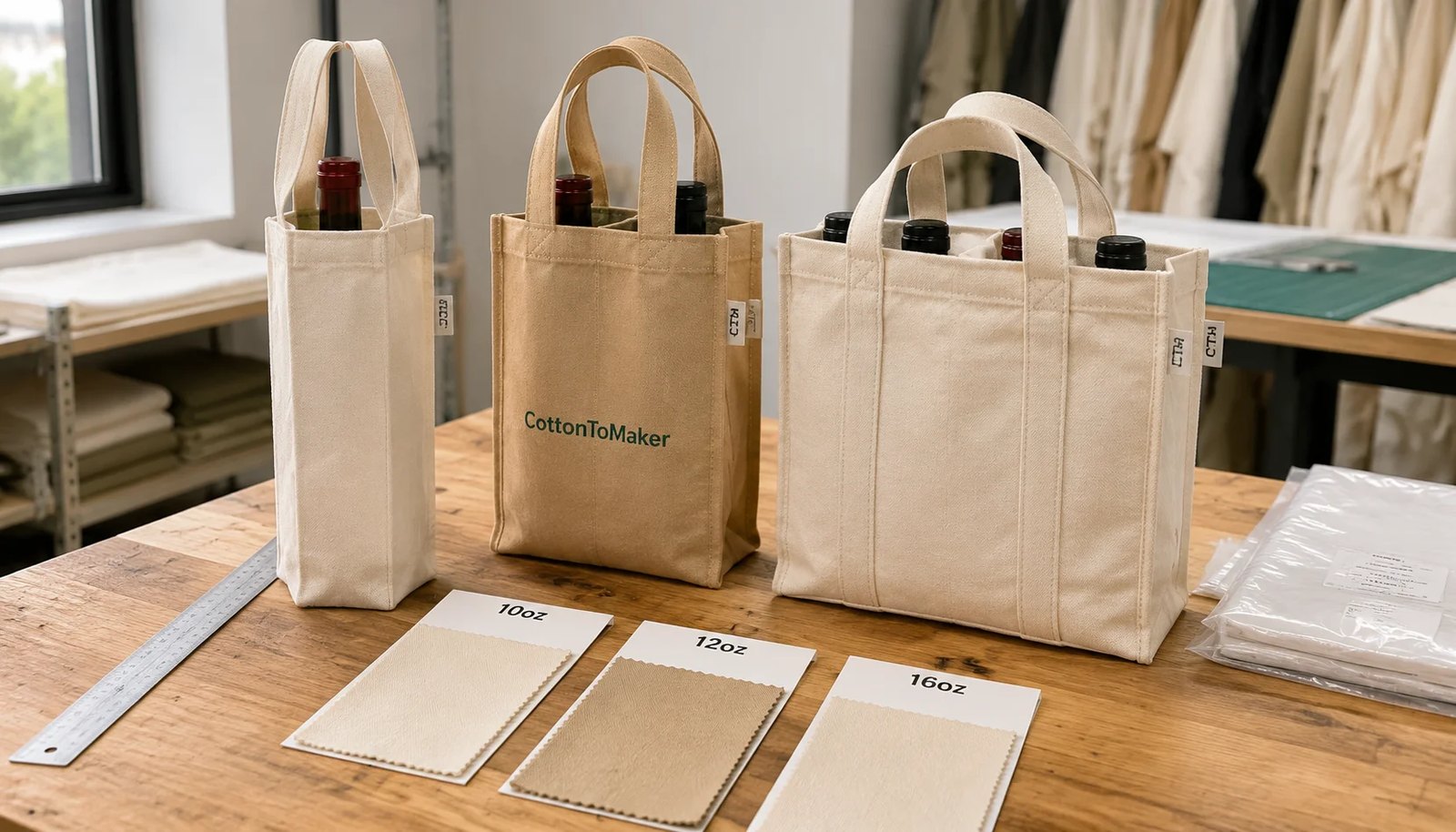
Why fabric weight is the main buying decision on canvas wine carriers
For natural grocers, a canvas wine carrier is usually purchased for one of three jobs: checkout add-on, promotional gift packaging, or reusable bottle transport. Those jobs look similar on a mood board, but the load profile is different. A single 750ml glass bottle can already push a light bag into seam stress if the handle anchoring is short or the fabric is too loose. Once the bag moves to two bottles or a gift set, fabric weight stops being a cosmetic decision and becomes a structural one.
The common mistake in RFQs is requesting 'canvas wine bag with logo' without naming bottle count, bottle dimensions, or carrying expectation. That pushes suppliers to quote the cheapest standard body, often around the lightest usable canvas, which may look fine in a sample room but fail during store use. Fabric weight has to be selected together with gusset depth, divider style, and handle reinforcement. If you separate those decisions, quotes may be cheap but not comparable.
- Use fabric weight as a load-bearing spec, not only a feel or premium-positioning spec.
- For wine carriers, GSM selection should be tied to bottle count, not just brand budget.
- A lower price from one supplier often means lighter fabric, shorter handles, or a non-stitched divider.
A practical GSM range for single, double, and gift-set wine carriers
For most custom canvas wine carriers sold into natural grocery channels, 10oz to 16oz canvas is the realistic buying band. In GSM terms, that is roughly 280 to 450 GSM depending on weave and finishing. Below this range, the bag may still be usable for one bottle, but it starts to feel promotional rather than retail-ready. Above this range, the product can become unnecessarily heavy, harder to print cleanly, and more expensive to ship without adding enough real benefit for a standard grocery program.
A simple rule works well for procurement teams. Use 10oz-12oz canvas for single-bottle bags intended for checkout resale or event giveaways. Move to 12oz-14oz for two-bottle carriers, especially if a stitched center divider is required. Use 14oz-16oz when the bag holds four bottles, a mixed bottle-and-jar hamper, or when the design includes a tall narrow profile that needs more body to stand straight. If the bag must carry glass plus premium inserts, the structure matters more than branding finish.
- Single bottle: 280-340 GSM usually balances cost, printability, and daily use.
- Two bottles: 340-400 GSM is a safer starting point when a divider is sewn into the bag.
- Gift or four-bottle packs: 400-450 GSM is often more reliable than adding cosmetic details to a lighter body.
- If bottle shape is tall Burgundy style or oversized, fit test before finalizing GSM.
How fabric weight affects print method, logo clarity, and retail presentation
Natural grocers often prefer simple branding: one-color logos, earthy tones, and uncoated fabric. That usually makes screen printing the best first quote. On 10oz-14oz canvas, a one-color or two-color screen print gives a stable balance of cost and repeatability. As canvas gets heavier and more textured, sharp small type and thin lines become harder to reproduce cleanly. Procurement teams comparing quotes should not assume all print methods deliver the same edge definition on every GSM.
If your artwork includes fine detail, gradients, or small text, a premium print method may look better than moving to heavier canvas. Heat transfer or digital printing can handle more detail, but unit cost is usually higher and process control matters more. Embroidery can work for small logos, but it adds stiffness and can distort a narrow bottle panel. For many wine carriers, the better decision is not the fanciest print method; it is choosing a fabric weight smooth enough for the logo to read well while still carrying the load.
- Screen print suits simple grocery branding and gives the cleanest cost structure at volume.
- Heavier, rougher canvas can soften fine logo edges and reduce small-text legibility.
- Embroidery is best reserved for small branding areas, not large front-panel marks on narrow bags.
- Request artwork-size limits and print tolerance in the quote, not after sample approval.
The real cost drivers behind fabric weight changes
Fabric weight affects cost directly through material consumption, but it also changes secondary cost. Heavier canvas can raise cutting waste, stitching time, handle reinforcement time, needle break risk, carton weight, and freight cost. Buyers often focus on piece price only, then miss that a 16oz body with boxed base and divider may increase landed cost more than expected. This is why quote comparison needs to separate material, printing, packing, and export carton assumptions where possible.
At the same time, buying too light can create hidden cost after delivery. Retail complaints, replacement stock, markdowns from distorted display bags, and labor spent sorting weak seams are far more expensive than moving from 10oz to 12oz during production. For natural grocers, the target is not the heaviest bag. It is the lightest construction that still survives bottle weight, shelf handling, and customer reuse without hurting the brand.
- Material cost rises with GSM, but so do sewing minutes and freight weight.
- A small fabric upgrade can be cheaper than adding complex reinforcements later.
- Quote at volume breaks such as 1,000, 3,000, and 5,000 pieces to see where setup cost starts to flatten.
- If comparing suppliers, normalize quotes by carton count and gross weight, not only FOB piece price.
MOQ logic: when standard fabric saves money and when custom weight is justified
Many factories keep stock natural canvas in common weights such as around 10oz or 12oz. If your program can use a standard fabric, MOQ is usually easier, sample lead time is shorter, and pricing is more stable. This matters for regional rollouts or chain pilots where the buyer needs market proof before scaling. A standard body with one-color print can often be sampled and quoted faster than a custom-dyed, custom-weight development item.
Custom fabric weight is justified when the bag is strategic: private-label wine gift packaging, a chain-wide branded resale program, or a repeated annual holiday SKU with known volume. In those cases, a tailored fabric and construction can reduce total failures, improve stack presentation, and support better quote consistency across seasons. The key is to decide whether your order volume is large enough to absorb fabric booking constraints and whether the visual difference matters at shelf level.
- Lower MOQ usually means stock canvas, standard size range, and simple print setup.
- Custom dye or uncommon GSM often raises MOQ because fabric mills require minimum booking.
- If launching small, use standard natural canvas first and reserve premium upgrades for reorder.
- Ask whether mixed prints can share one fabric run to improve MOQ efficiency.
Sample approval that actually predicts bulk performance
A wine carrier sample should do more than look correct. It should prove fit, load, and print readability on the chosen canvas. Too many approvals are based on an empty bag photo or a clean sample that uses better stitching than bulk. For this product, a meaningful pre-production sample includes the final fabric weight, final handle construction, final divider approach, and actual print process. Without those elements, the sample is only a shape reference.
The most useful sample sequence is simple. First, approve a blank fit sample around bottle dimensions if the size is custom. Second, approve a printed pre-production sample on final fabric. Third, if the order is large or timing is tight, request a shipping sample pulled from bulk before final dispatch. This sequence costs less than dealing with a delivered bag that does not hold the store's actual bottle profile.
- Load the sample with actual bottle weight for at least a short carry and upright stand test.
- Measure panel width, gusset, and handle drop on the approved sample and record them on the PO.
- Review print cracking, ink feel, and alignment after the bag is folded flat for packing.
- If using dividers, test insertion and removal speed at store level, not only factory assembly ease.
QC thresholds that matter more than perfect appearance
For canvas wine carriers, the most expensive defects are usually functional, not cosmetic. A small slub in natural cotton may be acceptable for a rustic retail look, but a weak handle box stitch is not. Procurement teams should align inspection criteria to real retail failure points: seam security, bottle fit, print placement consistency, divider integrity, and carton marking accuracy. Cosmetic grading still matters, especially on gift sets, but it should not distract from load-bearing checks.
Natural grocers often accept a more organic fabric appearance than premium fashion brands, which can be an advantage if approved properly. Slight flecks, small shade variation, and mild texture irregularity may be acceptable in unbleached cotton. What should be controlled tightly is consistency within a shipment. A mixed lot that varies visibly from bag to bag creates shelf presentation issues even if each bag is technically usable.
- Set acceptable size tolerance for width, height, and gusset before inspection begins.
- Use a seam and handle reinforcement standard tied to bottle load, not only visual stitch count.
- Define print position from seam edges with a measurable tolerance.
- Clarify what natural fabric irregularities are acceptable to avoid disputes after bulk production.
Packing decisions that change freight cost and retail handling
Packing is often left as a late-stage detail, but it directly affects landed cost, carton damage risk, and store receiving labor. Most canvas wine carriers ship flat-packed, which is correct for freight efficiency. The issue is how the divider, handles, and printed face are nested. If carriers are packed too tightly, printed surfaces can offset, gussets can crease hard, and divider boards or stitched inserts can deform. If they are packed too loosely, carton count falls and freight cost rises.
Natural grocer distribution also matters. Some buyers need inner bundles by store allocation, while others receive bulk cartons at a DC and break them down later. A practical packing spec includes pieces per inner, pieces per outer carton, carton dimensions, gross weight cap, barcode location, and whether each bag needs an individual polybag. For sustainability-sensitive channels, many buyers now prefer no individual poly unless print rub or dust protection truly requires it.
- Use flat packing with controlled nesting to protect print and reduce CBM.
- Set carton gross weight at a manageable warehouse handling level rather than maximizing fill only.
- If dividers are rigid or padded, test carton stacking before approving final pack-out.
- Match carton labels and SKU assortment to the retailer's receiving format to avoid relabeling charges.
Lead-time planning: where wine carrier programs usually slip
Lead time on canvas wine carriers is not just sewing time. Delays usually come earlier: artwork approval, fabric booking, color confirmation, sample revision, and final packing approval. A buyer may think the bag is simple because it is 'just canvas,' but once there is custom print, a special divider, or dyed fabric, the critical path becomes longer than for a basic tote. Heavy-season programs around holidays are especially exposed because print tables, sewing lines, and export booking windows tighten at the same time.
A more reliable schedule breaks the project into approval gates. Fabric confirmation comes first, then pre-production sample, then bulk cutting, then final inspection, then booking. If your business depends on a holiday or promotion start date, treat sample revision days as real lead-time, not optional buffer. It is often safer to freeze a standard natural fabric and simple print early than to keep adjusting a custom color while production slots disappear.
- Stock natural canvas can reduce lead-time risk compared with custom-dyed fabric.
- Print artwork changes late in the process often push back both sampling and production.
- Large runs with multiple SKUs need line allocation confirmed early, especially before peak gifting season.
- Request milestone dates in the quote, not only one final shipment date.
How to compare supplier quotes without being misled by a low unit price
A low quote on a wine carrier often hides one of five shortcuts: lighter GSM, shorter or weaker handles, smaller print area, loose internal divider, or aggressive carton compression. If the RFQ is not precise, each supplier fills the blanks differently and the comparison becomes meaningless. That is why the quote sheet should include fabric weight, size tolerance, print method, print colors, handle construction, reinforcement method, packing detail, MOQ breakpoints, and expected lead time.
For importers and distributors, the best comparison method is landed-use value rather than pure FOB. A slightly higher-priced supplier may become the better buy if the carton plan lowers freight, the sample process catches fit issues earlier, or the inspection standard reduces rework at destination. If two quotes differ by only a few cents but one includes a sewn divider and stronger handle reinforcement, that difference may decide whether the product can survive a full retail season.
- Normalize all quotes to the same GSM, print area, packing format, and bottle count.
- Request separate pricing for optional upgrades such as thicker canvas or divider stitching.
- Compare not just MOQ, but MOQ by color and by artwork version.
- Review carton dimensions and gross weight alongside unit price to estimate freight impact.
Specification comparison for buyers
| Spec decision | Recommended option | When it fits | Buyer risk to check |
|---|---|---|---|
| Single-bottle daily retail carrier | 10oz-12oz canvas, about 280-340 GSM | Best for low to medium bottle weight, high unit turnover, and price-sensitive checkout programs | Too light a fabric can twist at the handle seam if the bottle is tall and the webbing or self-handle is not reinforced |
| Two-bottle carrier with center divider | 12oz-14oz canvas, about 340-400 GSM | Suitable for curated wine pairs, holiday promotions, and better shelf presentation in natural grocery retail | Divider construction must be stitched into base seam; loose drop-in dividers often collapse during use |
| Four-bottle gift carrier | 14oz-16oz canvas, about 400-450 GSM | Needed when the bag must hold multiple glass bottles without sagging during carry | If the base is not boxed and the handle anchoring is short, the bag may distort even with heavy fabric |
| Natural unbleached look | Unbleached cotton canvas with minimal finishing | Fits organic, low-processed, earthy brand positioning common in natural grocers | Shade variation between lots is normal; approve an acceptable color range before bulk dye lot is booked |
| Large front logo on flat panel | Screen print on 10oz-14oz canvas | Most economical for simple 1-2 color branding and repeatable grocery programs | Ink spread and registration shift increase on textured coarse canvas; define print tolerance on art approval |
| Fine line logo or premium retail finish | Heat transfer or digital print on smoother pretreated panel fabric | Works for detailed graphics, smaller runs, or seasonal SKU changes | Per-unit print cost is higher and colorfastness can vary by supplier and curing method |
| Budget MOQ launch | Use stock natural canvas, standard size, one-color print | Best when testing one region or one banner before chain-wide rollout | Limited customization may create a generic fit; confirm bottle diameter and height with actual packing trial |
| Carton efficiency for import | Flat-packed carriers with nested dividers packed by exact carton count | Reduces CBM and simplifies DC receiving for retail distribution | Over-compressed packing can crease printed panels and distort padded or laminated styles |
Buyer checklist before sampling
- Define bottle count per carrier: single, double, or four-bottle before requesting quotes, because GSM and handle structure change with load.
- State target fabric weight in both oz and GSM if possible, for example 12oz canvas about 340 GSM, to avoid quote gaps between suppliers using different conversion habits.
- Include bottle dimensions and filled bottle weight, not only bag size, so the factory can build the base width, divider height, and seam reinforcement correctly.
- Specify whether the bag is intended for daily checkout reuse, gift packaging, or promotional giveaway; these uses justify different fabric and print choices.
- Request print method by artwork type: screen print for simple logos, heat transfer or digital for fine detail, embroidery only if branding area is small and premium positioning matters.
- Approve handle material and handle drop clearly: self-fabric handles, cotton webbing, or rope all affect comfort, seam load, and cost.
- Confirm if unbleached natural shade variation is acceptable or if a tighter color range is needed across deliveries.
- Ask for a pre-production sample with an actual wine bottle load test, not only an empty appearance sample.
- Define packing method by retail or distribution need: individual polybag, bundle pack, barcode label, carton count, and carton gross weight limit.
- State lead-time milestones separately for lab dip or fabric booking, sample approval, bulk production, and export booking.
Factory quote questions to send
- What exact fabric construction are you quoting: cotton canvas weight in GSM, yarn count if available, and whether weight is finished or greige?
- For this bottle count and bottle weight, what handle attachment method do you recommend, and how many reinforcement stitches are included at each handle base?
- Is the quoted divider sewn into the base and side seams, or inserted as a loose internal panel?
- What print method is included in the price, how many colors, what print area size, and what setup charges apply?
- Can you quote both stock natural canvas and dyed canvas so we can compare MOQ and lead-time differences?
- What is your MOQ by size, color, and print design, and can mixed artwork share one fabric booking?
- What sample stages do you provide: blank fit sample, printed pre-production sample, and shipping sample from bulk?
- What are your standard tolerances for bag size, panel alignment, print position, and fabric weight variation?
- How many pieces per export carton, what carton dimensions are expected, and what gross weight per carton do you recommend for safe handling?
- What defects do you classify as critical, major, and minor for this item during final inspection?
Quality-control points to confirm
- Fabric weight should be verified against approved spec; a practical tolerance must be agreed in advance because finished canvas weight can vary by construction and washing.
- Bag body size, base gusset, and divider height must be measured on finished goods because wine bottle fit failure usually comes from dimensional drift, not only fabric weakness.
- Handle pull points need visual and functional inspection for skipped stitches, short back-tack, seam grin, and uneven stitch density.
- Print position should be measured from a fixed seam reference, not judged by eye, especially on narrow single-bottle carriers.
- Natural canvas shade should be reviewed under consistent lighting, with acceptable lot variation defined before mass production.
- Bottle load test should be performed with actual filled bottles or equivalent weight to identify seam opening, handle rolling, and base distortion.
- Carton drop and stacking condition should be reviewed when bags are flat-packed with inserted dividers, because bent dividers create retail presentation complaints.
- Barcode, carton marks, and assortment labels must match retailer receiving format to avoid chargebacks or relabeling cost at the warehouse.