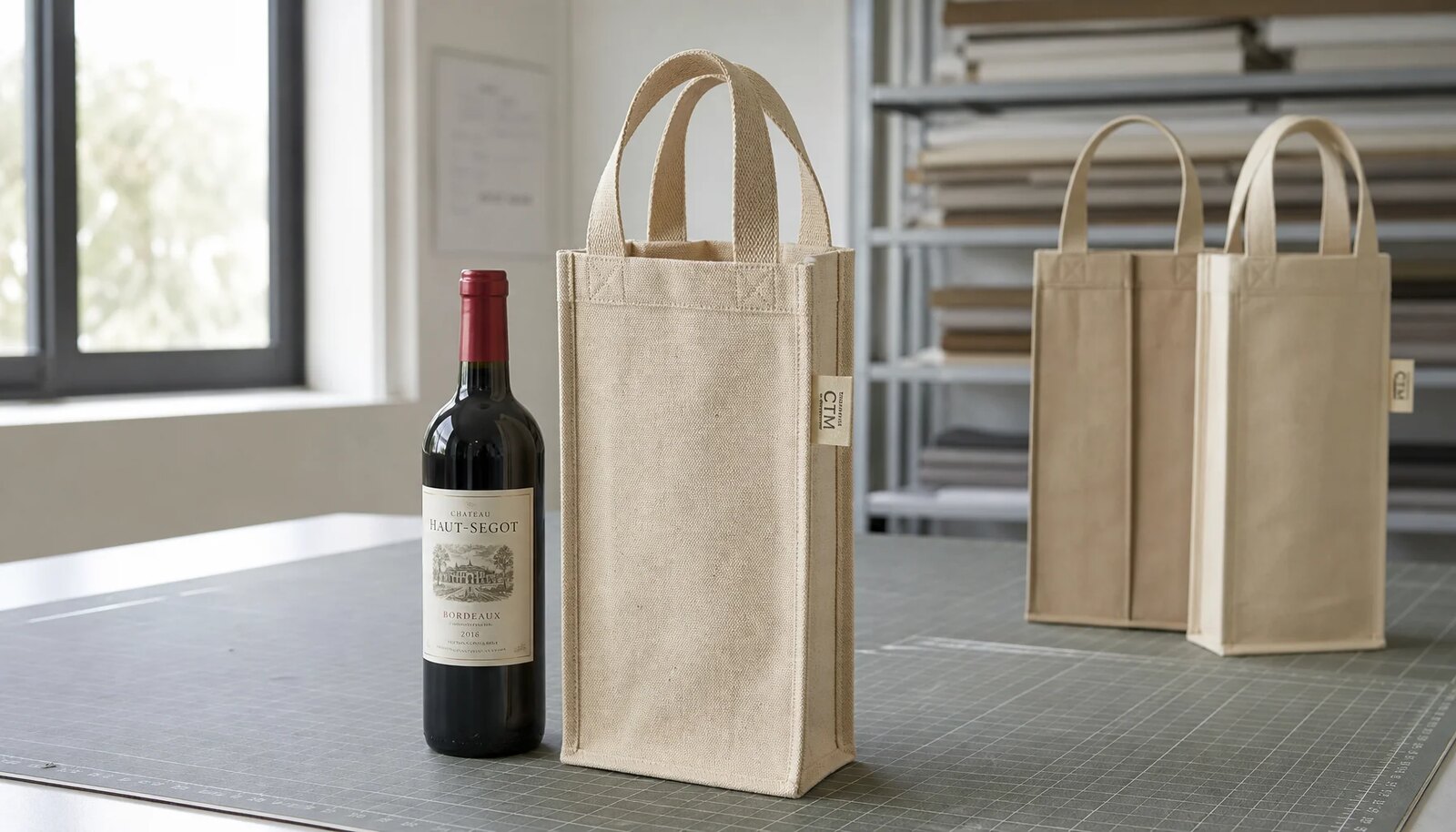
Why Fabric Weight Is a Procurement Decision, Not Just a Design Detail
In a canvas wine carrier, fabric weight affects more than the handfeel. It changes how the bag stands when loaded, how sharply the logo prints, how much the side seams twist under weight, and how the product survives venue handling before it ever reaches a guest. For procurement buyers, that means fabric weight is not a styling choice that can be settled later. It belongs in the first RFQ draft because it drives supplier assumptions on material cost, sewing method, reinforcement, and carton weight. If the weight is vague, every downstream comparison becomes noisy, especially when different vendors interpret 'standard canvas' in different ways.
The practical mistake is approving artwork first and construction second. A sample can look acceptable when photographed empty, then feel underbuilt once a full bottle is inserted and carried by the handles for even a short distance. That failure is often a spec problem rather than a factory accident. A lighter body may need a bottom insert, stronger bartacks, or a smaller print area to perform well. This is why a good canvas wine carriers fabric weight guide for event planners starts with load, shape, and usage channel. Once those are defined, decoration and price discussions become much more meaningful.
- Fabric weight influences structure, print behavior, and freight at the same time.
- An empty sample photo is not enough evidence for a load-bearing product.
- If the RFQ says only 'canvas wine carrier,' suppliers will quote different products.
- The safest sequence is use case first, construction second, branding third.
Ounces, GSM, and the Numbers Buyers Should Put on the RFQ
Many quotes still use ounce language because that is how canvas is commonly sold, but procurement teams compare more cleanly when they record both ounces and approximate GSM. As a working guide, 8 oz canvas is roughly 270 GSM, 10 oz is about 340 GSM, and 12 oz is about 410 GSM. Those are useful anchors, not absolute truths, because finishing, dyeing, and shrinkage can move the final number. What matters commercially is the finished fabric weight of the material actually going into bulk production, not a generic label copied from a mill card or a marketing sheet.
That is why the PO should not rely on ounce count alone. Ask the supplier to confirm the finished GSM of the approved lot and define how much variance is acceptable for your program. For example, a buyer may write a target such as '10 oz canvas, approximately 340 GSM finished, subject to buyer approval if outside the agreed range.' The exact range is your decision, but the point is to make it explicit. Without that clarity, one supplier may quote a true 340 GSM fabric while another is pricing something meaningfully lighter and still calling it 10 oz.
- Record both units: nominal oz and approximate finished GSM.
- Finished GSM matters more than a copied nominal fabric description.
- State tolerance in writing instead of assuming a factory default.
- If dyed or washed fabric is involved, confirm the post-finish weight, not just the greige weight.
Match Fabric Weight to the Bottle Profile and Event Channel
Not every 750 ml bottle behaves the same inside a carrier. A standard Bordeaux bottle is often narrower and easier to fit than a Burgundy bottle, and sparkling wine frequently adds both diameter and weight. Shoulder shape matters too because a wider shoulder can make the top opening feel cramped even when the base looks generous on paper. This is one reason experienced buyers send a dimensioned bottle drawing or the actual bottle reference before quoting. 'Fits one wine bottle' is too loose for a purchasing document if multiple brands or bottle styles may be used during the event season.
Once bottle geometry is clear, the fabric decision becomes more disciplined. An 8 oz body can be acceptable for a short-carry, one-bottle promotional giveaway if the bottle is standard and the branding is simple. For most corporate event work, 10 oz is the commercial center because it balances cost, cleaner shape, and better print stability. When the program moves into VIP gifting, retail resale, or heavier bottle formats, 12 oz becomes easier to defend because the product has to look more intentional in hand, on display, and after repeated handling by staff.
- Quote from actual bottle dimensions, not from volume description alone.
- Bordeaux, Burgundy, and sparkling bottles create different fit and weight demands.
- A premium event channel usually needs more structure than an internal giveaway.
- If several wineries are involved, spec the largest approved bottle to avoid late fit disputes.
Construction Details That Matter More Than Moving from 10 oz to 12 oz
Fabric weight is only one part of the product equation. In many cases, the bigger performance jump comes from construction choices such as a properly sized bottom insert, seam layout, gusset depth, and top-edge finish. A 10 oz carrier with a stable base and clean reinforcement often performs better than a 12 oz carrier built with weak stress points. Buyers should therefore treat the carrier as a package of decisions rather than a fabric-only SKU. On the RFQ, note whether the base uses a removable board or sewn-in stiffener, whether the bag is single-layer or lined, and whether the top edge needs binding for a more refined finish.
Handle design deserves the same level of detail. A filled 750 ml bottle can place real stress on the attachment points, particularly when guests lift the bag by one handle first or when venue staff move multiple units quickly. Specify handle material, width, length, and reinforcement method. If self-fabric handles are used, ask how many seam passes or bartacks are included. If cotton webbing is used, confirm whether the webbing color is stock or matched. These are not cosmetic notes. They determine failure risk, sample accuracy, and whether supplier pricing is being compared on an equal basis.
- Base support and handle reinforcement often matter more than one step of fabric weight.
- Write down the full construction package: body, gusset, top edge, insert, divider, and handles.
- Do not assume a divider is a simple add-on; it changes labor, fit, and QC points.
- Ask for close-up sample photos of the handle attachment and bottom structure.
Decoration Choices: Screen Print, Woven Labels, and What Canvas Can Really Hold
For most B2B event orders, one or two color screen printing remains the most reliable decoration route on canvas wine carriers. It is commercially efficient, repeatable at scale, and well suited to bold logos that need to read quickly in a hospitality or conference setting. Woven side labels are useful when the branding should feel quieter or more refined, and they help when the artwork contains finer details that would not hold cleanly on a textured weave. Embroidery can work on higher-end programs, but it adds cost, needle density, and the risk of fabric distortion if the logo is large relative to the panel size.
The key question is not which method sounds premium, but which method fits the artwork and the substrate. Coarser canvas naturally interrupts fine lines, light type, and gradients. Large solid ink areas can also stiffen the body or show cracking if the wrong ink system is used. Procurement teams should ask for an actual strike-off or pre-production sample on the quoted fabric weight, not a generic print sample from another product. Review it under normal event lighting, and check placement relative to side seams, fold lines, and the bottom insert zone where distortion is most visible.
- Screen print is usually the best default for bold event logos on canvas.
- Woven labels are useful when fine detail matters more than large front-panel impact.
- Embroidery changes both appearance and panel behavior, especially on lighter canvas.
- Always approve decoration on the real fabric weight and color, not on a substitute swatch.
Build an RFQ That Forces Comparable Quotes
A usable RFQ removes room for interpretation. For canvas wine carriers, that means writing down the bottle profile, finished dimensions, fabric weight, handle construction, decoration method, color reference, top-edge finish, bottom insert requirement, divider requirement, packing format, and delivery basis. If any of those items are left open, suppliers will fill the gap with their own assumptions. One vendor may quote a lighter fabric, another may omit the base board, and a third may include a different handle build entirely. The resulting price spread looks dramatic, but it is usually a spec spread, not a sourcing advantage.
Supplier route also matters. A direct factory with in-house cutting and sewing often gives better production visibility, while decoration may still be outsourced in some cases. A trading company can be workable if it transparently maps the production chain and manages approvals well. The problem is not the label attached to the supplier; it is undisclosed complexity. Ask which steps are in-house and which are subcontracted. Then compare price, MOQ, and lead time with that map in mind. A low quote backed by a fragmented route can easily create schedule risk when the event date is fixed.
- Treat vague quotes as incomplete, not competitive.
- Force suppliers to quote the same dimensions, GSM, construction, and packing basis.
- Ask for the production map: cutting, sewing, printing, labeling, and packing.
- Compare landed project risk, not only ex-factory unit price.
MOQ, Sampling, and the Approval Gates That Prevent Rework
MOQ in this category is usually a combination of fabric availability, color setup, print screens, sewing efficiency, custom trims, and export packing economics. That is why one supplier may accept a smaller run on natural canvas with a one-color print, while the same factory asks for a higher minimum once dyed fabric, lining, or a divider is added. Procurement buyers get better answers when they ask what specifically drives the MOQ instead of asking whether the MOQ is negotiable in general. The answer points to where simplification is possible and where the cost floor is real.
Sampling should be staged so each approval serves a purpose. A digital mockup can confirm layout and rough proportions, but it cannot validate handle attachment, fabric handfeel, print edge quality, or loaded performance. A physical pre-production sample should therefore be approved on the intended canvas, with the intended decoration, and with the intended bottle inserted. For higher-risk programs, ask for a packaging photo set and hold a sealed reference sample for inspection. That reference becomes valuable if shade, seam finish, or print placement drifts between sample approval and bulk production.
- Ask what drives MOQ instead of treating it as a fixed industry rule.
- Natural canvas, simple print, and simpler packing usually support lower minimums.
- A digital proof confirms layout; only a physical sample confirms performance.
- Keep an approved reference sample for inspection and any reorder discussion.
Quality Control Should Start Before Final Inspection
Many event buyers wait until the pre-shipment inspection stage to think about quality control, but that is late for a sewn product with multiple moving parts. The better approach is to define checkpoints across incoming material, in-line sewing, completed decoration, and final packed goods. Material checks can confirm fabric weight, shade, and obvious defects before cutting begins. In-line checks can catch handle misplacement, divider drift, skipped stitches, or poor bartacks while correction is still cheap. By the time cartons are sealed, the goal should be verification, not discovery of problems that require rework at scale.
The inspection method should also match the way the carrier will actually be used. A dimension check on a flat table is necessary, but it is not enough. Insert the approved bottle type, stand the carrier upright, lift it by the handles, and inspect how the seams, print area, and base behave under load. If you use AQL or another defined inspection plan, write it into the order rather than assuming the factory will choose one that matches your risk tolerance. Precision here reduces argument later because acceptance criteria were visible from the start.
- Set checkpoints for material, in-line sewing, completed goods, and packed cartons.
- Loaded bottle testing is more informative than flat measurement alone.
- Write the inspection plan into the PO if your organization uses AQL or similar sampling rules.
- QC language should describe acceptance criteria, not generic expectations like 'good quality.'
What to Write Into the PO So Defects Are Easier to Escalate
A strong purchase order turns broad preferences into inspectable requirements. For a canvas wine carrier, that means listing finished dimensions, fabric specification, handle details, reinforcement method, decoration location, acceptable color reference, bottom support, divider details, and packing instructions. It also helps to describe the reference documents that govern the order: approved artwork file, approved sample date, packaging approval, and any test photos. When issues appear, the real question is not whether the buyer expected something better. The question is whether the approved expectation can be traced back to a document the factory also accepted.
This matters most for defects that are annoying but easy to dispute, such as slightly off-center prints, different canvas shade from the approved sample, rough internal finish around the divider, or overly tight bottle fit on a sparkling bottle. If the PO and sample record are weak, the supplier can argue that the goods are still within a broad interpretation of the order. If the order is specific, the discussion becomes factual. Escalation is faster, and corrective action is easier to justify before the shipment moves or before a reorder is placed under the same part number.
- Reference the approved artwork and approved sample directly in the PO.
- Describe inspectable details such as handle drop, divider position, and print placement.
- State packing and labeling requirements as part of the product spec, not as a side note.
- Specific documents reduce post-production arguments about what was actually approved.
Packing, Carton Design, and Freight Decisions That Affect Event Readiness
Packing has a direct effect on event operations because the carrier often moves through a warehouse, a venue back room, or a hotel receiving team before it reaches the end user. If the units are packed too loosely, logos can rub, handles can crease, and the bags may arrive looking less structured than the approved sample. If they are overpacked with unnecessary inserts and excess protective material, carton count drops and freight cost rises. The right answer depends on channel. A venue handout program may only need clean flat packing, while a retail or 3PL route may require barcode labels, inner pack control, and more careful orientation inside the export carton.
Carton data should be part of quote review, not something discovered after the PO is placed. Carton dimensions, pack count, and gross weight influence freight, palletization, warehouse receiving time, and storage allocation. For sea shipments or long transit windows, ask how the goods are protected from moisture pickup and carton crush. If the printed face is vulnerable, specify whether units should be packed logo inward or separated by tissue or other light protection. These decisions are small at unit level but meaningful at project level, especially when the event date leaves little room for repacking on arrival.
- Packing format should match the final distribution channel, not just the factory's convenience.
- Carton dimensions and gross weight belong in supplier comparison from the start.
- Protect the print face and handle shape without adding unnecessary freight volume.
- For longer transit windows, ask about moisture and carton-crush precautions.
Specification comparison for buyers
| Spec decision | Recommended option | When it fits | Buyer risk to check |
|---|---|---|---|
| Entry fabric weight | 8 oz canvas, about 270 GSM finished, only with a simple one-bottle build | Short-carry giveaway programs, internal events, or cost-led promotions with limited branding coverage | Soft body can sag, bottle outline may show, and large prints can distort on the weave |
| Core event fabric weight | 10 oz canvas, about 340 GSM finished, with reinforced handles and a bottom insert | Most corporate tastings, hotel welcome gifts, winery events, and repeat annual programs | If quoted without a base insert or handle reinforcement, the apparent savings usually become a functional downgrade |
| Premium fabric weight | 12 oz canvas, about 410 GSM finished, often paired with binding, cleaner edge finish, or lining | VIP gifting, retail resale, executive welcome kits, or premium sponsor programs | Higher GSM increases unit cost, carton weight, and lead time pressure if the fabric is not stock-supported |
| Bottle fit basis | Quote from actual bottle diameter, height, and shoulder profile rather than '750 ml' only | Any order where the bottle shape is not a standard Bordeaux bottle or where multiple wineries are involved | Burgundy and sparkling bottles can run wider or taller, causing tight fit, neck collision, or unstable standing |
| Bottom structure | Bottom board or sewn-in stiffener sized to the finished base | Single-bottle carriers that must stand upright for display or guest handover | Missing or undersized base support leads to tipping, corner stress, and a lower-quality handfeel |
| Divider requirement | Use a sewn divider only for true two-bottle sets or when clink protection is needed | Wine pair sets, sponsor bundles, or hotel programs delivering two SKUs together | Divider height, center position, and internal width become QC points; poor execution causes bottle neck contact |
| Decoration method | One to two color screen print for bold logos; woven side label if artwork is fine or understated | Most B2B event orders where repeatability and cost control matter more than decorative effects | Fine text, gradients, and oversized ink coverage can look weak on coarse canvas unless tested on the real fabric |
| Handle build | Self-fabric or cotton webbing handles with bartacks or equivalent reinforcement at stress points | Any carrier expected to be lifted with a filled glass bottle by guests or venue staff | A clean sample photo does not prove load performance; request close-up reinforcement photos and a loaded sample |
| Packing route | Flat packed with logo face protected, fixed carton count, and barcode or shipping mark as needed | Venue distribution, 3PL intake, retail backroom handling, and export shipments | Loose packing creates print rubbing and handle deformation; overpacking increases freight and slows receiving |
Buyer checklist before sampling
- Confirm the exact bottle profile before quoting: diameter, height, shoulder shape, and whether the bottle is standard wine, Burgundy, sparkling, or custom glass.
- Define the use case in commercial terms: guest handout, VIP gift, hotel room drop, retail sale, sponsor pack, or warehouse-fulfilled event kit.
- Lock the fabric in both nominal ounces and approximate finished GSM, and state the buyer-approved tolerance in the RFQ or PO.
- Specify the construction package up front: one-bottle or two-bottle, bottom insert, divider, lining, binding, handle type, and reinforcement method.
- Approve the decoration method against the actual artwork and fabric texture, not from a digital mockup alone.
- State print size, print position, logo color reference, and whether slight weave show-through is acceptable on natural canvas.
- Request a physical pre-production sample made from bulk-intent material, plus a photo of the sample loaded with the intended bottle.
- Fix packing details before bulk starts: flat or formed packing, polybag requirement, carton count, carton dimensions, barcode labels, and shipping marks.
- Ask for the lead time by stage so schedule risk is visible: sample, artwork approval, fabric booking, cutting, sewing, printing, inspection, and ex-factory date.
- Compare pricing only after dimensions, GSM, print method, construction, packing, Incoterm, and outsourced operations are aligned across suppliers.
Factory quote questions to send
- What is the actual finished fabric weight in GSM for the quoted canvas, and how will you verify it on bulk material?
- Is the quoted material stock natural canvas, stock dyed canvas, or custom dyed fabric, and what does that change in MOQ and lead time?
- Which bottle profile did you quote against, and what internal width, gusset, and body height are you allowing for that bottle?
- What handle construction is included in the price: self-fabric or webbing, handle width, finished drop, and bartack or other reinforcement details?
- Which decoration method are you recommending for this artwork on this canvas, and can you share a strike-off or production photo on similar fabric weight?
- Which production steps are done in-house and which are subcontracted, specifically cutting, sewing, printing, embroidery, label sewing, and packing?
- What part of the order drives the MOQ: fabric roll requirement, color dyeing, print screen setup, divider sewing complexity, or custom packaging?
- What approvals will be issued before bulk production begins: digital layout, material swatch, pre-production sample, packaging photo set, or sealed reference sample?
- How will the carriers be packed inside the export carton, and what are the carton count, carton dimensions, net weight, and gross weight?
- What is the lead time by stage, and what changes if artwork approval slips, the fabric color changes, or the order adds lining or divider panels?
Quality-control points to confirm
- Verify the bulk fabric against the agreed finished GSM and buyer-approved tolerance, not only the nominal ounce claim on the quote.
- Measure finished body height, opening width, gusset depth, and handle drop after sewing and pressing, not only from the cutting pattern.
- Insert the intended bottle type during inspection to confirm easy entry, bottom seating, upright stability, and clearance at the neck and shoulder.
- Check handle attachment points for the approved reinforcement method and consistent placement on both sides of the carrier.
- Confirm the base board or stiffener is the agreed size, sits flat, and does not shift, crack, or expose sharp edges through the canvas.
- If a divider is included, inspect center position, divider height, and top-edge finish so the two bottles do not clash during carry.
- Review print registration, logo legibility, ink coverage, and basic rub resistance on the actual canvas texture rather than on a smooth sample swatch.
- Inspect seams for skipped stitches, seam puckering, loose thread ends, exposed raw edges, weak corner turns, and uneven binding or top-edge finish.
- Check cleanliness and storage condition: no oil marks, mildew odor, visible dust inside the bag, moisture damage, or shade mixing from different fabric lots.
- Verify carton count, barcode labels, shipping marks, and the orientation of packed units so the logo face is protected during transport and receiving.