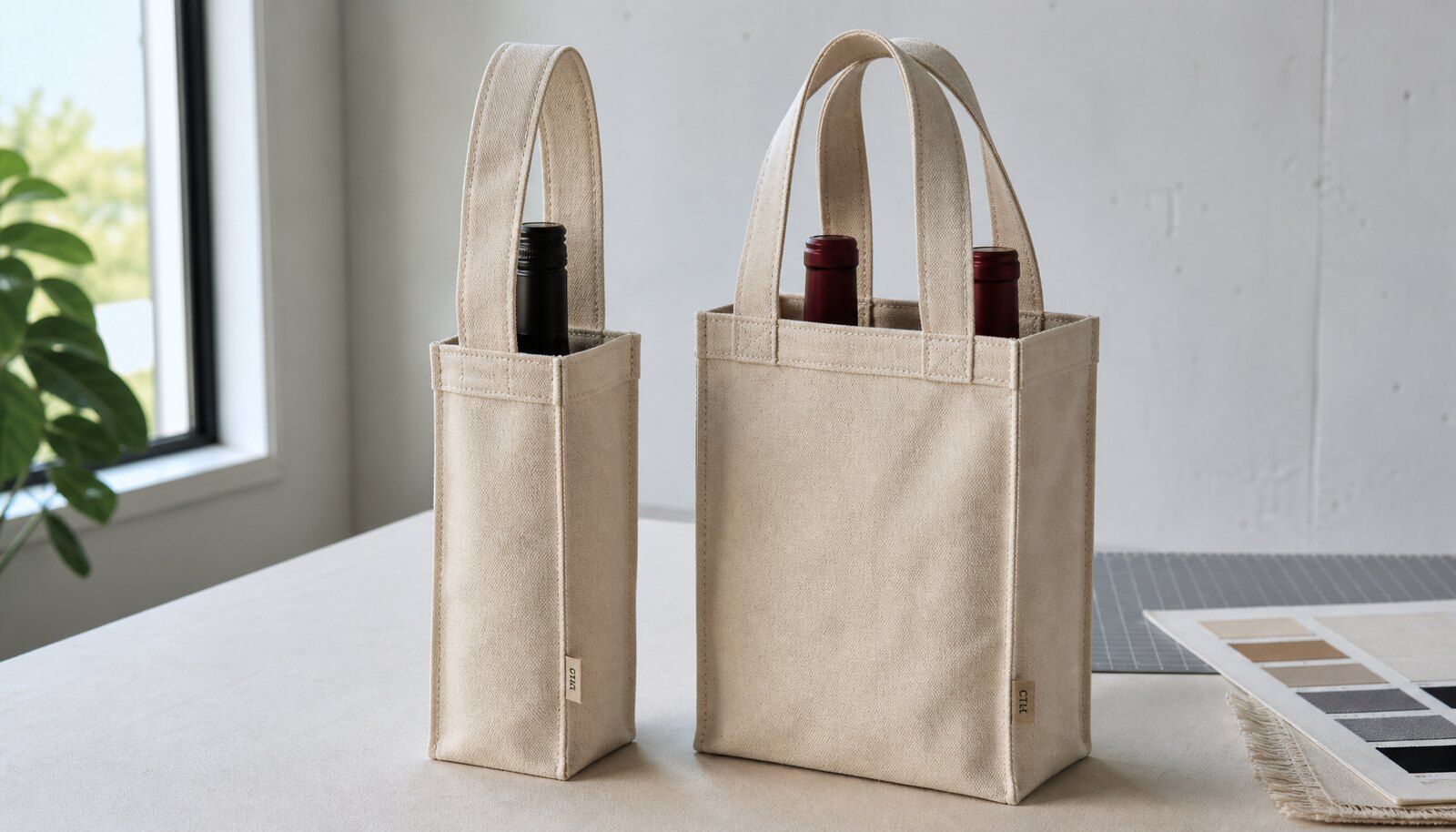
Why fabric weight matters more than a nice-looking sample
For boutique wineries, the wrong canvas weight usually fails in one of two ways: the carrier feels flimsy in hand, or it becomes too stiff and bulky to pack efficiently. The buyer problem is not simply choosing a heavier cloth. It is matching the fabric body to the bottle count, bottle shape, print method, and the way the product will move through the winery, retail shelf, or shipping carton.
A 1-bottle sleeve and a 3-bottle carrier do not need the same structure. A light sleeve can work at 8 oz, or about 270 GSM, if it is mainly for presentation. A 2-bottle or 3-bottle carrier usually needs 10 oz to 12 oz, roughly 340 to 410 GSM, because the fabric has to keep the bag upright, protect the bottles from rubbing, and survive repeated handling. Going too light creates seam stress. Going too heavy can increase sewing difficulty, carton volume, and freight cost.
- Set the fabric weight after the bottle count is fixed, not before.
- Use the sample to test hand feel, body, and fold size together.
- Treat canvas weight as part of the packaging system, not just a style choice.
Practical GSM bands for wine carriers
The easiest way to compare supplier quotes is to anchor them to three practical bands. An 8 oz canvas is usually a promotional or entry-level retail choice. A 10 oz canvas is the most common balance point for boutique winery use. A 12 oz canvas is better when the buyer wants a more premium feel, stronger structure, or less distortion after packing. Heavier than that is possible, but the commercial case needs to be clear because cost and carton bulk rise quickly.
The right band also depends on whether the bag is printed, lined, or reinforced. A heavy print on very light canvas can distort the panel, while a dense 12 oz cloth can make fine artwork look less crisp if the supplier uses the wrong mesh or ink thickness. If the carrier is expected to hold two standard bottles without sagging, 10 oz is usually the floor. If the product has a divider or an inserted base board, 12 oz becomes more attractive because the structure supports the added components better.
- 8 oz: best for short-term promotions, single bottles, and lower-cost gift programs.
- 10 oz: strongest all-round option for boutique winery retail and tasting-room use.
- 12 oz: better for premium sets, heavier bottles, and buyers who want more shelf presence.
How fabric structure changes the buyer result
Fabric weight is only part of the story. A loose weave at 10 oz can behave very differently from a tighter weave at the same GSM. For wine carriers, the factory should tell you the yarn count, weave density, shrinkage behavior, and whether the fabric is pre-shrunk or washed after sewing. Those details determine whether the bag stays square, whether the print stays flat, and whether the final dimensions remain stable after transit or light cleaning.
If the carrier has a divider, base insert, or reinforced handle, the seams need enough allowance to avoid puckering. Natural canvas often looks attractive for boutique wineries, but it can vary more in shade and fiber appearance than a dyed cloth. If you want a cleaner retail look, ask for a pre-shrunk or pre-washed canvas and define acceptable variation before bulk starts. That prevents a common sourcing mistake: approving a nice-looking sample and then getting a batch that folds differently or shrinks more than expected.
- Ask for yarn count, weave style, and shrinkage data in the quote.
- Approve final dimensions after wash or finishing, not only the cut size.
- Use a golden sample to lock the handle position, divider fit, and panel shape.
Print method choices and what they do to canvas weight
Boutique winery orders usually live or die on the decoration. Screen print is the standard choice when the logo is bold, the color count is low, and the buyer wants repeatable results. It works well on 10 oz and 12 oz canvas because the fabric has enough body to keep the print surface stable. Heat transfer can help with small runs or more detailed artwork, but it needs testing because some films age poorly on folded bag panels. Embroidery looks premium but adds cost and can pull lighter canvas out of shape if the stitch density is too high.
The buyer should not approve a print method only by looking at a sample image. Ask the supplier how the ink cures, what curing temperature or dwell time they use, and whether the print passes rub and fold testing. For winery retail, a carrier is often handled by staff, customers, and shipping teams before it reaches the end user. A logo that looks sharp on day one but cracks on the fold line after a few uses is a production failure, not a decoration success.
- Screen print suits simple logos and recurring bulk orders.
- Heat transfer suits small detail, but only if the film and adhesive are proven on canvas.
- Embroidery should be reserved for stronger cloth and a logo that can tolerate added stitch density.
Supplier routes and which one fits the buying problem
The quote is often determined by the sourcing route, not just the bag itself. A stock bag trader can move quickly, but the buyer may get limited control over fabric weight, handle length, or divider structure. A cut-and-sew factory can build the carrier to spec, but it needs clearer artwork, more exact measurements, and more disciplined sample approval. A decoration-only supplier can be efficient if you already have approved blanks, but that route adds handoff risk if the blank quality and print quality are managed by different parties.
For boutique wineries, the safest route is usually one accountable factory that handles cutting, sewing, decoration, and packing. That does not always give the lowest unit price on paper, but it usually gives the clearest claim path, fewer surprises on seam quality, and better control over carton loading. If the order is seasonal or tied to a launch date, single-source accountability matters more than shaving a small amount from the piece price.
- Use stock sourcing only when the spec is simple and the timeline is tight.
- Use a cut-and-sew factory when fabric weight, branding, or divider fit must be controlled.
- Use split sourcing only if you can manage two suppliers and their handoff points.
What MOQ really means for custom wine carriers
MOQ is usually tied to fabric width, dye lot, print screen setup, and packing labor, not just the bag shape. A 10 oz natural canvas carrier with one-color print can often run at a lower MOQ than a custom-dyed carrier with multiple decoration steps. If you add woven labels, metal accessories, or a cardboard insert, the factory will often raise MOQ because each added component creates its own setup and procurement burden.
Buyers should compare MOQ against the real demand forecast, not against the smallest number a supplier is willing to quote. If the winery needs a small first run for a tasting room launch, ask for a pilot quantity with clear re-order pricing. That gives you a live sample of retail performance without forcing the factory to guess on full production volume. A low MOQ that hides extra packaging charges or weak color control is not a good deal.
- MOQ rises when the order adds custom dyeing, lining, inserts, or multiple print colors.
- Ask whether the MOQ changes for repeat orders with the same spec.
- Separate pilot-run pricing from full-run pricing so the buyer can plan reorders.
Sample approval should lock size, feel, and print at the same time
A proper sample process for wine carriers has three stages: a size sample to prove the bottle fit, a pre-production sample to confirm the exact materials and decoration, and a golden sample that both sides sign off before the bulk lot starts. If the supplier skips one of those stages, the risk shifts into the production lot, where corrections cost more and move slower. For canvas carriers, the sample needs to show fold behavior, seam bulk, and how the bag stands when loaded.
The buyer should inspect the sample under the same conditions the product will face in use. Put in the actual bottle shape, close the carrier, carry it by the handle, and fold it back into pack form. Check whether the logo lands cleanly across the panel, whether the bottom seam pulls, and whether the inside thread ends are trimmed. If the sample feels right but the packed size is too large for the carton plan, the design still needs adjustment before approval.
- Approve the sample with the target bottle inside, not empty on a table.
- Treat the golden sample as the production reference for shape, print, and color.
- Do not approve a sample until the packed size is also confirmed.
QC thresholds that prevent the most common failures
The useful QC points for canvas wine carriers are straightforward. Fabric weight must match the approved spec. Seam lines must be even and tight enough to avoid skipped stitches at the handle and base. Print must survive fold and rub testing. Finished dimensions must keep the bottle steady without excess slop. These are the checks that prevent the product from arriving as a soft promotional pouch when the buyer expected a retail-ready carrier.
A buyer should also define a few reject conditions before production starts. Loose threads are not just cosmetic if they sit near the handle or divider. A slightly off-color natural canvas may be acceptable, but visible dye variation across the same lot often signals poor roll control. If the carrier will be stacked in cartons, compressed packaging should not crush the side panels or create permanent creases that make shelf presentation look cheap.
- Reject if the bottle rattles inside the carrier or if the bottom sags under normal use.
- Reject if the print cracks on fold points or rubs off under light handling.
- Reject if the carton plan causes crushed panels or overfilled cartons.
Packing, carton count, and freight are part of the spec
Many quote comparisons fail because the packaging basis is not the same. A bag packed flat with no polybag will move differently from a bag packed in an individual sleeve with a barcode label and carton mark. For a wine carrier, bulk packing is cheaper, but it can lead to scuffing, dust contamination, and folded creases that make the retail product look tired. Individual packing costs more, but it protects finish and helps if the product goes through distribution centers or e-commerce handling.
The factory should give you packed dimensions, carton count, and estimated CBM before you compare freight. That matters because a heavier canvas can reduce carton count if the bags are folded loosely or if inserts take up volume. If the order is international, ask how the factory arranges moisture protection and whether the cartons are strong enough for double stacking. Freight damage on a wine carrier order is often a packaging issue, not a sewing issue.
- Define whether each carrier ships bulk, in a polybag, or with an insert sleeve.
- Request carton dimensions and piece count per carton before approving the quote.
- Use moisture protection if the route includes long sea transit or warehouse dwell time.
How to read a quote without missing hidden cost
A good factory quote for canvas wine carriers should separate fabric, sewing, decoration, packing, and carton work. If those items are bundled into one line, the buyer cannot see where the cost is rising or where the supplier is saving money. That becomes a problem when a follow-up order needs the same spec but a different print method or carton plan. Clean quote data lets procurement compare factories on equal terms and prevents the common mistake of choosing the lowest price without knowing what was excluded.
For landed cost, compare the same trade term across all offers. EXW can look low but leave inland freight, export handling, and packing charges unaccounted for. FOB is easier if you already know your freight forwarder. DDP can simplify budgeting, but only if the supplier is experienced and the duty assumptions are accurate. The right quote is the one that shows the true total cost for the same spec, same pack, same lead time, and same sample standard.
- Ask for separate lines for fabric, sewing, print, label, insert, packing, and cartons.
- Compare all suppliers on the same trade term and the same packed quantity.
- Treat lead time, sample fee, and carton spec as part of the quote, not side notes.
Specification comparison for buyers
| Spec decision | Recommended option | When it fits | Buyer risk to check |
|---|---|---|---|
| 8 oz canvas from a stock supplier | Use only for light promotional single-bottle sleeves or short campaign runs | When price pressure is high and the bottle is light, slim, and rarely shipped long distance | Check seam stretch, bottom sag, and whether the carrier distorts after the first packing run |
| 10 oz canvas from a cut-and-sew factory | Best default for most boutique winery single- and two-bottle carriers | When you need a balanced look, decent body, and stable print quality without overpaying for heavy cloth | Confirm GSM tolerance, shrinkage after wash, and whether the fabric holds a crisp panel shape |
| 12 oz canvas from a retail-focused factory | Use for premium two-bottle carriers or heavier branded sets | When the bag must feel substantial on shelf and survive repeated handling in tasting rooms and gift shops | Watch for higher cost, slower print drying, and bulkier seams that can affect folding and carton count |
| Unlined carrier from a bag maker | Choose when the bottle is standard size and the buyer wants lower cost and simpler construction | When the carrier is mostly for gifting, tasting-room retail, or short-distance distribution | Check print show-through, inside thread trim, and abrasion at the bottle neck and base |
| Lined carrier with insert or divider | Use for premium sets, two-bottle carriers, or fragile glass and higher-value wine | When the product must look cleaner inside and hold bottles apart during shipping | Confirm lining attachment, divider width, and whether extra seams reduce usable interior space |
| Screen print on 10-12 oz canvas | Best for bold logos, one to three colors, and steady repeat orders | When the logo is large, the artwork is simple, and the buyer wants durable decoration | Ask for ink curing data, rub resistance, and whether the print cracks on folded stress points |
| Direct decoration by a local printer on imported blanks | Use when speed matters more than a single-source supply chain | When blanks are already approved and a local team can add logo or variable data quickly | Risk of two suppliers blaming each other if the seam, print, or packing fails |
| Fully finished export from one factory | Best for controlled quality, cleaner responsibility, and simpler claims handling | When the order needs one PO, one sample sign-off, and one packing standard | Check lead time, carton space, and whether the factory can manage all components without substitution |
Buyer checklist before sampling
- Define the bottle count, filled bottle diameter, and whether the carrier must fit Bordeaux, Burgundy, or wider specialty bottles.
- State the canvas weight in GSM or oz and set an acceptable tolerance before the quote is compared.
- Specify whether the carrier is for tasting-room retail, gift packing, shipping, or trade show giveaways.
- Confirm print method, ink count, logo size, and the exact placement area on each panel.
- Ask for seam allowance, stitch density, reinforcement points, and whether the handles are self-fabric or webbing.
- Agree on sample stages: size sample, pre-production sample, and golden sample.
- Request packing details: folded size, polybag requirement, carton count, carton dimensions, and barcode label format.
- Compare quotes on the same basis: EXW, FOB, or DDP, with material, decoration, and carton costs separated.
Factory quote questions to send
- What is the exact fabric weight in oz and GSM, and what tolerance do you hold on production lots?
- Is the canvas greige, dyed, pre-shrunk, or washed after sewing?
- What decoration method do you recommend for my artwork, and what is the maximum printable area?
- How many stitches per inch do you use on side seams, handles, and base reinforcement?
- Can you share carton loading data, packed bag dimensions, and estimated CBM per 1,000 pieces?
- What is the MOQ for a custom color, a custom print, and a custom woven or sewn label?
- What sample fee applies, and is it refundable against a bulk order?
- What is your standard lead time after sample approval, and what steps create delay risk?
Quality-control points to confirm
- Fabric weight must match the agreed spec and stay within the stated tolerance across random rolls.
- Finished dimensions must fit the target bottle size without excess slack at the base or neck.
- Print must pass rub testing and show no cracking, flaking, or ghosting after folding.
- Seams, handle joins, and bottom corners must hold under a pull test without skipped stitches.
- Color should stay within the approved strike-off or golden sample, especially on natural canvas.
- Packed bags must be clean, dry, odor-free, and free of loose threads or oil marks.
- Cartons must survive stacking and drop handling without crushed corners or bag deformation.