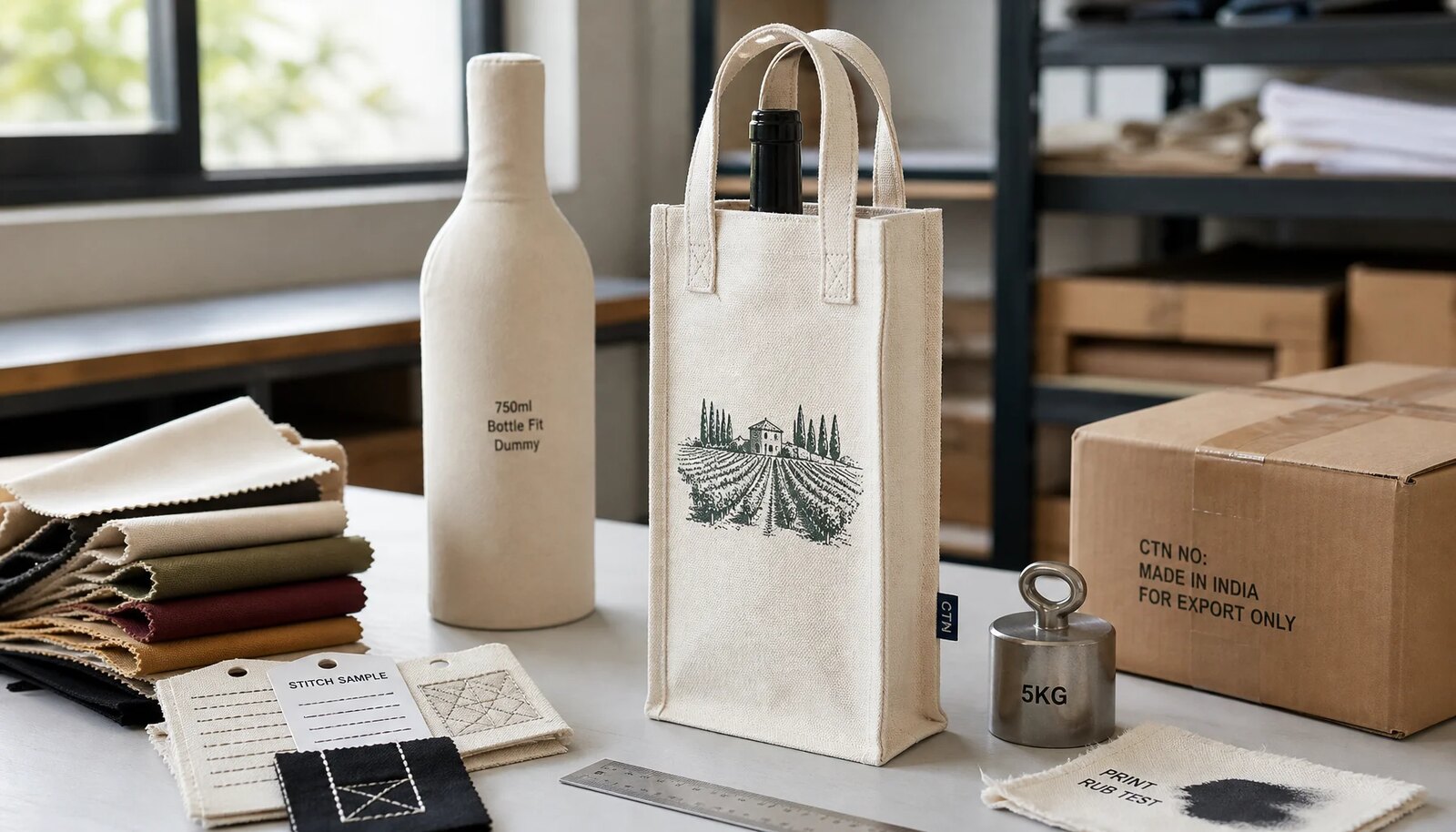
Start With the Event Path
A canvas wine carrier is not only packaging for a bottle. Before a guest touches it, the same unit may move through sewing, printing, carton packing, freight, receiving, venue sorting, sponsor staging, table setup, and handoff. Each step adds lifting, rubbing, compression, odor risk, or shape loss. If the bottle arrives safely but the carrier smells damp, leans on the table, scuffs at the logo, or tears at the handle, the order has failed its event job.
The sourcing brief should describe the event path before it asks for price. A tasting giveaway, wedding welcome kit, hotel room drop, winery retail carrier, sponsor activation, trade-show gift, and holiday corporate program do not need the same build. One program may need a clean, low-cost carrier for a short registration handout. Another may need a reusable branded piece with a firmer base, better handle comfort, and stronger packing protection.
Bottle shape belongs in this first discussion. A Bordeaux bottle, Burgundy bottle, Champagne bottle, spirits bottle, and tall slim bottle load differently. Shoulder width affects clearance. Filled weight affects handle stress. Height and center of gravity affect tipping. A carrier approved around one bottle can disappoint with another even when both are described as single-bottle wine carriers.
- Define the use as one-bottle, two-bottle, bottle-plus-accessory, or mixed bottle service.
- Share bottle height, maximum body diameter, shoulder width, neck diameter, and filled weight.
- State whether the carrier ships empty, pre-filled, bundled in kits, or packed by venue staff onsite.
- Clarify whether it must stand upright on tables, counters, shelves, room drops, or sponsor displays.
- List sorting needs by venue, sponsor, date, destination, colorway, SKU, or bottle type.
Turn Durability Into the RFQ
Writing strong canvas wine bag in an RFQ leaves too much room for interpretation. One supplier may quote heavier fabric. Another may keep the fabric light but add webbing handles. A third may change thread or stitch pattern. The prices may sit beside each other in a spreadsheet, but they are not quoting the same product.
Durability becomes comparable when it is written as measurable construction. Include fabric weight, composition, finish, finished dimensions, gusset depth, handle material, handle width, handle drop, attachment method, stitch density target, seam type, bottom support, branding method, logo placement, packing method, carton format, and inspection criteria. This does not need to be over-engineered. It only needs enough detail that each supplier prices the same event-ready carrier.
Use finished-product measurements, not only pattern or artwork size. Finished height, width, opening width, gusset depth, and bottom footprint control bottle loading and stability. Handle drop affects comfort and packing. Logo placement affects brand review and inspection. On a compact textile product, small dimensional drift can make the bottle bind, the base lean, or the logo look misplaced.
Write tolerances before production starts. If the approved sample is 350 mm high, the purchase order should not leave the acceptable bulk range to memory. Practical tolerances depend on the pattern and supplier capability, but the buyer should define separate limits for body dimensions, handle position, and print placement.
- Put the final bottle size and target load directly into the RFQ.
- Specify finished dimensions and tolerances for body, gusset, opening, handle drop, handle placement, and logo placement.
- Name the reinforcement method at handle load points instead of writing only strong handles.
- Include inner packing, carton count, carton marks, carton dimensions, and gross weight in the quote request.
- Attach final artwork files and state the branding method being quoted.
Specify Canvas With Enough Detail
For many structured single-bottle event carriers, 12 oz to 16 oz canvas, roughly 340 to 450 GSM, is a practical benchmark rather than a universal standard. It often gives enough body for a filled bottle while staying printable, sewable, and reasonable for bulk packing. Lighter canvas can work for short-use handouts, but it is more likely to sag, wrinkle in cartons, and show seam strain. Heavier canvas can feel more premium, but it may raise cost, sewing difficulty, carton weight, and freight cost.
Fabric weight alone does not define durability. Weave tightness, yarn quality, surface lint, finish, shrinkage behavior, and fabric stability also affect the finished carrier. A tighter weave often supports cleaner print edges and reduces fraying at seams. A loose or fuzzy surface can soften logo detail and make abrasion easier to see. Natural, bleached, dyed, washed, and coated canvas can behave differently during printing, folding, and humid storage.
Ask whether the fabric is stock or made to order. Stock canvas can support faster sampling and lower minimums, but shade and availability may shift by lot. Made-to-order fabric can offer more control over color and weight, but it may add lead time and fabric minimums. If dyed canvas is required, confirm whether dyeing changes hand feel, shrinkage, odor, or print adhesion.
A physical swatch is worth approving before the full sample. Photos help communication, but they cannot confirm touch, basis weight, surface lint, or smell. For natural canvas, approve a shade range rather than expecting every roll to match a screen image. For dyed canvas, review color under consistent lighting and ask how variation is controlled.
- Request fabric weight in both GSM and oz per square yard when possible, with written tolerance.
- Ask whether weight is measured before or after washing, dyeing, coating, or finishing.
- Approve a swatch for shade, weave, lint, odor, hand feel, and print surface.
- Confirm whether the fabric is 100% cotton or a blend, including any labeling implications.
- Record the approved swatch lot, supplier, date, nominal weight, finish, and shade reference.
Engineer Handles and Load Points
Handles deserve early attention because they concentrate bottle weight into small stitched areas. The canvas body may be acceptable while the handle attachment is not. Event handling increases the risk: the carrier can be lifted by factory teams, freight handlers, receiving staff, venue crews, and guests before the program is complete.
The quote should state handle material. Common options include self-fabric handles, cotton webbing, cotton tape, or another woven handle. Webbing can offer consistent width and efficient production. Self-fabric handles can look more integrated, but they need clean folding, stable stitching, and proper reinforcement. Handle width affects comfort and load distribution. Handle drop affects guest experience and how neatly the carrier packs inside cartons.
Reinforcement should spread the load across enough fabric. Box-X stitching, bartacks, double rows, and reinforced patches can all work when executed well. Ask what is included and request close-up photos of the sample construction. A front-facing product image is not enough; you need to see stitch pattern, handle end finish, thread tension, thread color, and whether the top edge is reinforced.
Sample testing should include repeated loaded lifts. For conservative sample checks, many buyers use a 3 to 5 kg load depending on bottle type and reuse expectation. That range should be treated as a practical stress check, not a universal certification. Inspect after the lifts, because a one-time lift tells you less than the condition of the handle after repeated handling.
- Specify handle material, width, finished drop, attachment position, and reinforcement dimensions.
- Name box-X, bartack, double-row stitching, reinforced patch, or another exact load-point method.
- Ask for thread type, thread color, and stitch density at side seams, bottom seams, gussets, and handle points.
- Check that handles are symmetrical and do not twist, curl the top edge, or distort the print panel.
- Reject samples where handle stitching deforms or tears after normal loaded lifting.
Test Bottle Fit and Stability
Bottle fit is a durability issue, not just a sizing issue. A tight carrier forces the bottle through the opening and strains side seams, top binding, and printed panels. A loose carrier lets the bottle shift, which stresses the base and feels unstable. A narrow gusset may look tidy when empty and then lean once loaded.
The best test uses the actual bottle. If that is not possible, use a rigid dummy load with the same height, maximum diameter, shoulder profile, neck shape, and filled weight. For Champagne, sparkling wine, and some spirits bottles, shoulder width and base diameter may matter more than nominal height. For tall slim bottles, center of gravity can create tipping risk even when dimensions look sufficient.
Check clearance at several points. The opening should allow loading without force. The shoulder area should not strain side seams. The body should hold the bottle without excessive shifting. The neck area should not pinch foil, wax seals, tags, ribbons, or decorative closures. If the carrier includes a pocket, divider, corkscrew sleeve, card pocket, or gift insert, test the complete loaded set.
Base stability should match the event workflow. Carriers used at registration tables, welcome stations, winery counters, hotel-room displays, retail shelves, or sponsor tables may need a flat gusset, reinforced bottom seam, heavier bottom panel, covered board, or removable insert. If upright presentation is not required, softer construction can be acceptable, but it should be a deliberate choice.
- Measure bottle height, maximum diameter, shoulder width, neck diameter, and filled weight before pattern approval.
- Test loading with the actual bottle or a dummy matching size, shape, and weight.
- Confirm the loaded carrier stands upright if table display or room-drop setup is required.
- Check that the base does not fold under the bottle after repeated set-downs.
- Photograph approved fit from front, side, top opening, and loaded base views.
Choose Branding That Can Wear
The logo on a canvas wine carrier has to survive more than a sample photo. It may rub against other units in cartons, fold across a printed area, brush against display tables, and be handled by guests. The best branding method depends on artwork complexity, canvas texture, handling risk, quantity, and reuse expectation.
Screen print is often a practical option for simple logos, solid colors, and medium to larger orders. When canvas surface, ink choice, and curing are controlled, it can give clean brand impact and reliable wear. It still needs testing. Under-cured ink or ink mismatched to the fabric can transfer, crack, smear, or scuff. Ask how drying or curing is controlled and how long printed units rest before packing.
Heat transfer can suit detailed artwork, gradients, short runs, or tight setup schedules. The common risks are edge lift, cracking across folds, heat marks, and weak adhesion on textured canvas. If heat transfer is quoted, test it on the final fabric. Fold the sample through the proposed packing method, apply light friction, and inspect the edges.
Embroidery, woven labels, sewn patches, and side labels can suit premium reusable programs. They avoid some ink abrasion issues, but they add QC points: patch alignment, frayed label edges, loose corners, needle marks, thread tension, and color consistency. On a small front panel, a patch that drifts even slightly can look careless.
- Approve logo color on the final canvas, not only on a digital proof.
- Write print placement tolerance from clear reference points such as centerline, top edge, side seam, or bottom seam.
- Use fold, rub, and light abrasion checks before approving the branding method for bulk.
- Confirm curing, drying, or heat-press controls and how soon printed units can be safely packed.
- Inspect branding after carton compression, not only immediately after printing.
Use a Practical Durability Test
A useful canvas wine carriers durability testing checklist for event planners should imitate the handling path the order will actually face. It does not need to become a laboratory program for every purchase. It does need to be consistent, documented, and realistic enough to catch predictable failures before bulk production.
Start with a loaded lift test. Place the approved bottle or dummy load inside the carrier and lift by the handles repeatedly. Inspect the handle attachments, top edge, side seams, bottom seam, gusset, and fabric around the stitch area after the test. If the carrier is meant for reuse or staff transport, increase the lift cycles and use the heavier end of the expected load range.
Run a set-down and stability check next. Load the carrier, set it on a surface similar to the event environment, lift it, rotate it, and set it down again. Watch the bottom panel and gusset. If the base folds inward, bows outward, or tips easily, revise the pattern or bottom support before bulk approval.
Then test print and packing stress. Fold the sample as it will be packed, press it under light compression, reopen it, and rub the logo with a clean white cloth. Look for ink transfer, cracking, ghosting, transfer edge lift, handle marks, or abrasion. Pack several samples in the proposed carton format and inspect for creasing, scuffing, odor, and shape loss.
- Loaded lift: repeat normal lifts with the agreed bottle-equivalent load, often 3 to 5 kg for conservative sample testing.
- Handle inspection: check stitch tension, reinforcement symmetry, top-edge curl, twisting, and fabric tearing.
- Base check: set the loaded carrier down repeatedly and confirm it remains upright when required.
- Print check: fold, reopen, rub lightly with a clean cloth, and inspect for transfer, cracking, ghosting, or edge lift.
- Carton check: pack samples in the proposed carton count and orientation, then inspect for compression marks.
- Documentation: photograph pass and fail conditions so corrections are specific.
Set QC Rules Before Production
Quality control works better when acceptable and unacceptable conditions are defined before production starts. Otherwise, buyer and supplier may disagree over whether a crooked logo, soft base, loose handle, stained panel, or strong odor is a defect or normal variation. Clear thresholds protect both sides by defining what shipment release will be judged against.
Use practical defect categories. Critical defects affect safety, usability, or the core requirement of the order. Examples include handle detachment, seam opening, wrong size that prevents bottle loading, wrong logo, unsafe contamination, or inability to hold the approved load. Major defects affect brand presentation, durability, or event readiness, such as visible stains, distorted shape, print placement outside tolerance, weak bottom support, wrong carton quantity, loose patch, or obvious print abrasion. Minor defects are small appearance issues that do not affect function and remain within approved limits.
For natural canvas, separate material character from defects. Slight slubs, small fiber variations, and shade movement inside the approved range may be acceptable. Oil marks, mildew spots, strong odor, dirt, fabric holes, print smears, and wet ink transfer are not material character.
For larger orders, use an agreed sampling plan such as AQL-based inspection or another defined method. Even when the supplier has internal QC, the buyer should define sample size expectations, defect categories, measurement points, load-test expectations, and photo requirements. Finished units should be pulled from different cartons and carton positions, not only from factory-selected top samples.
- Critical defects: handle detachment, seam opening, wrong size, wrong bottle fit, wrong logo, unsafe contamination, or inability to carry the approved load.
- Major defects: visible stains, distorted shape, print placement outside tolerance, weak bottom, loose patch, print abrasion, or incorrect carton count.
- Minor defects: small thread tails, slight canvas slubs, or shade variation within the approved physical standard.
- Inspection scope: check finished units, loaded samples, print surfaces, odor, and packed cartons from different carton positions.
- Approval record: keep the signed sample, spec sheet, tolerance sheet, photos, and defect rules together.
Approve Samples as Control Tools
A digital mockup is useful for checking approximate artwork position, but it is not a production approval sample. It cannot prove fabric strength, handle comfort, stitch consistency, bottle fit, print adhesion, odor, bottom support, or carton compression. The meaningful approval is a pre-production sample made with final or production-equivalent materials and construction.
Review the sample from three viewpoints: buyer, event operator, and recipient. Measure finished dimensions. Load the bottle. Lift the carrier repeatedly. Set it down. Fold it as it will be packed. Check whether the logo stays clean and whether the handles return to shape. Smell the fabric and packing. Compare the result with the RFQ line by line. If the supplier used substitute fabric, trim, or print process, mark the sample as provisional rather than final.
A control sample should be retained and labeled. Include supplier name, date, revision number, fabric weight, color, finish, handle material, print method, bottle used for testing, and any approved exceptions. When schedule allows, keep one control sample with the buyer and one with the supplier. This shared physical reference reduces subjective disagreement during bulk inspection.
Sample revisions should be specific. If the first sample is too soft, revise the fabric, bottom support, or pattern and record the change. If the handle pulls, revise handle width, reinforcement, stitch density, or attachment area. If the print rubs off, revise ink, curing, fabric finish, or packing. Avoid approving verbal promises that bulk will be stronger, cleaner, or better aligned unless the exact correction is written into the production specification.
- Request swatch approval before sample production when shade and hand feel matter.
- Ask for one buyer review sample and one retained control sample when schedule allows.
- Measure body height, body width, gusset depth, opening width, handle drop, and logo placement.
- Record all approved deviations from the original RFQ before bulk production starts.
- Do not release bulk production based only on a mockup, photo, or substitute-material sample.
Control Packing and Venue Readiness
Packing can damage an otherwise well-made carrier. Canvas can crease, twist, scuff, or lose shape when packed too tightly. Handles can rub across printed panels. Dark ink can mark adjacent natural canvas if curing is weak or packing pressure is high. A carrier that looks excellent at the sewing table can arrive with crushed corners, print scuffs, or tangled handles if carton planning is left until the end.
The right packing format depends on the event workflow. If carriers will be unpacked quickly and handed to guests, tangled handles and inconsistent folding create labor problems. If carriers will be displayed with bottles inserted, shape protection and base stability matter more. If they are going into gift kits, carton marks, SKU separation, and destination sorting may matter as much as the carrier construction.
Ask suppliers to quote inner packing, units per carton, carton dimensions, gross weight, carton marks, and palletization assumptions before confirming the order. Higher units per carton may reduce freight cost, but only if the packed product survives compression. Individual polybags, tissue, sleeves, or dividers may help in some programs, but they should be used for a clear purpose: print protection, dust control, sorting, or moisture prevention.
For multi-venue events, carton labeling belongs in the QC plan. Carton marks may need event name, destination, SKU, color, sponsor, quantity, PO number, and carton sequence. Clear marks reduce receiving errors and onsite sorting time. If the order includes multiple logos or colorways, request packed-carton photos and carton-mark photos before shipment release.
- Confirm whether units are flat packed, folded, shaped, individually wrapped, bundled, or packed with inserts.
- Check whether handles touch printed faces inside the carton and whether that creates scuff marks.
- Require carton marks by SKU, color, quantity, destination, event name, and carton number when needed.
- Ask for packed-carton dimensions and gross weight so freight and venue handling can be planned.
- Open random cartons before shipment release and inspect for odor, crushed shape, print transfer, and count accuracy.
Specification comparison for buyers
| Option | Best fit for event use | Durability advantage | Buyer check before approval |
|---|---|---|---|
| 12 oz to 14 oz cotton canvas | Budget-conscious tastings, registration gifts, single-night welcome bags, and simple one-bottle handouts | Printable, packable, and usually firm enough for a filled single bottle when the gusset and handle construction are correct | Confirm actual GSM or oz weight against the swatch, check sagging when loaded, and avoid treating light canvas as reusable unless testing supports it |
| 15 oz to 16 oz cotton canvas | VIP gifting, winery retail, sponsor tables, and carriers expected to feel more substantial | Better body, stronger hand feel, and improved shape retention compared with lighter canvas in many builds | Check sewing quality at thick seams, carton weight, fold marks, print compatibility, and whether the heavier fabric creates bulky corners |
| Cotton-rich blended canvas | Orders needing cost control, color consistency, or a specific hand feel while retaining a canvas look | Can improve dimensional stability or reduce some shrinkage depending on blend and finish | Request declared composition, labeling implications, odor review, print test results, and confirmation that the hand feel matches the brand expectation |
| Self-fabric handles | Premium-looking carriers where a unified canvas appearance matters | Integrated look and good branding presentation when folded, stitched, and reinforced correctly | Inspect handle folding, stitch density, reinforcement size, twisting, and top-edge distortion after repeated loaded lifts |
| Cotton webbing or cotton tape handles | High-volume event distribution, warehouse handling, and guest carry where consistent handle strength matters | Consistent width, efficient sewing, and predictable load distribution when attachment points are reinforced | Specify width, drop, color match, attachment area, box-X or bartack method, and whether webbing rubs against the printed face in cartons |
| Simple flat gusset | Short-use handouts, low-profile packing, and events where upright display is not critical | Keeps the carrier compact and cost controlled | Load the actual bottle and check leaning, bottom folding, and whether the bag feels stable during handoff |
| Reinforced bottom or removable insert | Welcome stations, retail counters, room drops, sponsor displays, and pre-packed gift sets | Improves upright presentation and reduces base collapse under a filled bottle | Confirm insert material, odor, cracking, moisture sensitivity, packed shape, and whether the insert shifts during handling |
| Screen print | Simple logos, solid colors, medium to larger runs, and programs needing clean brand visibility | Good balance of cost and durability when ink, curing, and canvas surface are compatible | Test final fabric for rub-off, cracking, ink bleed, curing marks, fold lines, and transfer under carton pressure |
| Heat transfer, patch, label, or embroidery | Detailed artwork, premium reusable carriers, small runs, or logo applications that need more texture | Can solve artwork or positioning needs that screen print may not handle well | Check transfer edge lift, patch alignment, loose corners, thread tension, needle marks, fold behavior, and abrasion after packing |
Buyer checklist before sampling
- Confirm the bottle type before quoting: Bordeaux, Burgundy, Champagne or sparkling, spirits, tall slim bottle, half bottle, magnum, two-bottle set, or bottle-plus-accessory kit.
- Send actual bottle height, maximum body diameter, shoulder width, neck diameter, filled weight, and any clearance items such as wax seals, foil, ribbons, hang tags, sleeves, or gift cards.
- State the event workflow: empty handout, pre-filled gift, hotel-room drop, staff transport, winery counter sale, retail display, sponsor table, or reusable guest carrier.
- Set a practical sample load target. Use the real filled bottle when possible; for conservative sample checks, many buyers use a 3 to 5 kg bottle-equivalent load based on bottle type and reuse expectation.
- Specify fabric weight in GSM or oz per square yard with tolerance, fiber composition, finish, color, and whether the quoted weight is measured before or after dyeing, washing, coating, or finishing.
- Approve a physical fabric swatch for shade, weave tightness, hand feel, odor, lint level, and print surface before sample production starts.
- Define finished dimensions: body height, width, gusset depth, opening width, bottom footprint, handle width, handle drop, and logo placement from reference points.
- Set written tolerances for body dimensions, handle placement, and print placement, using millimeter-based tolerances that match the design and supplier capability.
- Specify handle material, width, drop, attachment position, reinforcement pattern, stitch density target, thread color, and thread quality.
- Require the loaded sample to stand upright if the carrier will be used for registration tables, welcome stations, winery counters, retail shelves, sponsor displays, or pre-packed gifting.
Factory quote questions to send
- What exact canvas are you quoting: fiber composition, weave description, nominal GSM or oz per square yard, finish, color, and production tolerance?
- Is the fabric stock or made to order, and what shade variation should we expect for natural, bleached, or dyed canvas?
- Can you provide the fabric weight test result for the quoted swatch, and is the weight measured before or after washing, dyeing, coating, or finishing?
- Which finished dimensions are included in the quote, and what tolerances apply to height, width, gusset depth, opening width, handle drop, and logo placement?
- Which bottle dimensions did you use for the pattern, and can you test our actual bottle or a dummy matching its height, diameter, shoulder shape, and filled weight?
- What sample load check can you perform before bulk approval, and how will you inspect the carrier after repeated loaded lifts?
- Is the handle self-fabric, cotton webbing, cotton tape, or another material, and what are the finished width, handle drop, attachment size, and reinforcement method?
- Do you use box-X stitching, bartacks, double rows, reinforced patches, or another load-point construction, and can you share close-up sample photos?
- What thread type and stitch density are used at side seams, bottom seams, top edge, gusset seams, and handle attachments?
- Does the base use a simple gusset, reinforced seam, double-layer panel, removable insert, covered board, or other support, and what material is included?
Quality-control points to confirm
- Fabric basis weight is checked against the approved swatch and quoted tolerance; the body, handles, and bottom areas should not feel noticeably thinner than the control sample.
- Fabric appearance matches the approved shade range, with acceptable natural slubs but no oil marks, mildew stains, dye streaks, excessive lint, holes, or dirty handling marks.
- Finished dimensions match the signed sample and tolerance sheet, including height, width, gusset depth, opening width, bottom footprint, handle width, handle drop, and logo placement.
- Bottle fit is checked with the approved bottle or dummy load; insertion should be smooth, shoulder clearance adequate, and the loaded carrier should not twist, bind, or lean beyond the approved sample.
- Side seams, bottom seams, top edge, and gusset seams show even stitch tension, no skipped stitches, no broken threads, no seam opening, and no puckering that distorts the loaded shape.
- Handle reinforcement is centered, symmetrical, and consistent, with no twisting, stitch tearing, loose bartacks, fabric splitting, or top-edge curling after repeated loaded lifts.
- Loaded lift check uses the agreed bottle-equivalent load, commonly 3 to 5 kg for a conservative sample test depending on bottle type and reuse expectation, with inspection after cycles rather than only before.
- Bottom panel, gusset, or insert sits flat and does not collapse, bow outward, shift, squeak, crack, or cause the loaded carrier to tip during normal placement.
- Logo artwork, color, scale, and position match the approved sample; placement is measured from agreed reference points rather than judged by eye only.
- Print surface shows no cracking, pinholes, ghosting, ink bleed, wet ink transfer, heat-transfer edge lift, adhesive residue, scorch marks, or rub-off after light fold and friction checks.