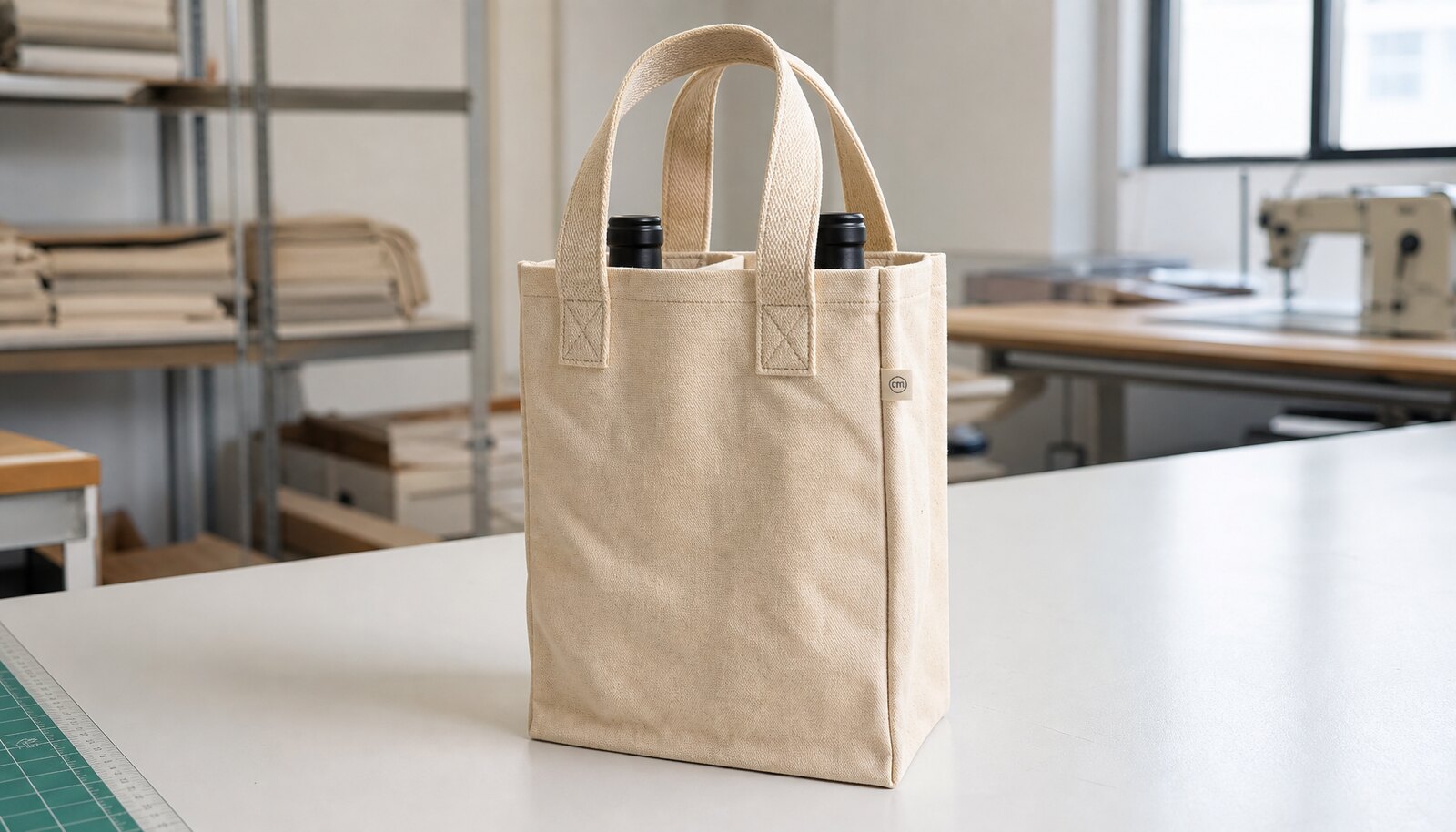
What durability means for a boutique winery buyer
For a boutique winery, a canvas wine carrier is not just packaging. It is a retail item, tasting-room add-on, and brand touchpoint that may be carried, stacked, gifted, and reused many times. If the carrier stretches, splits at the handles, or scuffs the logo after a few uses, the customer sees it as a product failure, not a packaging issue. That is why the durability discussion should start with the actual use case: one bottle or two bottles, retail shelf sale or staff use, lightweight gift bottle or full-size glass bottle, and whether the bag must survive repeated hand carry.
Buyers often get distracted by look and skip the stress points. In practice, durability is driven by four parts: fabric body weight, handle reinforcement, seam construction, and print durability. If those four are weak, a nice color and neat artwork will not save the program. The goal of your RFQ is to force the supplier to commit to a build that can survive real bottle weight and normal handling, not a generic “canvas bag” quote.
- Define the bottle count and bottle type before you talk about artwork.
- Treat handle and base strength as mandatory, not optional upgrade items.
- Assume retail customers will reuse the carrier more than a one-time gift pack.
Fabric weight and construction choices that actually hold up
For most boutique winery programs, the workable range is 12–16 oz canvas, roughly 400–540 GSM, depending on how structured the carrier needs to feel. Lower weights may work for a soft promotional carrier, but they can sag when fully loaded and show distortion at the seams. Heavier canvas gives better structure and a more premium handfeel, but the buyer should watch for higher sewing cost, slower stitching, and a possible increase in overall carton weight. If the carrier includes a divider or bottle sleeve, the fabric choice has to support that extra internal bulk without turning the bag stiff and awkward.
Construction is just as important as weight. A simple body sewn with a single topstitch can look fine in a flat sample and still fail under bottle load. A better spec uses a reinforced base, clean side seams, and handles attached with bar-tack or box-X reinforcement. If the winery wants a more giftable look, a rolled or bound top edge can improve structure, but the supplier should show that the finish does not cut into usable opening width.
- 12 oz / about 400 GSM: good for lighter, lower-cost promotional use, but more prone to sagging.
- 14 oz / about 470 GSM: common balanced choice for retail wine carriers with acceptable structure.
- 16 oz / about 540 GSM: better for premium feel, repeated use, and heavier bottle formats.
- Ask whether the stated weight is raw fabric weight or finished weight after coating/washing.
Comparison of sourcing routes for durability-focused programs
Not every supplier route gives the same control over durability. A local decorator can be fast for small runs, but they may not control fabric lots or reinforcement details as tightly as a factory. A broker can source multiple options, but the quote may hide the actual build details until late in the sample stage. Factory-direct sourcing is usually the best route when the buyer wants repeatable QC, predictable lead time, and a stable spec file that can be reused for reorder seasons.
The right route depends on how much variance your brand can tolerate. If the carrier is for tasting-room merchandising and seasonal gifting, a simple stock-canvas route may be acceptable. If the carrier sits next to premium wine bottles in retail distribution, durability and print consistency matter more, so a direct factory with sample approval and written substitution control is usually safer.
- Use factory-direct when repeat orders and stable specs matter.
- Use local decoration only if you can verify the actual base carrier source and reinforcement details.
- Use broker sourcing only when you need category comparison and can manage extra communication steps.
Supplier route decision table for canvas wine carriers
Use this comparison when you are deciding how to source canvas wine carriers for boutique wineries. The biggest mistake is comparing only unit price. A cheaper quote can lose money later if the carrier arrives with weak seams, inconsistent print placement, or carton damage that forces repacking. The table below focuses on buyer decisions that affect field performance, not generic spec labels.
The useful question is not “Which supplier is cheapest?” It is “Which route gives me the best control over fabric, sewing, print, and packing for the lowest landed risk?”
- Write decisions in measurable language, not only descriptive wording.
- Ask for sample photos plus one physical approval sample for important orders.
- Keep quotation, sample approval, and inspection notes tied to the same spec version.
Print method, logo placement, and wear resistance
For canvas wine carriers, print failure is a common source of complaints because the bag is touched frequently. Screen print is usually the most practical choice for a solid winery logo, especially when you want good opacity on natural canvas and controlled unit cost. It is stronger than many heat-transfer applications when the carrier will be handled repeatedly. For premium small runs, a woven label or embroidery can add perceived value, but embroidery adds density and may be less suitable if the carrier wall is narrow or if a divider runs close to the logo zone.
Logo placement needs to be specified in millimeters, not just “center front.” The supplier should show artwork position relative to seam lines, handle anchor points, and the top edge. On a bottle carrier, an image that looks centered in a flat print file can drift once the bag is assembled and stitched. If the brand uses a light ink on dark canvas, you should also ask for an opacity target or test strike so the artwork does not look washed out under retail lighting.
- Screen print: best for solid logos and repeatable color control.
- Heat transfer: useful for complex art, but watch for peel and crack risk.
- Embroidery: premium feel, but check whether it distorts thin canvas panels.
- Woven label: strong for brand marking on side or top seam with low wear risk.
Durability testing checklist for sample approval
Before approving production, test the sample like a retail buyer, not like a photo shoot. Load the carrier with the intended bottle type, then lift it by the handles, walk a short distance, set it down, and repeat the cycle several times. Watch the handle attachment points, the top edge, and the base panel. If the carrier has a divider, confirm the bottles do not clink together or shift enough to abrade labels. A sample that looks good on a table but twists when lifted is not ready for mass production.
A durable sample should pass basic physical checks without special handling. The body should not warp under normal bottle load, the seams should stay flat, and the print should remain intact after light rubbing with a dry cloth. If the carrier will be sold through tasting rooms, the sample should also feel comfortable in hand, because stiff, sharp-edged handles can reduce repeat use even when the bag is technically strong.
- Load test: actual bottle weight, not a dummy object that is lighter.
- Lift cycle: repeated lift, carry, set-down motions to expose handle stress.
- Rubbing test: check print and surface scuff resistance with light manual abrasion.
- Fit test: confirm bottle diameter clears the opening and divider without forcing.
QC thresholds buyers should write into the PO
The purchase order should define what counts as acceptable and what triggers rejection. Buyers do not need an academic test lab spec, but they do need practical thresholds. For example, stitching should be even with no skipped sections at visible stress points, print placement should remain within the approved position window, and the bag should stand and carry as intended without seam distortion. If a winery uses the carrier for premium gifting, surface defects that might be acceptable on a promotional bag may not be acceptable here.
Write the QC plan around the failure modes that hurt your brand. The most common problems are underweight fabric, weak handle reinforcement, poor divider alignment, misprinted logos, and carton damage that causes bags to arrive wrinkled or dirty. A short written QC standard saves time at the warehouse and gives your supplier a clear target during mass production.
- No loose or skipped stitches at handle anchors.
- No visible fabric holes, snags, oil marks, or stain spots on front panels.
- Logo placement within the approved tolerance band.
- Divider and base structure must hold bottle shape without collapse.
- Outer cartons must arrive intact, dry, and correctly labeled.
Packaging details that affect claims and warehouse labor
Wine carriers are often packed with other gift items, which makes packaging more important than many buyers expect. If the units are loose in a carton, the print can rub, the handles can fold sharply, and the carrier can arrive creased or dusty. For retail programs, individual polybags with a barcode sticker are common, then packed into export cartons with a clear count. If the carrier is sold as a premium gift item, a simple tissue insert or flat protection sheet can reduce seam marks and preserve shape without adding much cost.
Carton size matters because overpacked cartons slow handling and increase crush risk, while oversized cartons can waste freight space. Buyers should ask for gross weight, unit count per carton, and whether cartons are optimized for pallet stacking. If the carrier is a two-bottle style, the packed carton should be tested for how the handles and dividers sit during transit, since pressure points can create indent marks if the pack is too tight.
- Use individual polybag protection when the carrier has printed artwork.
- Confirm carton pack count against warehouse receiving limits.
- Ask for pallet stackability if the order ships in mixed SKUs.
- Verify barcode placement so the receiving team does not need to reopen cartons.
MOQ logic, quote structure, and landed-cost comparison
MOQ is not only a factory rule; it is a pricing mechanism. For canvas wine carriers, the main cost drivers are fabric color, print setup, reinforcement complexity, divider construction, and packing method. A standard stock color with one-color screen print can usually support a lower MOQ than a custom-dyed or heavily constructed style. Once you add special handles, full lining, or a rigid insert, the MOQ often rises because the factory needs more setup time and more stable material booking.
When comparing quotes, separate the price into sample cost, setup cost, unit price, packing cost, and freight assumptions. A quote that looks low may exclude carton marking, additional print colors, or reinforced handle stitching. For import buyers, landed cost should also reflect inspection, inland movement, and any extra repacking labor at destination. The cheapest ex-works quote is not necessarily the best buy if the product needs rework before retail use.
- Lower MOQ usually works best with stock canvas colors and simple logo print.
- Custom color, lining, divider boards, and premium finishes push MOQ upward.
- Ask for a line-item quote to expose hidden setup or packing charges.
- Compare landed cost, not just factory unit price.
Production schedule risks and sample timing
Lead time for canvas wine carriers usually breaks into two stages: sample development and bulk production. A practical sample window is often about 7–12 days, depending on artwork complexity and whether the factory already has the right fabric in stock. Bulk production commonly sits in the 25–40 day range after sample approval, but that can stretch during peak seasons, especially before holiday gifting or harvest promotions. Buyers should plan backwards from the sales date, not from the date the RFQ is sent.
The biggest schedule risk is not sewing time; it is approval delay. If the artwork file is unclear, the material spec is not frozen, or the buyer keeps revising handle length and divider layout, the project stalls before cutting begins. Keep the approval path tight: artwork confirmation, material confirmation, sample sign-off, then production release. Each change after that point can reset the calendar.
- Freeze logo artwork before sample approval.
- Confirm material stock before promising delivery dates internally.
- Allow buffer time for peak season and freight booking.
- Do not release production until the sample is physically signed off or approved in writing.
Specification comparison for buyers
| Spec decision | Recommended option | When it fits | Buyer risk to check |
|---|---|---|---|
| Fabric weight | 12–16 oz canvas, or about 400–540 GSM for most 1–2 bottle carriers | Retail-facing wine programs, gift sets, and repeated customer reuse | Very light fabric can sag at the base and distort print; very heavy fabric can increase cost and slow sewing |
| Handle construction | Double-layer handles with reinforced bar-tack or box-X stitching | When the carrier will be lifted fully loaded at bottle weight plus packaging | Thin single-layer handles often fail at the attachment point before the body wears out |
| Bottle divider | Full-height sewn divider or inserted divider board for 2-bottle styles | When brands need anti-rattle protection and cleaner shelf presentation | Loose dividers shift in transit and can scuff labels or cause imbalance |
| Print method | Screen print for solid logos; woven label or embroidery for premium small runs | When logo clarity and wash/abrasion resistance matter more than full-color graphics | Heat transfer may crack or peel if the carrier is handled often or stored warm |
| Closure style | Open top with reinforced rim, or simple hook-and-loop closure for premium gifting | When the carrier is used for direct sale, tasting-room retail, or gifting | Closures can create line complexity and raise reject risk if alignment is poor |
| Supplier route | Factory-direct with sample approval and production QC; avoid broker-only sourcing for repeat programs | When the order needs repeatable specs, carton control, and stable pricing | Broker quotes can hide fabric substitutions and add communication delays |
| MOQ approach | Price by fabric color plus print setup, with lower MOQ for stock canvas colors | When testing a new SKU or seasonal winery gift item | If MOQ is too low, suppliers may cut corners on sewing time or use mixed materials |
| Packing method | Individual polybag with barcode sticker, then export carton with inner divider if needed | When carriers are shipped with other gift items or wholesale cartons | Loose packing can crease print, rub seams, and raise claim rates on arrival |
| Lead time planning | Sample in 7–12 days, production in 25–40 days after approval, depending on season and customization | When the item supports tasting-room retail calendars or harvest promotions | Ignoring art approval and material booking time can push the order past the selling window |
Buyer checklist before sampling
- Confirm bottle count, bottle diameter range, and whether the carrier is for still wine, sparkling wine, or mixed formats.
- Lock fabric weight target in oz or GSM, and state whether washed canvas, raw canvas, or coated canvas is acceptable.
- Specify seam type, handle length, divider construction, and minimum reinforcement points.
- State print method, logo size, Pantone targets if needed, and acceptable color variance.
- Ask for pre-production sample photos, stitch close-ups, and a packed carton photo before mass production.
- Request carton pack count, carton size, gross weight target, and barcode label placement.
- Define inspection standard for seam strength, fabric defects, print defects, and dimensional tolerance.
- Require a written statement on material substitution policy and approval process.
Factory quote questions to send
- What exact fabric weight will you use, in oz and GSM, and is that before or after any coating or washing?
- How are the handles attached: bar-tack, box-X, or full seam reinforcement, and how many stitch lines per attachment?
- Can you show the divider structure, base reinforcement, and rim finishing in the sample before we approve production?
- What print method do you recommend for this artwork, and what is the expected abrasion resistance for that method?
- What is your MOQ by color and by print method, and where do setup fees or plate fees apply?
- Can you quote separate pricing for sample, production, logo setup, and export cartons?
- What is your standard lead time after sample approval, and which steps create delay risk in peak season?
- How do you pack units and master cartons, and can you confirm carton drop resistance and compression protection?
Quality-control points to confirm
- Fabric weight must match the approved spec within a practical production tolerance agreed in writing; do not allow a lighter substitute without sign-off.
- Handle attachment areas should show no skipped stitches, loose threads, or puckering; reinforcement must be symmetrical on both sides.
- Base panel and side seams should sit flat without twisting when the carrier is loaded with two bottles of the intended size range.
- Printed logos should be centered within the approved placement window and free from smudges, pinholes, or obvious registration drift.
- Divider height must be sufficient to separate bottle shoulders and keep labels from scraping in transit.
- Top rim and opening should not collapse during loading; the opening must remain usable after repeated hand flexing.
- Carton count, SKU label, and outer markings must match the packing list exactly; mismatches create warehouse delays.
- Random finished goods should be tested for a short-load cycle: insert bottles, lift, walk, set down, and inspect for seam stress and print wear.