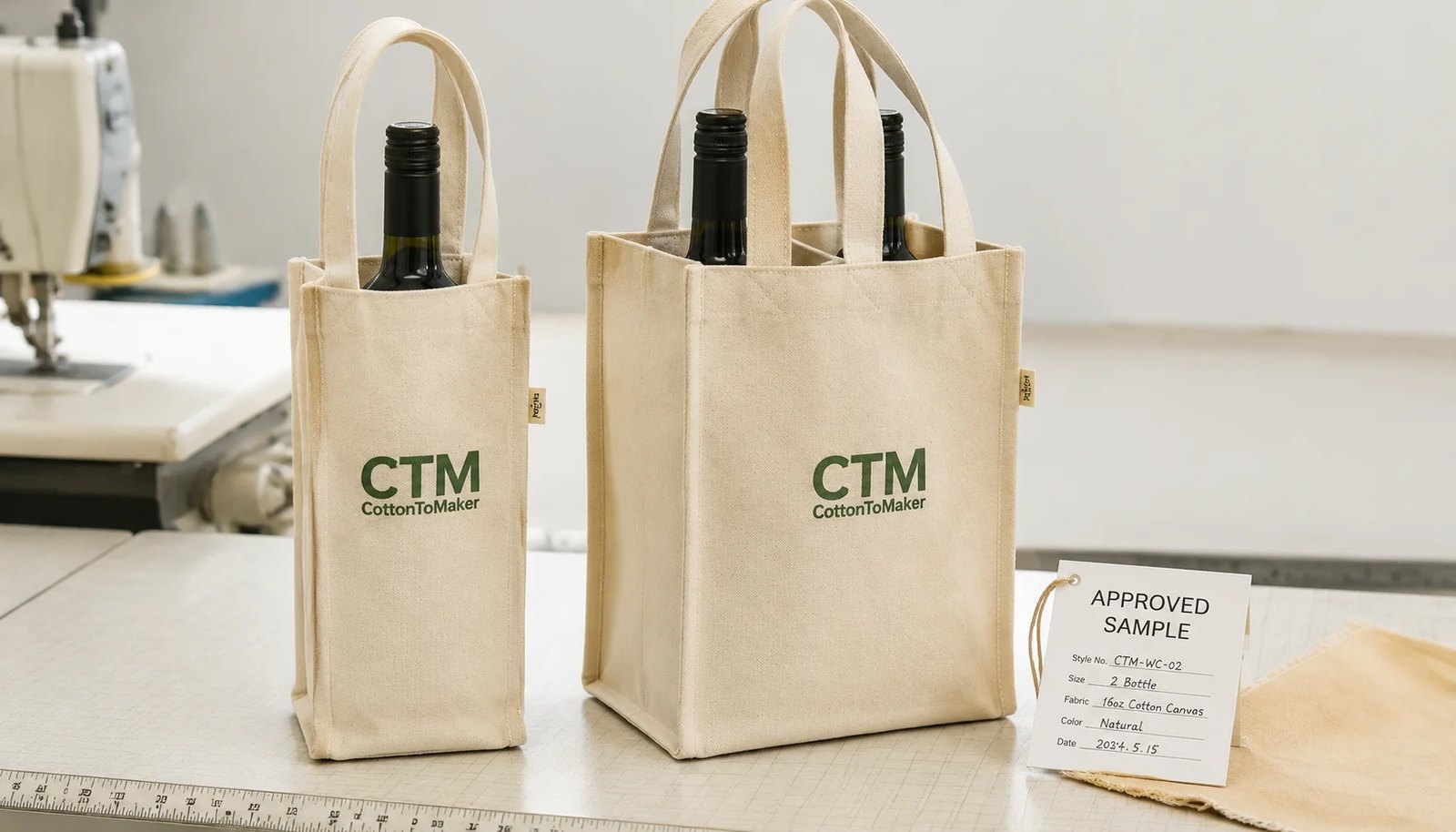
Start With the Real Failure Point
Wholesale canvas wine carriers for natural grocers are not ordinary promotional totes with a narrower shape. They carry glass, concentrated weight, and a product that customers often buy as a gift or for dinner the same day. A weak handle or divider is not only a bag defect; it can become a broken bottle claim at store level. The RFQ should therefore begin with load path and bottle fit, not with logo size.
The most common buying mistake is approving a clean-looking sample while leaving durability assumptions vague. A sample can stand well when empty and still fail after repeated loaded carry, especially if the canvas is light, the handle overlap is short, or the divider is only caught into the top seam. Treat the wine carrier as a small engineered fabric product with defined stress points.
- Primary stress points are handle attachment, side seam, bottom corner, divider seam, and upper opening.
- A one-bottle carrier usually fails differently from a two-bottle or six-bottle carrier because the load shifts less evenly.
- Natural grocer programs often need a balance of reusable feel, natural material appearance, and predictable carton handling.
- Durability language in the purchase order should be measurable, not limited to phrases such as strong canvas or heavy duty.
Choose Canvas Weight by Use Case
For most retail wine carrier programs, 10 oz to 12 oz cotton canvas is the practical starting range. This is roughly 340 to 410 GSM, depending on weave and finishing. Lighter 8 oz canvas may be acceptable for short-term single-bottle gift sleeves, but it often feels soft at the base and less credible for repeat grocery use. Heavier 14 oz canvas can work for premium programs, but it increases cost, sewing difficulty, carton weight, and sometimes makes the carrier too stiff for easy checkout handling.
Buyers should avoid comparing fabric only by oz if suppliers come from different markets. Some factories quote oz per square yard, some discuss GSM, and some quote a nominal weight that does not match finished fabric. Natural canvas can shrink, relax, or gain stiffness after finishing. The RFQ should require the supplier to state both oz and GSM and identify whether the value is before or after washing, dyeing, coating, or printing.
- 8 oz canvas: lower cost, suitable for light single-bottle promotions, higher risk of sagging and handle distortion.
- 10 oz canvas: good commercial baseline for single and two-bottle carriers when reinforced correctly.
- 12 oz canvas: stronger handfeel for reusable retail programs and heavier bottles.
- 14 oz canvas: premium feel, but check needle marks, turning difficulty, and higher freight impact.
- Natural unbleached canvas may show seed flecks and shade variation; define whether this is acceptable before sample approval.
Engineer the Handle Before the Logo
The handle construction is where low-cost quotes often hide risk. A simple self-fabric handle may be adequate if it has enough width, enough overlap into the body seam, and proper reinforcement. For wine carriers, handle width around 2.5 cm to 3.8 cm is common, but the stitch pattern matters more than the number alone. Box-X stitching and bartacks at the top stress zone are more reliable than a single straight stitch line.
Handle drop also affects store use. Too short, and the bag is uncomfortable when carrying two bottles. Too long, and the bottles swing more during walking. For single-bottle wine carriers, a compact handle can be fine. For two-bottle or six-bottle carriers, buyers should test the handle with actual bottles and typical user movement, not just static hanging.
- Specify handle width, finished handle drop, handle material, and handle overlap into the body.
- Require box-X or bartack reinforcement at all loaded attachment points.
- Use lockstitch with suitable thread size; very fine thread can cut into fabric under load.
- Reject samples with loose loops, skipped stitches, or handle panels that twist after loading.
- If webbing handles are used, confirm colorfastness and whether the look still matches a natural grocery brand.
Build Bottle Fit Into the Pattern
A wine carrier pattern should be drafted around bottle diameter, bottle height, and expected bottle mix. Standard 750 ml wine bottles are not all the same shape. Burgundy bottles, sparkling wine bottles, and some specialty beverage bottles are wider than slim Bordeaux bottles. If the carrier is too tight, staff will struggle at checkout. If it is too loose, the bottles hit each other and stress the divider.
For two-bottle and six-bottle designs, the divider should be treated as a functional component. It must be high enough to prevent glass contact, secured into the base or side seams properly, and made from fabric weight that does not collapse immediately. A divider that looks acceptable when open on a table may fold down when bottles are inserted quickly.
- State the maximum bottle diameter the carrier must accept, for example 85 mm or 90 mm if wider bottles are expected.
- Define the finished internal compartment width, not only the external bag width.
- For two-bottle carriers, test with one bottle loaded on one side to see whether the carrier twists badly.
- For six-bottle carriers, verify that the center divider and side panels share the load without tearing.
- Confirm whether the bottom needs double-layer canvas or a removable insert for better bottle stability.
Use Print Methods That Suit Natural Canvas
Most natural grocer wine carriers use simple branding: one or two color logos, store marks, seasonal messages, or private label artwork. On natural canvas, water-based screen print or pigment screen print is usually the most practical method. It gives a clean look, controls cost at wholesale quantities, and avoids the thick plastic feel that can occur when ink deposit is too heavy.
Print risk increases when the artwork has large solid blocks, small reversed text, tight registration, or pale colors on unbleached fabric. Natural canvas is not a perfectly white substrate, so cream, yellow, light gray, or soft green may shift visually. Buyers should approve the print on actual bulk fabric, not on a paper proof or a different cotton swatch.
- Use screen print for simple logos and larger runs where setup cost is spread across quantity.
- Use heat transfer only when artwork detail requires it, and test edge lifting on textured canvas.
- Use woven label or side label when the bag must stay mostly plain and natural-looking.
- Avoid oversized solid ink panels if flexibility and handfeel matter.
- Set print position tolerance, such as plus or minus 5 mm, and define whether slight fabric flecks under ink are acceptable.
Understand MOQ and Cost Drivers
MOQ is not only a factory preference. It is tied to fabric purchase, dyeing or finishing lots, print setup, cutting efficiency, sewing line changeover, and packing labor. A factory may technically make 300 pieces, but the unit cost can be high because the same sample, screen, line setup, and export documentation work is spread over a small order. For natural canvas wine carriers, practical wholesale levels often become more competitive as the order moves from trial quantity to repeat retail volume.
Buyers comparing quotes should separate fixed charges from variable unit cost. Screen charges, sampling fees, custom labels, carton markings, and special testing may appear outside the unit price. If one supplier includes reinforced stitching and export cartons while another quotes a basic unreinforced bag, the cheaper unit price is not a true comparison.
- Fabric weight increase raises material cost and carton weight, but may reduce failure risk.
- More bottle compartments increase cutting, sewing, divider alignment, and inspection time.
- Multi-color printing increases setup cost and registration control work.
- Retail barcodes, hangtags, belly bands, or individual polybags add labor and packing material.
- Rush orders may require fabric from available stock, reducing color and weight options.
Set Sample Approval Rules
A proper sample process should include at least one fit sample and one pre-production sample. The fit sample verifies dimensions, bottle loading, handle drop, divider height, and general construction. The pre-production sample should use final fabric, final print, final thread, final reinforcement, and final packing method. Approving only a photo sample leaves too many variables uncontrolled.
Sample review should be documented with measurements and photos. Mark the sample with approval date, version, and any allowed changes. If the buyer approves the appearance but still needs reinforcement improvements, those changes should be written into the approval note before bulk production. Otherwise the factory may follow the weaker sample exactly.
- Measure finished width, height, gusset, compartment width, handle drop, and print placement.
- Load the sample with the heaviest expected bottle mix and carry it for a practical handling test.
- Check whether bottles can be inserted easily by retail staff without forcing the seams.
- Rub the print dry and slightly damp to see whether ink transfers to fingers or nearby fabric.
- Photograph seam reinforcement and divider construction so inspection has a visual reference.
Define Durability Test Acceptance
Durability testing does not need to be complicated, but it must be specific. A useful buyer checklist defines load weight, test duration, number of cycles, and pass or fail condition. For a single-bottle carrier, testing only with one light bottle may understate risk. For a two-bottle carrier, use two full bottles and add a safety margin. For larger carriers, the test should include asymmetric loading because customers may not fill every compartment evenly.
The key is to test the same construction that will be used in bulk production. A handmade sample from a senior sample worker may be stronger than mass production if the sewing line is not instructed properly. Durability criteria should be included in the inspection plan and communicated before production starts.
- Loaded carry test: no handle tearing, stitch breakage, seam opening, or serious deformation after carrying at 1.5 to 2 times expected load.
- Repeated lift test: no visible thread failure after repeated lifting from a table or floor position.
- Divider movement test: bottles remain separated during normal walking movement.
- Bottom sag test: bag can stand or hold bottle position without excessive leaning after loading.
- Seam slippage test: side and bottom seams do not open under hand tension near stress corners.
- Print resistance test: no unacceptable transfer after dry rub and light damp rub.
Pack for Distribution, Not Just Shipment
Canvas wine carriers often arrive at a distribution center before reaching stores. Packing must protect both product shape and retail presentation. Over-compressed cartons can create permanent creases across the front print panel or bend divider panels so the bags do not open cleanly. Under-filled cartons waste freight space and allow bags to shift during transit.
The carton plan should include units per inner bundle, orientation, carton dimensions, gross weight limit, and moisture protection. Natural cotton canvas can absorb odor and humidity, so warehouse conditions and container moisture matter. If individual polybags conflict with sustainability goals, buyers can request bundle packing with a master poly liner, but the moisture risk should still be managed.
- Keep carton gross weight practical for DC handling, commonly below 15 kg to 18 kg unless the buyer specifies otherwise.
- Use flat packing that does not sharply fold handles across the print area.
- Add a master poly liner or moisture barrier when shipping natural canvas in humid seasons.
- Confirm carton compression strength if cartons will be stacked high in storage.
- Include carton marks, SKU, PO number, quantity, country of origin, and any retail routing labels required by the buyer.
Control Lead Time and Quote Data
Lead time for canvas wine carriers depends on fabric availability, print complexity, sample approval speed, production queue, inspection timing, and export packing. A basic natural canvas style with simple screen print can move faster than a dyed fabric style with custom labels and complex dividers. The buyer's own artwork approval and sample feedback cycle often affects the schedule as much as factory sewing time.
To compare supplier quotes, require the same quote data from every factory. The useful comparison is not only unit price. Procurement teams need fabric specification, construction details, sample timing, MOQ breakpoints, packing data, carton quantity, estimated CBM, payment terms, Incoterms, and validity period. Without those details, a low quote may become expensive after packing, rework, freight, or late approval.
- Typical timeline components include artwork proof, sample making, sample shipment, approval, material booking, printing, sewing, inspection, packing, and export handover.
- Quote each quantity break using the same specification so cost movement is visible.
- Request carton size, pieces per carton, gross weight, net weight, and total CBM for landed-cost comparison.
- Clarify whether the quote includes screen charge, sample charge, labels, hangtags, barcode stickers, and export cartons.
- Set the quote validity period because cotton fabric and freight-related costs can move between RFQ and purchase order.
Specification comparison for buyers
| Spec decision | Recommended option | When it fits | Buyer risk to check |
|---|---|---|---|
| Fabric weight | 10 oz to 12 oz cotton canvas, about 340 to 410 GSM after finishing | Natural grocers needing reusable carriers that feel substantial without becoming too stiff at checkout | Underweight canvas may pass visual approval but stretch around bottle bases after repeated loaded handling |
| Bottle format | Single-bottle, two-bottle, or six-bottle layout with sewn divider panels | Single and two-bottle styles suit gift purchases; six-bottle styles suit basket-building and club promotions | Divider height and bottom support must stop bottles from clinking during customer carry-out |
| Handle construction | Self-fabric handles with box-X stitching and bartack reinforcement at stress points | Best for repeat use, heavier bottles, and retail environments where bags are loaded quickly | Decorative handle stitching can fail if stitch density, thread size, and handle overlap are not specified |
| Bottom structure | Double-layer canvas base or inserted fabric-covered board if requested | Needed when carrying two or more glass bottles or premium bottles with thicker bases | A soft single-layer bottom can sag, causing bottles to lean and stressing side seams |
| Print method | Water-based screen print or low-bleed pigment print on natural canvas | Works for grocery branding, simple logos, seasonal wine events, and private label programs | Large solid print areas can crack or feel boardy if ink deposit is too heavy |
| Seam allowance | Minimum 8 mm seam allowance with lockstitch, reinforced corners, and trimmed loose threads | Appropriate for factory-controlled bulk orders where durability claims must be repeatable | Narrow seam allowance may look clean on a sample but pull open after load testing |
| Packing method | Flat packed by bundle with moisture protection and carton compression control | Good for importers, distributors, and retail DC receiving where cartons are stacked | Over-compressed cartons can crease handles, distort divider panels, and make retail presentation poor |
| Inspection level | AQL inspection with extra functional load and seam pull tests added to cosmetic checks | Useful when wine carriers are sold or given away in-store and failure creates bottle breakage risk | Standard visual inspection alone does not prove handle, divider, or bottom durability |
Buyer checklist before sampling
- Define bottle count and bottle diameter range before requesting pricing, including whether the carrier must fit standard 750 ml wine, champagne-style bottles, or mixed beverage bottles.
- Specify canvas weight in oz and GSM, and state whether weight is before or after dyeing, washing, or finishing.
- Require a physical pre-production sample loaded with real bottles, not only an empty appearance sample.
- Set acceptance criteria for handle strength, seam slippage, divider stability, bottom sag, print rubbing, and carton compression.
- Provide the supplier with logo artwork size, print colors, Pantone references, and acceptable position tolerance.
- Confirm whether the fabric must be natural unbleached, bleached white, dyed, organic cotton, recycled cotton blend, or conventional cotton canvas.
- Include packing requirements such as units per polybag, bundle quantity, carton size, carton weight limit, moisture control, and retail barcode needs.
- Request quotation data in a comparable format: fabric weight, dimensions, print method, MOQ, sample cost, tooling or screen charge, production lead time, packing, and Incoterms.
- Approve a golden sample with marked dimensions and stitch details before mass production starts.
- Book inspection timing early enough to allow rework before vessel closing or domestic delivery appointment.
Factory quote questions to send
- What is the exact canvas weight in oz and GSM, and is that measured before or after finishing?
- What yarn count, weave density, and shrinkage tolerance are used for the recommended canvas?
- What loaded weight has this handle construction been tested to, and for how long?
- Will the sample use the same fabric, thread, divider material, print ink, and handle reinforcement as bulk production?
- What is the minimum practical MOQ for this style, and what cost changes at 500, 1,000, 3,000, and 5,000 pieces?
- Which print method do you recommend for natural canvas, and what is the expected rubbing and wash resistance?
- How many pieces fit per export carton, what is the gross carton weight, and what carton compression grade is used?
- What are the usual lead times for sample, material booking, printing, sewing, inspection, and export packing?
- Can you provide photos or short videos of seam reinforcement, divider sewing, load testing, and carton packing for approval?
- What tolerances will you apply for size, print placement, fabric weight, and color shade?
Quality-control points to confirm
- Loaded handle test: carry the approved bottle count at 1.5 to 2 times expected loaded weight for a defined time, with no handle tearing, stitch breakage, or seam slippage.
- Drop simulation: lift and set down the loaded carrier repeatedly on a hard surface to check bottom sag, divider movement, and corner stress.
- Divider fit: bottles should stay separated during normal walking movement, with no glass-to-glass impact inside the carrier.
- Seam inspection: stress seams should show consistent stitch density, secure backstitching, trimmed threads, and no skipped stitches at corners.
- Print rub test: printed logo should not transfer visibly after dry rubbing and light damp rubbing on natural canvas.
- Dimension tolerance: finished width, height, gusset, handle drop, and divider width should match the approved sample within agreed tolerance.
- Carton test: packed cartons should resist crushing under normal stacking, with no sharp creases that damage handles or front print panels.
- Moisture control: fabric and cartons should be dry, odor-free, and protected from humidity during packing and transit.