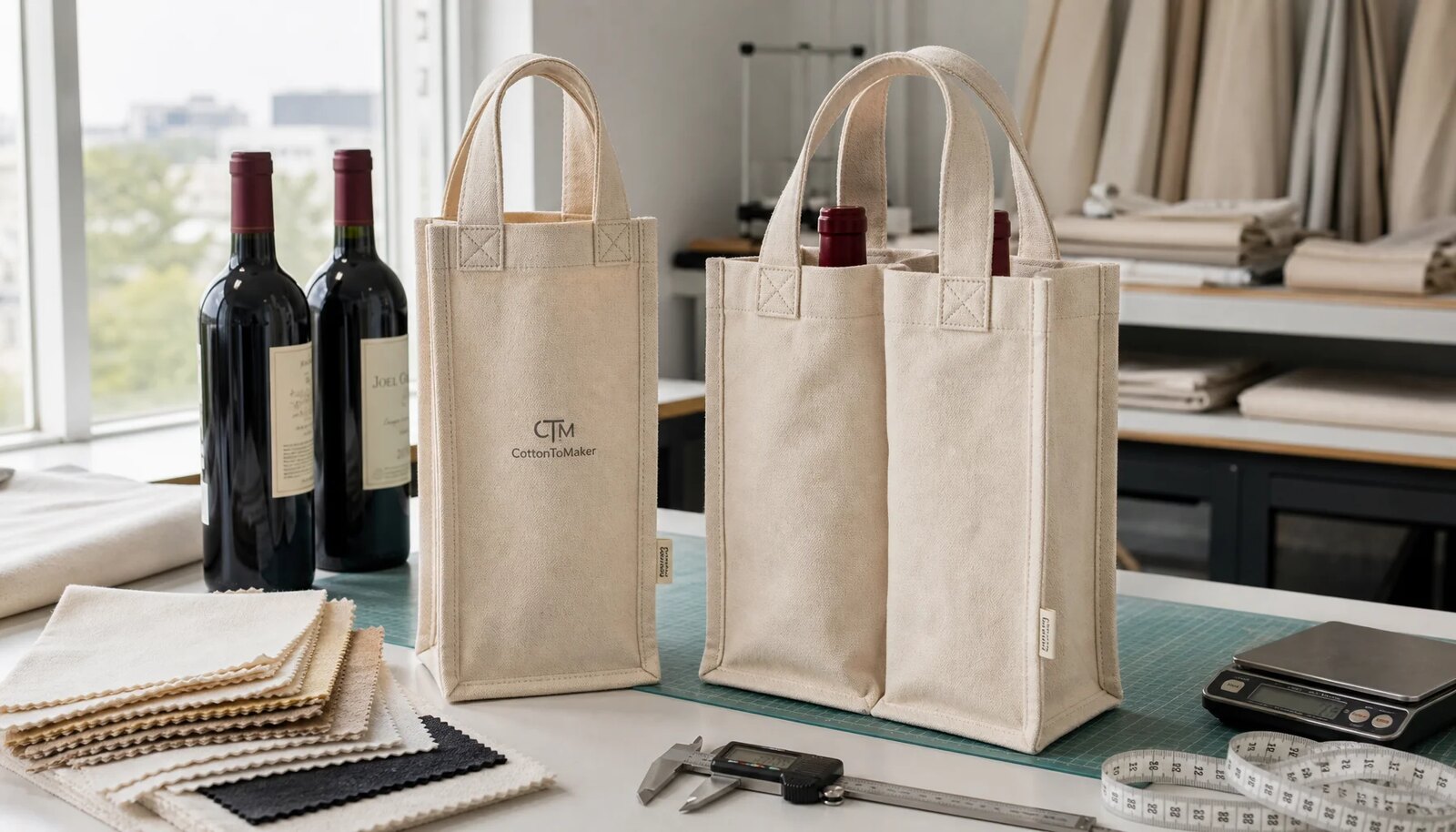
Start With the Risk: Glass, Crowds, and Reuse
A canvas wine carrier is not just a promotional tote with a narrow shape. It holds glass, often in a crowded booth where shoppers lift, compare, set down, and carry purchases while walking through a craft fair. If a weak tote fails, the brand looks cheap. If a wine carrier fails, the buyer may face broken bottles, spilled product, safety concerns, replacement claims, and a disappointed retail partner.
Durability therefore needs to be written into the RFQ, sample approval, purchase order, and inspection checklist. The supplier should know the bottle format, the expected load, the fabric target, the handle construction, the divider design, the print method, and the packing method before final pricing. A clean empty sample can still fail when two filled bottles pull on the handle seams or push against the gusset.
The biggest sourcing mistake is approving a generic 750 ml carrier without testing the actual bottle family. Bordeaux, Burgundy, Champagne, Riesling, spirits, and olive oil bottles vary in diameter, height, shoulder shape, and filled weight. One bottle may slide in cleanly while another scrapes the print, forces the side seam, or makes a two-bottle carrier lean. For craft fair programs, also consider distribution: goods may ship to wineries, retailers, pop-up teams, or regional warehouses, so carriers must arrive clean, display-ready, and easy to unpack.
- Put durability requirements in the RFQ and PO, not only in email notes.
- Approve the carrier loaded, not only flat and empty.
- Use the intended bottle format before bulk cutting.
- Separate cosmetic defects from safety or load-bearing defects.
- Treat handle tearing, bottom seam opening, and divider pullout as critical failures.
Canvas Weight and Fabric Specification
For many reusable craft fair wine carriers, 10 oz to 12 oz cotton canvas is a practical buyer-spec range. That is approximately 340-410 GSM, depending on weave and finishing. An 8 oz canvas can work for a simple one-bottle giveaway if the bottle is light and handle reinforcement is strong, but it usually has less structure and a lighter retail feel. A 14 oz canvas can look premium, but it adds seam bulk, sewing difficulty, material cost, carton weight, and freight impact.
The best canvas is not automatically the heaviest option. It is the fabric that meets the bottle load, table stance, print quality, target price, and repeat-order requirement. Ask suppliers to quote both ounces and GSM because mills and factories may use different measurement habits. Also ask when the weight is measured: greige fabric, after washing, after dyeing, after finishing, or on the final production fabric. For repeat orders, a declared tolerance such as ±5% is a useful procurement starting point unless both sides agree otherwise.
Canvas state matters. Natural canvas can show seeds, slubs, and shade variation, which may suit a rustic fair aesthetic but reduce logo sharpness. Bleached or dyed canvas can improve color control, yet it may affect shrinkage, crocking, MOQ, and lead time. If the program needs recycled-content cotton, organic cotton, or certification documentation, request that before quotation because it can change supplier options and labeling claims.
- Quote canvas in oz and GSM, with a declared tolerance.
- Use 10 oz for many cost-sensitive one-bottle reusable styles.
- Use 12 oz when two-bottle structure and stronger retail feel matter.
- Review 14 oz only after checking seam bulk and sewing feasibility.
- Keep an approved swatch for shade, hand feel, texture, and repeat orders.
Bottle Fit and Finished Dimensions
Bottle fit drives durability more than most buyers expect. The RFQ should include bottle diameter, height, shoulder shape, filled weight, label bulge if relevant, and bottle count. Standard filled 750 ml wine bottles often weigh about 1.2-1.5 kg depending on glass weight and style, so a two-bottle carrier commonly needs to handle at least 3.0 kg in a buyer-defined test. Heavier Champagne, spirits, olive oil, or premium glass formats should be tested at their actual filled weight.
Finished dimensions should be controlled in millimeters. A practical example is ±5 mm for width, height, gusset, handle drop, divider height, and bottom panel. Print placement may be controlled around ±3 mm to ±5 mm depending on artwork size and factory capability. Tighter tolerance can raise rejection rates and cost, but loose tolerance can create inconsistent bottle fit, uneven table display, and off-center logos.
Approve bottle fit with real bottles or agreed weighted dummies. Insert and remove bottles several times. Check whether the bottle scrapes the print panel, strains side seams, crushes the divider, or makes the carrier lean when loaded. Measure the empty carrier, but do not rely on empty measurements alone. Loaded pressure changes the front panel, gusset, bottom seam, and divider behavior.
- Provide bottle diameter, height, shoulder style, filled weight, and bottle count.
- Confirm whether one carrier must fit multiple bottle families.
- Use ±5 mm as a practical example for main finished dimensions.
- Check fit both empty and loaded.
- Reject carriers that require force to load or strain the seams.
Divider Construction for Two-Bottle Styles
In a two-bottle canvas wine carrier, the divider is a functional component. It reduces glass-to-glass contact, keeps the set organized, and helps the product look neat on a display table. If it is too low, it may separate the bottle bases but still allow bottle bodies or shoulders to hit. If it is too loose, it can fold during loading. If it is lightly tacked, it can pull out after repeated use.
A useful divider height often falls around 150-220 mm, but this should be treated as a buyer-spec example, not a universal rule. The correct height depends on bottle diameter, carrier height, and where the widest part of the bottle sits. The divider does not need to reach the neck in every design; it needs to separate the bottle body where contact risk is highest.
Attachment is as important as height. Stronger constructions usually anchor the divider into the bottom seam and side or center seams where the pattern allows. A floating divider may reduce sewing cost, but it should be accepted only after testing with the target bottles. Packing recovery also matters because craft fair wine carriers are often flat packed and compressed in cartons. Inspection should include loading bottles after unpacking, not only checking dividers at the sewing line.
- Specify divider height in millimeters.
- Connect divider height to the target bottle body, not a generic size.
- Prefer attachment into bottom and side seams where practical.
- Check whether bottles touch during normal carrying.
- Inspect divider recovery after flat packing and carton compression.
Handles, Stitching, and Load Tests
Handle failure is one of the most serious wine carrier defects because it may appear after goods have already shipped. Self-fabric handles give a consistent canvas look. Cotton webbing handles can offer stable strength and easier production control. Either option needs enough attachment depth, adequate seam allowance, strong thread tension, and a reinforcement pattern that spreads the load.
Load testing should be simple and repeatable. Define total test weight, lift cycles, lift height, hold time, and failure criteria. For many two-bottle 750 ml canvas wine carriers, 3.0 kg is a practical buyer-spec baseline. Use a higher load when the bottle is heavier or the carrier is sold as a premium reusable item. A dynamic check can lift the loaded carrier from table height to carrying height several times, followed by inspection of handles, side seams, bottom seams, and divider seams. A static hold can catch seam slippage or thread tension problems that a quick lift misses.
Box-X stitching, bar tacks, and reinforced double rows are common handle reinforcement choices. Placement matters. Reinforcement too close to a raw edge can tear through the canvas, and a very narrow stitch pattern can concentrate stress. During QC, reject skipped stitches, broken thread, loose knots, needle-cut fabric, major puckering at stress points, and any handle opening during the agreed test.
- Define test load using the actual filled bottle weight.
- Use box-X, bar tack, or reinforced double-row stitching at handle points.
- Inspect handle joints after testing, not only before testing.
- Add static hold checks for reusable or premium positioning.
- Confirm handle drop so loaded bottles do not swing excessively.
Print Method and Branding Durability
Craft fair wine carriers often serve as branded packaging, event merchandise, or sponsor visibility. That makes print durability a procurement issue. Screen printing is usually a strong starting point for solid winery logos, simple event marks, one to three colors, and repeat bulk orders. It performs best when ink, mesh, cure, and artwork detail match the canvas surface.
Natural canvas texture can break up thin lines, small text, and large solid blocks. Heat transfer or digital print can help with detailed artwork, short runs, or multiple sponsor versions, but these methods still need testing on the final canvas. Transfers can lift at edges or crack across folds. Digital print abrasion resistance depends on ink system and fabric finish. Embroidery can look premium, but it adds cost, may pucker canvas, and may not suit areas under bottle pressure.
A practical print approval should include a strike-off or pre-production sample on the final fabric color and weight. Check dry rub with a clean white cloth, light scratch with controlled hand pressure, fold or crease behavior, tape pull, transfer edge lift where relevant, and readability of small text. Also judge the logo after bottles are inserted. If the print distorts when loaded, the root cause may be bottle fit or gusset width rather than ink quality.
- Use screen print for clear solid logos and repeat bulk orders.
- Approve print on final production canvas, not only digital artwork.
- Avoid tiny reversed text unless sampled successfully.
- Set print placement tolerance, commonly ±3 mm to ±5 mm.
- Check printed panels empty, loaded, folded, and lightly rubbed.
MOQ, Cost Drivers, and Quote Comparability
MOQ for canvas wine carriers is rarely one simple number. It can change by fabric color, canvas weight, artwork count, print color count, label version, divider construction, insert board, packing method, and shipment split. Natural canvas with one logo usually creates less MOQ pressure than custom dyed fabric or several sponsor artwork versions. A supplier may accept a small total order but add setup charges or batch surcharges when the order is divided across many fair designs.
Make quotations comparable before negotiating. A 12 oz two-bottle carrier with stitched divider, box-X handles, two-color screen print, hangtag, insert board, protected packing, and export carton is not comparable to a lighter bag with straight stitching, one-color print, no insert, and bulk packing. The cheaper quote may simply be missing the durability and presentation requirements.
Landed cost should include freight and distribution handling. Heavier canvas can increase shipping cost, but it may improve gift value and reduce complaints. Individual packing adds material and labor, but it can protect natural canvas during multi-location distribution. Stronger cartons may cost more, but they can reduce crushed goods and repacking work. For procurement, the useful quote shows unit price, construction, QC assumptions, and logistics together.
- Ask MOQ per fabric color, artwork, print color count, label version, and shipment.
- Separate unit price from sample, screen, setup, label, insert, and packing charges.
- Compare quotes only after fabric, dimensions, handles, divider, print, and packing match.
- Request carton dimensions, units per carton, gross weight, and net weight.
- Confirm Incoterms before comparing landed cost.
Sample Approval Workflow
A strong sample workflow prevents many bulk issues. The first development sample can confirm size direction, construction concept, and material direction. The pre-production sample should be more complete. It should use final fabric weight, final fabric color, final thread, final handle reinforcement, final divider, final print method, final labels, and final packing. If the approved sample uses substitute fabric or unfinished print, durability is still unproven.
Measure and test the pre-production sample before release. Record width, height, gusset, handle drop, divider height, bottom panel, and print placement. Load the intended bottles, lift repeatedly, set the carrier on a flat surface, and inspect for leaning, seam stress, logo distortion, and handle movement. Pack the sample using the proposed packing method, then unpack it and check divider recovery and creasing.
Reference samples are important for reorders and inspections. Keep one approved sample with the factory and one with the buyer or inspector. Include the approved swatch, print reference, labels, and packing method if they are not obvious from the sample. For multi-SKU programs, approve each major artwork placement and label combination. One logo approval does not automatically approve a different sponsor mark with larger ink coverage or smaller text.
- Approve fabric swatch before bag sample when color or texture matters.
- Approve print strike-off before bulk printing when artwork is sensitive.
- Record measurements and tolerances in the PO or inspection checklist.
- Test real bottle fit before bulk cutting.
- Retain buyer, factory, and inspector reference samples.
Packing and Craft Fair Distribution
Packing is part of durability. A well-sewn carrier can still arrive dirty, damp, crushed, or badly creased. Natural cotton canvas can collect dust, absorb odor, and show moisture marks. Dividers can bend. Handles can crease at stress points. Printed panels can scuff against hangtags, inserts, carton seams, or other bags. Craft fair teams often have limited setup time, so each unit should unpack cleanly and look display-ready.
Flat packing is efficient, but it must be controlled. Dividers should be aligned rather than sharply crushed. Handles should be folded without pulling on attachment points. Printed panels should avoid rough inserts, staples, carton seams, and tag edges. Depending on route and sustainability goals, buyers can specify individual bags, bundle packing, carton liners, paper separation, or a poly liner. If goods may face sea freight or humid storage, moisture protection and odor checks become more important.
Carton planning should match how the goods will be used. Keep carton gross weight practical for small warehouses and event teams; under 15-18 kg is often easier to handle, although buyer policy and carrier rules should set the final limit. Mixed artwork programs need clear SKU separation and carton marks showing item number, PO number, SKU, quantity, carton count, gross weight, net weight, and destination marks when required. For first orders, packed carton photos are useful before shipment approval.
- Set carton gross weight targets before packing approval.
- Choose bundle or individual packing based on dirt, moisture, and scuff risk.
- Avoid over-compression that prevents gussets and dividers from recovering.
- Separate SKUs and artwork versions clearly.
- Check that tags and inserts do not scuff printed panels.
Inspection Timing and Failure Criteria
Final inspection can catch stains, loose threads, wrong counts, carton mark errors, and some measurement issues. It may be too late to solve weak handles, wrong canvas weight, poor print adhesion, or incorrect divider height. For first orders or high-value craft fair programs, consider an in-line check during printing or sewing. Early inspection gives the factory time to correct root causes before the full quantity is packed.
Define failure criteria before production. Critical defects should include handle tearing, bottom seam opening, divider pullout under agreed load, wrong bottle fit that forces seams, mildew odor, severe moisture exposure, and print adhesion failure. Major defects may include out-of-tolerance dimensions, visible stains, off-center print, weak divider recovery, and carton damage. Minor defects may include loose threads or small cosmetic issues within agreed limits.
Use AQL or the buyer's preferred inspection method, but make sure the checklist matches the product. A generic tote inspection may not test bottle fit or loaded performance. For wine carriers, the inspector should have the approved sample, measurement tolerance, bottle data or weighted dummies, print reference, packing standard, and defect classification. That is the difference between checking a bag and checking a carrier that must safely hold glass.
- Schedule inspection before cargo closing, not on shipment handover day.
- Give inspectors the approved sample, tolerance sheet, and bottle-fit basis.
- Classify load-bearing failures as critical defects.
- Include loaded lift checks and print adhesion checks in the inspection plan.
- Require clear photos for failed load, print, packing, or dimension checks.
Specification comparison for buyers
| Carrier option | Best use case | Useful buyer-spec example | Tradeoff to check |
|---|---|---|---|
| 8 oz canvas one-bottle carrier | Budget event giveaways, light retail add-ons, short-term fair promotions | Approx. 270 GSM canvas, reinforced handle stitching, tested with the actual filled bottle weight | May feel less structured on display and can sag if bottle weight, gusset, or handle reinforcement is not controlled |
| 10-12 oz canvas one-bottle carrier | Reusable winery retail carrier, giftable single-bottle sale, sponsor-branded fair merchandise | Approx. 340-410 GSM canvas with declared fabric weight tolerance, such as ±5%, and finished dimensions around ±5 mm | Higher unit cost than 8 oz, but better table stance, hand feel, and repeat-use perception |
| 10-12 oz two-bottle carrier with stitched divider | Craft fair bundles, winery tasting-room packs, two-bottle gifts, retail display sets | Pattern verified with target bottle diameter, filled weight, and shoulder shape; divider height specified in millimeters | Requires stronger handle attachment, better divider anchoring, and loaded fit testing because two bottles stress seams differently |
| Heavy canvas or reinforced-base carrier | Sparkling wine, spirits, olive oil, premium gift packs, heavier glass formats | 12-14 oz canvas or reinforced base; optional 1.5-2.0 mm insert board after load and packing tests | Adds seam bulk, sewing complexity, carton weight, freight cost, and possible insert-warp or sustainability concerns |
| Self-fabric handles | Natural canvas aesthetic, matching material look, simple branded retail programs | Handle attachment depth and reinforcement pattern specified; box-X, bar tack, or reinforced double row approved by sample | Can tear if stitch area is too narrow, too close to raw edge, or not tested after loading |
| Cotton webbing handles | Higher consistency, easier strength control, comfortable repeated carrying | Webbing width, color, attachment depth, and stitch pattern stated in RFQ and PO | May look less integrated than self-fabric handles and can create shade-matching issues |
| Screen print | Solid winery logos, simple one to three color sponsor marks, repeat orders | Print strike-off on final canvas; placement tolerance commonly ±3 mm to ±5 mm depending on artwork | Fine text and large solids need sampling because canvas texture affects edge clarity and ink coverage |
| Heat transfer or digital print | Multi-color artwork, short-run design splits, detailed fair graphics | Approve only after rub, light scratch, fold, tape-pull, and edge-lift checks on production canvas | Can crack, peel, lift at edges, or show weak abrasion resistance if not matched to fabric and cure process |
| Bulk packing with carton liner | Cost-sensitive wholesale shipment, internal distribution, low scuff-risk designs | SKU-separated bundles, carton liner or paper protection, practical carton gross weight target | Lower packing cost, but natural canvas can collect dirt and printed panels can scuff if compression is excessive |
Buyer checklist before sampling
- Send bottle data with the RFQ: diameter, height, shoulder shape, filled weight, label bulge if relevant, bottle count, and whether one carrier must fit Bordeaux, Burgundy, Champagne, Riesling, spirits, beer, or olive oil formats.
- Specify canvas in both oz and GSM, plus fabric state: natural, bleached, dyed, washed, pre-shrunk, recycled-content, organic, or certified material if required.
- Frame numeric targets as buyer specifications unless the supplier confirms a tested internal standard. Useful examples include 10-12 oz canvas, ±5% fabric weight tolerance, ±5 mm main finished dimension tolerance, and ±3 mm to ±5 mm print placement tolerance.
- Require a pre-production sample made with final fabric, final handle reinforcement, final divider construction, final print method, final label, and final packing method before bulk cutting.
- Test with real filled bottles where feasible. For many two-bottle 750 ml wine carriers, 3.0 kg total load is a practical buyer-spec baseline, with higher weight for heavy glass, sparkling wine, spirits, or olive oil.
- Define dynamic and static checks: repeated loaded lifts, short carry simulation, loaded tabletop stance, divider recovery after unpacking, and static hold if the carrier is marketed as reusable.
- Approve print on the production canvas, not only in artwork files. Check dry rub, light scratch, fold crease, tape pull, transfer edge lift, small text readability, and placement after loading.
- Confirm quote inclusions: sample charges, screen charges, strike-offs, labels, hangtags, insert board, individual packing, carton liners, export cartons, carton marks, inspection photos, and replacement terms for failed QC.
- Control packing so natural canvas stays clean and dry, printed panels avoid scuffing, dividers recover shape, and cartons remain practical for event teams to handle.
- Use inspection criteria for fabric stains, shade variation, fabric weight, dimensions, bottle fit, handle strength, divider alignment, print durability, odor, moisture exposure, packing, carton marks, and carton damage.
Factory quote questions to send
- What exact canvas weight are you quoting in oz and GSM, what tolerance applies, and is the weight measured before finishing, after finishing, or on the production fabric used for cutting?
- What finished dimensions will you quote for width, height, gusset, handle drop, divider height, and bottom panel, and what bulk tolerance can you hold?
- Which bottle type is your pattern based on, and can you test against our bottle diameter, height, filled weight, and shoulder shape before pre-production approval?
- What handle material is included: self-fabric, cotton webbing, or another tape? What reinforcement method is used at attachment points?
- What loaded lift test can you perform in the factory, what total test weight will be used, how many lift cycles will be checked, and what will count as failure?
- For two-bottle styles, how is the divider attached, how tall is it in millimeters, what seam allowance is used, and how will you check recovery after flat packing?
- Which print method is included, what ink or transfer type will be used, what is the maximum print area, how many colors are included, and what placement tolerance can you hold?
- Can you perform dry rub, light scratch, fold, and tape-pull checks on the approved production canvas and provide photos or retained tested samples for reference?
- Does the unit price include screen charges, sample charges, labels, hangtags, bottom inserts, individual packing, carton liners, export cartons, carton marks, and inspection support?
- What MOQ applies per fabric color, artwork, print color count, label version, packing method, and shipment, and how does pricing change if we split the order across several fair designs?
Quality-control points to confirm
- Fabric verification: check canvas weight against the agreed oz/GSM specification and tolerance, confirm fabric state, and compare shade and hand feel to the approved swatch before cutting or during incoming inspection.
- Dimensional inspection: measure finished width, height, gusset, handle drop, divider height, bottom panel, and print placement against the approved sample and PO tolerance.
- Loaded lift test: carrier holds the intended number of filled bottles or agreed equivalent weight without handle tearing, seam opening, fabric rupture, divider pullout, or excessive distortion.
- Static load hold: loaded carrier hangs or is held for the agreed time without progressive seam slippage, thread breakage, handle elongation, or stress whitening around handle attachment points.
- Seam allowance: side, bottom, divider, and handle seams maintain enough margin so raw edges do not fray into the stitch line after loading, folding, and handling.
- Handle reinforcement: attachment points use approved box-X, bar tack, or reinforced double-row stitching with no skipped stitches, broken thread, loose knots, needle-cut fabric, or misaligned reinforcement.
- Bottle fit: bottles insert smoothly, stand upright, do not force side seams, do not crush dividers, do not scrape the print panel, and do not make the loaded carrier lean excessively.
- Divider performance: dividers are centered, tall enough to separate bottle bodies, attached into approved seams, and able to recover after flat packing without collapsing during normal loading.
- Print durability: ink or transfer passes the agreed dry rub, light scratch, fold, and tape-pull checks, with no unacceptable cracking, peeling, smearing, edge lift, or loss of readability.
- Packing condition: carriers are clean, dry, correctly counted, SKU-separated, carton-marked, and packed without severe compression, bent dividers, scuffed prints, mildew odor, or dirty natural canvas.