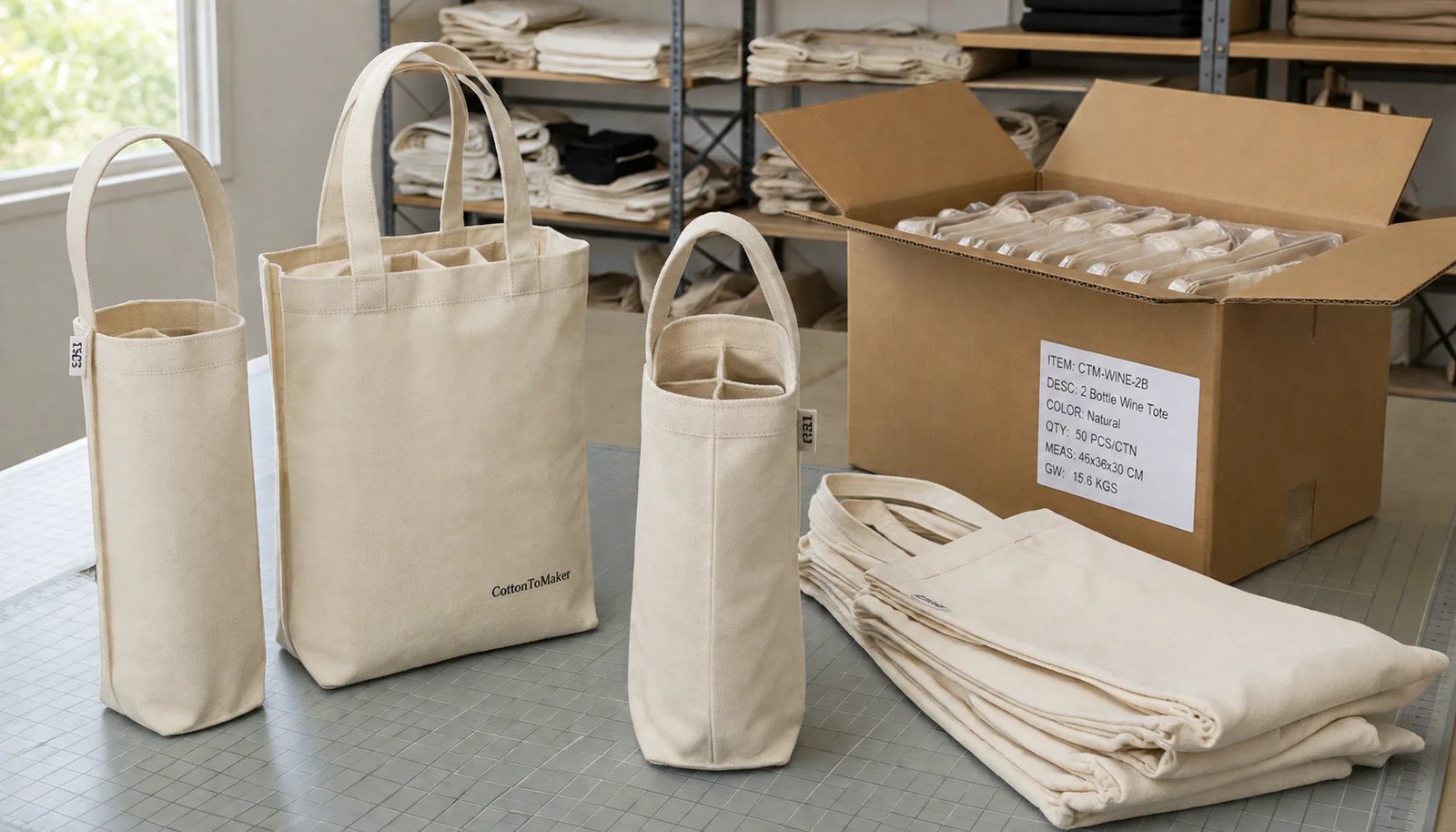
Why carton planning matters more than buyers expect
For wholesale canvas wine carriers, many buyers focus first on fabric, print, and unit price. The more expensive mistake usually happens later: the carton plan is left vague, suppliers pack by convenience, and the shipment lands with avoidable freight cost, awkward warehouse handling, or damaged presentation. Natural grocers are especially sensitive because these bags are often sold near checkout, stacked in back rooms with limited space, or allocated by store count instead of full-case replenishment.
A carton plan is not just a logistics note. It affects quoted freight cube, labor per unit, wrinkle level, print rub, master carton weight, and receiving speed at the importer or 3PL. If one supplier quotes 60 pieces per carton and another quotes 100 pieces, the lower unit price is not automatically the better buy. Dense packing can cut freight cost but increase crushing, folding marks, and recounting labor. The right answer depends on style, GSM, divider construction, and how the natural grocer distributes inventory.
- Single-bottle carriers usually allow tighter fold and higher units per carton
- 2-bottle carriers with stitched dividers consume more carton cube than buyers often estimate
- Heavy 12 oz canvas can make cartons hit handling limits before they hit volume limits
- DC-friendly packing can be worth more than a few cents saved on bulk stuffing
Start with the right bag structure before discussing cartons
Carton efficiency begins with product structure. For natural grocers, the most common canvas wine carrier formats are a single-bottle bag, a two-bottle gusseted bag with central divider, and a broader gift style designed for premium bottle presentation. Each behaves differently in folding and stacking. A flat single-bottle bag can be nested and packed compactly. A gusseted two-bottle bag with divider traps air, resists compression, and needs a more controlled fold pattern to prevent skewed stacks.
The fabric weight should suit actual retail use. For entry-level reusable wine bags sold near checkout, 10 oz canvas at roughly 340 GSM is often enough if handle reinforcement is correct. For a firmer premium feel or dark ink print with better body, 12 oz around 407 GSM is more common. Going heavier than that can improve stiffness but often hurts carton economics more than it improves in-store performance. In RFQs, state the intended bottle load, because some suppliers quote soft lightweight canvas that looks fine empty but sags when loaded with a 750 ml glass bottle.
- Single-bottle size example: around 15 x 38 cm flat body with small bottom gusset
- Two-bottle size example: around 20 to 22 x 38 cm with 10 cm gusset and stitched divider
- Typical handle width: 2.5 to 3.8 cm depending on style positioning
- State whether the bag should stand semi-upright empty or only when loaded
Fabric and print choices that change packing density
Buyers often separate product specification from shipping planning, but fabric and print directly change how many bags fit safely in a carton. A 10 oz natural canvas folds flatter than a 12 oz dyed canvas with large ink coverage. Screen print with moderate coverage usually packs well if the printed panel is folded inward with interleaving discipline. Thick transfers, puff effects, or oversized dark solids create harder fold lines and higher risk of surface rub during ocean transit.
For most natural grocer programs, one-color or two-color screen print on a natural canvas face is the practical baseline. It keeps setup reasonable, survives mass production better, and avoids excessive hand-feel buildup. If branding requires a small detailed logo or multiple seasonal versions below full print MOQ, heat transfer may look appealing, but it can stiffen the panel and complicate fold memory. Ask the supplier to show how the printed panel is oriented inside the pack. This is one of the simplest ways to avoid a shipment that looks creased on first shelf presentation.
- Natural or lightly dyed canvas usually shows less fold whitening than heavy dark pigment prints
- Large prints crossing gusset folds are more likely to distort in packing
- Water-based screen print generally folds better than thick plastisol deposits on canvas
- If using dark fabric, request crocking and rub evaluation against inner packing material
How MOQ logic should be built around fabric and carton efficiency
MOQ is not only a production constraint; it is also a carton planning issue. Factories usually base MOQ on fabric booking, color batch, print setup, and sewing line efficiency. If a natural grocer wants several artwork versions or store-specific promotions, the smartest approach is usually to keep one base fabric, one base size, and one carton standard while splitting only the print or carton mark. That protects unit economics and prevents mixed packing confusion.
A typical factory may accept a style MOQ per fabric color, then allow smaller splits across print variants if artwork size and print color count stay aligned. That said, too many micro-splits can leave buyers with inefficient partial cartons or nonstandard counts that are costly to receive and redistribute. Procurement teams should calculate not only unit price but also how many full cartons each SKU creates. A style that leaves many partial cartons at origin often creates picking and relabeling cost later in the supply chain.
- Use shared canvas, shared dimensions, and shared handle spec across seasonal artwork where possible
- Request MOQ by fabric color and by print variant separately
- Avoid odd carton counts that do not match store allocation or case pack logic
- Ask whether mixed SKU cartons are allowed and what surcharge or error risk they add
Packing design: the difference between low freight cost and warehouse complaints
A workable packing plan for canvas wine carriers should specify four levels: individual presentation, inner pack, master carton, and pallet or floor-load method if relevant. For natural grocers, individual polybagging is not always preferred, especially if the sustainability team objects to excess plastic. In that case, paper banding or bulk inner bundles can work, but only if the print is not prone to rub and the receiving team can count accurately. There is no universal best method. The right choice depends on shelf presentation needs and warehouse labor cost.
Master carton counts usually work best in the 40 to 80 piece range for canvas wine carriers, but the final number should be set by gross weight and carton crush risk rather than a generic target. Two-bottle divider styles may need lower counts to keep cartons square and avoid compression marks. If the bags will be repacked into store-level shipments after import, do not let the supplier maximize carton density at the expense of easy handling. Overly dense cartons save some ocean cube but can create more labor and more product touchpoints in the domestic network.
- Document whether goods are folded once, twice, or rolled before packing
- Keep printed face protected from direct friction with rough inner seams or handles
- Set gross carton weight target appropriate for your warehouse handling practice
- Use carton dimensions that palletize efficiently without top overhang
Sample approval should include a packing trial, not just the bag
Many importers approve the bag sample and skip the packing sample. That leaves the factory free to choose a fold and carton count later. For a simple cotton tote, that might be manageable. For canvas wine carriers, especially styles with dividers or premium print, it creates too much risk. A pre-production approval should include at least one mini packing trial using actual fabric, actual print, and the proposed inner pack method. Buyers need to see whether handles bunch, gussets flare, or printed panels crease under compression.
The ideal sample flow is simple: a dimension sample first, then a pre-production sample with bulk-like fabric and print, then a packing sample showing inner pack count and carton fit. If the program is large, ask for carton dimensions and a photo of stacked packed units before authorizing final bulk. This catches practical issues such as over-tight bundles, inconsistent fold direction, or cartons that are technically within size but impossible to palletize cleanly.
- Approve printed sample on the actual canvas weight, not a lighter development substitute
- Measure packed stack height for a known quantity to estimate realistic carton density
- Review whether divider panels shift or bend during bundling
- Request photos of carton sealing, side markings, and packed unit orientation
Quote comparisons should include freight math, not only FOB unit price
When comparing supplier quotes, procurement teams should line up more than unit cost and lead time. A quote for a 10 oz single-bottle carrier packed 100 pieces per carton may look cheaper on paper than a 12 oz better-constructed carrier packed 60 pieces per carton, but the real comparison needs landed cost and damage risk. Ask every supplier to provide carton dimensions, gross weight, and estimated units per container based on the exact quoted bag spec. Without that, freight assumptions are too loose to make a sound decision.
A useful quote sheet separates cost drivers into fabric, print, sewing complexity, and packing. For example, adding a divider, reinforcing handles, lowering pack count, or changing from loose bulk to individual polybagging can all move cost. The point is not to force one universal spec. The point is to make suppliers quote on the same commercial basis. If one quote includes thin carton board, no inner packing, and no print protection while another includes a stronger export carton and cleaner bundling, the lower FOB is not a like-for-like comparison.
- Request quote versions for two pack counts if freight is a major concern
- Separate unit cost from packing adder in the quotation template
- Include container loading estimate and whether cartons are floor-loaded or palletized
- Flag any quote that omits gross carton weight or provides unusual cube efficiency without explanation
QC thresholds that actually prevent receiving and shelf problems
Quality control for canvas wine carriers should reflect retail use and transit handling, not only visual appearance at final inspection. The main failure points are handle pull strength, uneven gusset shape, divider misalignment, print rub, stain contamination, and incorrect carton count. In natural grocery retail, a bag that looks acceptable in a factory stack may still fail when loaded with a bottle, placed on a shelf peg, or distributed through a busy back room. QC should therefore combine workmanship review with practical handling tests.
Acceptance criteria should be written in measurable terms where possible. Instead of saying 'good stitching,' specify no skipped stitches, no open seams, secure back-tacks at handle stress points, and a reasonable stitch density consistency across the run. Instead of saying 'clean print,' specify acceptable print position tolerance and whether tiny pinholes are allowed outside the main logo area. Carton inspection also matters. If carton dimensions vary too much from the booking sheet, your freight plan and pallet pattern can break down.
- Loaded carry test should reflect one or two filled 750 ml bottles depending on style use
- Print position tolerance should be agreed in millimeters relative to top hem or side seam
- Reject criteria should cover oil marks, mildew odor, fabric holes, and severe slub concentration
- Carton count variance should be zero unless buyer approves specific overage or shortage rule
Lead time risk usually sits in artwork, fabric booking, and carton approval
Canvas wine carrier production is not normally a highly technical category, but schedules slip when buyers underestimate pre-production dependencies. Fabric weight confirmation, dye lot timing, print screen setup, and carton artwork approval all affect bulk start. If a program includes store-specific carton labels or multiple promotional SKUs, carton mark approval can become a real bottleneck. This is common when the product itself is simple and teams assume packing can be decided later.
To keep the schedule realistic, buyers should separate the critical path into sample approval, raw material booking, print approval, and packing approval. A delayed carton spec can hold shipment as easily as a delayed bag sample if the factory cannot legally or operationally close export cartons without buyer sign-off. If you need a specific delivery window for a wine promotion or holiday reset, reserve time for at least one correction loop on both sample and carton mark.
- Natural canvas may book faster than custom dyed shades, but shade consistency still matters across SKUs
- Screen print lead time rises with multiple artwork variants even when bag construction stays the same
- Carton label approval should not wait until bulk sewing is nearly complete
- Build contingency for rework if packing trial shows print rub or awkward fold memory
A practical RFQ structure for natural grocer wine bag programs
The strongest RFQs for this category read like a production brief, not a mood board. They define bag function, bottle type, retail channel, print requirement, and shipping plan in one sheet. That gives factories enough detail to quote accurately and propose workable carton counts. It also helps procurement compare offers on a clean basis. Too many wine bag RFQs only attach artwork and rough dimensions, then rely on later email clarification. That is where hidden cost and avoidable variance enter the project.
For natural grocers, include the downstream handling context. Say whether goods go to one importer warehouse, a 3PL, or direct to a retail DC. State whether store allocation requires fixed case packs. Mention if sustainability guidelines limit individual polybags. This level of detail changes recommended packing. Factories that understand the destination handling flow usually give more reliable carton proposals than those quoting only to win on unit price.
- Bag style, dimensions, and bottle capacity
- Canvas weight in oz and GSM, color, and finish
- Handle spec, divider detail, and stitch reinforcement requirement
- Print method, artwork size, colors, and placement tolerance
- Inner pack count, master carton target, carton mark format, and barcode need
- Target ex-factory window and destination handling notes
Specification comparison for buyers
| Spec decision | Recommended option | When it fits | Buyer risk to check |
|---|---|---|---|
| Canvas weight | 10 oz to 12 oz canvas, about 340 to 407 GSM | Best balance for reusable grocery wine bags with stable body and controlled carton weight | Below 10 oz can collapse and print through seam shadow; above 12 oz raises freight and reduces units per carton |
| Bag format | Single-bottle flat-gusset style for lowest cube; 2-bottle gusseted divider style for gift or premium aisle | Single bottle for high-volume checkout resale, 2-bottle for higher ticket promotions | Divider adds labor, changes fold method, and can cut carton efficiency by 15 to 30 percent |
| Handle construction | Self-fabric webbing handle or reinforced canvas handle stitched into side seam | Suitable for 750 ml glass bottle load in natural grocery retail | Short stitch length or missing back-tack causes handle pull failures during loaded carry tests |
| Print method | 1-color screen print on flat panel; heat transfer only for detailed small runs | Screen print gives better cost at bulk volume and survives folding better on natural canvas | Large artwork near gusset fold can crack or skew; request print position tolerance and rub test standard |
| Inner packing | 10 to 20 pcs per inner poly or paper banded bundle, then master carton | Works for store allocation, receiving count accuracy, and simpler replenishment | Loose bulk pack lowers labor but slows DC recounting and increases wrinkle and print rubbing |
| Master carton count | 40 to 80 pcs per carton depending on style and fabric weight | Keeps carton weight manageable for warehouse handling while protecting shape | Overpacked cartons exceed manual handling limits or crush bottom units in humid transit |
| Carton board | 5-ply export carton for standard sea shipment; stronger burst grade for long domestic redistribution | Useful when importer breaks bulk at DC and sends to multiple stores | Weak cartons fail at pallet corners, especially with dense 12 oz canvas and long stack time |
| MOQ planning | Base MOQ by fabric color and print setup, often split across 2 to 4 SKUs sharing canvas and artwork size | Helps natural grocers run seasonal colors without paying full MOQ per style | Too many split SKUs can trigger surcharge, excess waste fabric, or inconsistent shade between runs |
| Carton mark and barcode | External carton label with SKU, color, quantity, PO, gross and net weight, carton size, and store code if needed | Essential for import receiving and retail allocation accuracy | Missing or nonstandard carton marks create relabeling cost and receiving delays at 3PL or DC |
Buyer checklist before sampling
- Define whether the carrier is for single 750 ml bottle, two bottles, or mixed bottle shapes before requesting dimensions
- State target canvas weight in oz and GSM, not only 'canvas', to prevent quote gaps between suppliers
- Specify whether an internal divider is required, removable, stitched, padded, or absent
- Approve flat size, gusset size, handle drop, and finished tolerance before bulk booking
- Decide the exact print method, print color count, artwork size, and print location relative to seams
- Set acceptable pack count per inner bundle and per master carton based on DC handling limits
- Require proposed carton dimensions, gross weight, and units per 20 ft and 40 ft container in the quote
- Review folding method so artwork does not sit on hard fold lines that cause cracking or transfer rub
- Request pre-production sample with actual fabric, actual stitch construction, and actual packing trial
- Include carton drop resistance or stacking requirement if goods will be repalletized after import
Factory quote questions to send
- What canvas weight are you quoting in both oz and GSM, and what is the fabric composition and weave?
- What is the finished bag size including gusset, and what tolerance do you apply to width, height, and handle length?
- Is the divider included in the quoted price, and how is it attached and stitched?
- What print method is included, how many colors, what artwork size, and what print position tolerance can you hold in bulk?
- What is the MOQ by fabric color, by print design, and by SKU split if we run multiple store programs?
- How many pieces fit per inner pack and per master carton, and what are the carton dimensions, gross weight, and net weight?
- Can you provide estimated units per 20 ft container and 40 ft HQ based on the quoted packing plan?
- What reinforcement is used at the handle stress points, and do you conduct loaded carry or seam pull testing?
- What sample stages are available: blank sample, printed pre-production sample, and carton packing sample?
- What is your lead time for sampling, bulk production, and carton mark approval after artwork sign-off?
Quality-control points to confirm
- Fabric weight should be verified against quoted GSM with tolerance agreed before production, especially if comparing multiple supplier offers
- Finished size tolerance should be documented for width, height, gusset, divider width, and handle drop
- Handle attachment must show even stitch density, no skipped stitches, and secure back-tack at stress points
- Screen print must have clean edges, correct color density, and no obvious offset from approved artwork position
- Divider alignment should allow bottle insertion without twisting and should not reduce usable interior width below approved spec
- Needle marks, oil stains, mildew odor, and dark cotton contamination should be within agreed acceptance criteria
- Folding method must protect printed area from abrasion and avoid sharp creases through dense ink coverage
- Inner pack count and carton count must match packing list exactly to reduce receiving claims
- Carton dimensions and gross weight should stay within approved tolerance so freight planning remains accurate
- Shipping cartons must remain square, taped correctly, and free from crush damage before container loading