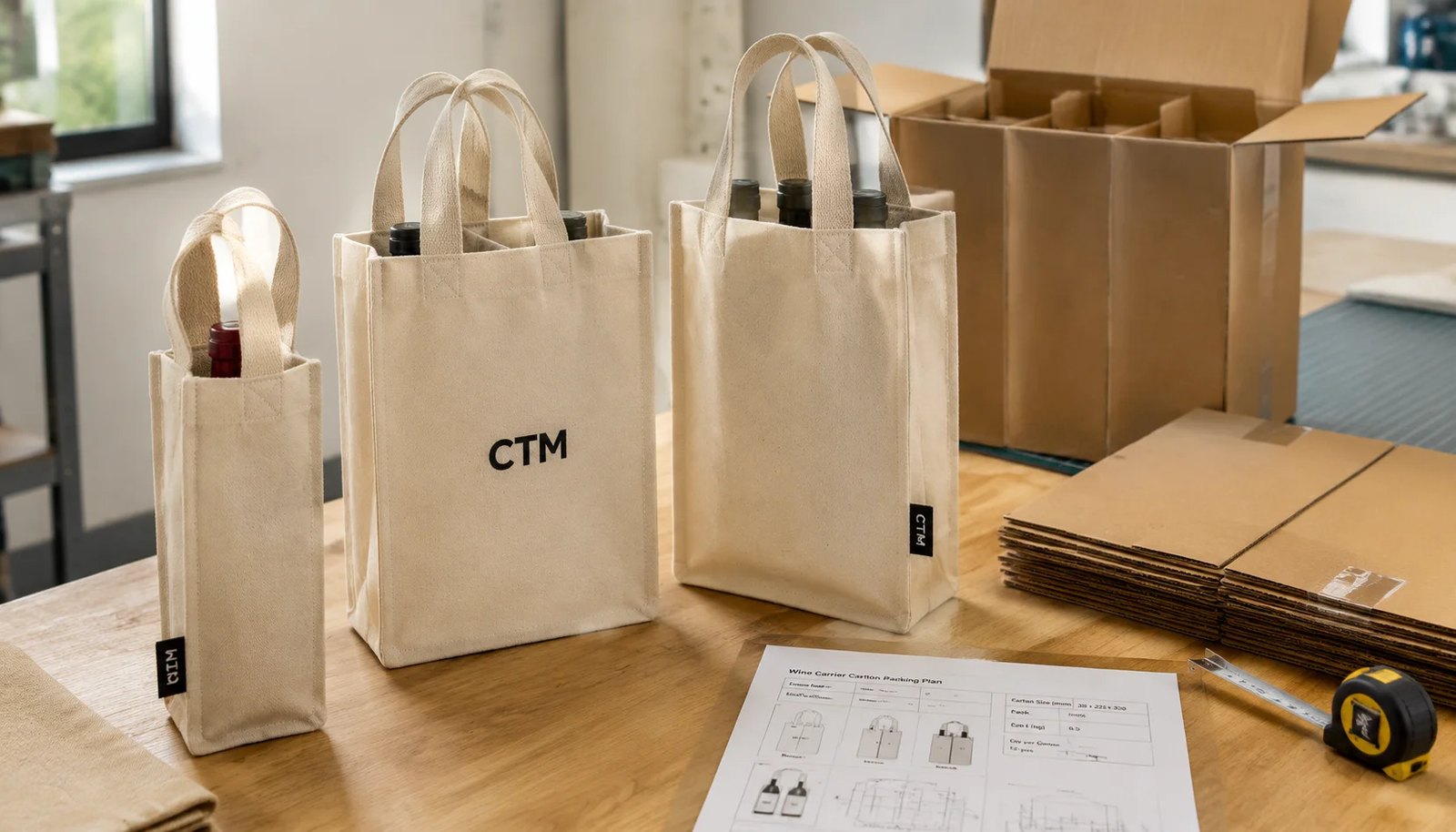
Why carton packing is the main cost control point in canvas wine carrier buying
For custom canvas wine carriers, buyers often spend most of their time debating fabric, print, and logo placement, then approve packing as an afterthought. That is a mistake for liquor retail programs. Carton packing controls freight cost, warehouse handling efficiency, store allocation, and even the presentation condition when bags reach shelves or gift counters. A good bag in a poor carton plan can still arrive wrinkled, rubbed, or counted wrong.
The buying problem behind the keyword is not simply how to package bags into boxes. It is how to build a carton plan that matches the retail route. A chain store promotion, a distributor replenishment order, and a gift-with-purchase campaign all need different carton counts, bundle formats, and carton strength. If your RFQ only says standard export carton, suppliers will quote different assumptions and the cheapest price may hide the weakest packing plan.
- Carton decisions affect unit freight, warehouse labor, damage rate, and store-ready handling.
- Packing should be quoted as a defined specification, not treated as a factory default.
- For wine carriers, load-bearing handles and folded print surfaces need better protection than ordinary tote bags.
Start from the retail use case, not the bag drawing
Before locking carton specs, define how the carrier will move after import. If cartons go from port to a national DC and then get split for individual stores, carton count matters more than maximum container fill. If the importer sells to distributors by full carton, denser packing may be acceptable. If the bags support premium bottle gifting, keeping panels smooth and logos clean may justify lower carton counts and inner protection.
The bag style changes the carton logic too. A single-bottle soft canvas sleeve can usually pack flatter than a structured two-bottle carrier with divider and wider gusset. Buyers who request the same carton count for both styles often trigger deformed gussets, creased handles, or carton bulging. The right approach is to write the packing plan from the actual end use: bottle size, gift positioning, handling route, and retail shelf speed.
- Define bottle format: 750 ml standard, sparkling, wider spirits bottle, or mixed-use gifting.
- State whether retail staff need easy recounting by bundle or by full-carton issue.
- Clarify if presentation matters more than freight density for the program.
Choose the right canvas spec before you optimize cartons
Packing efficiency depends heavily on fabric weight and structure. For most custom single-bottle wine carriers, 10 oz to 12 oz canvas, around 280 to 340 GSM, gives a stable body without turning the product into a bulky freight item. For double-bottle carriers or designs with a stitched divider, 12 oz to 14 oz, around 340 to 400 GSM, is usually safer. Below that range, the bag may pass visual inspection but fail under repeated retail handling or distributor repacking.
Heavier GSM is not automatically better. Once canvas gets too thick for the bag size, folding becomes bulky, print layers rub harder during compression, and carton count falls sharply. For buyers comparing quotes, the key is to normalize GSM, handle construction, and divider structure before comparing packing efficiency. A low unit quote on a lighter GSM can look attractive until you discover the carton cost is lower only because the product itself is underbuilt.
- Single bottle carrier common range: 280 to 340 GSM.
- Two bottle carrier common range: 340 to 400 GSM plus bottom reinforcement.
- If bottles are unusually heavy, request a loaded sample test with actual bottle weight.
- Record GSM tolerance in the PO to avoid light-weight substitution.
Print and trim choices that change packing performance
Screen print is usually the most stable option for canvas wine carriers sold in volume. It handles simple logos well, keeps unit cost reasonable, and generally tolerates folding better than many transfer methods when properly cured. Heat transfer can work for short-run, multi-color, or photo-like designs, but it creates a stiffer printed area that may crack on repeated fold lines if the bag is compressed too tightly in cartons.
Trim choices also influence packing. Woven labels add little bulk, but metal rivets, thick piping, foam inserts, and oversized leather-look patches quickly reduce packing density and increase carton abrasion points. For liquor retailers, practical branding often performs better than decorative trims. A simple side label with CTM-style woven branding, plus a clean screen print on the panel, usually packs better and causes fewer claim issues than raised decorations on a soft cotton body.
- Use screen print for repeat retail programs with stable artwork.
- Use transfer print only if color complexity justifies it and a fold test is approved.
- Avoid hard trims near fold lines unless presentation value clearly offsets freight and damage risk.
- Request a print rub test on folded samples if dark inks are used on natural canvas.
How MOQ logic affects the carton plan and your real unit cost
MOQ is not only a production threshold. It also changes how efficiently the order packs and ships. If you buy a low-volume trial run using stock canvas color and a standard bag size, the factory can often fit your order into existing cutting and material plans. That can keep MOQ realistic and reduce sampling time. If you add custom dyeing, a non-standard gusset, and a unique divider shape, the factory may still accept the order, but carton count and packing trial data become less predictable until actual bulk production begins.
From a quote comparison perspective, buyers should separate MOQ by component. The fabric dye lot MOQ may be different from the print MOQ, woven label MOQ, and carton print MOQ. A supplier may quote a low bag price while spreading setup costs into oversized carton charges or higher overrun allowances. If the retail program is still being tested, it is usually smarter to standardize the bag body and use branding elements that can be scaled later.
- Lower MOQ route: stock canvas color, standard size, simple print, plain export carton.
- Higher setup route: custom dyed fabric, custom divider, woven label, retail barcode labels, printed carton.
- Compare MOQ by fabric, print, labels, and carton, not as one blended number.
- Request overrun or underrun allowance terms if you need exact retail allocation.
Build a carton packing spec with numbers a factory can quote accurately
A usable carton packing plan should include more than pieces per carton. Put actual targets into the RFQ: inner bundle quantity, whether each bundle is polybagged or tied, folding orientation, logo direction, master carton wall strength, carton dimensions, gross weight limit, and shipping marks. This is how buyers force apples-to-apples quotation. Without these details, one supplier may quote 100 pieces per carton in a light 5-ply box while another quotes 50 pieces in a stronger carton with inner bundle protection. The lower quote may not be the better landed option.
For liquor retail buyers, manual handling limits matter. A carton that is technically efficient in CBM may be inefficient in the warehouse if staff need to split it repeatedly. As a practical example, many buyers prefer 25 to 50 pieces per master carton for structured wine carriers, depending on size and divider build. This is easier to count, easier to pick for store allocations, and less likely to cause carton collapse than very high counts.
- State target master carton count: for example 25, 40, or 50 pcs depending on bag style.
- Set a gross weight range acceptable for manual handling at the destination warehouse.
- Define inner bundle count if stores or distributors break cartons frequently.
- Request carton dimensions in the quote so container loading can be estimated early.
- If presentation matters, specify that front panels face the same way within bundles.
Sample approval should include a packing trial, not only a bag sample
Many approval cycles stop at the pre-production sample. The bag looks right, the logo looks right, and the PO moves forward. Then the bulk order is folded differently, compressed into larger cartons, and arrives with print offset or flattened gussets. A complete sample approval for canvas wine carriers should include at least one carton packing trial using the actual fabric, actual print, and actual fold method. This is especially important for darker prints, thicker GSM, and two-bottle carriers with dividers.
The packing trial should not be theoretical. Ask the supplier to pack the proposed carton count, seal the carton, leave it under stack load for a short period, then reopen and photograph the bags. Buyers can then approve how much creasing is acceptable for retail use. This extra step costs little compared with a freight claim or store rejection.
- Approve a blank fit sample with actual bottle size if dimensions are new.
- Approve print strike-off or color standard before pre-production sample.
- Require one packed-carton sample review for fold lines, print rub, and gusset memory.
- If the bag has divider structure, load actual bottles to verify bag shape and handle balance.
QC thresholds that matter for liquor retail distribution
Inspection criteria for wine carriers should focus on what fails in handling, not only cosmetic defects on the table. The main functional risks are weak handle joints, uneven gusset depth, poor divider alignment, base seam stress, and print damage created by packing pressure. For distribution channels, carton marking accuracy and count accuracy are also critical, because a mispacked carton creates downstream claims even when the product itself is acceptable.
QC thresholds should be written in practical terms. For example, define acceptable seam appearance, stitch density range, print position tolerance, and carton count tolerance. If your retailer uses shelf-ready unpacking, reject mixed orientation within bundles because it slows store staff. If the importer relies on barcoded outer cartons, define label placement and scan readability before shipment.
- Inspect loaded-handle performance using the intended bottle weight, not an empty bag pull check only.
- Set tolerance for body size and gusset width so actual bottles fit reliably.
- Use a print position tolerance that protects retail presentation across the front panel.
- Verify carton labels, SKU marks, and carton counts against the packing list before container loading.
Lead-time risks usually come from artwork, dyeing, and packing changes
For most canvas wine carrier orders, the biggest lead-time surprises do not come from sewing. They come from delayed artwork approval, custom fabric color development, revised carton counts, and late requests for retail labeling. When buyers change the packing plan after bulk cutting has started, the factory may need new carton sourcing, new carton marks, or even a fresh folding method trial. That causes avoidable delay at the end of the schedule, where every lost day matters most.
A practical timeline should separate each approval gate: artwork sign-off, fabric color approval if custom dyed, pre-production sample, packed-carton approval, bulk inspection window, and shipment booking. Buyers comparing suppliers should pay attention to how each vendor describes these milestones. A quote that shows only one production lead time number is less useful than a quote that breaks the path into approval-dependent stages.
- Stock color canvas can shorten the schedule compared with custom Pantone dyeing.
- Retail barcode or shipping mark changes should be frozen before carton printing starts.
- Packed-carton approval should happen before the majority of bulk packing is completed.
- Leave contingency time for rework if print rub or carton compression results are not acceptable.
How to compare landed cost, not only ex-factory price
The correct buying decision is rarely the lowest ex-factory bag price. For canvas wine carriers, landed cost is shaped by GSM, carton count, carton dimensions, gross weight, and damage rate risk. A supplier using a slightly stronger fabric and slightly better packing may quote higher on unit price but lower on total delivered cost if carton utilization improves and claims reduce. That is why procurement teams should compare at least three layers: product cost, packing and freight effect, and likely rework or claim exposure.
To make quotes comparable, create a simple landed-cost worksheet using each supplier's carton dimensions, pcs per carton, estimated CBM, and expected order quantity. Add the cost effect of any required inner protection and distributor labeling. Then note the non-price risk items: whether the supplier provided real packed sample evidence, whether handle reinforcement is clearly specified, and whether the carton plan matches your warehouse process. Those details decide whether the order runs smoothly after arrival.
- Normalize fabric GSM, print method, and handle construction before comparing prices.
- Add CBM and carton count data into your quote sheet, not just unit bag price.
- Note if one supplier includes stronger cartons or inner bundles while another excludes them.
- Treat claim risk and warehouse labor as cost items, even when not shown on the invoice.
Specification comparison for buyers
| Spec decision | Recommended option | When it fits | Buyer risk to check |
|---|---|---|---|
| Fabric weight for single-bottle carrier | 10 oz to 12 oz canvas, about 280 to 340 GSM | Best balance for wine gift retail, store promotions, and repeat replenishment programs | Below 260 GSM can feel weak at the base seam; above 400 GSM raises freight and may reduce folding efficiency |
| Fabric weight for double-bottle carrier | 12 oz to 14 oz canvas, about 340 to 400 GSM with reinforced bottom | Needed when two 750 ml bottles or heavier glass are common | If divider and bottom panel are not reinforced, handle stress failures show up during store handling |
| Print method | Screen print for bold logos; heat transfer only for short-run multi-color artwork | Screen print fits stable retail programs with repeat orders and better unit cost at volume | Heat transfer can crack on fold lines if cure and adhesion are not tested on the exact canvas finish |
| Handle construction | Self-fabric webbing handle with box stitch plus bar-tack | Reliable for liquor retail where bags are lifted by the handle many times before sale | Simple single-line stitch looks cheaper but is a common failure point in loaded drop tests |
| Inner bottle separation | Stitched center divider for 2-bottle bags; no loose insert | Better for retail replenishment because staff do not misplace separate dividers | Divider height must protect bottle contact; too short allows glass knock during shelf restocking |
| Master carton count | 25 to 50 pcs per carton depending on bag size and insert structure | Useful when distributors need cartons under manual handling limits and store-level allocation | Overpacked cartons reduce CBM efficiency only slightly but raise carton burst and deformation risk |
| Carton style | 5-ply export carton for light single-bottle bags; 7-ply for heavier 2-bottle programs or long transit | Choose based on bag density, stacking height, and destination handling quality | Thin cartons crush in mixed-container loading, causing handle creases and retail presentation issues |
| Packing format | Flat packed in PE inner bundles with orientation aligned, then master carton | Best for keeping freight cost down while preserving logo presentation and faster store counting | No inner bundling can increase dirt pickup, count errors, and print rub during local warehouse handling |
| MOQ route | Use stock canvas color plus standard size to keep MOQ lower; custom dyed fabric for scale programs | Good for importers testing a new liquor retail SKU before wider rollout | Custom dye lots on low volume often create shade variance and surcharge surprises in quote comparison |
Buyer checklist before sampling
- Define whether the carrier is for 1 bottle, 2 bottles, or mixed gift use, and state the bottle size and approximate filled weight in the RFQ.
- Specify canvas weight in GSM, not only terms like heavy canvas or premium canvas.
- State whether the bag must stand upright empty, only when loaded, or can remain a soft-body carrier.
- Include handle drop, handle width, and reinforcement method in the approved drawing.
- Choose print method based on artwork, reorder frequency, and expected abrasion during warehouse handling.
- Set folding direction and flat-pack method so printed panels do not crack or transfer onto other bags.
- Request carton dimensions, pcs per carton, gross weight, net weight, and estimated CBM before approving production.
- State whether retail stores receive full cartons, split cartons, or mixed SKU cartons, because this changes bundle and label planning.
- Approve a pre-production sample showing actual fabric, stitch density, print color, and carton packing trial together, not as separate approvals.
- Include carton drop, carton compression, and handle load test expectations if the bags will move through distributor warehouses.
Factory quote questions to send
- What exact fabric composition and GSM are included in the quote, and what tolerance will the mill allow?
- Is the quoted price based on stock greige canvas, stock dyed canvas, or custom dyed canvas?
- What print method is included, how many print colors, and is artwork setup charged separately?
- What stitch specification is used at the handle joint: box stitch, cross stitch, bar-tack count, and SPI range?
- For 2-bottle carriers, is the divider stitched into the side seam and bottom seam, or added as a loose insert?
- How many pieces fit per inner bundle and master carton, and what are the carton dimensions and gross weight?
- Does the quote assume flat packing, tissue interleaving, PE bagging, or any moisture protection?
- What is the MOQ for the exact size and color, and how does MOQ change if we choose custom Pantone dyeing or woven labels?
- What sample stages are available: digital layout, blank fit sample, printed pre-production sample, and carton packing sample?
- What lead time is needed for lab dips, strike-off, pre-production sample approval, bulk production, and final inspection readiness?
Quality-control points to confirm
- Fabric GSM within agreed tolerance and no visible slub concentration, oil marks, mildew smell, or unacceptable shade variation within a lot.
- Bag body size, gusset width, and handle drop within approved tolerance so bottles fit and the carrier hangs evenly at retail.
- Handle attachment reinforced with the agreed stitch pattern and no skipped stitches, loose thread ends, or seam grin under load.
- Print color and position match approved artwork, with no ghosting, major pinholes, transfer marks, or rub-off on folded areas.
- Divider position and height on 2-bottle styles prevent bottle contact and remain centered after repeated loading.
- Bottom seam and gusset alignment allow the bag to sit correctly when loaded; twisted body construction should be rejected.
- Carton count, bundle count, carton markings, and barcode labels match the packing list exactly.
- Master cartons remain structurally sound after normal warehouse stacking, with no burst corners, crushed sidewalls, or water-damaged board.