Why spa retailers need a tighter bulk quote than a basic bag price
A canvas wine carrier for a spa retailer is rarely just packaging. It sits beside candles, bath salts, robes, skincare kits, or resort gift sets, so the buyer is paying for presentation, repeat handling, and brand impression. A quotation that only says “natural canvas wine bag, one color print, FOB price” is not enough to compare suppliers fairly.
The main buying problem is hidden specification drift. One factory may quote 8 oz canvas with simple handles and another may quote 12 oz canvas with reinforced stitching. The first price looks better until the bag sags around a glass bottle, the logo prints unevenly, or the handle seam opens during store handling. A useful RFQ should lock the construction, artwork, packing, and inspection method before price comparison.
For procurement teams managing multiple spa locations or seasonal gift programs, the cost of a failed carrier goes beyond the unit price. A returned gift set, a disappointed resort guest, or a last-minute reorder with air freight can erase any initial savings. Building the quote around measurable specs—not assumptions—protects both the buyer’s budget and the brand’s retail reputation.
- Treat the wine carrier as a loaded product, not a flat promotional bag.
- Compare quotes only after fabric weight, finished size, handle construction, and print method are aligned.
- Require suppliers to quote carton data as well as unit price, because bulky canvas changes landed cost.
- Separate retail appearance requirements from factory production tolerances so quality disputes are easier to settle.
Start the RFQ with bottle fit, not with the bag photo
Most quote errors start when the buyer sends a reference image without bottle dimensions. A standard 750 ml wine bottle is different from a champagne bottle, a Burgundy-style bottle, or a tall slim bottle used for specialty beverages. The widest diameter, bottle height, shoulder shape, and whether tissue wrap or a gift card is inserted all affect the finished bag size.
For a single-bottle carrier, the buyer should provide the maximum bottle diameter and height, then allow practical clearance. For cotton canvas, 8–12 mm clearance around the widest point is normally safer than a tight fit, especially after sewing tolerance and fabric shrinkage. For two-bottle carriers, the divider height and base width decide whether bottles knock against each other.
A practical procurement scenario: a spa chain sourcing carriers for a holiday gift set that includes a standard 750 ml red wine bottle and a small glass honey jar. Without specifying the jar’s footprint, the factory may build a bag that fits the bottle but leaves the jar rattling against the glass. The RFQ should list every item that will sit inside the carrier, not just the primary bottle.
- Standard 750 ml wine bottle: usually suitable for a narrow single-bottle carrier if diameter clearance is allowed.
- Champagne or sparkling bottle: needs more width and stronger handle reinforcement because the bottle is wider and heavier.
- Two-bottle carrier: needs a stitched divider, not only a loose fabric strip, if glass protection matters.
- Gift-set insert: add allowance for tissue, hang tag, product card, or small spa accessory if packed inside the carrier.
Fabric weight and canvas type: where price and retail feel change
For spa retail programs, 10 oz to 12 oz cotton canvas is often the practical range. In GSM terms, this is roughly 270–340 GSM depending on weave and finishing. It feels more substantial than thin promotional cotton but is still sewable, foldable, and reasonable for export packing. If the bag must stand upright on a shelf, heavier fabric or a structured base may be needed.
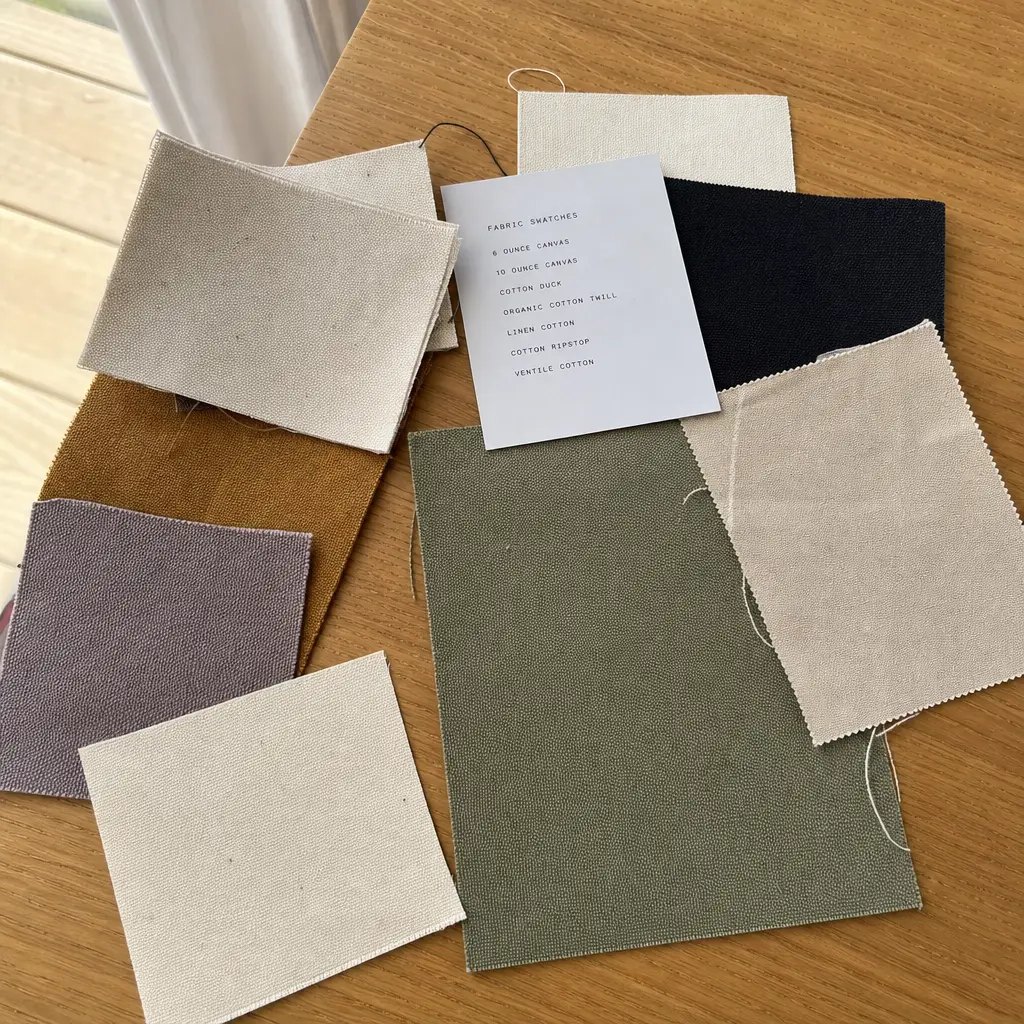
Natural cotton canvas is popular because it matches spa, wellness, and resort aesthetics. However, natural canvas can show cotton seed flecks, shade variation, and slub texture. That is part of the material, not always a defect. If the logo must print very cleanly or the retailer needs a pure white shelf look, bleached canvas or dyed canvas may be more controlled, but fabric cost and MOQ can increase.
Procurement teams should also ask whether the quoted canvas is stock fabric or made-to-order. Stock canvas typically has shorter lead times and lower minimums, but color and weight options are limited. Made-to-order fabric allows exact color matching and custom weight but adds dye lot approval time, higher MOQ, and potential minimum order charges from the mill.
- 6 oz to 8 oz canvas: lower cost, lighter freight, but less structure and weaker premium feel for glass bottles.
- 10 oz canvas: good middle option for single-bottle wine carriers and moderate retail use.
- 12 oz canvas: better body and durability, useful for higher-value spa gift sets.
- 14 oz and above: premium feel but higher sewing difficulty, thicker seams, larger carton volume, and higher freight cost.
- Dyed canvas: better brand color control but may require higher fabric MOQ and colorfastness testing.
Handle and seam construction are the real load-bearing quote items
A wine carrier fails at the handle before it fails in the middle of the fabric. The buyer should define handle width, handle drop, handle material, and attachment stitch. A narrow handle may cut into the hand when carrying a heavy bottle. A long handle drop may look elegant but allow the bottle to swing more during transport.
For a loaded glass bottle, the safest basic construction is self-fabric or cotton webbing handles sewn into the top panel with cross-stitch or box-X reinforcement. The stitch pattern should be visible on the approved sample and repeated in bulk production. If the quotation does not mention reinforcement, assume it is not included.
A buyer anecdote illustrates the risk: a spa retailer ordered 2,000 single-bottle carriers with a simple straight-stitch handle attachment. The pre-production sample looked fine, but after the first weekend of guest use, several handles began to tear at the stress point. The root cause was insufficient stitch density and no back-tack. The rework cost and brand embarrassment far exceeded the savings from omitting reinforcement in the original spec.
- Handle width: 2.5–3.8 cm is common; wider handles feel better with heavier bottles.
- Handle drop: define whether the bag is hand-carry only or needs forearm carry.
- Stress point: require back-tack or box-X stitching where the handle joins the body.
- Thread: polyester thread is often preferred for strength and consistency.
- Seam allowance: narrow seams save fabric but reduce strength and increase fraying risk.
Logo method: match the spa brand look to the canvas surface
Most spa retailers want branding that looks calm, clean, and not too promotional. On natural canvas, a one-color water-based screen print is usually the most cost-efficient and suitable method. It sits naturally on the fabric and works well for simple wordmarks, icons, and line art. The artwork should avoid extremely thin lines if the canvas weave is coarse.
Heat transfer can reproduce gradients or small details but may create a film edge that looks less natural on a wellness product. Embroidery gives texture but can distort thin canvas and raise cost. A woven label or cotton label sewn into the side seam can be a good premium option for minimalist brands, especially when the front panel should stay clean.
When evaluating supplier quotes, ask for a printed strike-off on the actual bulk canvas, not on a substitute fabric. The same ink system can look different on 10 oz versus 12 oz canvas, and natural cotton shade variation can shift the perceived logo color. A strike-off approved under office lighting may look different under the warm, dim lighting of a spa retail shelf.
- Screen print: best for one to three solid colors and medium to large logos.
- Water-based ink: softer hand feel, good for natural canvas, but curing must be controlled.
- Plastisol ink: stronger opacity in some cases but can feel heavier on a spa-style product.
- Heat transfer: useful for fine detail, not always ideal for a natural retail aesthetic.
- Woven label: premium and subtle, but requires label MOQ and extra sewing labor.
- Embroidery: durable but not ideal for very thin strokes or large filled logo areas.
MOQ logic: what a low minimum order quantity may exclude
MOQ is not only a number of bags. It is driven by fabric procurement, cutting efficiency, print setup, label production, sewing line changeover, and packing complexity. A supplier may accept 300 pieces for a stock natural canvas bag but require 1,000 pieces or more for dyed canvas, custom sizing, multi-color printing, or woven labels.
Spa retailers often need several store names, resort locations, seasonal taglines, or private-label versions. The RFQ should separate total quantity from per-design quantity. If the construction is identical but only the logo changes, a factory may combine cutting and sewing quantity while charging separate print setup costs. If fabric color changes, the combined MOQ may no longer apply.
A useful negotiation framework: categorize your SKUs into three tiers. Tier 1: identical construction, same fabric, different logo only—these are the easiest to combine. Tier 2: same construction, different fabric colors—fabric minimums become the constraint. Tier 3: different sizes or constructions—treat these as separate RFQ lines. Presenting this structure to suppliers upfront often yields more accurate pricing and reveals which factories can genuinely handle multi-SKU programs.
- Same bag, same fabric, different logo: possible combined sewing run with separate print screens.
- Same bag, different fabric colors: fabric MOQ and dye lot control become the limiting factors.
- Different sizes: cutting patterns change, so MOQ and sample cost should be separated.
- Woven label version: label MOQ may be higher than bag MOQ.
- Retail barcode by store: packing labor and carton sorting need to be quoted clearly.
Cost drivers to separate before comparing supplier quotes
A useful bulk quote should show what is included and what is not. Unit price alone hides many differences: fabric weight, print setup, sample cost, inner packing, carton strength, inspection support, and export documentation. For importers and distributors, carton cube can change the landed cost enough to outweigh a small unit price saving.
The buyer should request a quote sheet that separates tooling or setup from per-piece cost. This is especially important for spa retailers testing a seasonal program, because the first order may carry higher setup cost while repeat orders should become simpler if the same screen, label, and construction are reused.
To build negotiation leverage, request a cost breakdown that shows the approximate share of fabric, labor, printing, packing, and overhead. While not every supplier will provide full transparency, those that do allow you to identify where volume discounts or specification changes can realistically reduce cost without compromising quality.
- Fabric: weight, color, finishing, shrinkage control, and whether stock fabric is available.
- Labor: divider sewing, handle reinforcement, closure, label insertion, trimming, and final pressing.
- Printing: number of colors, screens, print positions, curing time, and artwork adjustment.
- Packing: individual polybag, tissue, hang tag, barcode label, carton strength, and moisture control.
- Compliance support: material declarations, labeling requirements, and documentation if requested by importer.
- Freight impact: carton quantity, gross weight, CBM, palletization, and destination receiving rules.
Sample approval: what to approve before mass cutting starts
A pre-production sample should be made with the intended bulk fabric, actual logo method, correct handle reinforcement, and final size. A photo sample is not enough for a wine carrier because bottle fit, handle feel, fabric stiffness, and print hand feel must be checked physically. If the first sample uses substitute fabric, it should be treated only as a construction sample, not final approval.
The approved sample should become the control sample for factory production and inspection. Mark the sample with date, version, material weight, print color, and approved comments. If a buyer approves a sample but later changes the bottle type or logo size, the factory should revise the sample or at least provide a strike-off and fit confirmation before production.
For spa retailers running multi-location programs, consider approving one master sample and then requesting a single production sample from the actual bulk run before the full order ships. This “top-of-production” sample can catch drift in fabric shade, print registration, or handle stiffness that occurred between the pre-production sample and the main production batch.
- Insert the real bottle and lift the sample repeatedly by the handle.
- Check whether the bottom seam sits flat or creates an unstable bulge.
- Measure finished width, height, gusset, handle drop, and divider height.
- Rub the printed logo after curing; check cracking, dusting, or tackiness.
- Review natural canvas shade and slub level under normal store lighting.
- Confirm label placement, barcode position, hang tag hole, and folding method.
Packing specifications that prevent creases, odor, and receiving errors
Canvas wine carriers are often flat packed, but the packing method still needs to protect the front logo panel. Over-compression can create hard creases through the print area, especially on heavier canvas. If the carrier has a structured divider or padded insert, the carton quantity must be reduced to avoid deformation.
Moisture protection is a frequently overlooked detail. Natural cotton canvas can absorb ambient humidity during sea freight, leading to mildew, musty odor, or stiff handling upon arrival—all unacceptable for a spa retail product. Specify that each carton must include a desiccant pack, and that individual carriers should be packed in perforated polybags to allow airflow while blocking direct moisture contact. For long-haul ocean shipments or destinations with high humidity, consider requesting a moisture-barrier carton liner as an additional safeguard.
For spa retailers with multiple store locations or mixed seasonal designs, carton discipline is a major cost saver. Mixed cartons may look efficient at origin but create receiving errors, wrong store allocations, and extra warehouse labor. The packing list should show SKU, color, logo version, quantity per carton, carton number range, gross weight, and CBM.
- Flat pack with logo panels aligned and protected from sharp folds.
- Avoid stuffing too many heavy canvas bags into one carton to reduce permanent creasing.
- Use moisture protection suitable for sea freight: desiccant packs, perforated polybags, and moisture-barrier carton liners for high-humidity routes.
- Keep one SKU per carton unless the buyer provides a clear mixed-carton packing plan.
- Set carton gross weight limits that warehouse staff can handle safely.
- Confirm shipping marks before mass carton printing or labeling.
Lead time risks: where spa retail programs lose calendar weeks
Bulk lead time should be counted after deposit, artwork approval, material confirmation, and sample approval, not from the first email inquiry. For a simple stock natural canvas carrier with one-color print, production can move faster than a dyed fabric, custom divider, woven label, and multi-SKU packing program. Peak season, fabric mill delays, and repeated artwork revisions are common schedule risks.
Spa retailers often align wine carrier programs with holidays, resort openings, wellness events, or gift set launches. A missed delivery date can leave the retailer with wine and spa products but no branded carrier. The buyer should build the schedule backward from the required in-warehouse date, including sample shipping, revision time, production, inspection, export handling, ocean or air transit, customs, and domestic distribution.
When evaluating supplier capacity, ask not just for the lead time on your order but for their total production capacity during your required delivery window. A factory that quotes four weeks but is already running at 90 percent capacity during that period may deliver late if any upstream delay occurs. Request a written production schedule with milestone dates and ask how the factory manages overlapping orders during peak season.
- Artwork clarification can take several days if Pantone colors, logo size, or file format are incomplete.
- Dyed canvas adds fabric approval and possible lab dip time.
- Woven labels or custom trims may run on a different supplier schedule than bag sewing.
- Inspection should be booked before production finishes, not after cartons are already waiting.
- Air freight may solve late delivery but can destroy margin on bulky canvas goods.
Specification comparison for buyers
| Spec decision | Recommended option | When it fits | Measurable spec vs. option |
|---|---|---|---|
| Fabric weight for spa retail gifting | 10 oz to 12 oz cotton canvas (270–340 GSM) | Best balance for boutique spa shops, gift sets, and wine-plus-wellness bundles where the bag must stand better than a thin tote | 6–8 oz (170–230 GSM): lower cost, less structure; 14+ oz (400+ GSM): premium feel, higher freight cube |
| Bottle capacity | Single-bottle carrier for standard 750 ml; two-bottle carrier only when divider construction is specified | Single bottle is safer for mixed retail programs; two bottle works for holiday gift packs and resort packages | Single: width 10–12 cm, height 32–35 cm; Two-bottle: width 20–24 cm, divider height at least 80% of bottle height |
| Handle construction | Self-fabric handles with cross-stitch or box-X reinforcement at the top panel | Suitable for glass bottle weight and repeated retail handling | Straight stitch: lower cost, higher failure risk; box-X: 3–5 stitches per corner, tested to 3 kg load |
| Logo application | Water-based screen print for simple spa branding; heat transfer for detailed gradients; woven label for premium low-contrast branding | Screen print is cost-efficient for natural canvas and one to three colors; labels fit minimalist wellness brands | Screen print: 1–3 colors, 150–200 mesh; heat transfer: full color, film edge visible; woven label: 2–4 cm, MOQ 500+ |
| Interior divider or padding | Stitched canvas divider for two-bottle bags; no padding unless the retail pack needs premium protection | Divider is enough for store-to-car use; light padding fits higher-value gift kits | Divider: stitched to base and side seam, height 80–90% of bottle; padding: 2–5 mm foam, increases labor and carton volume |
| Closure style | Open top for retail display; drawstring or snap only when transport security is required | Open top is easiest for spa shelves and POS merchandising; closure adds perceived value for gifting | Open top: no added labor; drawstring: 10–15 cm channel, 3–5 mm cord; snap: 2–4 snaps, alignment critical |
| Packing method | Flat packed by style and color, 50–100 pieces per export carton depending on fabric weight and structure | Works for most importers and distributors needing efficient inbound receiving | 50 pcs/carton for 12 oz canvas; 100 pcs/carton for 10 oz; carton weight limit 15–20 kg for warehouse safety |
| MOQ logic | MOQ separated by fabric color, print design, and size; negotiate combined MOQ only when construction is identical | Useful for spa retailers needing several logo versions or seasonal colors | Tier 1: same construction, different logo – combined sewing, separate print setup; Tier 2: different fabric colors – fabric MOQ 500–1000 m; Tier 3: different sizes – separate RFQ lines |
| Inspection threshold | AQL 2.5 for major defects and AQL 4.0 for minor appearance defects, with 100 percent carton count verification for mixed SKUs | Appropriate for retail programs where appearance and handle strength both matter | Major: handle tear, print failure, size >5 mm deviation; Minor: loose thread, shade variation within agreed limit; Bottle fit: 100% check on first 50 pieces, then AQL sampling |
Buyer checklist before sampling
- Define the bottle type: standard 750 ml wine bottle, champagne bottle, tall slim bottle, or mixed bottle range. Provide widest diameter and height.
- Choose single-bottle or two-bottle construction before requesting price, because the divider and seam labor change cost.
- State fabric weight in oz or GSM, not only the word canvas; request tolerance for fabric weight (within ±5%) and shrinkage (within ±3%).
- Provide logo artwork with Pantone references, printable size, print location, and note that natural canvas shade variation may affect color matching; request a strike-off on actual bulk canvas.
- Specify handle width (2.5–3.8 cm), handle drop, reinforcement stitch type (box-X or cross-stitch), and target loaded weight for testing (e.g., 3 kg for 750 ml bottle).
- List all SKU variables separately: bag size, fabric color, print color, label type, packing quantity, and shipping mark.
- Require a pre-production sample made with bulk fabric and the approved print method before mass production.
- Include carton packing limits for weight (15–20 kg max), dimensions, polybag use, moisture control (desiccant packs), and mixed-SKU restrictions.
- Request quote validity (30–60 days), sample lead time (7–15 days), bulk lead time after approval (30–45 days), and production capacity for repeat replenishment.
- Set inspection criteria for bottle fit (8–12 mm clearance), seam strength (3 kg load test), print adhesion (dry rub and scratch test), color, odor, stains, and carton damage.
Factory quote questions to send
- What fabric weight in oz and GSM are you quoting, and is it stock canvas or made-to-order fabric?
- What is the exact finished size, seam allowance, handle width, and handle drop used in your quotation?
- Can your quoted size fit our bottle type with at least 8–12 mm clearance around the widest point?
- For two-bottle carriers, is the divider stitched to the base, side seam, and top edge? What is the divider height as a percentage of bottle height?
- Which logo method is included in the unit price, and how many colors, positions, and screens are included?
- What setup charges apply for screen printing, heat transfer, woven label, or embroidery?
- What is the MOQ by style, fabric color, and print design, and can colors be combined under one fabric run?
- What sample cost, sample lead time, and revision cost should we budget before production approval?
- What carton quantity, carton size, gross weight, and estimated CBM per 1,000 pieces are used for freight planning?
- What production lead time applies after deposit and sample approval, and what could extend it during peak season?
Quality-control points to confirm
- Finished bag size tolerance within ±5 mm for width and height unless a tighter tolerance is agreed.
- Fabric weight checked against approved sample, normally within ±5% for cotton canvas.
- Bottle fit verified using the buyer's bottle type or a supplied dimension template; pass/fail criteria: bottle must insert and remove without force, with 8–12 mm clearance at widest point.
- Handle attachment tested with a loaded weight of 3 kg (for 750 ml bottle) held and lifted 10 times without seam tearing or stitch breakage.
- Box-X or cross-stitch reinforcement must be complete, with no skipped stitches at handle stress points; stitch density minimum 4 stitches per cm.
- Print color compared to approved sample under D65 lighting; natural canvas shade variation accepted within ΔE 2.0 or agreed limit.
- Print adhesion checked by dry rub (5 rubs with white cloth, no transfer) and light scratch test (fingernail, no flaking) after full curing.
- No strong chemical odor, oil stain, mildew mark, heavy slub on logo area, or visible dirt on retail-facing panels.
- Cartons packed to agreed quantity, without over-compression of printed panels or mixed SKU confusion; carton weight limit 15–20 kg.
- Shipping marks, barcode labels, and PO information verified against the packing list before container loading.