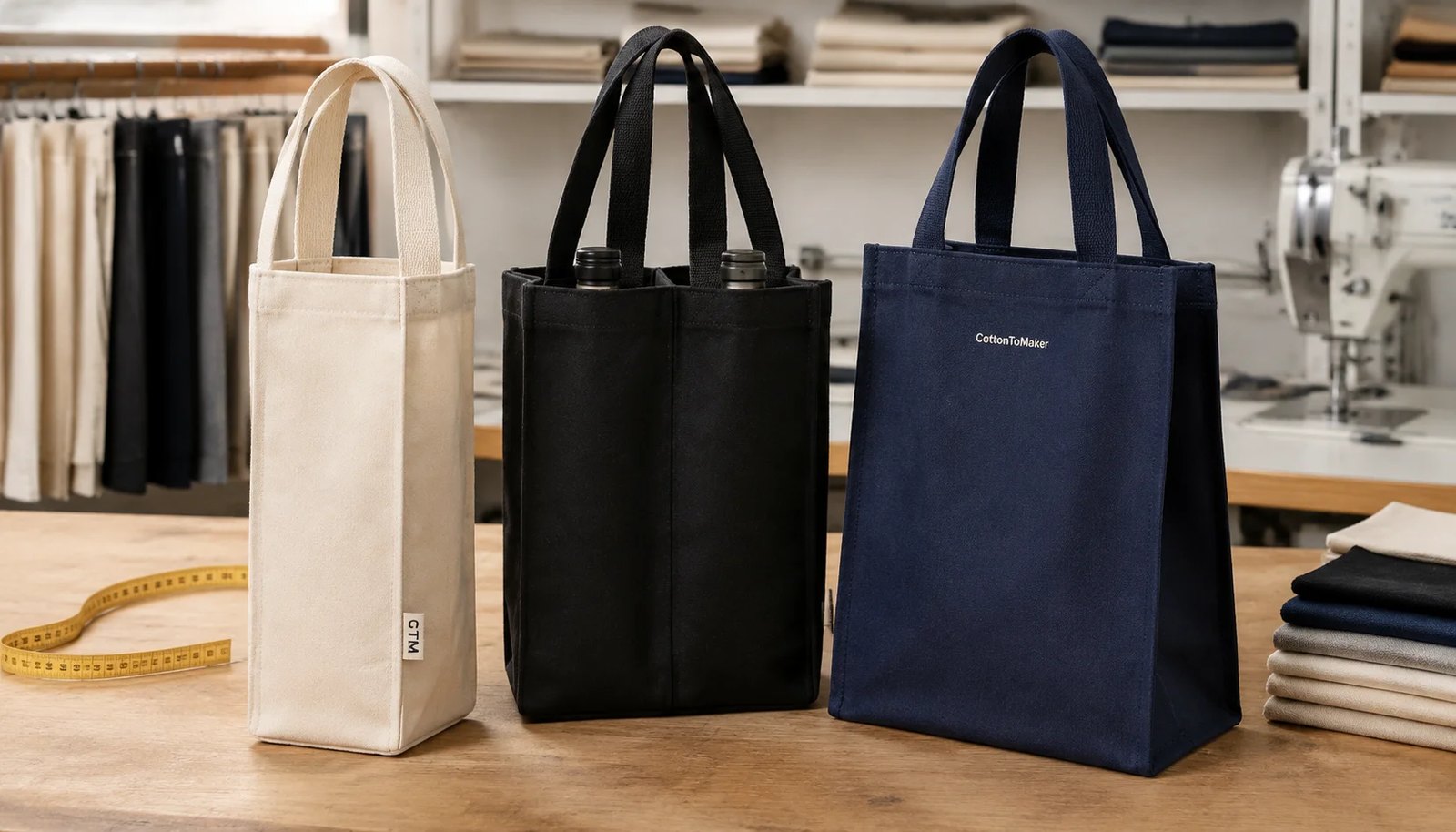
Why museum shop quotes often fail on a product that looks simple
A canvas wine carrier looks straightforward, which is exactly why many museum shop buying teams receive quotes that are hard to compare. One supplier may price a light single-layer bag with self-fabric handles, no structured base, and a small print area. Another may price a heavier canvas body with cotton webbing handles, reinforced stitching, and cleaner packaging. Both are described as a canvas wine carrier, but they are not equivalent products in cost, appearance, or retail performance.
For museum shops, the problem is rarely just first cost. The larger issue is mismatch between procurement expectations and production assumptions. A bag that works as a low-cost event giveaway may not work as a branded retail item sitting beside books, exhibition gifts, and premium food products. Museum stores typically need the item to feel curated, giftable, and reusable, even when the total order is modest and the artwork changes seasonally.
This creates a specific procurement challenge. Museum retail programs often have smaller runs than mass-market gift chains, but higher expectations around finish, branding accuracy, and launch timing. A quote guide therefore needs to focus on the few technical decisions that change both unit cost and buyer risk: bottle fit, fabric weight, handles, print method, packing, MOQ logic, and approval process. If those items are not fixed before asking for prices, the quote comparison becomes mostly guesswork.
The practical goal is not to turn a museum buyer into a bag engineer. It is to create a quote package that forces all suppliers to price the same product assumptions. That allows you to compare real differences in manufacturing capability, lead time, and service instead of comparing mixed specs hidden under the same product name.
- Most quote distortion comes from five variables: fabric weight, handle construction, print method, gusset size, and packing density
- Museum shop buying patterns often include low-to-mid MOQs, multiple artworks, premium gift expectations, and fixed event or exhibition deadlines
- A useful RFQ fixes dimensions, fabric, print area, handle spec, and carton assumptions before price comparison starts
- The cheapest quote is often simply the lightest spec or the least complete packing assumption, not the best value
Start with bottle format, retail use, and shelf presentation before asking for price
The first real specification is not the logo. It is the bottle the bag must carry. Standard 750 ml wine bottles are common, but museum shops also sell sparkling wine, olive oil, regionally produced spirits, and specialty bottles linked to exhibitions or local makers. These products vary in diameter, shoulder width, neck height, and total weight. If buyers request a generic wine bag without giving bottle dimensions, suppliers will quote from different assumptions, and small sizing differences will affect both cost and usability.
A practical RFQ should include bottle height, bottle diameter at the widest point, approximate filled weight, and whether the item needs to sit upright in display. If the museum shop wants one bag body that can serve more than one bottle type, say so. A versatile fit may require a slightly wider gusset or a little more top clearance, but that can be worth it if the same bag body supports several programs over time.
For many museum shops, a single-bottle format is the best commercial baseline. It is easier to merchandise, easier to replenish, and less costly to ship and store. It also works across a broader range of items, from wine to gourmet oil. A two-bottle carrier can make sense for donor gifts, paired regional products, or holiday gift sets, but it should be chosen because the retail plan supports a higher price point, not simply because it looks more premium.
Shelf presentation matters too. Some museum shops want the bag to stand upright near the register or in a gift display. Others treat it as a flat-folded add-on at wrap. These are different design intents. A standing display may need a squarer base, heavier fabric, and stricter gusset control. A fold-flat add-on can prioritize lower cost and lower freight cube. Defining this use case early makes the later quote discussion much cleaner.
- Useful RFQ inputs: bottle diameter, total bottle height, filled bottle weight, and any non-standard shoulder shape
- Typical single-bottle size example: 10-12 cm width x 9-10 cm gusset x 34-36 cm height
- Typical two-bottle size example: 20-22 cm width x 10-11 cm gusset x 34-36 cm height with center divider
- State whether the bag must stand upright on shelf or can function as a flat-packed checkout add-on
- If one bag must fit wine and olive oil, test both items in sample review rather than assuming one size works well for both
Choose canvas weight by retail positioning, not by habit
Fabric weight is one of the fastest ways to separate a budget carrier from a museum-shop-quality retail bag. It affects hand feel, body, sewing behavior, print appearance, fold marks, and freight. For most museum shop programs, 12 oz canvas, roughly 340 GSM, is the practical middle ground. It feels substantial enough for gift retail, prints well for simple logos, and still folds efficiently for shipping and storage.
Lighter 8-10 oz canvas can work when price is the top priority or when the bag is meant for promotional use rather than premium resale. The trade-off is that it tends to feel softer and less structured, and that difference becomes obvious when paired with glass bottles and curated merchandise. In a museum store environment, customers often read weight and structure as quality. A bag that collapses too easily may undermine the perceived value of the gift purchase.
Heavier 14-16 oz canvas can be the right choice when the bag must hold its shape, support darker dyes, or deliver a more premium hand feel. But heavier is not automatically better. It raises sewing difficulty, increases seam bulk, adds carton weight, and can deepen fold marks in flat packing. It may also reduce flexibility if staff need to store large quantities in limited backroom space.
Buyers should also clarify finish and color route. Natural canvas, bleached canvas, yarn-dyed fabric, and piece-dyed fabric behave differently in price and printing. Natural canvas often supports a clean heritage or institutional aesthetic, but it is more vulnerable to visible contamination. Dyed black or navy may look premium, yet dark shades require stronger print opacity control and can show lint more easily. A quote should reflect these differences rather than hiding them under a generic fabric line item.
- 8-10 oz canvas: lower cost, softer body, lighter freight, less premium feel
- 12 oz canvas: balanced cost, print surface, durability, and retail presentation for most museum shop programs
- 14-16 oz canvas: stronger structure and gift feel, but higher material, sewing, and freight cost
- Specify whether the quoted weight is finished GSM and request tolerance
- Clarify fabric route: natural, bleached, yarn-dyed, or piece-dyed, because each affects price and print response differently
Printing decisions shape both visual quality and quote accuracy
For museum shops, branding is rarely an afterthought. The bag may carry the institution name, an exhibition title, a collection-inspired graphic, or a donor-gift identity. Because the item is small, every print decision becomes visible quickly. Screen printing is usually the best match for canvas wine carriers with one-color or two-color graphics. It offers a natural finish, solid coverage, and scalable pricing at production volume.
However, screen printing still requires care. Canvas has texture and absorbency, so small serif text, distressed artwork, and delicate line work can fill in or lose edge clarity. A digital proof cannot fully predict this. Buyers should ask for a strike-off or print sample on the actual fabric color, especially when the design includes institutional marks that need to remain clean and legible. This is particularly important on natural canvas, where off-black or deep color inks can look different depending on fabric tone.
Heat transfer can be useful when the artwork is multi-color, photo-based, or tied to a short exhibition run that does not justify multiple screens. But it changes hand feel and may look less integrated with the fabric surface. For some museum brands, that is acceptable. For others, especially when the aesthetic leans craft, archival, or premium natural materials, screen print will feel more appropriate.
Buyers should also separate print setup charges from unit price. A low piece price can become less attractive if every artwork variation carries a full setup fee. Museum shops often run multiple seasonal designs on one bag body, so quote structure matters. If the same size and print position are used across artworks, ask whether setup can be partially shared or whether repeat costs can be reduced for future programs.
- Screen print usually suits one-color logos, institution names, exhibition titles, and simple artwork best
- Heat transfer can help with short runs or multi-color art, but may change the hand feel on canvas
- Approve artwork at actual print size, not only as a digital mockup
- Request strike-offs for fine text, dark dyed fabrics, and low-contrast logo colors
- Separate print setup cost from unit cost when comparing suppliers or artwork splits
Handle, seam, and reinforcement details are where cheap quotes reveal themselves
A wine carrier usually fails at the handle area first, not at the center panel. That is why handle construction needs to be written into the RFQ, not left to supplier interpretation. For a museum shop wine bag, cotton webbing handles with box-x reinforcement are often the safest commercial choice. They look cleaner, carry weight better, and communicate reusability more effectively than basic self-fabric handles.
Handle width matters as much as handle material. Narrow webbing can cut into the hand and look underbuilt when paired with a glass bottle. Wider webbing generally feels better and holds visual proportion on heavier canvas. Placement matters too. Even a good handle can feel awkward if it is set too close together or attached at inconsistent heights. This is why handle-drop measurement and placement tolerance should be part of sample approval.
Seam allowance and stitch density are also practical buying points. Museum buyers do not need to specify every sewing setting, but they do need assurance that the bag is constructed for actual bottle weight and repeated carrying. A weak upper seam, uneven gusset assembly, or incomplete reinforcement may not show until the bag is loaded. That makes pre-production review and basic load testing valuable, even for a relatively simple item.
If a two-bottle version is being quoted, the divider deserves special attention. A center divider can improve presentation and reduce bottle contact, but only if it is anchored correctly into the side and base seams. A loose or twisted divider adds cost without adding much function. That should be checked in both sample and final inspection.
- Useful handle width range: about 2.5-3.8 cm cotton webbing depending on bag scale and retail look
- Preferred reinforcement: box-x stitch or equivalent reinforced attachment at each handle point
- Require handle symmetry, secure seam finish, and no skipped stitches or thread unraveling
- Request a simple load test using actual bottle weight, not just a generic pull claim
- For divider styles, confirm divider anchoring at both side seams and along the base line
MOQ strategy matters more when museum shops run multiple artworks
Museum shops often want variety: one bag for the permanent collection brand, another for a temporary exhibition, and perhaps a holiday or donor version. That is realistic if the base bag remains standardized. In most factories, MOQ logic follows material usage and production changeover, not just total unit quantity. Fabric color, print screens, print colors, and packaging differences can all split what appears to be one order into several smaller manufacturing runs.
The most efficient structure is usually one common bag body with rotating front-panel artwork. If width, gusset, height, handle, and packing remain unchanged, many suppliers can quote the order as one body with artwork splits. This is often far easier than changing bag dimensions or fabric colors for each design. For museum buyers, that can preserve visual variety while keeping setup and sampling under control.
This is also where a low advertised MOQ can be misleading. A supplier may accept a small run, but recover margin through repeated setup charges, inefficient carton packing, or surcharges for every artwork change. Another supplier may quote a higher base MOQ but allow better sharing across designs. Procurement buyers should therefore request alternate quote scenarios: one artwork, three artworks on the same body, and several artworks with a shared fabric color. That exposes the real economics of the program.
If the museum shop expects annual repeats, ask a follow-up question: what can be reused next season? Screens may or may not be retained. Body patterns usually can be. Fabric color continuity may depend on lot availability. Understanding which costs disappear on repeat orders helps procurement build a more realistic long-term sourcing plan.
- Ask for MOQ by fabric color, by artwork, and by print color count
- Standardize the bag body where possible and vary only the printed panel art
- Request quote scenarios for one artwork, three artworks, and five artworks on the same bag body
- Check whether setup fees repeat on reorders or only on new artwork introductions
- Avoid unnecessary SKU complexity in labels and packing if the store team can work from barcode stickers instead
Use sample approval to catch the five issues that cause most downstream problems
A sample should do more than confirm that the logo looks acceptable. It is the buyer's best chance to test fit, handling, and construction before bulk materials are committed. For museum shops, sample review should be practical. Put a real bottle inside. Carry it by hand. Set it on shelf if the bag is meant to stand. Fold it the way production will fold it. A bag that looks good empty can behave very differently once filled or packed.
The first sample question is fit. Does the bottle slide in easily without scraping the print area or distorting the gusset? Is there enough clearance at the top so the customer can carry it comfortably without the bottle pressing awkwardly against the handle area? If the museum wants one size to fit several bottle types, test all of them during sample review.
The second question is appearance under use. Printed graphics can shift visually once the gusset opens. A logo that looks centered on a flat bag may sit too low or too close to a seam when the bag is filled. The third question is comfort and balance. Handles that seem acceptable on the table may twist or pull unevenly under bottle load.
The fourth issue is base behavior. If the bag is expected to stand upright, the sample should demonstrate that clearly with the real intended product inside. The fifth issue is post-packing appearance. Simulate the bulk fold and check for crease lines across the print panel, thread mess, lint attraction, and visible contamination. Approval comments should be measurable and specific enough to become factory instructions rather than general preferences.
- Check fit with the actual bottle or with a physical sample matching the real diameter and height
- Review the print while the bag is filled, not only when the body is flat
- Measure handle drop and check whether both sides carry evenly under load
- If upright display is required, test standing stability on a flat retail surface
- Simulate factory folding to see whether the chosen print position will crease badly in shipment
Packing and carton planning can change landed cost more than expected
For canvas wine carriers, flat packing is usually the best logistics choice, especially when museum stores have limited stockroom space and need efficient distribution to multiple locations. But the details of flat packing matter. If a supplier folds directly through the printed panel without instruction, the bags may arrive with crease memory that affects presentation. If cartons are overloaded, heavier canvas and webbing can create receiving and handling problems even before retail staff open them.
Packing should therefore be treated as part of the product specification, not as an afterthought. Buyers should define whether individual polybags are required, prohibited, or needed only for certain markets. Some museum shops prefer no individual poly for sustainability reasons. Others need protection from dust or transfer during long shipment. The correct answer depends on brand policy, transit conditions, and receiving environment.
Barcode placement and carton marking are especially important for organizations operating more than one shop or a central warehouse. A low-cost bag becomes expensive if receiving staff have to sort mixed cartons manually or relabel each item after arrival. Ask for clear outer-carton marks by SKU, artwork, color, PO reference, and carton sequence. Also ask for carton dimensions and gross weight during quotation, because freight planning based on unit price alone is incomplete.
If sea shipment is involved, moisture management deserves a brief discussion as well. Canvas is not highly technical, but it can still pick up odor or moisture issues in poor packing conditions. Basic export discipline such as dry packing conditions and sensible moisture protection can prevent avoidable complaints, especially on natural fabric where stains and odor are more visible.
- Define carton count target and a maximum gross weight to make warehouse handling practical
- Specify fold direction if the printed front panel should avoid a central crease
- State whether individual polybags are required, prohibited, or market-specific
- Require carton marks by SKU, artwork, color, PO number, and carton number sequence
- Ask for packed carton dimensions and loading assumptions for freight planning
Compare quotes on landed program cost, not only FOB price
The most useful quote comparison for museum shop procurement is not the lowest FOB unit price. It is the cost per sellable unit once setup, packaging, freight efficiency, and quality risk are considered. A slightly higher factory price may still be the better procurement choice if it reduces sample rounds, ships more efficiently, and arrives with fewer defects or sorting problems.
A practical comparison sheet should split one-time and repeat costs. One-time costs may include initial sample charges, print setup, custom labels, and any tooling related to packaging. Repeat costs usually include unit price, standard packing, and ongoing labeling. Once those are separated, buyers can model how the program behaves at different order volumes or with different numbers of artworks.
This becomes especially valuable for museum shops managing temporary exhibitions or smaller thematic runs. A low unit price from one supplier may be offset by full setup charges on each artwork. Another supplier may quote a slightly higher unit price but offer more efficient artwork sharing across the same body. Looking only at piece cost hides that difference.
It is also wise to model a small defect allowance and receiving labor impact. If one supplier's cartons are mixed, mislabeled, or inconsistent, internal handling cost rises. Procurement buyers often know this operational pain already, but it is rarely captured during quote comparison. Building landed cost more realistically helps prevent short-term savings from creating downstream labor and stock-control issues.
- Separate one-time costs from repeat-order costs in your comparison sheet
- Compare dyed fabric and natural fabric scenarios if your brand can accept either
- Include packaging adders, barcode labels, and any compliance costs as separate lines
- Model the effect of artwork splits rather than comparing only one headline MOQ scenario
- Consider warehouse sorting and relabeling effort as part of practical landed cost
Lead time risk usually sits in approvals and materials, not in sewing itself
Canvas wine carriers are not highly technical products, so many delays come from approval stages rather than from actual sewing capacity. Dyed fabric booking, custom webbing color, woven labels, and artwork clarification often take longer than the sewing operation. Museum buyers should therefore ask suppliers to break lead time into stages instead of giving one total number that is hard to verify.
A useful timeline starts with sample development, then sample revision if needed, then pre-production confirmation, then material readiness, then bulk sewing and packing. This matters because exhibition launches and holiday sales are date-sensitive. A quote that promises a short bulk lead time but ignores fabric booking or approval lag is not more reliable just because the total number sounds attractive.
Buyers should also ask which materials are stock-supported and which are made only after order confirmation. Natural canvas may be available quickly, while custom-dyed fabric or matching webbing may extend lead time. If several artworks are involved, print preparation and internal coordination can also add time even when the bag body remains the same.
The key procurement question is not just when the goods leave the factory. It is whether the timeline still allows import, receiving, sorting, and shop distribution before the retail launch. A supplier that gives a transparent stage-by-stage schedule is often a safer partner than one offering the shortest unbroken total lead time.
- Ask for lead time by stage: sample, revision, pre-production, materials, bulk production, and ex-factory date
- Confirm whether fabric, webbing, labels, and packaging materials are stock items or custom-made for your order
- Multiple artworks may extend pre-production coordination even if the body construction stays unchanged
- Work backward from the in-store date, not only from shipment date
- Treat approval speed on the buyer side as part of lead-time management, especially for logo and sample sign-off
Specification comparison for buyers
| Spec decision | Recommended option | When it fits | Buyer risk to check |
|---|---|---|---|
| Sourcing route: direct factory vs trading company | Direct factory with in-house cutting, sewing, and basic printing coordination | Best for repeat museum shop programs, private label requirements, and tighter control over revisions, QC, and packaging instructions | Confirm who cuts and sews the bags, whether printing is subcontracted, and whether the approved sample was made on the same production path as bulk goods |
| Fabric weight | 12 oz canvas (about 340 GSM) for most single-bottle retail; 14-16 oz canvas (about 400-450 GSM) for premium gift presentation | Use 12 oz when price, foldability, and broad SKU utility matter; move heavier when shelf presence and a more structured hand feel are required | Some quotes use lighter finished fabric than stated, or quote loom-state weight instead of finished GSM; require GSM tolerance and swatch approval |
| Handle construction | Cotton webbing handles stitched with box-x reinforcement | Suitable for one- or two-bottle use where the bag should feel reusable and giftable | Weak single-line stitching, narrow webbing, or unstable handle placement can fail under glass bottle load |
| Single vs double bottle format | Single-bottle bag unless your retail plan clearly supports paired gifting | Best when the museum shop wants lower MOQ, easier replenishment, less freight cube, and more flexibility across wine, olive oil, and specialty bottle items | Two-bottle dividers add fabric, sewing steps, carton volume, and can reduce sell-through flexibility if bottle programs change |
| Print method | Screen print for simple museum branding; heat transfer only for multi-color artwork or very short runs | Screen print is usually the most practical method for one-color logos, exhibition branding, and institutional marks on canvas | Fine serif details, low-contrast art, or dark dyed fabric may need strike-off approval to avoid edge spread, weak opacity, or unreadable text |
| Inner structure | No padding for standard gift-retail use; stitched center divider only when bottle-to-bottle contact is a real concern | Good for museum shops that want a clean reusable bag without moving into protective transit packaging | Buyers often overbuild the bag when the larger breakage risk is poor outer-carton packing and handling, not the bag body itself |
| Packing route | Flat packed in export carton with SKU marks, fold-direction instruction, and moisture control for sea shipment | Best for reducing freight cost and backroom storage volume while keeping retail receiving manageable | Fold marks through print panels, barcode misplacement, mixed-artwork cartons, and missing desiccant or moisture precautions create avoidable receiving problems |
| MOQ structure | Base MOQ by fabric color, then artwork quantity split by SKU or store group where possible | Useful when one museum operator wants several exhibition-themed prints on the same bag body | Suppliers may quote a low MOQ headline but recover margin through high setup charges, low carton efficiency, or surcharges for artwork and color splits |
Buyer checklist before sampling
- Define the exact bottle use case first: standard 750 ml still wine, sparkling wine, olive oil, regional spirits, or mixed specialty bottles
- State target fabric in both oz and GSM, for example 12 oz canvas approximately 340 GSM, and note whether it is natural, bleached, or dyed
- Provide finished bag dimensions including body width, gusset depth, total height, handle drop, and whether the base must stand upright on shelf
- Specify if the bag is single-bottle, two-bottle with divider, or a wider gift-bottle format intended for premium packaging
- Confirm handle material, width, and attachment method, such as cotton webbing with box-x reinforcement
- State print method preference, artwork size, print location, number of colors, and whether ink must match a Pantone reference
- List the real load requirement, such as one filled 750 ml bottle with normal retail carrying, or two bottles with divider support
- Require sample approval and pre-production sample approval against final fabric, final print color, and final handle construction before bulk cutting
- State packing method in detail: flat packed, fold direction, barcode label location, inner poly requirement or prohibition, carton count, and carton gross-weight limit
- Request separate pricing for sample charge, print setup, unit price, woven label, hangtag, divider, barcode sticker, and any packaging adders
Factory quote questions to send
- Is the quoted fabric weight measured on finished fabric, and what GSM tolerance do you allow in bulk production?
- Does your unit price include fabric cutting, printing, webbing handles, handle reinforcement, side gusset sewing, thread trimming, and final cleaning?
- What is the MOQ by fabric color, and can multiple artworks share one fabric lot if the bag size and construction remain the same?
- Will the same factory make both the sample and the production order, or are any steps such as printing, dyeing, or sewing subcontracted?
- What handle webbing width, thickness, and fiber content are included in the quote, and how are the handles reinforced?
- What finished-size tolerance do you apply to width, gusset, and height on this style?
- Can you provide a simple load-test method for one-bottle and two-bottle versions, including pass or fail criteria and sample size?
- What print method do you recommend for our logo on this fabric color, and which artwork details are at risk of filling in, fading, or losing edge sharpness?
- What carton quantity, carton dimensions, and gross weight are assumed in your quote for flat-packed goods?
- How many days are needed for initial sample, revised sample if needed, pre-production sample, and bulk production after final approval?
Quality-control points to confirm
- Fabric weight and color must match the approved swatch within agreed tolerance; mixed-shade panels in the same bag are not acceptable
- Finished dimensions must follow approved tolerance, commonly plus or minus 0.5-1.0 cm depending on bag size, wash state, and fabric finish
- Print position must match the approved artwork placement with no visible ghosting, pinholes, heavy ink spread, weak opacity, or obvious skew
- Print color on natural or dyed canvas should be checked under neutral light against the approved standard or strike-off, especially for institutional logos
- Handles must match approved length and be sewn symmetrically; visible handle-height variance on packed goods should be rejected
- Handle reinforcement stitching must be complete with no skipped stitches, broken threads, unraveling thread ends, or loose bartack points
- Upper seam, side seam, and base seam must be secure with no seam grin under normal bottle load
- Inner divider, if ordered, must be sewn securely into side seams and base line without twisting, loose edge finishing, or misalignment
- Bag opening, gusset, and base seam must be even so the carrier hangs correctly and stands correctly if upright display is required
- No oil marks, mildew odor, rust transfer, excessive lint, needle damage, black contamination, or water stains on natural canvas