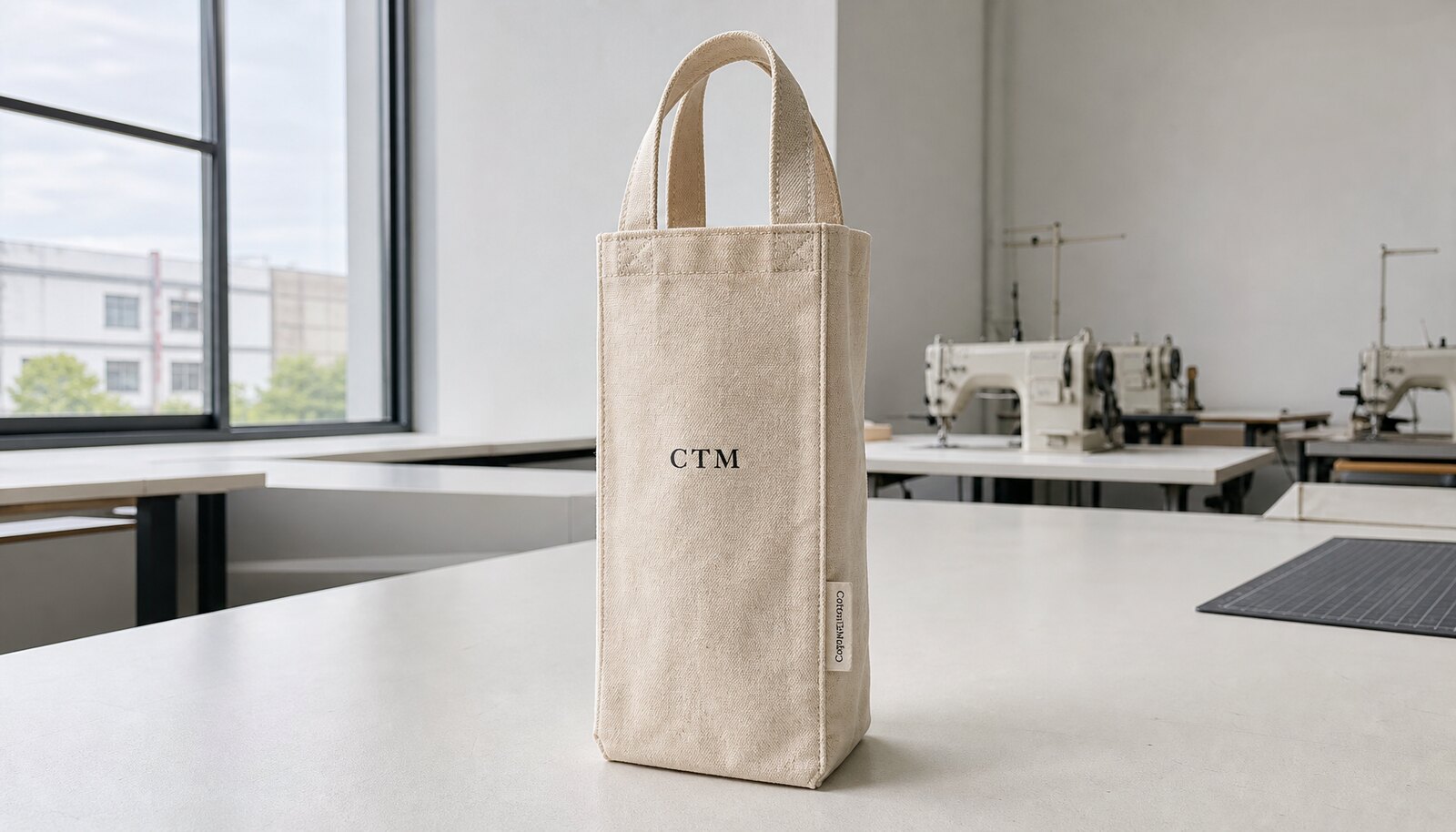
Why Hotels Buy Canvas Wine Bags
Hotels do not buy canvas wine bags only as packaging. They use them where presentation and handling matter: welcome gifts, VIP amenities, room-service delivery, banquet handoff, minibar upsell, and retail or souvenir counters. In those settings the bag becomes part of the guest's first impression of the property. A loose sleeve with weak stitching looks improvised; a properly specified bag makes the bottle feel deliberate and brand-aligned.
That is why this product should be sourced as a hospitality item, not as a generic promotional bag. The buying logic is different from a standard tote: the opening has to fit a bottle, the base has to carry weight without slumping, and the print has to remain legible on a rough weave. Procurement teams get better results when they define the guest scenario first and the decoration second.
- Welcome gifts usually need a clean front panel, minimal branding, and a premium handfeel.
- Room-service and banquet use favor speed, clear fit, and bulk packing over decorative details.
- Retail-style hotel programs need stronger color control, better finishing, and more consistent carton presentation.
Start With The Bottle, Not The Bag
The bottle is the spec anchor. A standard 750 ml bottle, a taller Bordeaux shape, a wider Burgundy shape, or a bottle with a thicker base can all change the fit. Buyers should record the real bottle height, widest body diameter, shoulder shape, and whether the closure is cork, screw cap, or tamper banded. If the bottle is usually chilled, the condensation and slight size variation should be part of the brief as well.
Finished dimensions should be written with the fit target, not just as a nominal size. A supplier can cut a sleeve to the wrong proportions and still meet a vague dimension line. For hotel use, ask for finished length, width, and seam allowance together, plus a stated bottle fit range. If the bag is expected to handle multiple bottle shapes, add a small gusset or wider allowance instead of forcing a tight one-shape fit.
- Write the bottle dimensions into the spec sheet before asking for price.
- State whether the bag must fit a chilled bottle or only a room-temperature bottle.
- Ask the supplier to test the actual bottle used by the hotel, not a generic sample bottle.
Materials And Construction That Hold Up In Hotels
For most hotel programs, 10-12 oz canvas is the practical starting point. It gives enough structure to stand up on a counter, prints cleanly, and keeps unit cost reasonable. Move to 14 oz or above when the bag needs a premium handfeel, has to support heavier bottles, or is likely to be reused by guests. The important point is to define the weight in oz or GSM, and to confirm whether the quoted figure is the finished fabric weight or just the base cloth before processing.
Construction details matter as much as fabric weight. A single-bottle sleeve with an 8-10 mm seam allowance and a reinforced bottom is usually the most efficient solution. If the bottle is wider or the hotel expects frequent reuse, ask for a small gusset rather than a looser overall cut. On load-bearing seams, a practical target is 7-9 stitches per inch, with bartacks or equivalent reinforcement at the top corners and any handle attachment points.
Unlined canvas is acceptable for back-of-house use or cost-controlled amenity programs. If the bag will be seen by guests at close range, a thin lining can hide inner seam appearance and make the product feel more finished. The supplier should quote any lining separately, because it changes labor, packing, and lead time more than many buyers expect.
- 10 oz: efficient for controlled hotel amenities and lighter bottles.
- 12 oz: a balanced default for most branded hotel programs.
- 14 oz+: better for premium presentation, higher reuse, and heavier bottles.
Branding And Print Specs That Suppliers Can Actually Make
Canvas wine bags are unforgiving when the artwork is vague. A logo that looks crisp in a PDF can blur on rough weave if the lines are too fine or the print size is too small. For simple one-color or two-color hotel logos, screen print is usually the most stable commercial option. It gives predictable cost and works well on repeat orders, provided the artwork is not overloaded with tiny type or thin strokes.
For more premium programs, a woven label or embroidery can improve the perceived value, but both options need tighter planning. Embroidery can distort small text, and a woven label can feel too detached if the rest of the bag is meant to look natural and understated. Heat transfer is the least forgiving over time and should be reserved for short runs or event-based use, where the hotel accepts a shorter visual lifespan.
The buyer should specify logo placement by measurement, not by feel. Use a top-edge and side-edge reference, set an acceptable tolerance, and require the supplier to confirm the actual print area on a physical strike-off. A good working tolerance is plus/minus 3 mm on front-panel placement for this category. If the hotel expects a strict brand color, approve against a signed sample or Pantone target rather than a screen preview.
- Use screen print for simple logos and repeatable cost control.
- Use woven labels or embroidery only when the premium look justifies the higher cost.
- Reject artwork that depends on extremely thin lines, tiny text, or unsupported color effects.
How To Compare Quotes Without Getting Misled By Unit Price
A useful quote for canvas wine bags for hotels should show the entire production logic, not just a single per-piece number. At minimum it should state fabric weight, finished size, seam allowance, print method, logo size, packing style, carton quantity, and sample terms. If those fields are missing, two suppliers can quote very different products under the same bag name, and the buyer will only discover the gap after sample review or, worse, after production starts.
The hidden cost is often in setup and handling. Screen creation, embroidery digitizing, label application, fold method, inner packing, and carton marking can all move the landed cost more than a small fabric upgrade. This is why buyers should ask for a base version, a premium version, and a gift-ready version if the hotel is still deciding between presentation levels. That structure turns a vague comparison into a procurement decision.
When comparing offers, do not stop at landed unit price. Compare carton count, gross weight, and freightable volume as well. A slightly cheaper bag that packs poorly can cost more in shipping and warehouse handling than a better-built bag with a tighter fold and more efficient carton count.
- Ask for itemized pricing when the order includes labels, lining, or special packing.
- Require the supplier to identify sample charges and sample freight separately.
- Reject quotes that do not say what is excluded, especially shipping, cartons, and artwork setup.
Supplier Validation: Factory, Trading Company, Or Converter
Direct factory sourcing is usually the best fit for repeat hotel programs. It gives the buyer clearer visibility on fabric source, sewing quality, print setup, and final inspection. The tradeoff is that the buyer has to manage the specification carefully. If the brief is weak, the factory will still make something, but it may not be the same product the hotel had in mind.
Trading companies can be useful when the hotel is buying several item types at once or wants shipment consolidation across multiple SKUs. They can also help when the buyer needs a single commercial contact across different factories. The risk is that visibility drops unless the trading company is willing to show the actual production site, the real QC owner, and the line that will make the bags. A polished sales presentation is not enough.
For short-run event work, a local converter or decorator may be adequate, but the validation bar should still be practical. Ask for the business license, factory address, photos or video of the sewing line, sample room evidence, and the name of the person who will approve final packing. It is also worth asking how they handle reorders, because a supplier that cannot repeat a basic spec reliably is not a low-risk option for a hotel group.
- Direct factory: best for repeatability, lower ambiguity, and stronger cost control.
- Trading company: useful for mixed product sourcing or consolidated shipping.
- Local converter: acceptable for rush or low-volume work if consistency is verified.
Sample Approval Should Be A Controlled Step, Not A Formailty
The sample is not only a visual check; it is the contract reference for size, feel, print, and fit. The hotel should test the actual bottle in the actual bag, then review the front, back, seams, inside finish, and carton presentation. If the bag is tight, the bottle should slide in without forcing the seam open. If it is loose, the bottle should not wobble so much that the presentation looks unfinished. A sample that is slightly off at this stage will usually drift further in bulk production.
The sample should also be documented as a control point. Photograph the approved front, back, side seam, inside seam, and packing configuration. Mark the approved sample with the date and the buyer's notes, then keep the same reference in both the hotel file and the supplier file. If the order is large or the logo placement is sensitive, ask for a pre-production sample or a signed strike-off before bulk material is cut.
Any change after approval should trigger a written deviation, not a verbal okay. If the supplier changes logo size, fabric weight, closure, or packing format, the buyer should decide whether the change is acceptable before the production line runs. That control step is what protects hotel buyers from receiving a product that is close to the approved sample but not actually the same.
- Test with the real bottle and the real closure, not a generic substitute.
- Approve a physical sample before screens, embroidery files, or bulk cutting are fixed.
- Archive photos and the signed sample so the reorder path is clear later.
Inspection Criteria Buyers Can Put Straight Into The PO
QC for canvas wine bags should be operational, not descriptive. A buyer should be able to tell an inspector exactly what to measure and what to reject. Start with dimensions: check a sample set from each size lot and compare against the approved drawing. A practical tolerance is plus/minus 5 mm on length and width for this category, with the print centered within plus/minus 3 mm unless a different placement is intentionally approved.
Next inspect stitching and reinforcement. The base should not open under normal hand pressure, and the bartacks at the top corners should not show separation when the bag is gently tugged. A good rule is to reject any seam split, missing bartack, or thread break in a load-bearing area. Loose trim threads are a minor issue only if they are short, neat, and not left hanging on the visible surface.
Print quality should be judged against the actual artwork, not just against the white background in a PDF. Text should be readable at normal viewing distance, edges should not feather excessively, and color should not drift beyond the approved sample. For brand-sensitive hotel programs, define the acceptance method in advance: signed physical sample, Pantone target, or both. If there is a smell, stain, oil mark, or carton contamination, the lot should not be treated as ready for guest-facing use.
- Use AQL 2.5 major / 4.0 minor unless the hotel has a stricter standard.
- Reject wrong size, wrong logo, seam failure, and missing reinforcement as major defects.
- Check carton count, labels, and fold consistency before the shipment leaves the factory.
Packing, Cartons, And Warehouse Handling For Hotel Groups
Packing is easy to ignore until it slows receiving. For back-of-house hotel distribution, bulk packing is usually the right choice because it reduces labor and keeps the landed cost down. The supplier should still state how the bags are folded, how many go into each carton, and what the carton dimensions will be. If the cartons are too large or too heavy, they become awkward to move in hotel warehouses and can raise damage risk during internal handling.
For guest-facing presentation, a hotel may choose individual polybags, tissue wrap, or a simple card insert, but only if the presentation step is actually needed. Decorative packing should not be added by default. It increases material cost, labor, and carton cube, and it rarely improves the guest experience unless the hotel is handing over the bag directly as part of a premium amenity or retail purchase.
Carton marks should be explicit and repeatable. Include SKU, color, size, quantity, destination property or distribution center, and any orientation marks needed for stacking. If the product will be stored in humid or coastal locations, ask the supplier whether moisture protection is available and how the carton is sealed. A few minutes of clarity at the packing stage prevents a lot of receiving friction later.
- Keep carton gross weight manageable for manual handling.
- State the fold method so future reorders do not drift.
- Use carton marks that match the hotel's warehouse and receiving process.
The Mistakes That Create Rework On This Product
The most common error is buying from a visual reference without writing the fit spec. A supplier can make a bag that resembles the sample photo yet fails on the actual bottle. Another common mistake is treating all canvas as interchangeable. The difference between 10 oz and 14 oz is not cosmetic; it changes structure, print appearance, and cost in ways the quote should make visible.
A third error is leaving QC abstract. If no one defines stitch density, seam allowance, print tolerance, or defect categories, the factory will use its own default, and that default may not align with hotel expectations. Buyers should also avoid changing artwork after sample approval unless the schedule and cost impact have been reviewed. For seasonal hotel launches, one uncontrolled revision can erase the margin between on-time delivery and missed rollout.
The practical answer is to turn the order into a controlled spec pack: bottle measurements, finished size, fabric weight, print placement, packing method, inspection standard, and reorder reference sample. That is the level of detail suppliers need if the hotel wants clean quotes and repeatable production.
- Do not approve from a mockup alone when fit matters.
- Do not compare suppliers on unit price without carton and freight impact.
- Do not treat sample approval as final if later changes are still being discussed.
Specification comparison for buyers
| Spec decision | Recommended option | When it fits | Buyer risk to check |
|---|---|---|---|
| Fabric weight | 10-12 oz canvas for standard hotel use; 14 oz or heavier for premium feel, reuse, or heavier bottles | Welcome amenities, suite gifting, minibar presentation, and retail-style hotel programs | Confirm whether the weight is finished fabric weight, not just base cloth before washing or printing |
| Construction | Single-bottle sleeve with 8-10 mm seam allowance, reinforced base, and bartacks at stress points; add a small gusset if bottle diameters vary | Most hotel bottle presentation and takeaway programs | A narrow flat sleeve may fit one sample bottle but bind on chilled bottles or bottles with wider shoulders |
| Stitch spec | Target 7-9 stitches per inch on load-bearing seams and a reinforced bartack of about 18-24 stitches at handle joints | Any bag that will be carried by guests or staff | Loose stitching, skipped stitches, or weak bartacks usually show up first at the base and top corners |
| Print method | Screen print for one- or two-color logos; woven label or embroidery for premium programs; heat transfer only for short runs | Simple hotel branding, repeat orders, or premium presentation with higher unit tolerance | Require print position tolerance within plus/minus 3 mm and confirm durability on textured canvas |
| Closure and carry | Open top for fast room-service use; short webbing loop or drawstring only when the guest needs to carry it away | In-room presentation, welcome gifts, and event giveaway use cases | Long handles add cost and can twist the bottle without improving function |
| Packing | Bulk pack 50-100 pcs per 5-ply export carton, with carton marks, SKU labels, and a target gross weight under 15-18 kg | Warehouse distribution and multi-property hotel groups | Oversized cartons and vague marks slow receiving and inflate freightable volume |
| Supplier route | Direct factory for repeat programs; trading company for consolidation or mixed SKUs; local converter for small rush orders | When the buyer cares about repeatability, schedule control, or multi-item sourcing | Ask who actually owns the sewing line and final QC, not just who issued the quotation |
| Inspection standard | AQL 2.5 major / 4.0 minor, plus first-article review on print, dimensions, and bottle fit | Orders where brand consistency matters or the hotel wants a repeatable reorder plan | If the supplier cannot state an inspection standard, they probably do not control one |
| Lead time | 7-10 days for samples and 20-35 days for bulk after approval on standard specs | Forecasted hotel programs and seasonal gifting | Any quote that excludes sample time, screen creation, or packing changes is incomplete |
Buyer checklist before sampling
- Start with the bottle: record bottle height, body diameter, shoulder shape, closure type, and whether the bottle will be chilled when inserted.
- State the use case in the PO: room-service presentation, welcome amenity, minibar upsell, banquet gifting, or retail resale. The finish should match the use case.
- Specify fabric weight in oz or GSM and state whether shrinkage has already been absorbed in the finished size.
- Call out finished dimensions and seam allowance together so suppliers are not guessing at fit.
- Require seam reinforcement at the base, side seams, and any handle attachment point.
- Define the print method, artwork size, print position from top and side edges, and accepted color target.
- Request a physical strike-off or pre-production sample on the same canvas, not a digital mockup alone.
- Ask for packing details: fold method, carton quantity, carton dimensions, gross weight, and carton mark format.
- Set a QC standard before you place the order: AQL level, defect categories, measurement tolerance, and bottle-fit test method.
- Compare landed cost, not only unit price, and include sample charge, freight, carton cost, and any optional presentation packing.
Factory quote questions to send
- What is the exact canvas weight in oz or GSM, and is it based on finished fabric weight or raw cloth before washing and print?
- What are the finished dimensions, seam allowance, and internal fit range for the target bottle size?
- What stitch density do you sew on the load-bearing seams, and how many stitches are in the bartack at the stress points?
- Which print method are you quoting, and what is the included tolerance for logo position and color match?
- Can you confirm whether the artwork is centered within plus/minus 3 mm of the approved placement drawing?
- Is the quote for a sample, pre-production sample, or bulk production sample, and what happens if the sample needs one revision?
- What is the MOQ at this spec, and how does unit price change at 500, 1,000, and 3,000 pieces?
- What packing is included per carton, what are the carton dimensions, and what will the gross weight be per carton?
- Are export cartons, moisture protection, barcode labels, and carton marks included or charged separately?
- What inspection standard do you use, and can you share the AQL target and defect classification?
Quality-control points to confirm
- Dimensions: measure at least 5-10 finished bags per size. Pass if length, width, and gusset stay within plus/minus 5 mm of the approved sample or drawing.
- Fit test: insert the actual hotel bottle, including any cap or closure. Pass if the bottle seats fully, does not bind at the shoulders, and stands upright without leaning.
- Seam allowance: inspect one opened sample from each size run. Pass if side and bottom seams hold the agreed allowance, typically 8-10 mm, with no seam opening under normal hand pull.
- Stitching: check that seams are continuous, even, and free of skipped stitches. Fail any seam split, missing bartack, or loose thread longer than 15 mm left untrimmed on a visible surface.
- Bartacks and stress points: pull gently on handle joints and top corners. Pass if reinforcement does not separate and no thread breakage appears under normal hand stress.
- Print position: compare against the approved artwork or strike-off. Pass if the logo is within plus/minus 3 mm of target placement and remains centered visually on the front panel.
- Print clarity: reject blurred edges, washed-out fills, or blocked small type. For textured canvas, any fine text that cannot be read at normal viewing distance is a fail.
- Color match: use a signed physical sample or Pantone target. Minor variation in canvas base color is acceptable only if pre-approved; unexpected tone shift is a defect.
- Surface quality: reject oil marks, broken yarns, thin spots, stain marks, or uneven weave that would make the bag look inconsistent in a multi-property hotel program.
- Odor and cleanliness: open cartons and sniff a random sample. Reject strong chemical odor, dust, or contamination inside the carton.