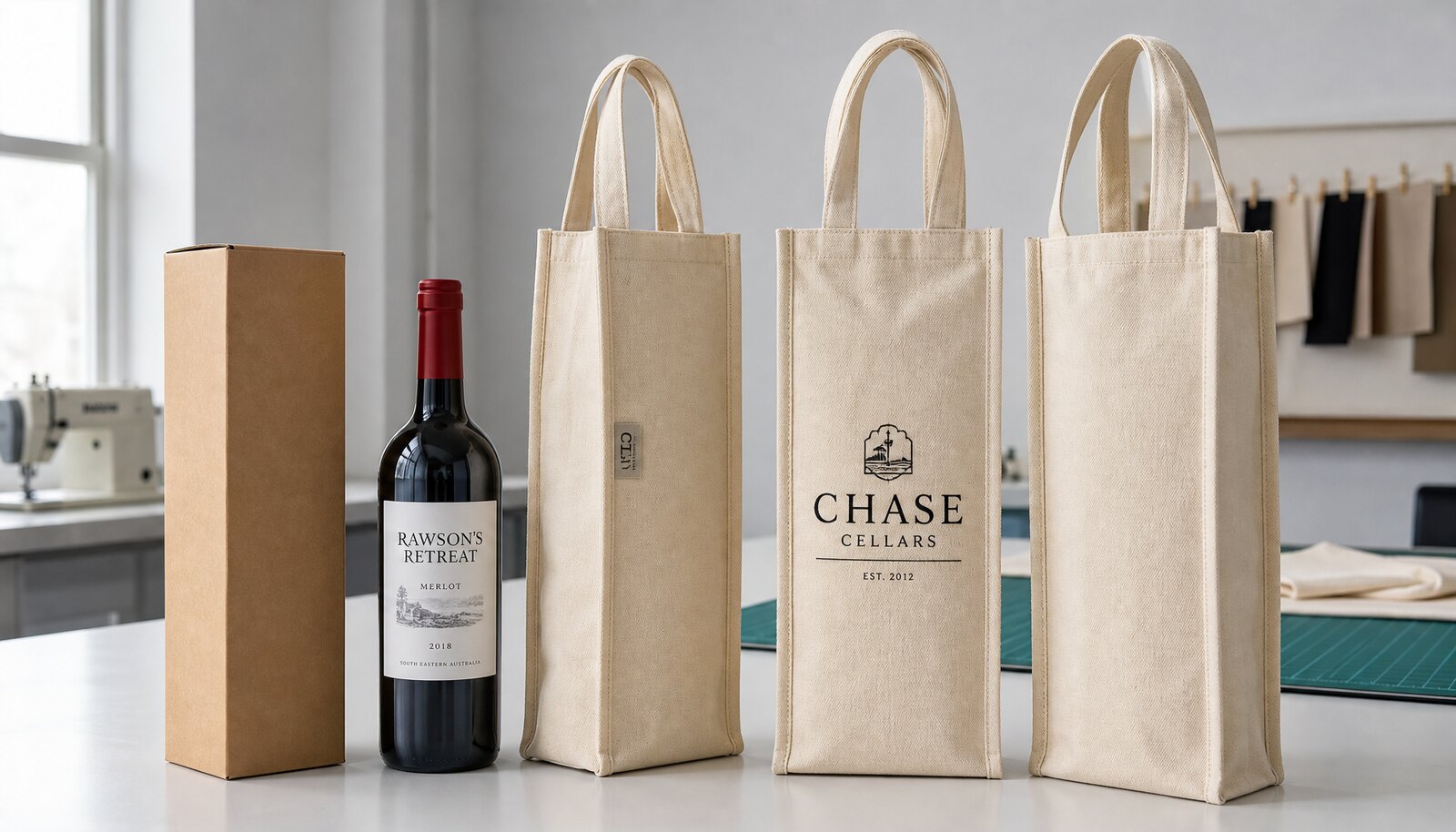
What procurement buyers need from canvas wine bags for events
Canvas wine bags for events sit at the intersection of presentation, protection, and logistics. The buying requirement changes depending on where the bag appears in the workflow: a guest handout at a gala, a sponsor gift at a conference, a retail bundle for resale, or a venue pack-out item that staff must move in volume. Those uses do not need the same construction. A premium gift bag must look neat when it reaches the end user. A venue distribution bag must be easy to count, store, and hand out fast. A retail version must be consistent enough that one carton does not look different from the next.
The first procurement mistake is to start with logo placement before the use case is fixed. The better sequence is simple: identify the bottle type, decide whether the bag is one-time presentation packaging or reusable accessory packaging, then set the fabric weight, build details, and print method. Once that order is established, the supplier can quote something that matches the event rather than a generic wine pouch. That also makes internal approval easier, because the team can see how each detail affects bottle fit, shipping density, and presentation.
It also helps to think beyond the visual mock-up. Event buyers often see only the front-of-house moment, but the bag passes through other hands first. Warehouse teams may unpack cartons, venue teams may repack items into kits, and guests may carry the bag briefly before setting it on a table or into a gift basket. Every handoff creates a chance for crushed fabric, smudged print, or incorrect counts. A good spec reduces those risks with measurable requirements instead of loose wording like “premium,” “thicker,” or “nice finish.”
If the order is seasonal or repeatable, plan for reorders at the initial RFQ stage. A one-off event may tolerate higher setup cost, but a recurring sponsorship program needs stable fabric, repeatable decoration, and the same carton configuration every time. That is where many buyers save money or lose it. A bag that is inexpensive at the factory but inconsistent in pack-out can create additional labor, rework, or presentation issues at the event site.
- Start with the event use case, not the logo.
- Set the bottle type before finalizing size or closure.
- Treat the bag as both a branding item and a logistics item.
- If the program will repeat, design for reorder consistency from the start.
Bottle fit and dimensions: the spec that decides everything else
Bottle fit is the foundation for any order of canvas wine bags for events. A 750 ml bottle is common, but that label does not guarantee a standard profile. Bordeaux bottles, Burgundy bottles, Champagne-style bottles, and taller sparkling bottles differ in body diameter, shoulder shape, and neck height. A bag that looks neat on one bottle can feel tight, saggy, or unstable on another. If the event includes mixed bottles, the buyer should not rely on a single reference photo or a vendor’s “standard size” claim.
The most useful RFQ detail is a measurement sheet based on the actual bottles that will be used. Include bottle height, body diameter, shoulder width, base diameter, and the top height you want visible above the opening. If the bag must stand upright on a table or inside a gift box, the base gusset matters as much as total height. If the bag uses a drawstring, flap, or insert-card closure, those elements change the usable opening and the allowance needed for clean insertion.
Ask for a dimensioned pattern before the first sample is cut. That drawing should show overall height, body width, gusset depth, seam allowance, and handle length. For mixed-bottle programs, request fit confirmation with the widest and tallest bottle in the set. The goal is not to make the bag oversized. It is to make sure the real bottle goes in smoothly without straining seams or leaving excess fabric that wrinkles around the base.
For procurement teams, small dimensional differences can have real commercial consequences. A 5 mm shift in gusset depth may change how the bottle sits in the carton. A slightly narrower opening can slow pack-out if staff must force bottles into the bag at the venue. When the order is large, those seconds add up. That is why fit should be approved on physical samples, not only on art files or rough factory sketches.
- Use actual bottle measurements, not only bottle type names.
- Approve the widest or tallest bottle in a mixed program.
- Ask for a dimensioned pattern drawing before sampling.
- Confirm whether the bag must stand upright in use or in carton.
Fabric weight, canvas finish, and why GSM should be stated clearly
Most buyers land in the 8 oz to 10 oz range for this product category, which is roughly 270–340 GSM. That range usually gives enough body for a wine bottle without making the bag overly stiff or expensive to produce. At the lower end, the bag is often suitable for simple event giveaways where the main job is to carry and present the bottle. At the higher end, the bag feels more structured and can look more premium on a table or in a gift kit, but it also increases fabric cost and shipping weight.
The finish matters as much as the weight. Raw canvas, washed canvas, dyed canvas, and bleached canvas do not behave the same way in sewing, printing, or packing. Raw cloth may have more lint or a stronger natural odor. Washed cloth can feel softer and reduce shrink concerns, but it may cost more. Dyed cloth can create a stronger visual identity for the event, yet it may change the final appearance of the logo and can require a more careful color match. Buyers should not approve a sample on “feel” alone if the delivery standard calls for a specific fabric state.
The practical procurement rule is to use numeric specifications. Ask for GSM or ounce weight, fiber composition if relevant, and whether the cloth is pre-shrunk, washed, or bleached before sewing. If the bag is printed, ask for the weave density or at least whether the supplier considers the surface coarse or fine. Coarse weave makes small text and thin rules harder to reproduce, and it can lead to uneven ink edges if the artwork is not adjusted.
If there is any chance the bag will be reused, cleaned, or displayed for longer than a single event day, the finish deserves even more attention. A lightly finished canvas may be acceptable for a short promotional handout but not for a retail bundle that sits on shelf. State the expectation early so the supplier does not quote a cloth that feels right in a sample room but performs poorly once the order is packed and delivered.
- Specify GSM or oz, not just “canvas.”
- Ask whether the cloth is raw, washed, dyed, bleached, or pre-shrunk.
- Higher GSM improves structure but also raises freight and sometimes lead time.
- A coarser weave needs bolder artwork and wider line spacing.
Construction details that affect appearance, load, and rework
Construction is where a simple-looking bag becomes reliable or troublesome. Handle attachment is the most important point. If the handles are anchored weakly, the bag can still pass a quick visual check but fail when a bottle swings inside during transport. Buyers should ask how the handles are secured, whether bar-tacks are used, and how the top hem is finished. Reinforced attachment points matter more than decorative flourishes when the bag will move through a busy event environment.
The base structure is the second key decision. A flat bag may work for a low-cost handout, but a gusseted base gives the bottle a more stable profile and reduces stress on the side seams. That is especially helpful if the bags will be placed into gift boxes or stacked for distribution. Buyers should also ask whether the inside seams are overlocked, bound, or left raw. Raw seams can be fine for a basic campaign bag, but premium gifting or retail usually benefits from a cleaner internal finish.
Closure style should match the handoff, not the mood board. A drawstring can improve presentation and create a gift-like feel, but it can slow bottle insertion. A flap can look polished but may interfere with speed at the venue. An open-top bag is the simplest and often the cheapest, but it may not feel complete unless the event workflow includes an insert card or additional wrap. Each option changes sewing time, material usage, and carton density, so it should be chosen intentionally.
For procurement, the best question is not “which construction looks best?” It is “which construction will behave best in our actual event process?” If staff need to pack many bottles quickly, a simple open-top design with a stable gusset may outperform a decorative closure. If the bag is meant to be kept, gifted, or photographed, a closure or more refined inside finish may justify the added cost. The right answer depends on the job, not the trend.
- Check handle anchoring and top hem reinforcement first.
- Use a gusset if stability, shelving, or gift-box packing matters.
- Ask whether inside seams are overlocked, bound, or left raw.
- Choose the closure based on packing speed and event handling.
Decoration options: choosing the right logo method for textured canvas
Decoration on canvas has to respect the fabric surface. A one-color screen print is still the most dependable option for many event orders because it is economical, readable, and usually stable on textured cloth. It works especially well for sponsor names, event titles, and simple brand marks with moderate stroke width. If the artwork is bold and the quantity is consistent, screen printing often gives the best balance of price and durability.
Heat transfer is worth reviewing when the artwork includes multiple colors, gradients, or detailed elements that would be expensive to separate for screen print. The caution is that canvas texture can weaken the look of very fine graphics. A mock-up on paper is not enough; buyers should request a strike-off or physical test on the actual cloth. Embroidery can create a more premium look, but it also adds thickness and can distort lighter fabrics. It is better suited to a special branded piece than to a tight event budget where speed and flat packing matter.
Woven labels and sewn patches are useful when the buyer wants tactile branding without full-surface print coverage. They can be especially helpful on neutral natural canvas because they create a contrast point without competing with the weave. The tradeoff is that they introduce additional production steps and may require tighter placement control so the label does not sit awkwardly near a seam or fold. If the logo sits close to the opening or side seam, ask how the factory controls placement before production begins.
The most useful artwork review is a technical one. Ask the supplier for the minimum line thickness they can reproduce cleanly, the smallest font size they recommend, and the space they need around seams or edges. Thin fonts and legal text often disappear on rough canvas. If the bag will be handled frequently at the event, ask whether the print is resistant to light rubbing. A beautiful artwork file is not enough if the cloth texture or process choice makes the finished logo hard to read.
- Use screen print for bold logos and stable volumes.
- Use heat transfer only after testing on the actual fabric.
- Ask for minimum line width, small-font limits, and seam clearance rules.
- Use woven labels or patches when you want tactile branding with less print coverage.
MOQ, sampling, and how quantity changes the economics
MOQ is not a fixed market number. It reflects how much setup the supplier needs for fabric cutting, printing, sewing, and packing. For a simple custom order, a direct factory may quote a practical MOQ around 1,000 to 3,000 pieces per style or color. That range can move upward if the order uses multiple print positions, special labels, dyed cloth, or nonstandard packing. A buyer who asks only for the lowest MOQ may get a higher unit price or limited customization in return.
The better method is to ask for stepped pricing at several quantities using the same finished size and decoration. A quote at 1,000, 3,000, and 5,000 pieces shows where the unit cost falls and whether the supplier is building in heavy setup cost. If the event is one-off, a lower MOQ may be acceptable. If the program repeats every season, the buyer should also ask for the replenishment price when the same tooling or artwork is reused. That separates the true production cost from the initial development cost.
Sampling needs its own line in the budget and its own approval status. A supplier may charge for a development sample, a revised sample, or shipping of approval samples. That is normal. What matters is whether those charges are transparent and whether changes after approval trigger a new lead time. For time-sensitive events, buyers should distinguish between a quote sample, a pre-production sample, and the sealed reference sample that production must match. Otherwise, a small revision can quietly reset the calendar.
It is also worth asking what part of the MOQ is driven by the decoration process and what part is driven by fabric purchase. If the MOQ drops when the artwork is simplified or the packing format changes, that tells the buyer where the real cost pressure sits. This helps internal teams decide whether a slightly higher MOQ is cheaper than paying a lower quantity premium and then absorbing rework or repacking costs later.
- Ask for stepped pricing at multiple quantities.
- Keep first-order pricing separate from replenishment pricing.
- Budget for sample making, revisions, and freight.
- Compare MOQ only after size, print, and packing are fixed.
Supplier routes and how to choose between factory, trader, and converter
The best supplier route depends on control, timing, and how many hands the order needs to pass through. A direct factory is usually the strongest route when the specification is stable and the buyer wants visibility into fabric, sewing, and packing. Factories are often better when the order will repeat, because it is easier to lock a reference sample and reorder the same construction later. The downside is that a factory may be less flexible if the buyer wants fast changes after sampling.
A trader can be useful when the event order is part of a larger mixed program or when the buyer needs one contact to coordinate multiple items. Traders often help with communication, export handling, and consolidation. The tradeoff is visibility: the underlying factory, process standard, and material source may be less obvious unless the buyer requests it. That is not automatically a problem, but it does mean the buyer should be stricter about sample approval, inspection criteria, and written confirmations.
A local converter is often the better choice for urgent timelines, small replenishment runs, or situations where domestic delivery and fast turn are more valuable than the lowest factory price. Local conversion can reduce shipping time and simplify communication, but it can also carry a higher unit price. Buyers should not assume local automatically means more reliable. The same questions still apply: what is the fabric weight, what is the stitch standard, what is the packing count, and what exactly will the carton look like on arrival?
The most practical supplier test is to ask each route the same three things: what they control directly, what they outsource, and what they can prove with documents or a sample. A factory should be able to show construction detail. A trader should be able to identify the actual process owner. A converter should be able to explain how much of the final product is made in-house versus sourced. If a supplier cannot answer that clearly, the risk is not the label on the business card; it is the lack of process visibility.
- Choose a factory when repeatability and construction control matter most.
- Choose a trader when you need consolidation or multi-item support.
- Choose a converter when speed and domestic handling matter more than the lowest unit cost.
- Ask each supplier to state what they control, outsource, and can prove.
How to read quotes without missing hidden cost
A quote for canvas wine bags for events should be broken into component parts. At minimum, the buyer should know what is included in fabric, sewing, decoration, packaging, and shipping term. A single-line unit price hides too much. One supplier may include individual polybags and carton marks, while another quotes only the sewn bag. Both can look competitive, but they are not quoting the same product. If the comparison starts from different assumptions, the result is not procurement; it is guesswork.
Freight and packing density are often the hidden cost drivers. A bag packed flat in bulk can cost less to ship than a retail-ready version with a polybag and insert card. But the cheaper packing method may leave the order wrinkled, dusty, or inconvenient to redistribute at the venue. Procurement teams should compare landed cost, not just the ex-factory price. That means adding product cost, cartons, freight, duty, local handling, and any repacking labor needed after receipt.
Ask the supplier to quote both EXW and FOB on the same specification. That makes it possible to separate the factory price from port-related cost. It also exposes whether carton size is inflating freight. A change in fold direction or carton count can affect cubic volume enough to matter on larger orders. If the event is urgent, request the earliest ship date after sample approval, not only the sewing lead time. That helps avoid the common mistake of treating production days as the whole schedule.
A useful quote also states assumptions. For example: one print color, one side, standard packing, and a certain carton count. If the supplier later changes any of those, the quote should be adjusted. Buyers who ask for assumption clarity tend to catch hidden cost early: extra labels, revised artwork, special folding, odor airing, or nonstandard cartons. Those items are not always expensive individually, but together they can turn a low quote into a costly order.
- Separate product cost from packing and logistics assumptions.
- Compare landed cost, not only the factory quote.
- Request EXW and FOB on the same spec.
- Confirm carton size and piece count because freight is volume-sensitive.
Packaging economics: presentation, damage control, and warehouse efficiency
Packaging is not a side note for event orders. It changes unit cost, presentation quality, and how fast the bags can be distributed. Individual polybags improve cleanliness and make the product feel more retail-ready, but they add labor, plastic cost, and carton volume. Bulk packing is cheaper and usually better when the bags will be repacked locally or used immediately by venue staff. If the bags are part of a premium gifting program, an insert card or a carefully controlled fold can add value without much material cost.
The right packing method depends on who opens the carton. If a warehouse team will repack the bags into event kits, compact carton count and easy counting matter most. If guests will receive the bags directly, then fold direction, print visibility, and odor matter more. Buyers should decide whether the product should arrive ready to hand over, ready to shelf, or ready to repack. Those are different packing goals, and they lead to different cost structures. Asking for “best packing” without defining the use case usually produces vague answers.
Carton loading also affects freight and damage risk. Overcompressed bags can hold crease lines and press the print area. Underfilled cartons waste shipping space and can shift in transit. Ask for carton dimensions, gross weight, and whether the supplier recommends moisture protection for sea freight or long transit. If the order includes other event items, such as notebooks, glasses, or promotional inserts, ask how the bag cartons will be grouped so the warehouse does not have to open and sort multiple boxes by hand.
A good packing spec can also reduce downstream labor. For example, if the fold direction is set so the logo faces outward when unpacked, venue staff can place the bag more quickly. If the carton count is consistent, receiving teams can verify inventory faster. These are small details, but in event sourcing they often matter more than a tiny unit-price difference.
- Choose packing based on who opens the box and how it will be used.
- Bulk pack lowers cost; retail-ready packing improves presentation.
- Ask for carton dimensions, gross weight, and loading method.
- Set fold direction if the logo needs to face outward on unpacking.
QC and inspection: the checks that matter most for event orders
Quality control should be written into the order before production starts. For this category, the key acceptance points are size, fit, stitching, print quality, packing consistency, and odor or stain condition. A shipment can look fine in a single sample and still fail at carton level if a cutting batch is slightly smaller or the print is misregistered. That is why the approval sample should be tied to a specific fabric lot, finish, and construction style.
Dimension tolerance matters because a few millimeters can affect insertion speed and bottle stability. Ask the supplier to define allowable variation for height, opening width, gusset depth, and print placement. Stitching should be checked at the handle joints and top hem, where stress is highest. If the bag will be handled often, print should be reviewed under daylight and tested with a light rub. For gifting or retail display, odor and lint can be just as important as visual appearance, especially with raw or lightly finished canvas.
A practical inspection plan usually has three layers: in-line checks during sewing, pre-pack checks before cartons are closed, and final carton sampling before shipment. Larger or higher-value orders may justify a third-party inspection with AQL-style sampling, especially when the event date is fixed and rework would be expensive. The important point is to document the result against the approved sample number. That makes it easier to reject substitution, such as a different fabric hand, a different seam finish, or a changed carton count.
Do not leave acceptance language vague. “Good quality” does not help if the print is slightly off position or the handles are a different length across cartons. Measurable tolerances do. If the team cares about a clean presentation at the event, include photo approval for packing, carton markings, and fold direction as part of the QC record.
- Write measurable tolerances for size, print position, and stitch quality.
- Inspect handle joints, top hem, and bottle fit on real samples.
- Check odor, lint, stains, and carton count before shipment.
- Tie production to a named approval sample so substitutions are easy to catch.
Specification comparison for buyers
| Buying decision | What to specify | Best-fit sourcing route | Tradeoff to verify |
|---|---|---|---|
| Bottle fit | Finished size, gusset depth, opening width, and the actual bottle shape used for approval | Direct factory for repeatable custom sizes | A standard 750 ml fit may fail on Bordeaux, Burgundy, or Champagne bottles if gusset and height are not adjusted |
| Fabric weight | 8 oz to 10 oz canvas, or 270–340 GSM, plus finish state | Factory or converter with fabric control | Heavier cloth improves body but raises fabric cost, freight weight, and sometimes lead time |
| Decoration | 1-color screen print, multi-color print, woven label, or sewn patch | Factory for stable repeat orders; converter for quick domestic runs | Textured canvas can blur fine lines; ask for minimum stroke width and print registration tolerance |
| Packing format | Bulk pack, polybag, insert card, retail folding, carton count | Local converter or factory with carton discipline | Cheaper bulk packing can create creases, odor retention, or uneven presentation on arrival |
| MOQ structure | MOQ by style, color, print position, and packaging combination | Direct factory if the spec is stable; trader if combining SKUs | A low entry MOQ may hide higher setup fees, tighter material choices, or limited color options |
| Lead-time control | Sample timing, bulk production window, and shipment term | Factory for planned programs; local converter for urgent delivery | Lead time should be counted from sample approval, not from first inquiry |
| Inspection standard | Size tolerance, stitch quality, print adhesion, carton count, and smell acceptance | Any route, if the QC checklist is written before production | Without measurable limits, buyers cannot reject crooked prints, weak handles, or off-spec cartons consistently |
| Landed-cost variables | EXW or FOB price, freight, duty, carton volume, and sample charges | Any route, but quote on identical terms | A cheaper unit price can become more expensive once packing density and freight are added |
Buyer checklist before sampling
- Confirm the bottle format first: standard 750 ml, champagne-style, Burgundy, or a mixed bottle set.
- Specify finished dimensions in centimeters or millimeters, not only a reference photo.
- State fabric weight in GSM or oz and identify the fabric finish: raw, washed, dyed, or bleached.
- Define the decoration method, number of colors, artwork placement, and minimum line thickness.
- Ask for a pattern drawing that shows seam allowance, gusset depth, handle length, and opening width.
- Confirm whether the bag must stand upright, be gift-ready, or be repacked at the venue.
- Set the packing format: bulk pack, individual polybag, insert card, master carton size, and carton marks.
- Request a pre-production sample made from final materials before any bulk cutting starts.
- Define tolerance limits for dimensions, print placement, stitch quality, and color variation.
- Ask the supplier to quote EXW and FOB on the same spec so you can compare landed cost fairly.
Factory quote questions to send
- What is the exact canvas weight in GSM or oz, and is the cloth raw, washed, bleached, or dyed before sewing?
- Can you confirm the finished size, gusset depth, seam allowance, and handle length with a technical drawing before sampling?
- Which print method is included in the unit price, and what is the setup charge per color, per side, and per artwork revision?
- What MOQ applies to this exact combination of size, color, print method, and packing format?
- If we change only the packaging, does the MOQ or price change? If so, by how much?
- What is your standard tolerance for length, width, opening width, gusset depth, and print alignment?
- How many bottles have you tested in the sample, and what bottle shape was used for fit confirmation?
- What inspection steps do you perform before shipment: stitch count, handle pull check, print rub test, odor check, and carton count?
- Can you quote the same order on EXW and FOB terms, with freight assumptions stated separately?
- What is the point of no return for fabric cutting, printing plates/screens, or label production if the event date changes?
Quality-control points to confirm
- Verify the fabric weight against the approved spec using an agreed method or supplier certificate; do not accept a softer hand feel if the order calls for a heavier canvas.
- Check bottle fit with the actual bottle type that will be used at the event, not only with a standard sample bottle.
- Inspect handle attachment points, top hem, and side seams for skipped stitches, loose threads, uneven bar-tacks, or weak reinforcement.
- Measure finished dimensions on a random carton sample and compare them to the approved tolerance window.
- Review print placement, color density, edge sharpness, and registration under daylight, then repeat with a rub test if the bag will be handled frequently.
- Check for bleed-through, cracking, pinholes, or ink build-up on textured canvas, especially around fine lines and small text.
- Assess odor, lint, and visible stains before packing if the bags will be used for gifting or retail display.
- Confirm that all cartons carry the correct artwork version, quantity count, and any barcode, insert card, or hangtag specified in the PO.
- Ask for a packing photo before shipment so you can see fold direction, carton fill, and outer marks.
- If the order is long-haul or multi-stop, include moisture protection and corner protection in the packing standard.