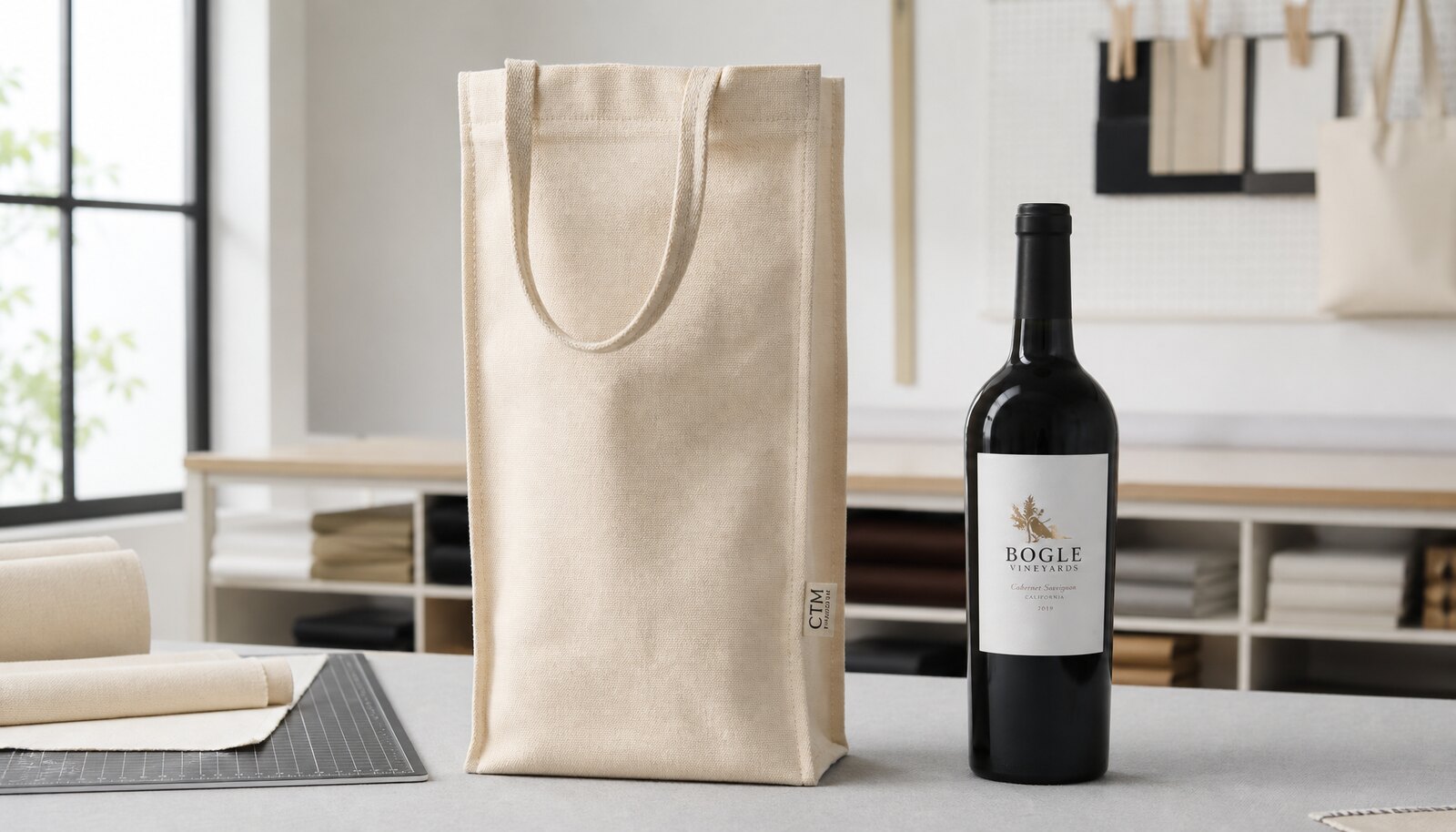
What canvas wine bags solve for ecommerce buyers
For ecommerce, canvas wine bags are rarely just packaging. They shape the first impression, protect the bottle during parcel handling, and create the reusable value that can make a gift bundle feel more complete. Buyers often use them for seasonal promotions, private label wine accessories, gifting sets, subscription inserts, or retail add-ons. In each case, the bag has to do three jobs at once: fit the bottle, carry the brand message, and arrive looking clean after transport. That is why the sourcing brief should start with bottle dimensions, use case, and packing flow before artwork is even discussed.
The common mistake is treating every wine bag as interchangeable. A lightweight promo pouch may work for a short holiday campaign, but it can fail in a retail bundle if the seams twist, the print looks faded on rough canvas, or the bag collapses around the bottle. If the product moves through DTC fulfillment, Amazon, retail replenishment, or subscription kitting, the bag must be specified like any other component in the packout. Otherwise a supplier can technically deliver the right item while still producing an unsellable result.
For procurement teams, the practical question is not whether canvas looks premium in the abstract. The real question is whether the bag can be repeated across lots without drift in fabric shade, seam finish, or packing count. That is why buyers need a spec sheet with measurable details, not just a product name and a logo file.
- Define the end use first: gift packaging, add-on accessory, retail SKU, or subscription insert.
- Measure the bottle, not just the label size: height, shoulder width, and base diameter matter.
- Decide whether the bag is meant to hide the bottle, frame it, or provide reusable carry value.
- Map the fulfillment path: factory-packed, warehouse-repacked, or store-ready off the line.
Fabric weight, weave, and finish: what changes the quote
Canvas wine bags for ecommerce are commonly built from 10 oz to 12 oz canvas, which is roughly 340-400 GSM finished weight. That range is usually strong enough to hold shape, print cleanly, and survive normal fulfillment handling without feeling overbuilt. Below that range, the bag may look soft or collapse around the bottle. Above it, the bag becomes more expensive and can slow cutting and sewing, especially when the design includes side gussets, a drawstring top, or reinforced handles. Buyers should ask the factory whether the weight is finished fabric weight, pre-wash weight, or greige weight, because those numbers are not interchangeable.
Weave and finish matter just as much as weight. A tighter weave tends to show logos more cleanly and reduces the chance of obvious pinholes or uneven print fill. A washed or distressed finish may look attractive in retail photography, but it can also increase variation from bag to bag and make shade matching harder. Natural canvas usually gives the easiest baseline, but if the program uses dyed or bleached fabric, request lab dip confirmation and a view of the fabric under normal daylight, not just under factory lamps.
Construction details should be part of the fabric decision. A simple open-top bag with a side gusset and reinforced hem quotes lower than a drawstring bag, a padded insert style, or a double-layer base. If the wine bag is intended for repeated carry use, ask for the handle drop dimension, seam allowance, and reinforcement method at the bottom corners. These details affect both the perception of quality and the unit cost.
- 10 oz canvas is usually enough for light gift use and lower unit cost.
- 12 oz canvas is a safer default for premium retail or repeated reuse.
- Ask whether the quoted weight is finished fabric or raw fabric; the two are not the same.
- For dark-dyed canvas, request color consistency across panels before approving bulk.
- Request seam allowance and reinforcement details in writing, not only a sample image.
Construction specs buyers should ask for before comparing quotes
A lot of quote comparisons fail because the suppliers are not quoting the same construction. The bag may look similar in a photo, but the sewing can be very different. For procurement buyers, the key spec points are seam allowance, stitch density, handle reinforcement, top hem width, corner finishing, and whether the bag uses a single-layer or double-layer opening. These details affect strength, appearance, and labor content far more than a marketing description does.
A practical RFQ should ask the supplier to name the seam allowance, thread type, and stitch density in measurable terms. For example, a buyer can request a seam allowance of 10-12 mm, a consistent stitch count in the range of 8-10 stitches per 25 mm for standard seams, and bar-tacks or back-tacks at handle joins. The exact target can vary by factory capability and bag style, but the buyer should not accept a quote that does not state the construction standard. If the quote only says “strong stitching,” there is no reliable basis for bulk acceptance later.
Reinforcement is especially important at the handles and the bottom seam. Ask where the factory places back-tacks or bar-tacks, how long those reinforcements are, and whether the ends are visually trimmed cleanly. For a bag that may be picked up and set down multiple times, weak attachment points are one of the most common reasons for complaints. If the design includes a drawstring, ask how the cord ends are finished and whether the channel is stitched to prevent fraying or twisting.
- Ask for seam allowance in millimeters and stitch density in a measurable range.
- Require reinforcement detail at handle ends, bottom corners, and any drawstring channel.
- Confirm whether top hem is single-fold or double-fold, since that changes appearance and price.
- Ask for thread type and color matching if visible topstitching is part of the design.
- If the bag uses a gusset, confirm the gusset depth and how it is pressed or formed.
Decoration methods: what works on rough canvas and what creates risk
Canvas is a textured substrate, so decoration method matters. For most canvas wine bags for ecommerce, 1 to 2 color screen print is the most practical option for logos, seasonal copy, and simple brand marks. It is cost-effective, repeatable, and usually strong enough to survive normal handling. However, the roughness of canvas can distort fine lines, small type, and delicate icon details. Buyers should therefore request a strike-off or pre-production print sample if the artwork has thin strokes, knockouts, or closely spaced text.
Woven labels and sewn-on labels are a good alternative when the design is too detailed for direct print or when the brand wants a more premium finish. They usually cost more than a simple print, but they can reduce the risk of color bleed and registration drift. Embroidery can create a stronger tactile impression, but it adds thickness, changes sewing complexity, and may not suit small logos. Heat transfer can work on short runs or complex graphics, but on rough canvas it often needs tighter process control and may age less gracefully if the bag is repeatedly handled in shipping or at retail.
The buyer-side rule is simple: match the artwork to the substrate. If the design depends on gradients, tiny lettering, or photo-like detail, canvas may not be the right decoration surface unless the supplier can show comparable production. If the bag is a repeat item, ask for a standard art tolerance and a physical approved sample kept on file. That reduces arguments later over whether a print shift is acceptable or not.
- Best all-around choice: 1-2 color screen print for logos and simple graphics.
- Use woven or sewn labels if the logo contains fine type or small icon details.
- Request print position tolerance in millimeters, not just a visual approval.
- Avoid overcomplicated artwork on rough canvas unless the factory has proven results.
- Ask whether the print ink sits on top of the weave or partially sinks in, because that changes appearance and wash behavior.
MOQ, dye lots, and why low quotes can hide extra cost
MOQ for custom wine bags is not just a number on a quote. It is tied to fabric sourcing, print screen setup, cutting efficiency, and packing labor. A factory can often offer better pricing when the order is large enough to absorb setup cost across more pieces. For ecommerce buyers, a realistic starting point is often 3,000 to 5,000 pieces per style and color if customization is moderate. If you want multiple artwork versions, special dye colors, or custom retail packing, the economic minimum is usually higher than the headline MOQ suggests.
When comparing suppliers, separate true manufacturing MOQ from marketing MOQ. Some vendors will accept a small order but limit the number of print colors, restrict material options, or charge extra for individual bag packing. That can be acceptable for a test launch if it is clearly disclosed. It becomes a problem when the sample looks premium but the bulk order quietly shifts to thinner fabric, simpler stitching, or a different handle construction. Buyers should request a line-item quote that makes those tradeoffs visible.
Dye lots are another source of hidden risk. Natural canvas still varies, but dyed or washed canvas can shift between runs if the mill batch changes. For a program with multiple colorways, ask whether the factory will hold fabric from the same dye lot for the first lot and whether it can reserve material for repeat orders. If the answer is unclear, treat the reorder risk as part of the sourcing decision, not an afterthought.
- Ask for MOQ by style, color, and print version.
- Check whether the quoted price assumes standard bulk packing only.
- Confirm if special colors require dye-lot minimums or fabric surcharges.
- Treat a very low MOQ as a test order, not a benchmark for future scaling.
- Ask whether repeat orders can match the same fabric lot or only the same color standard.
Sourcing routes compared: factory, trader, and stock programs
The right sourcing route depends on control, speed, and how much variation your brand can tolerate. Direct factory sourcing is usually the strongest choice for custom ecommerce programs because it gives the buyer more control over fabric weight, print placement, seam details, and packing configuration. It also makes issue resolution easier because the same party that quotes the job is responsible for cutting, sewing, and packing. The tradeoff is that factories may require clearer specs and may not be as flexible on tiny runs or mixed-item consolidation.
A trading company can help if you need a broader product mix, multiple factories, or easier communication across languages and time zones. The downside is that a trader may not control every step of the process, so a material mismatch or packing issue can take longer to trace. Domestic stock wholesalers are fastest for urgent launches, but they usually offer less customization and less control over exact bag dimensions, decoration method, or carton configuration. Stock sourcing is helpful for speed, not for long-term brand consistency.
For a repeat program, the sourcing route matters as much as the first sample. A supplier that cannot repeat the same canvas shade, stitch quality, or carton count can cause avoidable receiving issues on replenishment. The decision should therefore be based on the full production path, not only on unit price.
- Use direct factory sourcing when repeatability and spec control matter most.
- Use a trader only if the communication benefit or multi-item consolidation is real.
- Use stock sourcing for urgent launch timing, not for custom brand accuracy.
- Ask who owns QC, what is outsourced, and where final packing happens.
- Confirm whether the factory keeps archived samples and production records for reorders.
Supplier option comparison for procurement buyers
The table below is designed for buyers comparing route, risk, and commercial timing. It includes the tradeoffs that often matter more than the nominal unit price: what you can control, how fast you can start, what type of inspection you will need, and which supplier type is most likely to repeat the same result on a second order. In procurement, the cheapest quote is only useful if the supplier can hold the same spec through production and replenishment.
Use this comparison to push suppliers into measurable answers. If a supplier promises low MOQ, fast lead time, and premium finishing all at once, ask exactly where the saving comes from. It may be genuine stock availability, but it may also mean thinner fabric, simpler reinforcement, or lower packing accuracy.
- Write decisions in measurable language, not only descriptive wording.
- Ask for sample photos plus one physical approval sample for important orders.
- Keep quotation, sample approval, and inspection notes tied to the same spec version.
- Compare lead time together with fabric availability, not after the quote is accepted.
What a useful factory quote should include
A useful quote for canvas wine bags for ecommerce should break out material, decoration, sewing, packing, and carton details. If a supplier only gives one flat price, you cannot tell whether the quote includes a heavier canvas, reinforced stitching, a higher-cost print method, or retail-ready packing. That makes landed cost comparison unreliable. Two quotes can look similar on paper while one includes a much better construction standard than the other.
The quote should show unit price by quantity tier, sample fee, setup fee for printing or labels, packaging cost, expected lead time, carton quantity, and carton dimensions. It should also state what is excluded: freight, import duty, customs clearance, third-party inspection, and any artwork conversion or plate cost. If the supplier wants to charge separately for sewing, printing, and packing, that is fine as long as the buyer gets the breakouts in advance. The problem is not separate pricing; the problem is hidden pricing.
For procurement teams, the cleanest quote is one that can be copied into a comparison sheet without interpretation. Ask the factory to use the same naming convention for style, size, color, print version, and packing unit across all lines. That reduces the chance of a later mismatch between the quote, purchase order, and packing list.
- Compare unit price at the same MOQ and same packing method.
- Separate sample cost from bulk pricing.
- Make sure the quote names the exact canvas weight and closure style.
- If freight is excluded, ask for carton count and carton size so landed cost can be estimated.
- Ask for a quote version number so later revisions can be tracked cleanly.
Sample approval: what to inspect before bulk release
The pre-production sample is not just a visual approval; it is the only reliable chance to verify fabric handfeel, bottle fit, stitching behavior, print result, and packing presentation before bulk cutting begins. For canvas wine bags, the most common issue is scale. A bag can look fine flat on a table but become too tight or too loose once a bottle is inserted. The second common issue is print behavior on rough canvas, where fine details can blur or shift slightly compared with the proof. Buyers should test the sample with the actual bottle or a dimensionally accurate dummy and should not approve by photo alone unless the bag is a simple stock item.
A strong approval process uses one sealed golden sample and one working sample for internal review. The golden sample should include the final fabric, final print, final stitch construction, and final packing presentation if packing is part of the order. Keep it signed and dated. If the supplier changes fabric shade, print method, or handle construction after approval, that change should be called out in writing and only accepted if the buyer signs a revision. Otherwise the bulk lot should be considered off-spec.
The sample review should also include a quick assembly test. Fill the bag, close it if applicable, lift it by the handle, and check whether the seams deform or the opening loosens. If the project uses a drawstring, open and close it several times to see whether the channel twists. These are simple buyer-side checks that catch problems before production scales up.
- Check bottle fit with the actual bottle or a dimensionally accurate dummy.
- Inspect stitch density at handles, side seams, and bottom seam.
- Measure print placement against a marked reference line.
- Approve packing format only after the sample includes labels, inserts, and carton marks if those are part of the order.
- Keep a signed golden sample and a second sample for internal reference.
Packing formats, carton configuration, and warehouse impact
Packing is often underestimated in wine bag programs. A bulk-packed canvas bag is usually the lowest-cost option and works well when a warehouse will rework, kit, or relabel the product later. Retail-ready polybagging, hangtags, and size stickers improve shelf readiness and can help with marketplace or store receiving, but they also add labor, plastic, and carton volume. If your fulfillment center will do the final prep anyway, factory retail packing may be unnecessary. If the bags ship directly to stores or are counted as individual sellable units, the packing spec belongs in the RFQ from the start.
Packing changes carton configuration more than many buyers expect. A bag with cotton rope handles may compress differently from a flat-fold canvas pouch, so the outer carton count can shift. If the bags include inserts, tissue, warning cards, or barcode labels, the inner pack count and outer carton count may need to change again. Buyers should ask the factory to state whether bags are flat-packed, pre-shaped, or compressed in a defined way so that the receiving team knows what to expect. Carton dimensions should be chosen for both protection and freight efficiency, not only for factory convenience.
A sensible packing spec includes master carton marks, inner pack count, outer carton count, carton dimensions, and any palletization requirement if the shipment will move through a warehouse network. If the product is small enough, a 5-ply or 7-ply carton decision may matter too, especially for long transit or mixed freight. Buyers should match the carton spec to the route and handling conditions rather than leaving it open to supplier default.
- Bulk pack lowers cost and usually suits warehouse repacking.
- Retail polybags improve shelf readiness but increase labor and plastic use.
- Require master carton marks with style, quantity, and carton number range.
- Confirm whether flat-fold or pre-shaped packing is used for final shipment.
- Ask for carton count, carton dimensions, and whether compression affects bottle fit after unpacking.
Specification comparison for buyers
| Spec decision | Recommended option | When it fits | Buyer risk to check | Typical price / lead-time tradeoff |
|---|---|---|---|---|
| Fabric weight | 10 oz to 12 oz canvas, usually about 340-400 GSM finished weight | Most ecommerce wine gift programs, reusable retail packaging, and private label launches | Too light and the bag feels thin or wrinkles badly; too heavy raises unit cost and slows sewing | Lower cost and faster sewing at 10 oz; better structure but slightly higher cost and longer sewing time at 12 oz |
| Sourcing route | Direct factory with pre-production sampling and in-house sewing/packing | You need control over fabric, print placement, seam details, and carton configuration | A trading layer can hide the true material source and make quote comparison harder | Best for repeat programs; usually steadier lead time, while trader quotes may look flexible but add markup and slower issue resolution |
| Decoration method | 1 to 2 color screen print or woven/sewn label for clean branding | Simple logos, seasonal SKUs, and repeat orders with stable artwork | Fine lines, gradients, and small text can print poorly or shift on rough canvas | Screen print is usually lowest cost; labels add cost but reduce artwork risk and often shorten approval debates |
| Closure style | Open-top with gusset or drawstring closure | Open-top suits fast packing and retail display; drawstring suits gift presentation | Closure changes sewing time, bottle fit, and carton packing count | Open-top is usually faster and cheaper; drawstring adds labor and can extend lead time |
| Handle option | Self-fabric handles or cotton rope handles with reinforced stitching | Ecommerce orders where the bag may be carried after gifting | Weak bar-tack count or short handle drop can cause customer complaints | Self-fabric handles are cheaper and quicker; rope handles feel premium but increase sewing time |
| MOQ strategy | Start with 3,000 to 5,000 pcs per color/style if customization is moderate | Brand test runs, marketplace launches, and seasonal campaigns | Low MOQ quotes may exclude real print setup, fabric dye lot limits, or packing labor | Lower MOQ often means higher unit price and less scheduling leverage with the factory |
| Sample approval route | Pre-production sample plus sealed golden sample | First run, new artwork, or new supplier onboarding | If the sample is approved only by photos, fabric shade and stitching tolerance can drift | Sampling adds time up front but reduces rework, returns, and warehouse disputes later |
| Packing format | Bulk-packed with size labels and master carton marks, or retail polybag if required | Warehouses that rework or kitting operations that add inserts later | Retail polybags can increase labor, plastic cost, and carton size if not specified early | Bulk pack is usually cheaper and faster; retail-ready packing raises labor and can extend lead time |
| Supplier choice | Factory with in-house cutting, printing, sewing, QC, and packing | Program needs stable lead time and lower defect risk | Split production across subcontractors increases mismatch in color, print registration, and packing count | Factory sourcing usually gives better repeatability; trader/stock routes can be quicker but less controlled |
Buyer checklist before sampling
- Confirm wine bottle size: standard 750 ml, magnum, or mixed bottle program, and provide bottle diameter and height.
- Specify canvas weight in GSM or oz, plus whether you want bleached white, natural, dyed, or washed finish.
- Lock artwork limits: number of print colors, logo size, placement, and whether you need both sides printed.
- Define handle style, closure style, and whether an inner divider or insert board is needed for gift packs.
- State MOQ by color and by print version, not only total order quantity.
- Require a pre-production sample, sewing spec sheet, and carton packing plan before bulk approval.
- Ask for defect tolerance, carton drop-test approach, and inspection method for print alignment and stitch quality.
- Confirm seam allowance, bar-tack count, thread type, and reinforcement at handle ends and bottom corners.
- Ask the factory to state carton quantity, carton dimensions, and whether bags are flat-packed or pre-shaped for shipping.
- Request a signed golden sample or sealed reference sample so bulk production can be matched against one physical standard.
Factory quote questions to send
- What exact canvas weight do you quote, and is it finished GSM or greige fabric weight?
- Is your quote based on direct factory production, or are any steps outsourced?
- How many print colors are included, and what is the setup charge per color?
- What is the MOQ per color, per artwork, and per packing style?
- Can you share the sewing construction: seam allowance, bar-tacks, handle reinforcement, top hem width, and thread type?
- What packing do you include by default: bulk pack, inner polybag, size sticker, carton mark, or retail hangtag?
- What sample lead time do you need, and what changes trigger a new sample fee?
- What are your standard carton dimensions and outer carton quantity for this wine bag model?
- Which QC points are accepted before shipment, and can you share an inspection report template?
- Can you confirm whether the quote includes cutting, printing, sewing, finishing, packing, and carton labeling as separate or bundled costs?
Quality-control points to confirm
- Fabric weight should match the approved sample within a practical tolerance agreed in the PO; a visibly thinner cloth is not acceptable even if the quote is lower.
- Measure fabric with a consistent method and record whether the result is finished fabric weight or before-wash / greige weight so the factory cannot switch units mid-discussion.
- Seam strength at the bottom gusset, side seams, and handle joins should be reinforced with consistent stitch density and clean back-tacks; ask the factory to state stitch count per inch or stitches per 3 cm on the spec sheet.
- Handle reinforcement should include a defined bar-tack length and count at each attachment point; a single short tack is not enough for repeated carry use.
- Print placement should remain centered and consistent across the batch; use a measurement tolerance such as ±3 mm to ±5 mm from the approved reference, depending on artwork size and bag style.
- Print coverage should not leave broken edges, smearing, or visible off-register layers beyond the approved tolerance; small logos on rough canvas need a strike-off checked under normal viewing distance.
- Bag opening and bottle fit should match the approved bottle dimensions with enough clearance for easy insertion but without excessive looseness; test with an actual bottle or dimensionally accurate dummy.
- Color should match the approved lab dip or sealed sample across panels and repeat lots; natural canvas can still vary, but the variation should not look uneven within one carton.
- Packing count should be verified carton by carton, especially if polybags, inserts, or hangtags are included; ask for inner pack count and outer carton count on the packing list.
- Labels, care marks, and barcodes should match the order sheet and be positioned consistently for warehouse receiving; check that carton marks match SKU, color, and quantity before dispatch.