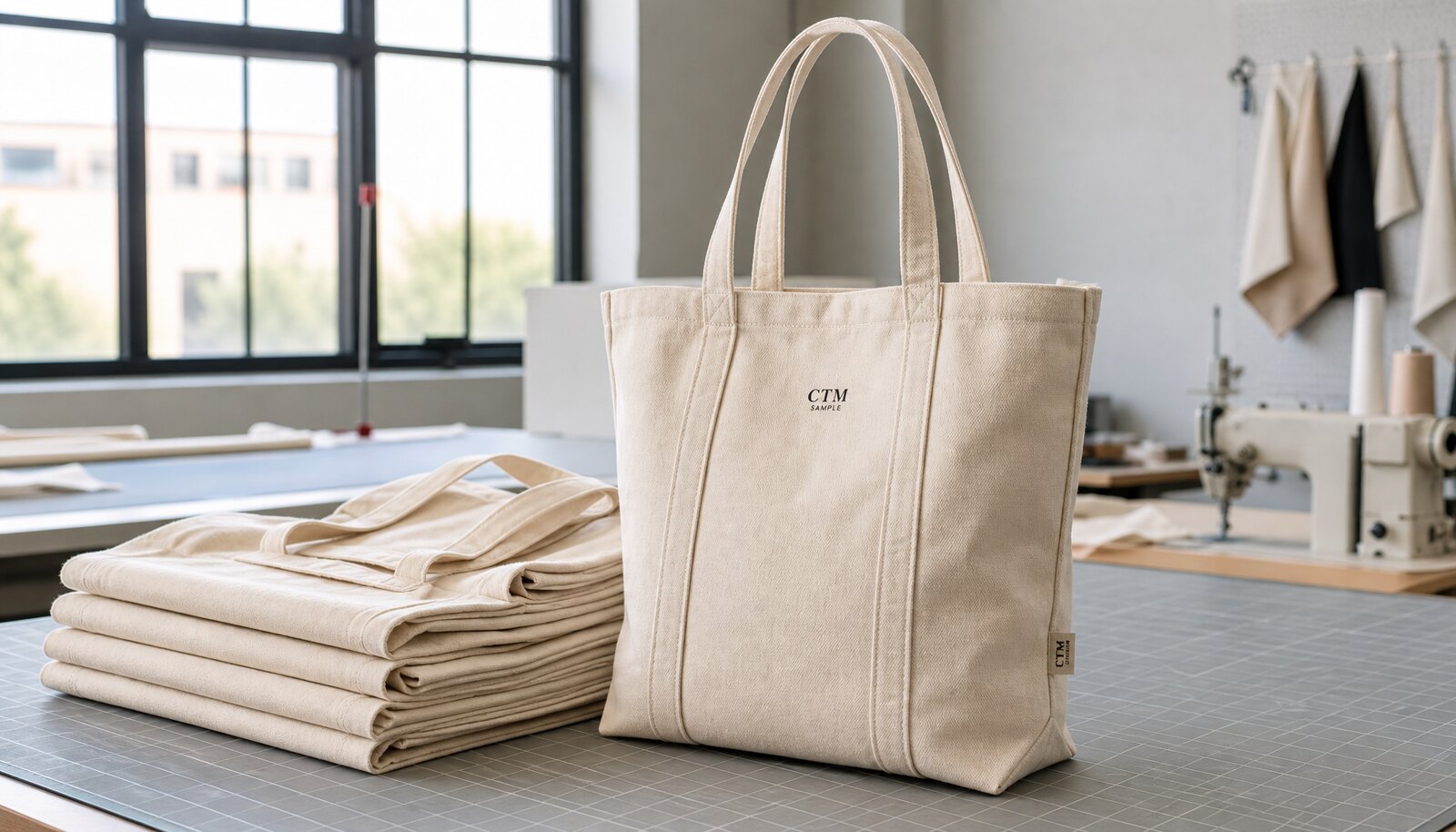
Start with the bag’s job, not the supplier’s default spec
A reorder memo works only when it reflects how the bag is actually used. For farmers market programs, canvas tote bags are not just display items. They get loaded with produce, jars, herbs, bread, flowers, and mixed groceries. They are folded, set on tables, carried over the shoulder, stuffed into car trunks, and reused. That use pattern changes the buying logic. A bag that looks fine in a product photo can still disappoint in real use if the body collapses, the handle length is wrong, or the print starts to crack after a few folds.
Before you ask for quotes, define the use case in plain procurement language. Is this a resale item, a give-away, a vendor carry bag, or a staff bag? Will the bag carry heavy items such as jars and cartons, or mostly light produce? Does it need to stand upright for merchandising? Will it be washed? Those questions determine the right canvas weight, handle reinforcement, and print method far more than a generic 'tote bag' label does.
Buyers also need to think in terms of repeatability. A one-off event bag can tolerate more flexibility than a program you plan to reorder every season. For repeat orders, the risk is not just defects on a single run. It is drift: a slightly thinner fabric lot, a longer handle on one reorder, or a different print feel because the supplier changed ink or curing settings. The memo should be written to prevent drift, not just to approve a first sample.
- State the heaviest common load, not the average load, before approving construction.
- Separate retail resale bags from bags used only as free promotional items.
- Define whether the bag must hold shape upright or whether a flat-fold bag is acceptable.
- Record the expected re-order cadence: monthly, seasonal, or ad hoc.
- Treat handle comfort and shoulder carry as a real requirement, not a nice-to-have.
Lock the canvas construction before asking for price
The fastest way to get useless quotes is to request pricing with only a loose phrase like 'heavy canvas.' You need a measurable construction spec. For sourcing, that means fabric weight in ounces or GSM, weave type, finish, and acceptable tolerance. It also means understanding that the same listed weight can behave differently depending on yarn quality, weave density, and finishing. Two suppliers can both say '10 oz canvas' and deliver very different bag feel and durability.
For tote programs used in farmers markets, a mid-to-heavier canvas usually makes sense when the bag is sold as a reusable retail item. Buyers often want enough body for the bag to open cleanly on a table, enough surface stability for print, and enough strength for repeated carry. Lighter canvas can work for promotions or short-cycle events, but it needs tighter expectations on load and seam security. If your team is comparing suppliers, weight alone is not enough. You also need a target hand feel, whether the canvas is natural or finished, and whether prewashing or dyeing is part of the construction.
The cleanest RFQ practice is to specify the fabric in a way the factory can source consistently. Ask whether the fabric will come from one mill lot or whether the factory plans to split sourcing. Ask for mill origin if available, and ask whether the supplier can provide any basic fabric test data, such as shrinkage, colorfastness, or rub resistance. If the bag is natural canvas, ask how much visible slub, seed speck, or shade variation is typical and what the supplier considers acceptable. Those details matter more than a broad statement that the canvas is 'premium.'
- Use oz or GSM plus tolerance, not a vague quality phrase.
- Ask for yarn quality, weave density, and finish description, not only fabric weight.
- For dyed or washed canvas, request shrinkage and colorfastness expectations upfront.
- Confirm whether the bag needs a firm body or a softer hand.
Size, gusset, and handle specs should be written like a production drawing
Many tote problems start with dimensional ambiguity. A buyer says the bag should be 'medium size' or 'large enough for produce,' and the factory fills in the gaps. That is where reorders become inconsistent. For canvas tote bags used at farmers markets, the finished size should be written with width, height, and gusset depth. Handle length and handle drop should be listed separately, because those two numbers determine whether the bag is easy to shoulder-carry when full.
Gusset depth is especially important. A shallow tote may look neat but can be frustrating for produce or mixed grocery use because it does not open well or stand steadily. A wider gusset can improve usability, but it also changes fabric consumption and carton cube. The buyer should choose the gusset based on actual contents, not just appearance. If the tote is intended for flat items such as books or event materials, a modest gusset may be enough. If it is for market shopping, the gusset must support practical load shape.
Handle construction deserves the same discipline. Self-fabric handles, webbing handles, folded handles, and longer shoulder-drop handles all behave differently in use and cost differently to make. Handle width matters for comfort. Reinforcement matters for load safety. And the attachment point matters for durability. A tote that carries well in the hand can still fail on the shoulder if the drop is too short or the reinforcement is weak. Put those dimensions in the spec, not in the margin.
- Specify finished width, height, gusset depth, handle length, and handle drop.
- State whether the tote must be hand-carry, shoulder-carry, or both.
- Define handle width and the reinforcement style at the attachment point.
- Ask for a measured production sketch from the factory before sample approval.
Choose a sourcing route that matches reorder stability and QC control
Not every supplier route is suitable for a repeat tote program. A direct cut-and-sew factory with in-house printing is often the simplest choice when the product spec is stable. It usually gives better control over the details that matter in a reorder: fabric reservation, stitch consistency, print registration, and packing. It also tends to make corrective action easier if the second run differs from the first. When the same site handles the job from fabric through packing, accountability is clearer.
A trading company can still be useful when the order includes several bag styles, multiple decoration methods, or a broader promotional program. The value is coordination, especially if procurement wants a single point of contact. The tradeoff is that the actual production site can change, and the approved sample may not come from the exact same line that builds the reorder. That can create variance if the trading company is not strict about process control.
For buyers, the real question is not 'factory or trading company' in the abstract. It is which route gives the best control over repeatability, response time, and corrective action. If the program is likely to reorder often, you want a sourcing partner that can freeze the core spec, repeat the same print setup, and provide consistent pack counts. If you need rapid changes across several tote families, a managed sourcing route may be worth the extra oversight, but only if the final QC owner is clearly named.
- Use direct factory sourcing when the spec is stable and the reorder pattern is predictable.
- Use a managed sourcing route only if final QC ownership is clearly defined.
- Ask whether the sample will be built by the same line that will make production.
- Confirm which party answers for defects after delivery.
Compare quotes on landed cost, not just ex-factory price
A tote quote can look attractive until you put all the cost pieces side by side. For canvas bags, the ex-factory unit price is only one part of the picture. Print setup, carton configuration, packing method, inner polybags, labels, freight cube, and even how the bags are folded can change landed cost. A bag that is cheaper to make per unit may end up more expensive to ship if the carton pack is inefficient or the finished bag takes too much cube.
Procurement teams should ask for a quote format that breaks out the cost drivers. The supplier should show the blank bag price, print cost by color, setup or plate charge, packing cost, and any label or insert cost. Then compare the same spec across suppliers. If one supplier is quoting a heavier fabric, one is quoting a tighter pack, and one is including print setup in the unit price, the numbers are not comparable. The buyer needs a clean apples-to-apples sheet.
Landed-cost modeling also matters for reorder planning. A program that sells through market stalls or retail partners may have thin margin tolerance, so a small change in freight or carton volume can move the margin materially. If you know your target sell price, you can work backward from landed cost and see whether the order size, fabric choice, and pack format still make sense. That is better than approving the lowest quote and hoping the margin survives transport and handling.
- Request separate lines for blank bag, print setup, packing, and carton cost.
- Compare landed cost using the same bag spec and same pack format.
- Ask for carton dimensions before freight booking.
- Check whether the supplier includes or excludes local inland transport at origin.
Use a comparison matrix that helps you choose the right supply path
The table below is intended to support sourcing decisions, not just list options. Each row asks a different question a procurement buyer should answer before placing or reordering canvas tote bags. The goal is to prevent the common mistake of comparing only unit price while ignoring repeatability, QC risk, and schedule impact. For this product category, those hidden costs often matter more than the headline quote.
In practice, the best supplier is not always the cheapest one and not always the one with the longest tote resume. It is the supplier that can repeat the same bag, pass inspection, and keep the program on schedule without inflating landed cost. That is especially important when the bags are tied to a farmers market calendar, seasonal promotion, or retail launch window.
- Use the table to compare the way the supplier works, not only what they say they can make.
- If a quote is lower but the pack is less efficient, ask for a revised landed-cost view.
- Tie the sourcing path to repeat order stability, not just first-order convenience.
Build MOQ logic around sell-through and seasonality, not supplier pressure
MOQ is often treated as a supplier number, but for repeat tote orders it should be a buyer planning decision. The right lot size is the smallest order that keeps your unit cost, service level, and inventory risk in balance. Farmers market demand can be seasonal, weather-sensitive, and region-specific. A large opening order can make sense if the bag is a core retail item with steady movement, but it can be risky if demand is tied to a short market season or a one-time event.
The key is to separate the bag body from the decoration. If the core tote is stable, you can sometimes reorder the same blank bag and change only the print or label for different campaigns. That reduces dead stock and helps you keep the same fabric and sewing spec. If the bag body changes often, every new version may trigger a fresh MOQ, a fresh sample, and a different inventory profile. That is why buyers should define what is frozen and what is variable before they ask for volume pricing.
A useful reorder rule is to plan backward from sell-through, not forward from wishful volume. Estimate the monthly or seasonal sell-through rate, add production and freight time, and then add a buffer for delay. If your stock level falls below that buffer, you are already late. The point is to trigger the next order early enough that you can absorb transit variation, sample delay, or artwork correction without losing the selling window.
- Keep the core bag spec frozen if you want easier repeat ordering.
- Treat print changes as a separate MOQ and approval decision.
- Use sell-through rate plus lead time to set the reorder point.
- Avoid overcommitting to a single oversized SKU when channel demand differs.
Treat samples as a production control tool, not a box-checking step
For canvas tote reorders, sample approval is where many expensive mistakes can still be prevented. A blank sample should confirm the sewing, size, gusset depth, handle length, and reinforcement. A decorated sample should confirm print placement, color density, edge sharpness, and ink cure. If the supplier uses a different process for the sample than for production, the sample is less useful, so ask how the sample is built and whether it comes from the same method planned for bulk work.
Physical checking is better than relying on photos, especially when the bag is natural canvas. The hand feel of the fabric, the fullness of the weave, and the quality of the handle attachment are hard to judge from an image. Compare the sample against the previous approved reference if the order is a reorder. That is more reliable than comparing to memory, because subtle drift is easy to miss when teams are busy or when different people are reviewing the order.
If your program includes a printed logo, ask for a print strike-off or pre-production sample if the artwork or ink system changed. Then inspect it under the light conditions that matter to your retail or warehouse team. A logo that looks acceptable on a bright workbench can read differently in a market stall or under store lighting. You are not approving art in the abstract; you are approving how the finished bag will look in the real channel.
- Approve a blank sample for construction and a printed sample for decoration.
- Measure the sample directly; do not rely on photo approval alone.
- Compare reorders against the last approved physical reference.
- Confirm whether the sample was made with the same fabric lot and print process as production.
Write QC requirements the factory can actually inspect against
Quality control for tote bags should be specific enough to enforce and simple enough for the factory to understand. A good memo separates functional defects from cosmetic variation. Functional defects are the ones that threaten use: open seams, weak handle attachment, wrong dimensions, missing prints, or major staining. Cosmetic variation includes minor shade differences in natural canvas or slight texture variation that does not affect use. If you do not draw that line, every inspection becomes subjective.
The practical QC checklist should cover measurement, stitching, print, fabric defects, and packaging. For size, set a tolerance band before production starts. For stitching, define what counts as unacceptable: skipped stitches, loose thread tails, open seam ends, or uneven reinforcement. For print, specify the acceptable centering window and color expectation. If a bag will be loaded with produce or market goods, include a simple loaded-carry test so the team can see whether the handle anchors and seams hold after stress.
It is also worth using a formal inspection language such as AQL or an equivalent agreed inspection method. The exact number matters less than having one standard the buyer and factory both accept. If the supplier understands that a certain number of major defects will trigger rejection or rework, there is less room for dispute after the goods arrive. Ask for the defect categories in writing before production, not after an issue appears. Then align carton count, label data, and pack consistency with the same inspection standard.
- Define major defects and minor defects before production starts.
- Use an agreed inspection method such as AQL or a clearly documented equivalent.
- Check seam integrity, print alignment, and bag dimensions on every sampled lot.
- Include a loaded-carry test for bags intended for real market use.
- Inspect carton marks and quantity against the packing list, not only the goods themselves.
Add fabric testing, color control, and wash checks to the memo
If the tote is more than a one-time giveaway, basic fabric testing is worth including in the sourcing memo. Buyers do not need a full lab program for every order, but they do need enough evidence to avoid obvious surprises. Ask the supplier what fabric checks are already available: shrinkage after wash, colorfastness if dyed, and rub resistance if the bag has printed or colored areas. If the order will be repeated, ask whether the fabric or print system has changed since the last run.
For natural canvas, color control may sound simple, but even undyed fabric can vary in shade, surface specks, and yarn appearance. If the bags are all the same base color, agree on a reference sample or limit the acceptable shade spread. If the bags are dyed or washed, define the target more tightly. Dyed canvas should not only match visually; it should also stay acceptable after handling, folding, or damp use. A bag carried at a market may get exposed to moisture, cold produce, or repeated folding, so the finish should survive realistic use, not just a static showroom check.
For print durability, the practical test is simple: fold the decorated area, inspect the print edge, and verify whether the ink cracks, transfers, or changes appearance. If the bag is expected to be washed or wiped repeatedly, include that condition in the sample evaluation. Even if the supplier does not provide a formal lab report, the buyer can still ask for a basic proof-of-performance sample, and the memo should say what will be checked when it arrives.
- Ask for shrinkage, rub resistance, and colorfastness data when the order justifies it.
- Set a shade reference for natural, dyed, or washed canvas.
- Fold the printed area during sample review to check cracking or transfer.
- Use the same review conditions that the tote will face in real use.
Specification comparison for buyers
| Decision area | Option to consider | Best fit | Procurement implications | QC / sourcing watchout |
|---|---|---|---|---|
| Supplier route | Direct cut-and-sew factory with in-house printing | Stable repeat orders where the same bag, artwork, and pack style recur | Usually easier to keep construction, print registration, and packing consistent; often simpler to manage reorders and corrective actions | Confirm whether fabric, sewing, printing, and packing all happen onsite or whether any step is subcontracted |
| Supplier route | Trading company with managed factory network | Programs that need several tote variations or mixed product families under one PO | Can simplify admin across multiple SKUs, but quote comparability is weaker if each run may come from a different plant | Ask who owns final QC, which factory made the approved sample, and whether the same site will repeat production |
| Fabric construction | Plain weave canvas, 8 oz class | Promotional or light retail use where cost and foldability matter more than stiffness | Lower material cost and easier folding, but less body and less margin for heavy carry use | Verify yarn quality, weave consistency, and seam security; a low-grade 8 oz canvas can feel weaker than expected |
| Fabric construction | Heavier plain weave canvas, 10 to 12 oz class | Retail resale or customer-purchase bags that need better shape retention and a stronger hand | Better perceived value and better print surface, but higher fabric cost and sometimes longer cutting/sewing time | Do not accept a vague 'heavy canvas' description; require a target weight, tolerance, and finish description |
| Fabric origin / finish | Undyed natural canvas with no extra wash | Most programs where buyers want neutral appearance and simpler replenishment | Usually easier to reorder because the fabric is broadly available and less likely to have finish drift | Check for visible seed specks, slubs, and shade variation lot to lot; align acceptance limits before approval |
| Fabric origin / finish | Bleached, dyed, or washed canvas | Brand-sensitive programs that need a specific aesthetic or softer hand feel | Can raise cost and extend lead time because color matching and finishing add variables | Require color standard, shade band, wash shrinkage data, and rub / crocking expectations |
| Handle construction | Self-fabric handles with reinforcement | Classic tote appearance, good for retail branding, and easier visual consistency | Can be cost-effective, but handle width, fold, and reinforcement need to be specified clearly | Check handle cut width, finished width after folding, and bar-tack or box-X reinforcement at stress points |
| Handle construction | Webbing handles | Programs needing better shoulder comfort or extra strength for repeated use | May cost more, but handle feel and durability can be better for heavier market loads | Confirm webbing fiber type, edge smoothness, colorfastness, and whether webbing is sewn over or fully embedded |
| Print method | Screen print, one to three spot colors | Repeatable reorders with simple logos and stable artwork | Usually the most predictable for repeat runs and easiest to compare across suppliers | Inspect registration drift, ink opacity, cure quality, and cracking after fold tests |
Buyer checklist before sampling
- Confirm the end use: customer-purchase retail bag, market give-away, or staff / vendor carry bag.
- Lock the fabric weight in oz or GSM, plus the acceptable tolerance, before sending the RFQ.
- Specify weave type, finish, color state, and whether the canvas must be washed, dyed, or left natural.
- State finished size, gusset depth, handle length, handle drop, and whether the bag must stand upright.
- Define handle construction, reinforcement method, and minimum stitch expectations in the spec sheet.
- Lock artwork size, side placement, number of print colors, and print method before asking for price.
- Ask for a blank sample, then a decorated sample, then a pre-production sample if anything changed.
- Request a landed-cost quote that separates unit price, print setup, packing, carton, and freight assumptions.
- Set inspection criteria for measurements, stitching, print alignment, and fabric defects before production starts.
- Build a reorder trigger that includes production time, freight time, buffer stock, and market-season demand.
Factory quote questions to send
- What exact fabric are you quoting: weight, weave, yarn quality, finish, and mill source if available?
- Is the canvas produced in one mill lot, or will you split sourcing across multiple fabric lots?
- What is the finished bag measurement tolerance for width, height, gusset, and handle length?
- Please quote blank bags separately from printed bags, and separate print setup from recurring production cost.
- What is the MOQ for the base bag, for each print color, and for any handle, lining, or label change?
- Is printing in-house, and if not, who is responsible for artwork alignment, cure control, and final approval?
- What sample stages do you offer: blank sample, strike-off, pre-production sample, and production reference?
- What is your standard lead time after sample approval, and what factors usually extend it?
- What carton pack, carton marks, and unit fold method are included in the quote?
- What inspection method do you use, and what defect categories are rejectable under your final QC standard?
Quality-control points to confirm
- Measure finished width, height, gusset, and handle drop against the approved spec, using an agreed tolerance band before packing release.
- Confirm canvas weight by supplier declaration and random physical verification against the approved sample or lab-cut reference.
- Check weave consistency for slubs, thin spots, broken yarns, and obvious loom defects that could affect print appearance or strength.
- Inspect stitching at side seams, bottom seams, handle anchors, and gusset corners for skipped stitches, loose ends, and open seam risk.
- Require reinforcement at handle stress points, typically bar-tack or box-X style attachment where load demand justifies it.
- Test print alignment, edge sharpness, registration, color density, and cure quality on the actual bag material, not only on print paper.
- Perform a loaded carry test with the intended use weight and carry orientation, then re-check handle seam integrity afterward.
- Review shrinkage after wash or wet handling if the bag will be exposed to repeated cleaning or damp produce handling.
- Check colorfastness or crocking on dyed or printed canvas, especially where the bag may rub against clothing or product packaging.
- Inspect final carton count, SKU labeling, carton strength, and pack consistency against the shipping and warehouse plan.