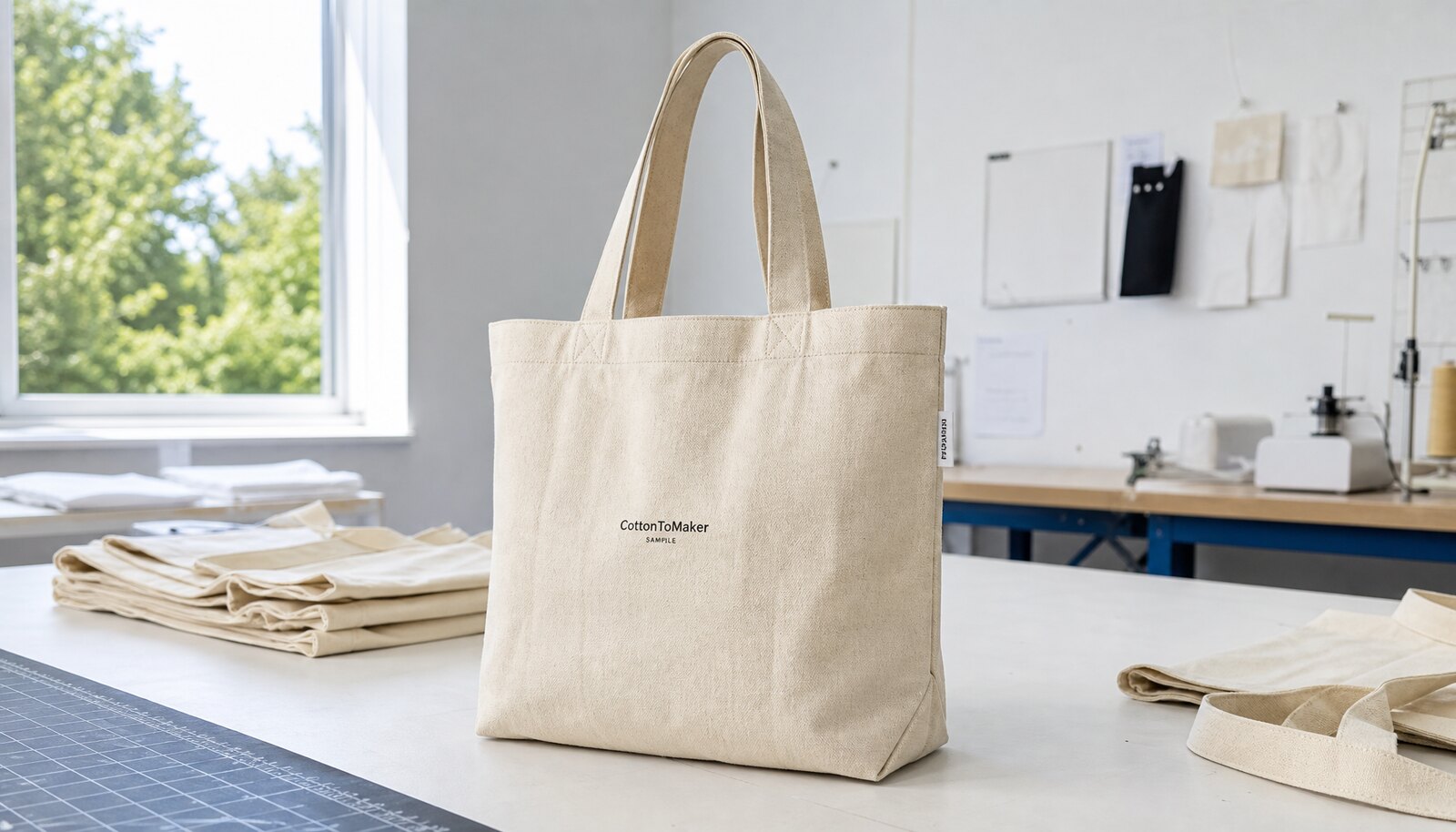
Start With the Tote's Job, Not the Fabric Roll
The right canvas tote is defined by the event it serves. A registration bag that carries flyers for two hours is not the same product as a library-style tote that needs to hold books, binders, and branded inserts through a full trade show day. If you start by asking for fabric weight before you define the use case, you usually buy the wrong thing: either too light to survive the load or too heavy for a giveaway that never needed premium structure. The better approach is to define what the attendee will actually put in the bag, how long it will be carried, and whether the tote is meant to be kept, reused, or discarded after the show.
For B2B buyers, that distinction matters because it changes the entire spec. A tote for a publisher, library program, or book fair often needs a stronger body, better handle comfort, and a cleaner print surface than a basic event giveaway. A tote used in a booth refresh or registration desk might prioritize low unit cost and quick packing instead. Once the job is clear, the rest of the sourcing conversation becomes much more precise: you can choose the right weave, set a realistic maximum load, and compare suppliers on the same commercial basis instead of on a vague "canvas tote" description.
- Define the tote by use case: giveaway, registration, retail, or book-carrying.
- State the intended load in real terms, not just "light" or "heavy."
- Decide whether the bag needs to feel premium, plain, reusable, or disposable after the event.
Read Canvas Beyond GSM
GSM is useful, but it is not enough on its own. Two canvases with the same nominal weight can behave differently if one has a tighter weave, thicker yarn, or a different finish. That is why a buyer should ask for both the weight and the construction. A tighter, denser weave usually prints cleaner and resists distortion better, while a looser weave may feel softer but can look more casual and show the contents more easily. If the supplier only gives you a single weight number, you still do not know how the tote will feel in hand or how it will hold up once loaded.
The finish matters almost as much as the fabric itself. Raw canvas can look authentic and cost-effective, but it may shrink, feel rough, or vary more between lots. Bleached canvas changes the color base and can improve graphic clarity, while washed or pre-shrunk canvas can improve hand feel and size stability. None of these options is automatically better. The right choice depends on whether the tote needs a natural retail look, a controlled printed surface, or a more polished finish for repeated use. Ask the factory to identify the actual production fabric, not just the marketing term they use for it.
- Ask for fabric construction, weave density, and finish, not only the ounce weight.
- Treat ounce-to-GSM conversions as approximate, because finish and weave can change how the fabric performs.
- Use a swatch or production sample to judge hand feel and print surface before approving bulk.
Use a Material Decision Matrix Instead of a Static Spec List
Most tote specs fail because they list parts instead of tradeoffs. A better sourcing matrix ties each material decision to a business outcome. For example, a midweight canvas may be the best overall option when the goal is a clean print, moderate load capacity, and stable pricing. A heavier canvas makes sense when the bag has to hold books or sample kits and still look presentable after repeated handling. A lighter canvas can work for short-carry programs, but it only saves money if the buyer is comfortable with lower structure and a more casual appearance.
This is also where procurement teams should think about decoration and timing together. Some fabrics print beautifully with simple one-color screen work and become expensive or unpredictable when the art is too detailed. Some finishes take ink cleanly but need extra approval because the shade base changes from lot to lot. When you compare options, do not ask only "which fabric is cheapest?" Ask which build gives the lowest total risk across unit cost, print quality, freight volume, defect rate, and reorder consistency. That is the decision a buyer actually has to make.
- Compare cost, durability, decoration quality, and lead-time impact in the same matrix.
- Use a heavier build only when the load and brand presentation justify it.
- Treat reorders as part of the decision, not an afterthought.
Match Handles and Structure to the Actual Load
Handles are where a tote either feels trustworthy or cheap. Thin handles can technically hold weight and still feel wrong in use because they dig into the hand, twist under load, or make the tote sag awkwardly on the shoulder. For trade show use, buyers should specify handle width, handle drop, and reinforcement at the join rather than assuming the factory will choose well. Cotton webbing usually gives better hand comfort and a more stable carry profile, while self-fabric handles can create a cleaner look if the stitching and reinforcement are done properly.
Structure should also follow the contents. A flat tote might be fine for brochures, but once books or boxed inserts enter the picture, a gusset and stronger bottom support become more than aesthetic choices. A base insert or bottom reinforcement can help the bag stand upright at a booth table and reduce print wrinkling when the tote is set down and lifted all day. The key is to match the structure to the event behavior. If the bag needs to survive repeated lift-and-set movement, the seam and bottom design should be treated as functional components, not visual details.
- Specify handle width, handle drop, and reinforcement detail in the quote.
- Use webbing when comfort and load handling matter more than a fully matching fabric look.
- Ask for a gusset or base support if the tote must stand up or carry books.
Choose Decoration That Will Survive the Show Floor
For canvas, screen print is still the most reliable decoration method in many trade show programs. It usually gives better ink coverage, cleaner edges, and better repeatability than cheaper alternatives when the design is simple. That makes it a strong choice for one- or two-color logos on natural or lightly finished canvas. If the tote will be folded and reused repeatedly, a properly cured screen print generally ages better than a decorative film that sits on top of the fabric. Buyers should still insist on a decorated sample under normal light so the real color, opacity, and edge quality can be judged outside a digital mockup.
Transfers and other decoration methods have a place, but they should be chosen for a reason. They are useful when the artwork has many colors, the order is small, or the lead time is too tight for screen setup. The tradeoff is often feel and durability. A large transfer can become stiff, crack at fold lines, or peel at corners if the bag is handled hard. Embroidery can add perceived value in some cases, but it also adds weight, cost, and distortion risk if the logo is large. For most trade show tote programs, the safest approach is to keep the decoration simple, readable, and tested on the actual fabric.
- Use screen print for simple logos and repeatable bulk runs.
- Use transfer methods only when artwork complexity or MOQ makes screen print impractical.
- Approve decoration on the real fabric under normal daylight and after a basic rub check.
Treat Sustainability as a Sourcing Question, Not a Slogan
Buyers increasingly get asked about recycled content, fiber origin, and chemical finishes, but those questions only help if they are tied to the actual program. Recycled cotton content can be useful when the buyer needs a lower-impact story or a more visible sustainability signal, but it can also introduce shade variation and texture inconsistency. Conventional cotton may give more consistent color and hand feel. Neither is automatically the right answer. The right choice depends on whether the program prioritizes documentation, appearance, repeatability, or cost control.
This is also where sourcing risk can hide. A supplier may describe a fabric as "eco" or "natural" without clarifying the fiber mix, dye system, or finish. That may be harmless for a low-stakes giveaway, but it is not enough for a buyer who has packaging standards, retail requirements, or compliance checks. Ask for the documents you actually need, such as fiber content declarations or relevant certification references, but do not collect paperwork for its own sake. If a claim is important to the customer, the factory should be able to support it in writing.
- Ask what fiber content, dye system, and finish are actually in the production fabric.
- Expect more shade and texture variation from recycled content unless the supplier controls it tightly.
- Request only the compliance documents your program needs, then verify that they match the physical sample.
Specify Size, Packing, and Distribution Before Bulk Starts
A tote can be well made and still fail the program if the size or packing is wrong. Finished dimensions matter because buyers often plan inserts, folders, or books around the bag's internal space. The quote should state finished size after sewing, not only cut size, and it should explain whether the measurement is taken with the bag laid flat or fully shaped. Packing matters just as much. A flat-fold tote in a simple polybag may be fine for event distribution, but a retail or premium program usually needs cleaner inner counts, better carton labeling, and a pack method that prevents the print from being crushed in transit.
Distribution constraints should also shape the spec. If the bags will be shipped to multiple trade show booths, a warehouse, or a retail partner, then carton size, gross weight, and labeling become operational decisions, not administrative details. Overpacked cartons can deform the canvas and wrinkle the print. Underpacked cartons can waste freight cube and create receiving issues. Buyers should ask the factory to quote the tote, packing, and carton layout as one system so the product arrives the way it was approved, not as three separate assumptions stitched together at the last minute.
- Ask for finished dimensions after sewing, not only cut dimensions.
- Define inner pack count, carton marks, and whether a polybag is acceptable.
- Check that the packing method protects the print and does not crush the bag shape.
Build the Quote So It Can Actually Be Compared
Most quote problems are comparison problems. If one factory prices a lighter canvas, another prices a heavier weave, and a third includes print setup and packing in the body price, the lowest number tells you very little. A useful RFQ should separate the bag body, decoration, packing, and freight basis so every supplier is answering the same question. It should also ask who owns the screens, cutting pattern, and reorder data, because those items matter when the buyer comes back for a second production run. Without that clarity, the first order may look fine and the reorder may drift in quality or cost.
The same logic applies to quantity tiers. A tote that is competitive at a small pilot order may not be competitive at a larger event run if the supplier is using different assumptions about setup or carton volume. Good buyers ask for pricing across at least two or three quantity levels when possible, then compare the unit price against the production details, not against a mockup image. If the supplier cannot explain the build clearly, the quote is not ready for procurement. A quote that is easy to compare is usually a sign that the factory understands repeat business.
- Separate fabric, decoration, packing, and freight assumptions in the quote.
- Ask who owns screens, patterns, and production records for reorders.
- Compare multiple quantity tiers so you can see where setup and scale actually change the price.
Set Measurable QC Gates Before Production Starts
Quality control for bulk tote orders should be defined before cutting begins. A buyer should not wait for the first carton to discover what counts as an acceptable defect. Start with the basics: finished dimensions, print placement, stitching quality, and carton count. Then add practical acceptance rules. For example, the bag should match the approved sample closely enough that the difference is not visible in normal use, seams should not open under the agreed load test, and visible presentation areas should be free of stains, holes, broken stitches, or dirty handling marks. These are ordinary requirements, but they only work when they are written down.
It also helps to define simple test methods. Use a first-article check on the first production pieces, then inspect a random sample from the lot before packing is released. Do a dry rub test on the print after cure. Load the bag with the real items it will carry and lift it repeatedly to check handle stress and seam behavior. If the bag is meant to sit on a table or floor, check that it still looks presentable after being packed and unpacked. QC should answer one question clearly: will this bag look and perform like the approved sample when it reaches the trade show floor? If the answer is uncertain, the order is not ready.
- Write acceptance criteria for size, print, seam strength, and carton count before bulk production.
- Use the real contents for load and handling tests, not an abstract weight spec alone.
- Reject any lot that shows visible presentation defects in front-panel areas or repeated seam failures in testing.
Review the Supplier on More Than Price
For procurement buyers, the right supplier is not just the one with the lowest unit price. It is the one that can hold the same build over repeat orders, explain its material choices clearly, and show enough process discipline to protect the approved sample. A strong supplier will answer specific questions about fabric construction, finishing, reinforcement, print setup, packing, and reorder ownership without drifting into vague language. That is a sign they understand the product as a production system, not just as a picture on a quote sheet.
The final decision should weigh commercial control as much as cost. If one supplier can give you a cleaner sample trail, better documentation, and clearer QC ownership, that may be more valuable than a slightly lower price from a supplier that cannot explain the build. For trade show programs, small production misses are visible immediately and often in public. The bag sits in front of customers, staff, and partners. That means the sourcing process has to be disciplined enough to protect appearance, utility, and reorder consistency at the same time.
- Prefer suppliers who can explain fabric, finish, decoration, and packing without changing the story.
- Value reorder stability, not just first-order pricing.
- Treat the approved sample as a control document, not a loose reference photo.
Specification comparison for buyers
| Sourcing decision | Best-fit option | What it changes for cost, durability, decoration, and timing | Buyer risk to verify |
|---|---|---|---|
| Body fabric for standard handouts | Midweight canvas with a tight weave | Usually the best balance of price, print clarity, and everyday trade show durability. It keeps the bag presentable without adding unnecessary weight or stiffness. | Confirm whether the quote is based on finished fabric or cut fabric, and ask for a physical swatch rather than relying on a spec line alone. |
| Body fabric for heavier kits | Dense canvas with stronger yarns and less open weave | Better for books, binders, and mixed sample kits. It costs more and may slow sewing slightly, but it reduces sagging and handle stress. | Check whether the factory is quoting the same fabric after washing or finishing, since those steps can change hand feel and size stability. |
| Lightweight budget option | Lighter canvas for short carry distances | Lower cost and easier freight handling, but it can slump, wrinkle, and show contents more easily under bright show lighting. | Verify that the tote will not be overloaded and that the logo will still read cleanly on a thinner body panel. |
| Fabric finish | Raw, bleached, washed, or pre-shrunk canvas | Affects shade, shrinkage, softness, print response, and consistency across reorders. Pre-treatment often improves control but can add cost and lead time. | Ask how much size change is expected after finishing and whether the approved sample represents bulk production or only a pre-finished state. |
| Handle construction | Self-fabric handle or cotton webbing with reinforcement | Webbing usually improves hand comfort and load handling. Self-fabric can look cleaner and more unified, but it needs careful reinforcement to avoid stretching. | Confirm handle width, handle drop, stitch pattern, and whether reinforcement is identical on both sides. |
| Structure | No gusset, side gusset, or gusset plus base support | A gusset can improve capacity and shape retention. A base insert helps the bag stand up and protects the printed panel from collapsing. | Ask whether the structure changes the finished footprint, carton fit, or decoration area. |
| Decoration method | Single-color screen print, multi-color transfer, or small woven label | Screen print is usually the most stable choice for canvas. Transfers help with complex art or smaller runs but can feel less durable if overused. | Request a strike-off or decorated sample under normal daylight and check rub resistance after curing. |
| Sustainability path | Conventional cotton, recycled cotton content, or verified fiber sourcing | Can affect price, shade consistency, and documentation requirements. Recycled content may improve the sourcing story, but it can also create variation in tone or texture. | Ask for fiber content declarations, dye/finish details, and any third-party documents you actually need for your program. |
| Sourcing route | Factory direct versus stock blank plus local decoration | Factory direct gives better control over pattern, materials, and repeat orders. Stock blanks can move faster but usually reduce consistency and customization. | Verify who owns the pattern, screens, and packing spec for reorder purposes, and compare quotes on the same build rather than the same picture. |
Buyer checklist before sampling
- Define the tote's real use case: registration bag, book carrier, retail carry bag, or giveaway handout.
- Set the expected load in practical terms, such as brochures, books, binders, or sample kits.
- Request the exact fabric construction, not only the ounce weight, and ask for a sample swatch.
- Confirm whether the canvas is raw, bleached, washed, pre-shrunk, or otherwise finished.
- Specify handle width, handle drop, reinforcement style, and whether the tote must carry on the shoulder.
- State the gusset depth, finished size, and whether the bag must stand upright when loaded.
- Choose the decoration method based on artwork complexity, run size, and durability expectations.
- Lock the packing format: flat fold, inner pack count, carton marks, and any retail labeling.
- Ask for a quote that separates bag body, decoration, packing, and freight assumptions.
- Agree in writing on size tolerance, print placement tolerance, defect limits, and reorder ownership of patterns or screens.
Factory quote questions to send
- What is the exact canvas construction, fiber content, and finish, and can you send a swatch or production photo of the weave?
- Is the fabric weight stated before or after finishing, and what size change should I expect in production?
- What are the finished dimensions, handle drop, gusset depth, and tolerance range you will hold on bulk orders?
- How is the handle attached, what is the handle width, and what reinforcement is used at each stress point?
- Which decoration method do you recommend for this artwork, and what is the maximum safe print area on the panel?
- Can you show me a strike-off or sample decorated on the same fabric and in the same ink or transfer system?
- What is included in the MOQ: per color, per artwork, per print screen, and per packing configuration?
- Who owns the cutting pattern, artwork setup, and screens for reorders, and are there any storage fees?
- What are the sample stages, what does each sample prove, and which stage becomes the golden sample for bulk approval?
- Can you quote the bag separately from packing and freight so I can compare landed cost apples to apples?
Quality-control points to confirm
- Finished body dimensions should stay within the agreed tolerance on a statistically meaningful sample from the lot; for many buyers, a starting point is about plus or minus 1 cm on standard tote dimensions and about plus or minus 0.5 cm on handle drop, unless your program needs tighter control.
- The tote should match the approved swatch for weave density, shade family, and hand feel, with no obvious downgrade to a looser or thinner canvas.
- Handles should be equal in length, centered, and attached without twist, skew, or exposed loose ends at the attachment points.
- Reinforcement at each handle join should be complete and symmetrical, using the agreed stitch pattern such as X-box or bar tack, with no skipped stitches.
- Seams should not open, pucker excessively, or show broken stitches when the bag is loaded with the agreed test contents and lifted repeatedly.
- A practical load check should use the real intended contents, with the bag carried or lifted several times without seam failure, handle stretch that changes the approved shape, or obvious fabric distortion.
- Print should be crisp, properly aligned, and fully cured; a dry rub test with a clean white cloth should not show unacceptable ink transfer after curing.
- Visible front-panel defects such as stains, oil marks, holes, broken yarns, snags, or dirty handling marks should be absent from presentation areas.
- Carton counts should match the packing list exactly, and inner packs should be consistent enough for receiving and warehouse picking.
- Labels, SKU codes, color marks, and carton marks should be readable and accurate, with no mismatch between carton contents and the purchase order.