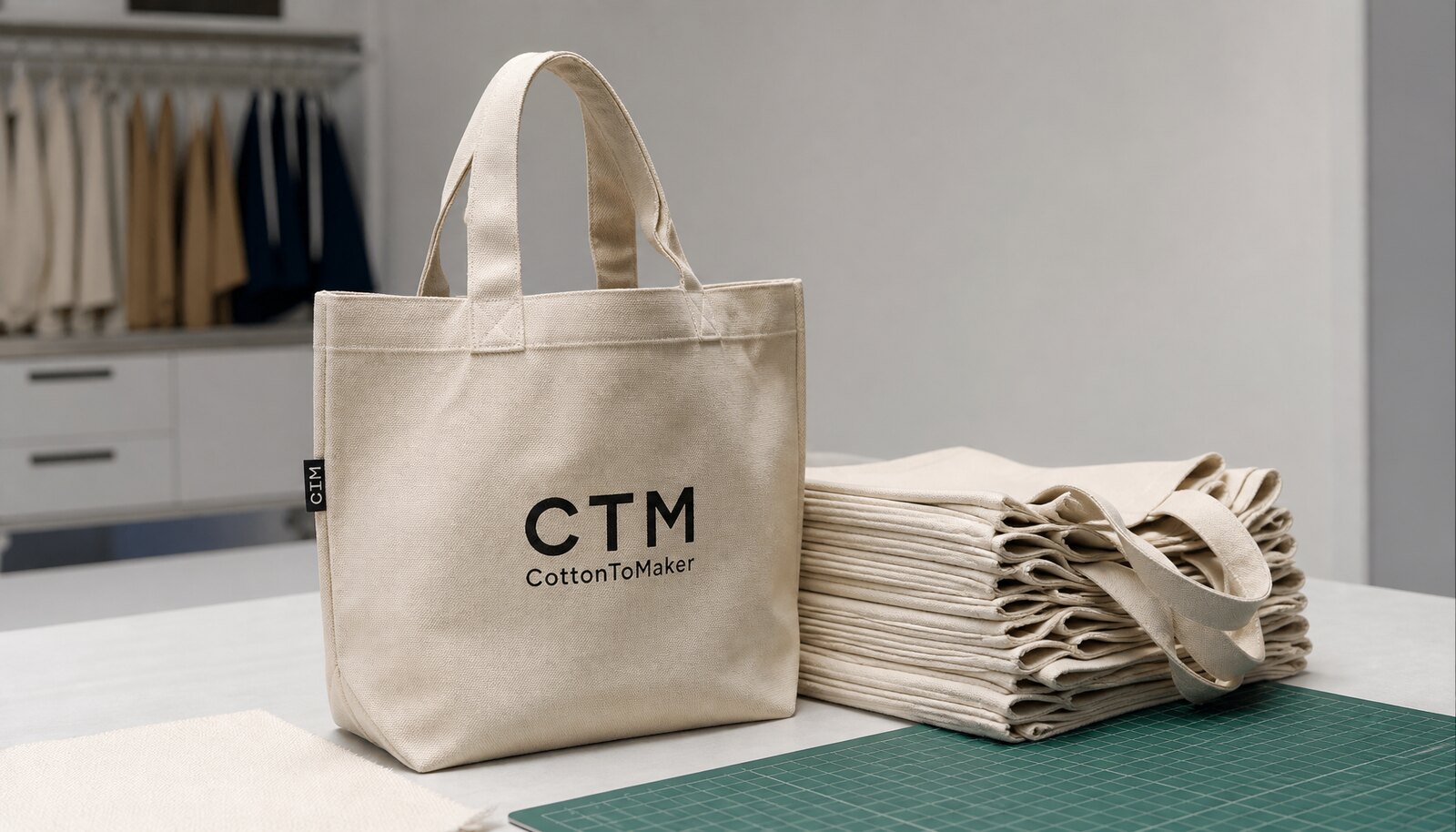
What retail chains are actually buying
A tote bag for a retail chain is not just a promotional item with a logo. It is a repeatable purchase that has to satisfy merchandising, logistics, and procurement at the same time. The bag needs enough structure to look intentional on shelf, enough strength to survive customer use, and enough production consistency that the second and third orders do not look different from the first. That is why the material decision matters more than the artwork decision. A clean logo on weak canvas still produces a weak product. A modest logo on stable canvas usually looks better in stores and creates fewer complaints after launch.
The buyer's real job is to control variables that affect the total program cost. Those variables include fabric weight, weave density, finish, shrinkage, dye lot variation, handle reinforcement, print method, carton efficiency, and the factory's ability to repeat the same standard across lots. If those are not defined early, the quote will still arrive, but it will be hard to compare, harder to approve, and even harder to reproduce. For a retail chain, reproducibility is a commercial requirement, not a nice-to-have.
- Treat the tote as a controlled retail SKU, not a one-off giveaway.
- Write the bag spec so another buyer could order the same product next season.
- Align the material choice to the real use case: shelf display, customer carry, or distribution-center handout.
Cotton versus recycled canvas
Cotton canvas remains the safest default when the program prioritizes predictable look and feel. It is easier to source in common weights, usually easier to print on, and less likely to surprise the buyer with abrupt shade shifts from lot to lot. If the chain wants a natural hand feel and a straightforward production path, cotton is often the lowest-risk baseline. That does not mean it is automatically the cheapest. The actual cost depends on yarn quality, weave density, finishing, and the amount of control the supplier has over the mill input.
Recycled canvas can be the right answer when the brief includes sustainability language, but procurement should not treat it as a direct substitute without verifying the source. Recycled fiber content can vary more than buyers expect, especially if the supplier blends multiple feedstocks or changes mills between seasons. The finished bag may still be perfectly usable, but the shade, feel, and shrink profile may move more than a cotton-only program. If the chain needs a sustainability claim, ask for documentable traceability, not just a verbal assurance. If the chain only needs a durable neutral tote, cotton is often easier to manage and easier to reorder.
- Choose cotton when brand consistency and print repeatability matter most.
- Choose recycled canvas only when traceability can be documented at the fabric stage, not after sewing.
- Do not approve recycled content without understanding whether the fiber is post-consumer, pre-consumer, or a blend.
Weight, yarn count, weave density, and shrinkage
The usual shortcut is to talk only about 10 oz or 12 oz canvas, but procurement needs a deeper view. Two bags with the same ounce weight can behave very differently if one uses a tight weave and the other uses a looser construction. Yarn count and weave density affect how the fabric cuts, how clean the print edge looks, and how much the bag shifts after finishing. A tighter weave generally gives a cleaner merchandising appearance and reduces the chance that the print sinks into the fabric. A looser weave may feel softer at first touch, but it often carries more risk on bulk orders because the panels can drift after sewing and finishing.
Shrinkage matters because the chain is buying a finished dimension, not a theoretical fabric roll. Raw canvas can move enough after wash or heat exposure that a bag approved from flat-cut dimensions no longer meets the store specification once production is complete. Buyers should ask whether the supplier cuts with shrinkage allowance already built in, and whether the dimension sheet is based on raw cloth or finished cloth. If the bag will be supplied in a natural unwashed state, that needs to be stated explicitly. If the bag will be pre-shrunk or washed, the final measurements should be tied to the post-finish state. Otherwise the sample can look right while the bulk arrives undersized or distorted.
- Ask for both fabric weight and construction details; one number is not enough.
- Require the factory to state whether the spec is measured before or after finishing.
- For repeat orders, lock the same mill standard or you risk subtle changes in handle feel and bag body.
Color and finish choices that affect shelf presentation
Retail chains care about how the bag looks from one meter away, not just how it looks in a product photo. Natural unbleached canvas usually gives the most consistent starting point because it avoids extra dye variables and often gives the cleanest price. Bleached or bright white canvas can look more premium on shelf, but it also raises the chance of visible shade inconsistency or yellowing if the finishing standard is weak. Dyed canvas can be useful when the bag needs to match a chain palette, yet it adds more control points: color recipe, mill lot, finishing conditions, and rub resistance. The more precise the color brief, the more important it is to insist on a sealed sample and a clear tolerance method.
Finish changes the entire buying equation. A raw bag may be cheaper, but it often wrinkles more, shrinks more, and presents a softer but less controlled look. A washed or enzyme-softened bag can feel better in hand and sit more naturally on display, but the buyer has to accept some size movement and possibly a slightly less crisp print edge. Pre-shrunk canvas is often the practical middle ground for a chain program because it reduces dimensional surprises without forcing the budget into a premium finishing route. The right answer depends on whether the chain is optimizing for shelf impact, repeatability, or lowest unit price. In most cases, the most expensive-looking finish is not the best procurement choice if it makes reorders harder to stabilize.
- Use a sealed physical sample for any color that matters to the brand.
- Ask the supplier how the finish changes shrinkage, hand feel, and print sharpness.
- If the bag is sold at retail, prioritize a finish that stays consistent through reorder cycles rather than a finish that only looks good on the first sample.
Print and branding choices that survive retail handling
Screen printing remains the default for most canvas tote programs because it is predictable, durable, and economical when the same artwork repeats across many stores. For one- or two-color artwork, it usually gives the best balance of cost and repeatability. Buyers should still ask about ink system, cure temperature, mesh count, and whether the print sits above or into the fabric. Those variables affect rub resistance and the final visual edge. A cheap-looking print is often the result of weak curing or poor mesh selection rather than a bad design file.
Transfer and digital methods are useful only when the art genuinely needs them. If the chain wants a photo image, a gradient, or a short-run seasonal design, those methods may be justified. But procurement should expect a higher risk of cracking, edge lift, or texture mismatch on rough canvas, especially if the supplier is stretching the method beyond its ideal use case. A more practical approach is to force the supplier to print the exact artwork on the exact canvas weight during sampling, then inspect it under use conditions. Fold the bag, rub it, compress it in a carton, and see whether the print still looks clean. If it fails there, it will not improve after shipping.
- Use screen print for repeat chain logos and simple brand marks.
- Insist on a print test on the final canvas weight, not a smooth substitute fabric.
- Ask whether the quote includes one side or both sides, because the pricing difference can be material.
How to verify factory capability before you place the order
A procurement quote is only useful if the factory can actually produce the product to the stated standard. The first check is capability, not price. Ask who cuts the fabric, who prints it, who sews it, and who packs it. If those steps happen in different places, find out how lot control is maintained and who owns each quality checkpoint. For a chain order, the buyer needs a clear answer on how the supplier keeps the same fabric standard, the same stitch pattern, and the same packing count from sample to bulk. If the supplier cannot explain that flow, there is a real risk that the bulk order will drift even if the sample looks correct.
The second check is capacity. A factory can make a beautiful sample with skilled hands and still fail on bulk if the line balance is weak or the inspection team is too small. Ask how many sewing lines are assigned to tote production, what the daily output is per line, and how many operators work in cutting, sewing, trimming, and packing. Then ask what they inspect in-process rather than only at the end. A good tote factory should be able to explain stitch control, handle reinforcement control, and carton count control without improvising. If the answers stay vague, the buyer should treat that as a sourcing risk rather than a communication issue.
- Ask for the production flow from fabric receipt to final carton sealing.
- Verify whether the same factory will cut, sew, print, and pack the bags or whether the work is split across subcontractors.
- Request sample photos from current production, not just finished marketing images.
FOB, CIF, and EXW: compare landed cost, not headline price
The lowest quote is not always the lowest landed cost. EXW may look inexpensive because the supplier only prices the bag at the factory door, but the buyer then absorbs export pickup, origin handling, freight booking, documentation, and inland movement. CIF bundles transport, but it can hide the cost of route choice, carrier choice, and port handling. FOB is often the cleanest comparison point for retail procurement because it keeps the product cost visible while allowing the buyer to compare freight separately. The right incoterm depends on the team's import process, but all suppliers should be normalized to the same basis before price comparison.
A realistic landed-cost review should include more than the bag line. It should cover carton dimensions, carton count, carton optimization, label requirements, any export testing, any inner polybag labor, and the cost of booking the shipment into the buyer's schedule. A quote that excludes one of those items can still be valid, but it cannot be compared directly with an all-in quote. Buyers should build a comparison sheet that isolates the variables. When two suppliers quote the same canvas weight, the same print, and the same packing method under the same incoterm, the procurement decision becomes much clearer. When those inputs differ, the lowest price is often a false signal.
- Compare all quotes on the same incoterm before judging unit price.
- Separate product cost from freight, export handling, and compliance testing.
- Use carton size and count as part of landed-cost analysis because they change cube, freight efficiency, and warehouse handling.
Quality control and test methods you can actually use
QC for canvas totes should be functional and measurable, not vague. The buyer does not need luxury-level finish on every seam, but the chain does need repeatable dimensional control and reliable strength. Start with measurable acceptance criteria. Define what counts as a major defect, what counts as a minor defect, and what is an automatic reject. For brand colors, use a physical sealed sample and a practical color tolerance method. For structural integrity, use pull testing on handles and seams on the first production lot, not only on the sample. For shrinkage, define the wash or steam method and measure the final dimensions after the test, not before.
A useful inspection plan usually combines visual checks and functional checks. Visual checks cover stains, shade bands, misprints, skipped stitches, and trim errors. Functional checks cover bag size, handle length, reinforcement, pull strength, and carton count. AQL works well here because it gives the factory and buyer the same language for acceptance. Many teams use AQL 2.5 for major defects and 4.0 for minor defects, but the exact standard should be written into the order so there is no dispute later. If the bag is going into a chain launch, the inspection plan should also include pack-out checks: barcode readability, carton marks, and fold consistency. Those items do not change the bag itself, but they can still delay receiving or store distribution if they are wrong.
- Check the sewn sample under load, not just as a flat product.
- Define the allowable color difference for critical brand colors and keep a physical reference sample on file.
- Use AQL and defect definitions in the PO so acceptance is measurable, not subjective.
Packing, distribution, and store readiness
Packing affects both logistics cost and how the bag is received at the store or distribution center. Bulk packed totes are usually the most efficient option for warehouse flow because they reduce labor and cube. If the chain needs the product to land shelf-ready, then single-piece packing or retail inserts may be necessary, but that should be treated as a separate costed requirement. Buyers often compare two suppliers without noticing that one quoted loose bulk and the other quoted a more complete retail-ready format. The products may look identical in a sample room and still carry very different distribution costs.
The folding method matters more than many teams expect. A tote that folds inconsistently can take up unnecessary carton space and wrinkle differently from one carton to the next. Standardize the fold direction, the handle tuck, and the pack count so each carton behaves the same way in receiving. Also confirm whether the distribution center needs inner polybags, moisture protection, or external labels. If barcodes are required, test readability before bulk shipment. The goal is to avoid a product that passes sample approval but arrives in a packing state that creates friction at the warehouse or store level. For chain buyers, packaging is part of the product, not an afterthought.
- State whether the order is bulk packed or shelf-ready packed before requesting a quote.
- Standardize fold method and pack count so cartons are consistent across production lots.
- Confirm barcode placement and scan quality if the bags will enter a controlled distribution system.
A practical buying workflow for repeat orders
The safest procurement process is simple: define the spec, approve the sewn sample, test the critical points, and then release bulk against a written acceptance standard. That sequence sounds obvious, but many tote orders fail because the team approves artwork before the sample, or approves the sample before the finish is truly locked. When the order is for a retail chain, the buyer should require a compact but complete spec sheet that includes size, fabric, finish, print, reinforcement, packing, and tolerance. Without that, every supplier will make small assumptions, and small assumptions become large differences once the order is in production.
The other discipline is reorder control. If the chain expects seasonal replenishment, the first order should not be treated as a one-off. The procurement file should capture the exact fabric standard, artwork position, mill reference, and packing method so the same tote can be repeated later. If the chain wants a different color or finish in the next run, that should trigger a fresh approval. This keeps the product line stable and makes supplier comparison more meaningful over time. Buyers who manage tote programs well are not only comparing prices. They are controlling a repeatable specification that can survive several buying cycles without drifting.
- Approve the physical sample before placing the bulk release.
- Archive the final spec, sealed sample, and inspection standard for reorders.
- Treat any change in fabric, finish, or packing as a new approval, even if the artwork is unchanged.
Specification comparison for buyers
| Spec decision | Recommended option | Tradeoff vs cheaper alternative | Procurement implication |
|---|---|---|---|
| Fiber base | 100% cotton canvas when the chain wants the most predictable hand feel and print surface; recycled canvas when sustainability wording is part of the brief and the mill can prove traceability | Cotton is usually easier to control across lots; recycled content can add 0% to 12% to cost depending on certification, and may increase shade variation if the feedstock mix is inconsistent | Ask for fiber content by lot, not just by brochure. If recycled content is claimed, request documentation that links fabric to the stated source and content level |
| Canvas weight | 10 oz for price-led promotions or lightweight handouts; 12 oz for mainline retail or repeated customer use | Moving from 10 oz to 12 oz usually adds 8% to 15% to fabric cost and freight weight, but it also improves body, reduces wrinkling, and makes the bag feel more substantial | If the bag will sit on shelf or be sold as an accessory, 12 oz is often easier to defend. If it is a short-use event bag, 10 oz can be sufficient |
| Yarn count and weave density | Tight plain weave with single-ply yarn in the 10s to 12s range and a compact face | A denser weave improves print clarity and reduces see-through, but can add 3% to 8% to cost and slightly slow sewing if the fabric is stiffer | Request the yarn count and weave density on the spec sheet. Loose weave is a common reason for uneven print absorption and size drift after sewing |
| Finish | Pre-shrunk or controlled wash finish when final dimensions matter; raw canvas only when the buyer accepts more size movement | Pre-shrinking typically adds 2% to 6% to cost and may add a few days to lead time, but it reduces post-production size loss from roughly 4% to 8% down to a tighter band | If dimensions are contract-critical, define whether measurements are taken before or after finishing. Raw fabric without a shrink allowance is a frequent source of rejection |
| Color treatment | Natural or reliably piece-dyed canvas with a sealed color standard for chain programs that need brand consistency | Dyed canvas can add 5% to 18% to cost and often increases lot-to-lot variation and lead time, especially if the mill must run a custom shade | Do not approve color by screen only. Require a physical sealed sample, and define the tolerance method for brand colors before the factory cuts fabric |
| Handle construction | Double-fold handle with cross-stitch and bar tacks at the stress points | A stronger handle set usually adds a modest per-piece cost increase, but it can reduce the chance of retail complaints and warehouse damage | Ask the supplier to show stitch pattern, handle width, and stress reinforcement on the pre-production sample. Handle failure is one of the most visible defects in store |
| Print system | 1 to 2 color screen print for repeat chain artwork; transfer or digital only when the design truly needs it | Screen print has lower unit cost at volume and better repeatability; transfer can speed short runs but may crack or peel sooner on rough canvas | Separate print cost from bag cost in every quote. A low bag price with an expensive print process is not a real savings if the program will be reordered |
| Commercial term | FOB factory or FOB port when procurement wants a clean landed-cost comparison; avoid comparing EXW and CIF as if they were equivalent | EXW can look cheap but pushes freight, export handling, and documentation onto the buyer; CIF bundles transport but can hide inland costs and routing choices | Normalize all quotes to the same incoterm, carton spec, and inland movement. Otherwise the lowest quote may simply be the least complete quote |
Buyer checklist before sampling
- Lock the finished bag size, gusset depth, handle drop, and target loading use case before asking for quotes.
- Specify fiber content, yarn count, weave density, GSM or ounce weight, and whether the measurement basis is raw or finished fabric.
- State the finish requirement clearly: raw, pre-shrunk, washed, enzyme-softened, bleached, dyed, or recycled-content canvas.
- Provide vector artwork, Pantone references, print placement measurements, and whether the design must align to seams or center lines.
- Require a sewn pre-production sample using final fabric, final print method, and final handle construction before bulk approval.
- Define color tolerance with a physical sealed sample and a method such as Delta E for critical brand colors.
- Ask for shrinkage expectations, wash testing method, and the cut allowance the factory has already built into production.
- Confirm packing format, fold direction, inner bag requirements, carton count, barcode label position, and master carton dimensions.
- Request factory traceability details for the fabric mill, dye lot, and finishing house when the order uses custom fabric or recycled content.
- Agree the inspection plan in advance: defect definitions, AQL level, and what counts as a major versus minor defect.
Factory quote questions to send
- Which mill supplies the fabric, what yarn count and weave density are you quoting, and can you show lot traceability for the fabric you will cut?
- Is your price based on FOB, CIF, or EXW, and what exact charges are excluded from the quote? Please list packing, labels, export cartons, and inland handling separately.
- What is the quoted fabric weight before and after finishing, and what shrinkage allowance do you use when you cut panels?
- Which finish is included in the price: raw, pre-shrunk, washed, bleached, dyed, or recycled-content canvas?
- What handle structure are you quoting, how many reinforcement stitches or bar tacks are used, and what load test do you apply to the handle area?
- How many sewing lines can you dedicate to this order, what is the daily output per line, and where are the QC checkpoints during cutting, sewing, and packing?
- Can you provide a physical pre-production sample made from final materials, plus photos of the exact stitch pattern, print placement, and carton packing method?
- What AQL level do you inspect to, and who signs off the final inspection report before shipment?
- What is your lead time split by sample, bulk production, inspection, and export booking, and which stage usually causes delay?
- If we reorder the same tote later, can you reserve the same fabric lot or mill standard, and what changes would trigger a new approval cycle?
Quality-control points to confirm
- Fabric lot matches the approved spec for fiber content, yarn count, weave density, and finished weight, with a practical tolerance such as plus or minus 5% unless the buyer sets a tighter band.
- Color match is checked against the sealed sample, not just a digital file; for critical brand colors, a Delta E target such as 2.0 or better is a workable procurement benchmark.
- Shrinkage after the agreed wash or steam test stays within the buyer's defined limit, commonly 3% or less for pre-shrunk programs, with the measurement basis stated clearly.
- Finished dimensions are checked after sewing and finishing, with width, height, and gusset all within the agreed tolerance and the bag remaining symmetrical when filled.
- Seam quality is inspected for skipped stitches, loose thread tails, seam puckering, and stitch density consistency along side seams, bottom seams, and handle anchors.
- Handle attachment is tested with a static pull target set to the intended use, such as 15 kg for standard retail totes or 20 kg for heavier carry programs, using the same reinforcement pattern as the approved sample.
- Print placement is measured from the seam or centerline, with registration within the agreed tolerance and no bleeding, cracking, ghosting, or pinholes visible on random samples.
- Surface appearance is checked for stains, oil marks, broken threads, fabric holes, shade bands, or mixed lots that would be visible at shelf level.
- Inspection follows an agreed sampling plan such as AQL 2.5 for major defects and 4.0 for minor defects, or another buyer-defined standard that is written into the PO.
- Carton counts, barcode labels, outer marks, and packing configuration are verified at packing and again at shipment release so the distribution center receives the same unit count that was approved.