Canvas Tote OEM Sustainability Sourcing Criteria for Australia
By Vincent Xi, Editorial Author
For B2B buyers placing a canvas tote OEM order for Australia, sustainability sourcing criteria should function as quotation approval gates, not as a supplier marketing score. The RFQ should require each bidder to connect the proposed finished-product claim to its covered components, supporting documents, manufacturing site, bill of materials, approved sample, order records and shipment-release conditions. Compare prices only after those fields align. If a claim is broader than its evidence, narrow or remove it before issuing the purchase order.
The available evidence consists of supplier self-descriptions from Szoneier Fabrics and INITI, together with sourcing recommendations from the Dreamway buyer guide. These sources can inform RFQ questions. They do not independently verify a bidder, manufacturing site, material lot, finished canvas tote or Australian order.
Author basis: The approved Vincent Xi author profile identifies Vincent Xi as an Editorial Author. It does not document factory visits, product testing, certificate verification or procurement outcomes, so this article makes no first-hand experience claim.
Canvas Tote Sustainability Sourcing Criteria for Australia RFQs
Use the following buyer-defined gates for the exact configuration being quoted. They are procurement controls, not requirements attributed to a standard, certification scheme or audit programme.
| Decision gate | Mandatory supplier response | Buyer review | Release rule |
|---|---|---|---|
| Claim wording | Exact wording proposed for the finished canvas tote | Compare the wording with the supplied evidence and identify qualifications or exclusions | Hold if the wording is undefined or broader than the evidence |
| Component scope | Claim and composition status for body fabric, handles, thread, lining, reinforcement, decoration, labels and packaging | Review the bill of materials and component specifications | Pass only when included and excluded components are explicit |
| Evidence identity | Document type, holder, issuer, manufacturing site, scope, status, validity information and verification route | Match the document to the bidder, proposed site, material and claim | Hold if any required match cannot be established |
| Product lock | Fabric, construction, dimensions, decoration, tolerances and packaging | Compare the technical specification, bill of materials and controlled sample | Pass only when the evidenced material and quoted construction are aligned |
| Order linkage | Records proposed for incoming material, production, packing and shipment | Confirm that records can be linked to the purchase order | Hold if the supplier cannot name the records or responsible release points |
| Change control | Materials, processes, sites and subcontracted work requiring prior approval | Include a written change clause in the quotation acceptance and purchase order | Hold affected production or shipment after an unapproved change |
| Inspection and release | Inspection stage, sample-selection method, acceptance rules, corrective action and release authority | Review the agreed inspection and shipment records | Hold shipment if mandatory records are missing or acceptance rules are not met |
| Australian quote basis | Destination, delivery term and named place, currency, packing basis, freight inclusions and quotation validity | Normalize commercial assumptions across bidders | Compare prices only when the product, destination and included charges match |
Evidence for a material claim should not be treated as proof of seam strength, handle attachment, print durability or another performance property. Conversely, a quality inspection does not establish recycled, organic, undyed or other material status. Keep claim verification and product-quality controls separate in the RFQ.
What the Supplied Sources Support
The source register below limits each citation to the sourcing question it can support.
| Source context | Attributable source statement | Permitted RFQ use | Not established by the source |
|---|---|---|---|
| Szoneier Fabrics supplier page | The page describes the supplier's own canvas tote sourcing options and refers to GRS recycled cotton, organic cotton certification and undyed natural cotton | Ask a bidder to define the claimed material, covered components and documents available for the quoted route | Current document status, another supplier's status, site coverage or coverage of the proposed order |
| INITI supplier page | The page describes its own tote offering with references to GOTS, OEKO-TEX STANDARD 100 and BSCI | Ask for the exact document, holder, issuer, site, scope, status and verification route behind an equivalent quotation statement | That the quoted product, material, site or order is certified or currently covered |
| Dreamway buyer guide | The guide recommends reviewing documentation associated with GOTS, OEKO-TEX, BSCI and GRS, considering material choices and checking whether a supplier accepts third-party QC | Use document review and inspection access as separate supplier-qualification questions | Independent verification of a listed manufacturer, certificate, claim or inspection result |
| Vincent Xi author profile | The profile supports the author name, role and profile URL used in the byline and structured data | Attribute editorial authorship | Factory, testing, certification or purchasing experience |
GRS, GOTS, OEKO-TEX STANDARD 100 and BSCI are named here only because the cited pages refer to them. The supplied pages do not reproduce their formal requirements. A supplier's material option, document-support process or inspection practice is a company statement, not a scheme requirement.
Do not describe a supplier, site, material or finished canvas tote as certified without reviewing a current document that matches the intended claim and scope. Where an issuer, certification body or scheme owner provides a verification route, record the result with the quotation review.
For each proposed claim, require the bidder to provide:
- The exact finished-product wording and intended placement.
- Every component included in or excluded from the wording.
- The declared composition of each relevant component.
- The document type, holder, issuer, site, material or product scope, status, validity information and verification route.
- The records proposed to connect purchased material, production and packed goods to the order.
- For undyed, unbleached or similar wording, the processes excluded by the claim and any processes that remain in use.
- An unclaimed or more narrowly claimed quotation option if the requested wording cannot be supported.
Remove undefined wording such as eco-friendly from the specification unless the supplier replaces it with a claim whose meaning, component scope and evidence can be reviewed.
Make Sustainability Sourcing Criteria Measurable in Manufacturing
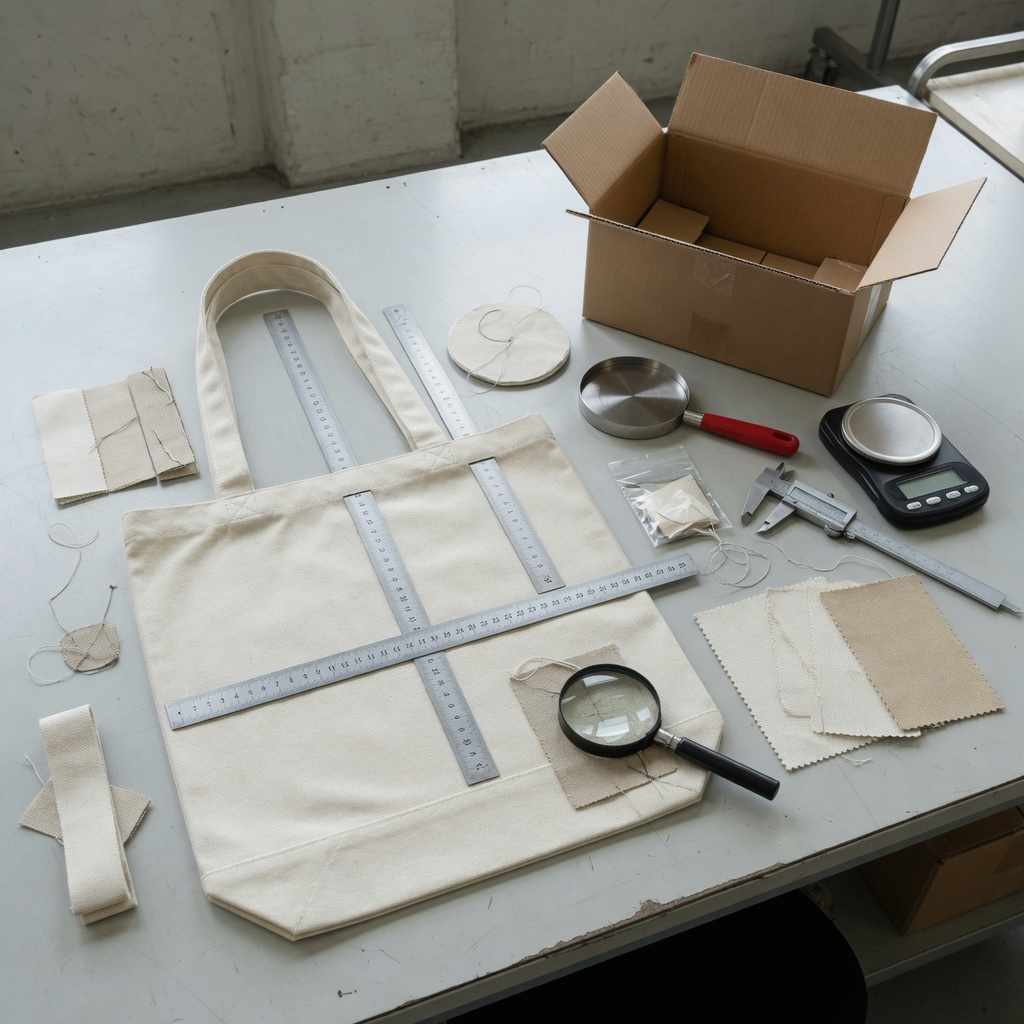
Evidence review is not comparable when bidders quote different canvas weights, finished dimensions, handle constructions, decoration systems or packaging. Attach the evidence request to a controlled product specification.
Every value in the following table is an illustrative RFQ assumption created for this article. The values are not sourced product facts, standard requirements, performance recommendations or CottonToMaker specifications. Each must be replaced or explicitly verified in the supplier quotation, technical specification and approved sample before purchase-order approval.
| Illustrative assumption | Defined component and scope | Required verification |
|---|---|---|
| 340 grams per square metre (g/m2) nominal fabric mass | Main-body canvas only, before application of a buyer-approved tolerance | Supplier quotation, material specification, measurement method and approved swatch |
| 380 millimetres (mm) wide x 420 millimetres (mm) high | Finished tote body measured flat at agreed points, excluding the handles | Dimensioned drawing, supplier-proposed tolerances and controlled sample |
| 25 millimetres (mm) finished width | Each handle at the agreed measurement location after construction | Dimensioned drawing, measurement method and controlled sample |
| 650 millimetres (mm) exposed length | Each handle measured along its centreline between the agreed top-edge attachment points | Dimensioned drawing, supplier-proposed tolerances and controlled sample |
These assumptions demonstrate how to make the RFQ measurable; they do not provide sustainability evidence. A canvas mass or finished dimension cannot substantiate a material claim.
Require each bidder to complete the following manufacturing fields without relying on undefined terms such as standard tolerance or normal test.
| Specification area | Supplier entry required | Buyer approval record |
|---|---|---|
| Body fabric | Fibre composition, weave, nominal mass, colour or natural variation, finish, proposed tolerance and measurement method | Material specification and controlled swatch |
| Handles | Material, construction, finished width, exposed length, placement, attachment method and proposed tolerances | Technical drawing and controlled sample |
| Seams and reinforcement | Seam construction, stitch specification, hem construction, reinforcement locations and permitted workmanship variation | Construction sheet, sample and inspection checklist |
| Finished dimensions | Measurement points, target values, tolerances and measurement conditions | Dimensioned drawing and inspection checklist |
| Decoration | Decoration material or system, artwork reference, placement, colour reference and acceptance method | Approved decorated sample |
| Other components | Thread, lining, closure, hardware, labels and reinforcement, with composition where relevant to the proposed claim | Controlled bill of materials |
| Packaging | Individual packing, carton configuration, packaging materials and buyer restrictions | Packaging specification and packing sample |
For a requested performance check, specify the specimen, production stage, method, acceptance threshold, responsible party, report format and action after failure. The supplied sources do not provide order-specific methods or thresholds, so none should be presented as a default requirement.
Connect Claim Evidence to Production Release
An evidence file has limited procurement value unless it remains connected to the approved material, sample and production route. Maintain an order document register containing the claim, document type, holder, issuer, site, scope, status, validity information, verification route, reviewed file and purchase-order relevance.
| Buyer-controlled release point | Required match | Hold condition |
|---|---|---|
| Quotation approval | Bidder, manufacturing site, claim wording, component scope and evidence | Entity, site or scope is unresolved |
| Pre-production approval | Evidence, bill of materials, technical specification and controlled sample | Sample or specification differs from the evidenced material route |
| Material release | Incoming material identity, approved specification and required order records | Material cannot be connected to the approved source or specification |
| Production change | Proposed material, component, process, site or subcontractor change | Written approval and affected evidence review are incomplete |
| Inspection and shipment | Production, packing, inspection results and mandatory shipment records | Agreed records are absent, inconsistent or outside the inspection scope |
The Dreamway guide's reference to supplier willingness to accept third-party QC can support an RFQ question about inspection access. It does not prove that an inspection occurred, covered the agreed scope or produced an acceptable result.
Australia Quote and Freight Controls for Canvas Tote Manufacturing
Give each bidder the same buyer-defined Australian destination and commercial assumptions. The RFQ should state the destination postcode or named port, delivery term and named place, quotation currency, required dispatch window, quotation-validity basis and the event that starts each lead-time stage.
Request an itemised quotation covering:
- Sample, artwork, tooling and development charges.
- Material and component price assumptions.
- Unit price tied to the approved construction and claim scope.
- Document review, testing and inspection charges.
- Individual packaging, export-carton and pallet assumptions where applicable.
- Freight inclusions and exclusions for the named Australian destination.
- Units per carton, carton dimensions, carton net mass, carton gross mass and total carton quantity.
- Material reservation, sample development, approval, production, inspection and dispatch stages.
- Dependencies such as payment, artwork approval, material availability, evidence acceptance and sample approval.
- The conditions under which price, material or freight assumptions may be revised.
Require written buyer approval before changing the manufacturing site, material, individual packaging, carton configuration or another quoted cost assumption. A bid is commercially comparable only when it uses the same specification, evidence scope, packing basis, Australian destination and included charges.
The supplied evidence does not establish Australian requirements for environmental claims, fibre descriptions, country of origin, product labelling, customs, product safety or imports. This article therefore does not prescribe those requirements. Before order approval, have proposed claims, labels, carton marks and import documents reviewed by appropriately qualified Australian legal, customs and logistics advisers where applicable. The supplier should manufacture against buyer-approved instructions rather than being treated as the final authority on Australian compliance.
Canvas Tote RFQ Release Decision
| Decision | Required condition | Buyer action |
|---|---|---|
| Approve for commercial comparison | Claim, components, evidence, manufacturing site, specification, sample, records, Australian destination and quote inclusions align | Compare the itemised quotation with bids on the same basis |
| Hold | A required document, scope match, specification field, inspection rule or commercial assumption is missing or inconsistent | Request a corrected response and keep the quotation outside final comparison |
| Remove the claim or requote | The supplier cannot support the requested wording for the proposed route | Delete or narrow the claim, or request a different evidenced material option |
| Hold production or shipment | An unapproved substitution, site change, failed acceptance rule or missing mandatory record affects the order | Obtain written disposition and repeat the affected review before release |
Approval under this matrix is a buyer's procurement decision. It is not proof of certification, legal compliance, product performance or environmental benefit beyond the evidence actually reviewed.
Methodology and Limitations
The evidence set was limited to the supplied descriptions and retained URLs for the Szoneier Fabrics supplier page, INITI supplier page, Dreamway buyer guide and Vincent Xi author profile. Publication or page-capture dates, complete certificate files, certificate-database results and archived page versions were not supplied.
The method was to classify supplier-page statements as attributed self-descriptions, treat buyer-guide recommendations as sourcing context, and convert supported questions into RFQ fields, evidence gates and release controls. No supplier statement was treated as independent proof. The fabric mass and dimensions were introduced only as clearly labelled example assumptions showing how to draft measurable manufacturing fields.
The sources do not establish current certification, covered manufacturing sites, material-lot status, finished-product performance, production capacity, pricing, lead time, freight cost or Australian compliance. Before approval, verify current documents through an appropriate issuer or scheme route where available, confirm the proposed entity and manufacturing site, reconcile the bill of materials with the controlled sample, and obtain order-specific commercial and Australian delivery terms.
Discuss Your Requirements
Review our manufacturing capabilities, then share your specifications for a supplier-fit review.