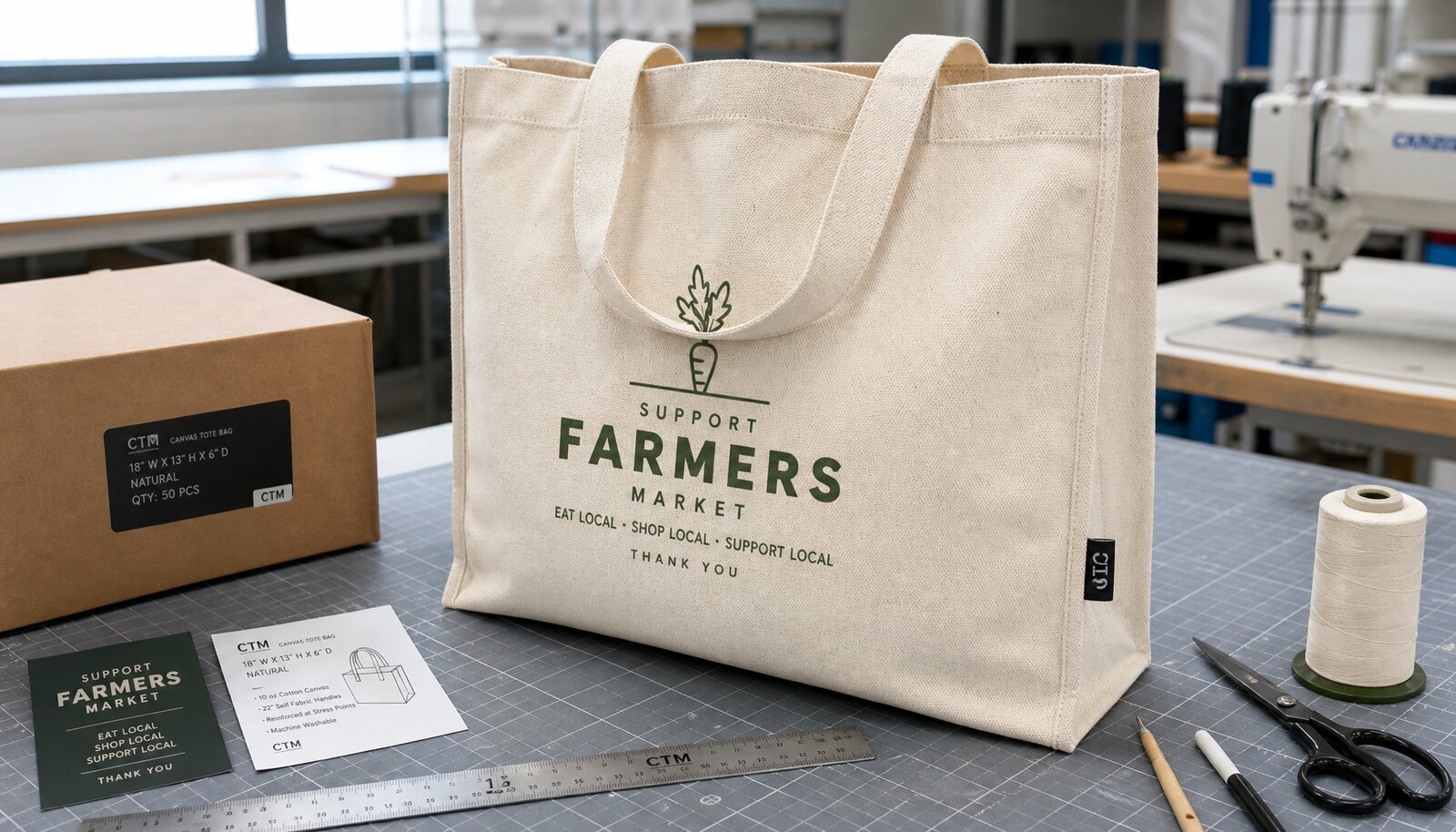
What This Buyer Guide Is Solving
When buyers source canvas tote bags for farmers markets, the main failure mode is not a bad shape. It is a quote that hides different assumptions under the same product description. One supplier may price a basic bulk-packed tote, another may include retail unit packing, and a third may quietly downgrade the fabric weight or trim details to reach the target number. If those differences are not normalized, the quote comparison is not useful.
These bags often sit at the intersection of merchandising, packaging, and transit performance. They may be sold near produce, used by event staff, handed out with inserts, or shipped through a distributor before reaching a retail shelf. That means the buyer has to specify more than a logo and size. The spec needs to cover how the bag feels, how it holds up, and how it arrives at the destination.
The point of this guide is to help procurement teams build a usable RFQ and avoid the usual late-stage surprises: fabric mismatch, weak handles, poor carton packing, or a quote that looked competitive only because packaging and labor were omitted.
- Compare like for like before you judge price.
- Treat packaging as part of the product, not an afterthought.
- Define the commercial use first so the bag spec matches the channel.
Start With Channel And Use Case
A farmers market tote for staff use is not the same as a tote sold as branded merchandise. Staff bags need practical capacity, easy handling, and a price that survives repeat replenishment. Retail bags need cleaner finishing, tighter stitching, and a presentation standard that looks intentional when a shopper picks it up from a display or rack.
The first RFQ line should describe the channel in plain language. Say whether the bag is for retail resale, event giveaway, staff carry, or a premium branded product. Then define what it will hold. If the tote is meant to carry brochures, a bottle, produce, or small boxed goods, that load should shape the gusset depth, handle drop, and fabric weight. A bag that can stand upright also merchandises better, but that usually requires more structure and tighter sewing control.
Channel choice also affects warranty expectations. A giveaway bag can tolerate lighter build and simpler packing. A resale bag usually needs better print consistency, stronger handles, and more consistent fold appearance because the buyer is paying for shelf perception as much as utility.
- Name the channel in the RFQ: giveaway, retail, staff, or mixed use.
- Describe the actual load, not just the bag category.
- Decide whether shelf appearance or lowest landed cost matters more.
Choose Fabric Weight And Construction For Load, Not Just Price
For most buyer programs, 12oz to 14oz canvas is the useful range. Twelve-ounce fabric is often enough for light retail carry, event handouts, and lower-cost programs where the tote still needs some body. Fourteen-ounce fabric is the safer option when the bag must carry heavier market goods, survive repeated use, or maintain a boxier shape after packing. The difference is not only tactile. It also affects print opacity, stitch stress, carton weight, and how the finished bag behaves after folding.
The construction details matter as much as the fabric weight. Look closely at the side seams, bottom seam, and handle attachment points. A tote that uses reinforced bar-tacks and a clean hem usually performs better than a thinner bag with a more attractive quote. If the bag is expected to be reused often, ask for reinforcement at all load points, not just the handles. Washed or pre-shrunk canvas is worth considering when dimensional consistency matters after sampling and bulk packing, because raw cloth can shift after finishing and cause size drift.
Buyers should also watch for how the supplier describes the cloth. Some quotes use generic weight language without telling you the actual GSM, weave density, or acceptable variation. That leaves too much room for hidden substitution. Ask for the base fabric specification, not just the bag spec.
- Use 12oz for lighter programs and 14oz when load capacity and shape retention matter.
- Confirm the real GSM and whether the cloth is raw, washed, or pre-shrunk.
- Require reinforcement at handle joins and stress points for repeated use.
Print And Branding Choices Change More Than Appearance
Screen print remains the most practical option for many canvas tote programs because it is efficient on simple logos and scales well for volume. It usually gives strong color on natural canvas when the ink, mesh, and curing are controlled. For buyers who want a more premium look, woven labels, sewn side labels, and embroidery can work well, but they each change cost, setup time, and sometimes how the bag behaves after folding.
The tradeoff is not cosmetic only. A large print area can affect fold lines and retail presentation. A dense embroidery panel can stiffen one section of a lighter tote. A woven label may be cleaner for branding but smaller than the buyer expects once it is attached to a seam or edge. If the logo crosses a gusset, seam, or pocket edge, ask the supplier to show the decoration on a sewn production-intent sample rather than a flat digital mockup.
Color count matters too. Simple one-color art is easier to control and less expensive. If the buyer wants multiple colors, gradients, or very fine type, the quality risk rises. The RFQ should state the maximum logo size, Pantone references if relevant, and the acceptable variation in placement. That avoids disputes when the bulk lot arrives slightly different from a showroom sample.
- Use screen print for simple logos and scalable volume.
- Use embroidery or woven labels when the brand value supports the higher cost.
- Approve decorated samples in sewn form, especially if artwork crosses seams or folds.
Packaging Should Match The Sales Channel
Packaging is where a lot of tote programs become expensive without anyone noticing. A wholesale buyer may only need folded bulk packing to reduce labor and freight cube. A retail buyer may need each tote in an individual polybag with a barcode, insert card, or hangtag. For farmers market programs, a belly band or kraft wrap can be a better fit than a full polybag if the bag is meant to be displayed in a seasonal merch rack and sold as an eco-friendly item.
The right packaging choice depends on the route to the final customer. Bulk packs are efficient, but they shift labor to the warehouse or retailer and can make shelf presentation inconsistent. Individual packs protect the bag and preserve the print surface, but they add material, counting time, and carton volume. If the supplier quotes a low unit price without specifying pack format, the buyer should assume the quote is incomplete until proven otherwise.
This is also where the buyer should insist on practical details: how the bag is folded, whether handles are tucked or laid flat, whether inserts are aligned, and whether the barcode label is on the bag, polybag, or master carton. Those small decisions can change labor time and error rate more than the sewing itself.
- Use bulk pack when freight and warehouse efficiency are the priority.
- Use individual packing when shelf readiness and product protection matter more.
- Specify folding method, insert placement, and barcode location before sampling.
MOQ Is Usually A Set Of Thresholds, Not One Number
Buyers often ask for MOQ as if there is one answer, but tote programs usually have several minimums. A supplier may accept a low minimum for a natural canvas bag with one-color print and no custom packaging, then raise the threshold as soon as the buyer asks for dyed cloth, a zipper, a custom label, or a retail insert. If you only request a single MOQ number, you do not see where the real constraint is.
The better approach is to break MOQ into parts. Ask for the minimum by fabric type, print version, closure option, and packaging style. That lets the buyer see whether the quote is actually flexible or just cheap in the simplest configuration. It also helps explain why one supplier can offer a lower MOQ but a longer timeline: they may be consolidating through a trading layer or waiting for another customer’s fabric run.
Procurement teams should be careful with color and trim changes. A tote that is available in natural canvas at low volume may require a separate minimum for black, dyed, or custom-labeled versions. The quote needs to say which costs are fixed, which are variable, and which components are reusable on repeat orders.
- Ask for MOQ by fabric, print, and packaging line item.
- Treat zipper, pocket, and label additions as MOQ multipliers.
- Separate stock-material offers from fully custom builds.
Factory Verification Matters More Than The Sales Conversation
For a buyer program, the commercial contact is not the same thing as the production source. Before you accept a quote, confirm who actually cuts, prints, sews, and packs the bags. If a trading company is involved, ask how the factory is selected, what parts of the process are subcontracted, and who signs off on bulk quality. The risk is not just margin. Hidden outsourcing can create sample drift, slower corrections, and difficulty tracing defects when something goes wrong.
A factory check should be practical, not ceremonial. Ask for evidence of recent production in a similar construction, the line that will handle the tote, and whether the factory can show the same fabric weight and finishing method. If possible, have the supplier provide a sample record that names the actual production site, not just the commercial brand. That makes later problem-solving much easier if the bulk order shows a mismatch.
Regional sourcing tradeoffs are real. Mainland China factories often offer deeper material access, wider decoration options, and strong scale on repeat programs. Vietnam and other Southeast Asian options may fit buyers who value regional diversification or tariff strategy, but the buyer should confirm trim availability and whether the factory has the exact sewing and print capability needed. South Asia can be competitive on labor-intensive construction, but fabric finish consistency, lead time, and communication around pack standards need closer verification. The right answer depends on order size, repeat frequency, and the buyer’s tolerance for lead-time variability.
- Verify who actually produces the bag, not just who quotes it.
- Ask for production-site evidence tied to a similar tote construction.
- Compare regions on capability, lead time stability, and trim sourcing, not on labor cost alone.
Sampling Should Prove Function, Not Just Visual Match
A production-intent sample should answer one question: does this bag work the way the buyer needs it to work? That means measuring the finished body size after pressing, checking handle drop on both sides, confirming seam alignment, and reviewing how the bag folds for pack-out. If the tote includes a zipper or snap, test it several times and check for snagging or distortion at the opening. A nice photo is not proof of a reliable bag.
The sample stage is also where the buyer should lock acceptable tolerances. If the supplier sends a sample that differs from the agreed fabric weight, print placement, or stitch construction, treat it as a warning. Do not assume the bulk run will improve on its own. Write the approved sample revision into the order record so inspection has something concrete to compare against.
If the buyer expects a family of versions, such as one natural tote and one dyed version with the same brand mark, sample each variant separately. Material and dye changes can affect print opacity, seam behavior, and fold appearance. A single approved sample is not enough to cover every variant in a commercial program.
- Approve a production-intent sample, not a showroom substitute.
- Measure dimensions, handle drop, and seam alignment on the real sample.
- Document the final sample revision so bulk inspection has a reference.
Cartons, Labels, And Transit Can Damage A Tote Program Quietly
Canvas is sturdy, but it still suffers in transit when the carton plan is sloppy. The carton should be based on the compressed unit size after folding, not the bag laid flat. If the carton is too loose, the bags shift and rub against each other or the carton wall. If it is too tight, the folds turn into hard crease marks that may still be visible when the bag reaches a retail shelf. The best count per carton usually comes from a real trial pack rather than an estimate.
Master carton markings should be simple and consistent. Use style number, color, quantity, carton number, and destination. If the buyer uses multiple channels, the inner-pack quantity must match the warehouse handling plan. A distributor may want larger masters for efficiency, while a retail chain may want smaller packs to support store replenishment. These are commercial decisions, but they directly affect packing labor and freight economics.
This is also where QC should include photo confirmation. Ask the factory for a packed carton photo showing fold direction, label placement, and unit count before the goods ship. That one step catches a lot of avoidable errors, especially on first orders.
- Base carton count on trial packing and actual folded size.
- Keep master carton marks consistent across the lot.
- Ask for a packed carton photo before shipment.
Lead Time Risk Is Usually In The Front End
A realistic schedule for canvas tote orders includes artwork approval, sample production, fabric booking, printing setup, sewing, packing, inspection, and export or domestic freight booking. The sewing line itself is rarely the only bottleneck. Delays tend to come from late artwork changes, packaging components that are still missing, or a sample approval that lands after the fabric lot has already been scheduled. For a seasonal farmers market program, that can push the shipment past the selling window.
The safest plan is to freeze the functional spec before cutting begins. That means the size, fabric weight, print file, pack format, and carton spec should all be signed off before bulk production starts. If the order will split between a distributor and a regional warehouse, that should be stated early because it changes pack configuration and sometimes the carton mix. If a supplier says the lead time is short, ask what they are assuming is already in stock and what still needs to be booked.
The buyer should also identify the critical-path component. For example, a custom zipper pull, woven label, or printed insert can easily become the schedule constraint even when the sewing capacity is available. Good sourcing discipline means the supplier tells you where the risk is before you ask for acceleration.
- Build in time for at least one sample round plus full production after approval.
- Freeze artwork and packaging before bulk cutting starts.
- Ask the supplier to identify the longest-lead component in the order.
Specification comparison for buyers
| Buyer decision | Best fit option | Tradeoff to expect | What to verify before order |
|---|---|---|---|
| Fabric weight | 12oz to 14oz canvas, with 14oz better for heavier market carry | 12oz usually lowers price and freight, but it can feel softer and show more print show-through; 14oz improves structure and load confidence at the cost of higher material and carton weight | Confirm actual GSM, roll-average variation, finished shrink, and whether the quote assumes washed or raw cloth |
| Fabric finish | Washed or pre-shrunk canvas when the bag must stay consistent after sampling and retail packing | Washed cloth costs more and may slightly change hand feel, but it reduces surprise shrinkage and helps keep dimensions stable after bulk pressing | Ask for the cut size after shrink allowance and whether the supplier has already compensated in pattern dimensions |
| Decoration method | One- or two-color screen print for volume, woven label or embroidery for premium branding | Screen print is efficient and durable when artwork is simple; embroidery and woven labels lift perceived value but can add setup cost, slow production, or distort on lighter canvas | Request rub testing, fold-line review, and a sewn sample if the artwork crosses seams or gussets |
| Handle build | Cotton webbing or self-fabric handles with bar-tacks and X-box reinforcement | Webbing usually feels stronger and is faster to sew; self-fabric handles can look cleaner but may require more precise stitching and better reinforcement to avoid stretch | Check handle drop, symmetry, stitch density, and pull-test method at the load points |
| Closure | Open top for utility, zipper only when contents need containment or resale value is higher | Open-top bags are simpler, cheaper, and less failure-prone; zippers improve product security but introduce extra components, more defects, and longer lead time | Confirm zipper tape color, slider grade, snag clearance, and whether the closing edge has been test-opened repeatedly |
| Packaging format | Folded bulk pack with a belly band for wholesale, individual polybag only when the bag must arrive shelf-ready | Bulk packing lowers labor and freight cube; unit packing supports retail presentation but adds material, counting time, and carton volume | Specify whether barcode labels, inserts, and warning text are included in the unit pack quote |
| Supplier type | Direct cut-and-sew factory for repeat programs, trading company only when you need mixed-category consolidation | Direct factories usually give better control over fabric, sewing, and packing; trading companies can help with multi-SKU coordination but may add another layer between buyer and production | Verify who actually cuts, prints, and packs the bags, and ask for the factory name on the sample record |
| Carton strategy | Carton count based on trial packing and compressed unit size, not loose flat-panel dimensions | Overpacked cartons crease canvas and can distort print; underfilled cartons increase freight cube and risk shifting in transit | Request carton size, gross weight, stack limit, and a packed sample photo before shipment |
Buyer checklist before sampling
- State the use case in one line: giveaway, retail resale, staff carry, or branded market tote.
- Lock the finished size, gusset depth, and handle drop before releasing artwork.
- Choose fabric weight by load and shelf presentation, not by price alone.
- Specify print method, print size, ink colors, and whether one side or both sides need decoration.
- Decide the pack format early: bulk fold, belly band, polybag, insert card, hangtag, or barcode label.
- Request a pre-production sample made with production materials, not a showroom substitute.
- Set written tolerances for finished size, seam alignment, print placement, and carton count.
- Ask for a trial pack photo so you can verify compression, fold direction, and carton fit.
- Compare quotes line by line, including packing labor, carton specification, and any setup charges.
- Require the supplier to identify the factory, not just the commercial contact, before PO release.
Factory quote questions to send
- What is the exact fabric GSM, weave, and shrink allowance behind the quoted price?
- Is the quote based on raw canvas, washed canvas, or pre-shrunk canvas?
- Does the unit price include cutting, sewing, printing, pressing, unit packing, and master carton packing?
- Is the quoted decoration one color or multiple colors, and is it one side only or both sides?
- What MOQ applies separately to fabric color, print version, zipper or closure option, and packaging style?
- Can you name the actual factory, and can that factory be shown on the sample or inspection record?
- What carton size, pcs per carton, gross weight, and stack limit are you proposing?
- What is the production lead time after sample approval, and what is the longest-risk item on the schedule?
- What overrun and underrun tolerance do you apply, and how are defects credited or replaced?
- What test method do you use for seams, handles, color rub, and closure function before shipment?
Quality-control points to confirm
- Finished body dimensions should stay within the agreed tolerance after pressing, folding, and final packing.
- Handle drop, handle length, and handle symmetry should match the signed sample on both sides.
- Main seams, gusset corners, and handle bartacks should be dense, even, and free of skipped stitches or thread breaks.
- Print placement should stay within the approved alignment window and show no smearing, pinholes, ghosting, or thin coverage.
- If the bag uses a zipper, snap, or magnet closure, it should open and close smoothly without catching canvas fibers.
- Unit packs should contain the exact count, correct insert, and accurate barcode or care label if required.
- Master cartons should match the approved carton dimensions, quantity, and gross weight range.
- The bulk lot should match the approved sample in color tone, fabric hand feel, seam finish, and print opacity.
- Carton compression should not leave permanent fold marks or visible abrasion on the printed face.
- A simple pull test on handle joins should confirm the reinforcement survives realistic market use.