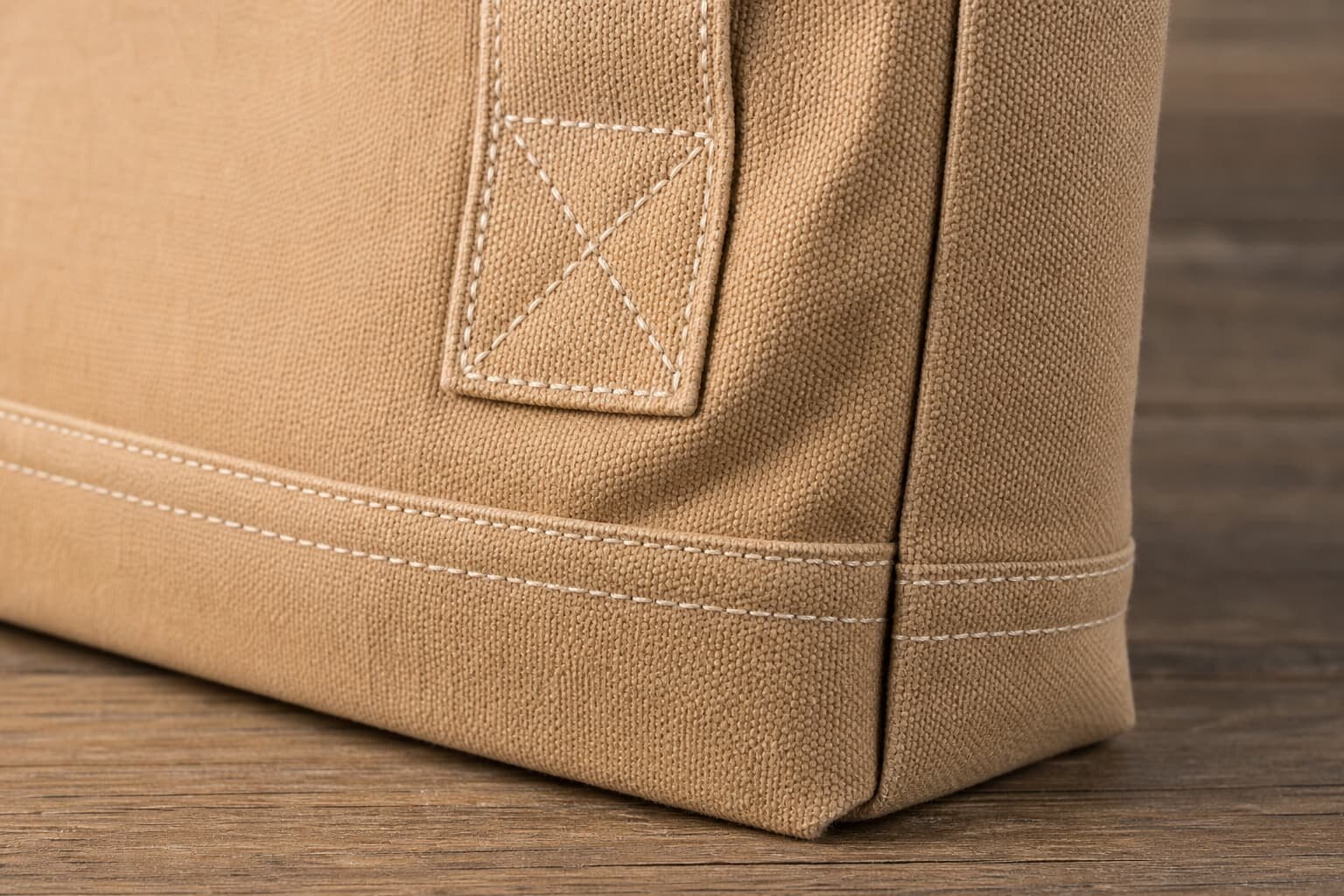
Why Woven Label Placement Must Be Quoted Before Sampling
A woven label looks like a small detail, but on a canvas tote bag it changes the sewing sequence, visible branding, inspection method, and sometimes the unit price. If the RFQ only says “add woven label” with a reference photo, different suppliers may quote different operations. One factory may insert a folded label into the side seam during assembly. Another may sew a flat label onto the front panel after the bag is finished. Both quotes can appear similar, but the labor time, label MOQ, rejection risk, and final look are not the same.
For procurement teams, the practical goal is not to over-design the label. The goal is to remove guesswork before the sample is made. Placement should be described with finished measurements, construction type, label fold type, and print relationship. This is especially important when comparing quotes from several canvas tote bag factories because a low price may simply mean the supplier assumed the easiest placement, not the placement your brand team expects.
- Use finished bag measurements, such as “right side seam, 80 mm below top edge,” instead of only “side label.”
- Separate label cost from label sewing cost so quote comparisons are fair.
- Confirm whether the label is supplied by the buyer or produced by the tote factory.
- Approve the placement on a real fabric sample, not only a digital layout.
Common Label Positions and Their Production Impact
The most common placement for a canvas tote bag woven label is the side seam. It gives a retail-looking brand detail without competing with front screen print artwork. Side seam insertion is efficient when planned before sewing, because the folded label is caught in the seam while the bag panel is joined. It becomes less efficient if the bag is already closed, because the operator may need to open part of the seam or use a more difficult top-stitch method.
Top hem labels, front patch labels, inside pocket labels, and handle-base labels are also workable, but each one has a different risk. A top hem label can be partly hidden when the bag is folded or filled. A front patch label is more visible but adds extra stitching and can pucker on lighter canvas. A handle-base label must not weaken the handle reinforcement. The best placement is the one that supports the brand design while staying compatible with the tote construction.
- Side seam label: efficient, discreet, good for retail and private-label programs.
- Top hem label: visible when empty, but may fold inward during use.
- Front patch label: strong branding, but higher labor and stricter alignment control.
- Inside pocket label: good for private-label compliance, but easy for QC to overlook.
- Handle-base label: minimal branding, but must stay outside the main load-bearing bartack zone.
How Fabric Weight Changes the Placement Decision
Canvas tote bags are often quoted by ounces per square yard or GSM. A light 6 oz canvas is usually around 200 gsm, 8 oz is often around 270 gsm, 10 oz is around 340 gsm, and 12 oz is commonly around 400 gsm, depending on yarn and weave. Heavier canvas gives a cleaner premium feel, but it also creates thicker seams. If a folded woven label is inserted into a heavy side seam with a gusset, the operator may be sewing through multiple layers of canvas plus label material. That can cause skipped stitches, needle marks, or uneven label exposure if the machine setup is not correct.
For lighter canvas, the problem is different. A stiff woven label may pull the fabric or create puckering around a patch label. If the label is wider than the seam structure can support, it may not sit flat. Buyers should therefore ask the factory to recommend label size based on fabric weight and seam construction, not only on the graphic design. A 25 mm visible side label may be fine on a 12 oz canvas shopper but may look too heavy on a 6 oz promotional tote.
- 6 oz to 8 oz canvas: use softer labels, smaller visible width, and avoid large patch labels unless tested.
- 10 oz to 12 oz canvas: side seam and patch labels work well, but needle size and stitch tension matter.
- 14 oz and heavier canvas: confirm machine capability for seam insertion at gussets and handle reinforcement zones.
- Dyed canvas: test label color transfer and check whether dark label yarn stains light packing material.
- Washed canvas: approve label appearance after washing if the tote has a garment-wash or enzyme-wash finish.
Print Method Conflicts Buyers Should Prevent
Canvas tote bags often combine a woven label with screen printing, heat transfer, digital print, embroidery, or a simple one-color brand mark. The placement decision should be made before print artwork is locked. A side seam label may not affect a center front print, but a front patch label can force the print position to move. A top hem label can interfere with a full-bleed upper print area. If the label is added after printing, the sewing operation can leave needle holes or thread tails over the printed surface.
Heat is another issue. Screen print curing and heat transfer pressing can flatten, discolor, or mark a woven label if the label is already attached and the press area overlaps. For most programs, factories prefer to print panels first, cure or press them, and then sew labels during assembly. For patch labels, the sequence may be print first, press and cool, then attach label. The RFQ should ask the factory to state the planned sequence because it affects sample approval and defect responsibility.
- Screen print: keep label away from wet ink handling and curing pressure.
- Heat transfer: avoid placing woven labels inside the heat press platen area.
- Embroidery: check backing, hoop marks, and whether label sewing covers any thread ends.
- Digital print: confirm fabric pretreatment will not stain or stiffen the label area.
- Discharge or pigment dye effects: approve label after finishing, not before finishing only.
Specify Label Size, Fold Type, and Sewing Method
A clear woven label specification has two sizes: the total cut size and the visible finished size. For a side seam loop label, the supplier may cut a label at 25 x 50 mm, fold it in half, and leave about 20 to 22 mm visible after seam allowance. If the buyer only approves the flat artwork size, the finished label can look smaller than expected. For end-fold labels sewn onto a front panel, the folded ends must be included in the cut size so the logo is not too close to the stitch line.
The sewing method should also be named. A seam-inserted label is captured while joining panels. A patch label is usually top-stitched on two or four sides. A top hem label may be inserted under the folded hem and secured by the hem stitch. Each method affects labor, rejection risk, and how easy it is to inspect. For quote comparison, ask suppliers to state the method rather than just confirming “woven label included.”
- Loop fold: common for side seam labels; confirm which side faces outward.
- Center fold: similar to loop label, often used when both sides show branding or care information.
- End fold: used for patch-style labels; ends are folded under before stitching.
- Straight cut: cheaper, but edges may fray unless heat cut or ultrasonic cut is suitable.
- Manhattan fold or book fold: useful for labels requiring more text, but usually not needed for simple tote branding.
MOQ Logic: Tote MOQ and Woven Label MOQ Are Not Always the Same
Many buyers expect the woven label MOQ to match the canvas tote bag MOQ. In production, they are often separate. The tote factory may accept 500 or 1,000 bags depending on fabric availability and production schedule, while the label mill may require a minimum loom quantity based on label width, yarn colors, and setup time. If your order is small, the factory may either charge a label setup fee, produce extra labels for stock, or use a simpler label construction.
This matters when comparing supplier quotes. One quote may include only the exact number of labels required for the order, while another includes extra labels for sewing loss and future repeat orders. A realistic RFQ should ask how many labels will be produced, how many are included in the price, and whether unused labels will be stored, shipped, or discarded. For distributors handling multiple SKUs, it may be possible to use one master woven label across several tote colors to reach a better MOQ.
- Ask for label MOQ separately from bag MOQ.
- Confirm whether setup charge is included or listed separately.
- Allow extra labels for sewing loss, inspection rejects, and sample development.
- Use the same label across multiple colorways when brand rules allow it.
- Clarify ownership of remaining labels if the factory produces more than the bag order quantity.
Sample Approval: What to Check Before Bulk Production
A woven label placement sample should use the final or equivalent canvas weight, final seam construction, final label type, and final print method. A sample made on thin substitute fabric may approve the artwork but not the production behavior. If the final bag is 12 oz canvas with a bottom gusset, the sample must show how the label sits near that thickness. If the final program includes a front screen print, the sample should show the label and print together so spacing can be judged in real use.
Buyers should request both a full-bag photo and close-up measurement photo before signing off. The close-up should show a ruler from the nearest finished edge to the label position. The full-bag photo shows whether the label looks balanced with handles, gusset, and print artwork. For important retail programs, keep one approved physical sample sealed or clearly marked. This becomes the reference for inline inspection and final inspection.
- Check label position from top edge, side seam, bottom edge, or handle base according to the spec.
- Check label angle; a small tilt is more visible on a plain canvas tote than on busy printed fabric.
- Check visible label size after sewing, especially for side seam loop labels.
- Check stitch color and stitch density against the approved sample.
- Check whether the label scratches, curls, frays, or feels too stiff for the tote fabric.
Practical Tolerances and Acceptance Criteria
Tolerances should be realistic. Canvas is a cut-and-sewn textile product, not a molded plastic part. Fabric can stretch slightly during cutting, printing, pressing, and sewing. For most canvas tote bags, a label placement tolerance of plus or minus 5 mm is often more practical than expecting exact placement to the millimeter. For large retail orders or highly visible front patch labels, the buyer may request tighter control, but the factory must confirm it can hold that tolerance in bulk production.
Acceptance criteria should cover more than position. Include label orientation, readable logo, exposed size, stitch quality, seam security, color matching, and contamination. A label that is perfectly positioned but sewn upside down is still a major defect. A label that is secure but stained by ink or oil may fail retail inspection. Define major and minor defects before production so the factory’s QC team and the buyer’s inspector judge the same standard.
- Position tolerance: commonly plus or minus 5 mm unless a stricter standard is approved.
- Angle tolerance: label should appear straight; visible tilt on patch labels should be rejected or classified.
- Orientation: all labels must face the same direction and correct side of the bag.
- Stitching: no skipped stitches, loose threads, broken seams, or exposed raw label edge unless approved.
- Cleanliness: no oil marks, ink transfer, glue marks, or dye migration around the label.
Packing and Lead Time Issues Often Missed in RFQs
Packing can damage a well-made label if it is not considered. A raised woven patch label can create pressure marks when bags are tightly compressed in cartons. A dark label on natural canvas may transfer shade if the bag is packed damp or under heavy pressure. Side seam labels can be bent sharply when totes are folded too small. For export cartons, the packing method should protect the visible branding because the first retail impression is often made when the bag is unpacked.
Lead time also needs to include the label process. Woven labels usually require artwork checking, yarn color confirmation, loom setup, label sampling, bulk weaving, cutting or folding, delivery to the tote sewing line, and incoming inspection. If the buyer changes label size or color after tote fabric is already cut, the schedule can slip. In the RFQ, ask the factory to separate tote production lead time from label development time, especially for first orders.
- Use flat folding when the label is on the front panel and should not be creased.
- Avoid tight compression if labels are thick, metallic, embossed, or placed near a fold line.
- Request moisture control for dyed canvas and dark woven labels.
- Confirm whether each bag is bulk packed, individually polybagged, belly banded, or tissue protected.
- Build label sampling time into the approval calendar before confirming the final delivery date.
Quote Data Buyers Should Put in the RFQ
A good RFQ does not need to be long, but it must include the data that affects cost and risk. For the tote body, give finished size, fabric weight, fabric color, handle size, gusset style, print method, print size, order quantity, packing method, and target delivery. For the woven label, provide artwork, label size, visible size, fold type, placement measurement, stitch color, label quantity, and whether the factory or buyer supplies the labels.
Ask the factory to return the quote in a way that separates assumptions. This helps procurement compare real cost instead of comparing incomplete prices. A supplier that lists label MOQ, label lead time, sewing method, and sample charge may appear more expensive at first, but the quote is usually more useful. The lowest quote is not helpful if it excludes the label setup, assumes a different placement, or cannot hold the brand’s required tolerance.
- Bag spec: finished size, canvas weight or GSM, color, gusset, handle, stitching, and reinforcement.
- Branding spec: print method, print size, artwork position, woven label artwork, and label placement.
- Commercial spec: quantity by SKU, target shipment date, Incoterms if relevant, carton requirements, and inspection standard.
- Sample spec: number of samples, approval photos required, physical sample destination, and who pays courier cost.
- Quote format: separate tote cost, print cost, label cost, label sewing cost, packing cost, and setup or sampling fees.
Specification comparison for buyers
| Spec decision | Recommended option | When it fits | Buyer risk to check |
|---|---|---|---|
| Side seam woven label | Folded label inserted into right side seam, 15-25 mm visible width | Retail totes, brand label required but front artwork should stay clean | Side seam must be accessible before bag closing; label can tilt if seam allowance is inconsistent |
| Top hem label | End-fold or loop label sewn under top folded hem | Gift totes, promotional bags, simple one-panel construction | Label may be hidden when bag is filled or distorted if hem is too narrow |
| Front panel patch label | Flat woven label stitched on four sides after printing and pressing | Premium canvas totes where the label is part of the design | Extra needle holes, stitch color mismatch, and higher labor cost than seam insertion |
| Inside pocket label | Small woven label sewn to pocket edge or lining seam | Private-label retail programs needing branding without external logo | Pocket must be included in BOM; label inspection is easier to miss during final QC |
| Handle base label | Small loop label caught under handle reinforcement stitch | Minimal branding on heavy canvas shopper bags | Handle bartack area becomes crowded; label can affect handle strength if placed inside stress point |
| Label plus screen print | Woven label placed away from printed logo by at least 20-30 mm | Brands using both fabric label and front artwork | Print curing heat and label sewing order must be controlled to avoid stain, puckering, or misalignment |
Buyer checklist before sampling
- Define the exact label position using a measurement from the finished bag edge, not only a photo reference.
- Confirm whether the label is inserted into a seam, sewn on top, sewn into the hem, or attached to a pocket.
- State finished bag size, fabric weight in oz or GSM, gusset type, handle width, and seam construction because all affect label access.
- Approve woven label artwork, fold type, cut size, visible size, yarn colors, and wash or rub resistance before tote sampling.
- Check that label placement does not interfere with screen printing, heat transfer pressing, embroidery backing, bartacks, or handle reinforcement.
- Request one close-up photo with ruler and one full-bag photo for every sample approval round.
- Set tolerance for label position, angle, and stitching before bulk production starts.
- Specify whether labels must face outward on the right side, left side, front panel, or inside pocket to avoid mixed orientations.
- Require packing protection if labels are dark, raised, metallic yarn, or sewn over dyed canvas.
- Ask the factory to quote label cost, sewing labor, setup waste, and any MOQ separately from the tote body cost.
Factory quote questions to send
- What is the finished visible size and total cut size of the woven label you are quoting?
- Is the quoted label inserted into the side seam during assembly or sewn onto the finished tote as a separate operation?
- What is the minimum order quantity for the woven label supplier, and can label MOQ be shared across multiple tote colors?
- How many label colors are included, and will metallic yarn, high-density weave, or soft-edge cutting change the unit cost?
- What tolerance can you hold for label position from the top edge, side seam, bottom seam, or handle base?
- Will the bag be printed before or after the woven label is attached, and how will you prevent heat or ink contamination?
- Can you provide a pre-production sample showing final fabric GSM, final label, final stitching, and final packing method?
- How many extra woven labels should be produced for sewing loss, rejects, and future reorders?
- Will carton packing compress or bend the label area, and do you recommend tissue, polybag orientation, or flat packing?
- What extra lead time is required for label artwork proofing, loom sampling, label production, and incoming label inspection?
Quality-control points to confirm
- Measure label placement from a stable finished edge on at least the first 20 bags from the line and then by AQL sampling.
- Check label orientation before sewing: logo direction, front/back side, fold direction, and left/right side location.
- Inspect stitch density, skipped stitches, loose threads, label fraying, and whether needle holes damage the woven edge.
- Confirm the visible label size after seam insertion; do not accept samples where the seam consumes too much of the logo.
- Rub-test dark woven labels against natural or light canvas to detect dye transfer before packing.
- Check that print artwork is not shifted to compensate for label placement unless the buyer approved the revised print layout.
- Review bulk cartons for label crushing, sharp fold lines, moisture marks, and pressure transfer from inked areas.
- Keep a signed sample or photo standard showing correct label position, tolerance, stitch color, and packing orientation.