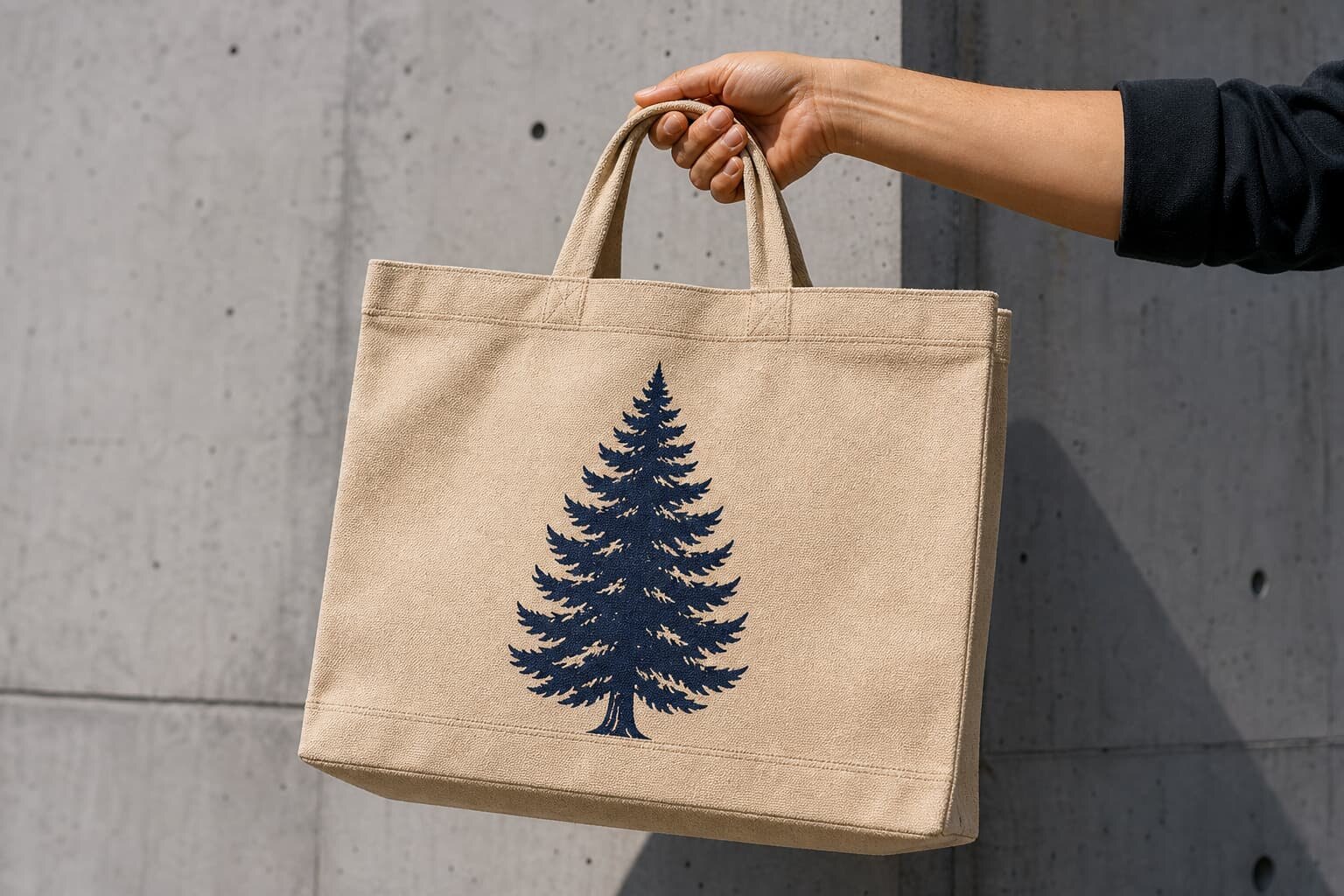
Why the Woven Label Approval File Matters
A canvas tote bag woven label approval file is not just an artwork attachment. It is the control document that tells the factory what label to buy, where to sew it, how to align it with the bag print, and what the inspector should accept in bulk. Without this file, the factory may still produce a good bag body but fail the branding detail that the buyer cares about most.
For procurement teams, the risk is usually not one single dramatic mistake. It is a chain of small assumptions: the merchandiser approves a photo, the label supplier changes yarn color, the sewing line measures from the wrong edge, and the packing team folds through the label. By the time the goods are in cartons, the issue becomes expensive to sort and difficult to negotiate.
- Use the approval file to connect artwork, trim purchasing, sewing, printing, packing, and inspection.
- Do not approve a woven label from a cropped photo without size and placement references.
- Keep one clear approval standard for supplier, buyer, third-party inspector, and reorder team.
Define the Bag Base Before Approving the Label
The woven label cannot be approved in isolation from the canvas tote bag construction. A 6 oz promotional tote, a 10 oz retail tote, and a 16 oz heavy shopper will not carry the same label in the same way. Lightweight cotton canvas may pucker if the label is stiff or if the stitch tension is too high. Heavier canvas can make a small side label look buried if it is sewn into a bulky seam.
For most retail and brand merchandise programs, buyers commonly review canvas between 10 oz and 12 oz, roughly around 340 to 407 GSM depending on the supplier's conversion and finishing process. A lower GSM may be acceptable for event giveaways or budget campaigns, but the label sewing must be tested because thin fabric shows needle holes, seam distortion, and label tension more clearly.
- State fabric weight in both oz and GSM where possible, because suppliers may quote in different systems.
- Confirm whether the canvas is greige, bleached, dyed, or washed, as finishing can affect shrinkage and label placement.
- Ask whether the woven label is sewn before or after side seam closing, because this changes access and sewing accuracy.
- Check handle reinforcement stitching near the label area if the label is close to the top side seam.
What the Approval File Should Contain
A useful approval file is specific enough that a new merchandiser can take it to the sample room and understand the required result without guessing. It should include the woven label artwork, finished label size, cut size before folding, fold direction, yarn colors, backing requirement, sewing thread color, label position, tolerance, and photos of the approved sample. If only the logo file is attached, the supplier still has too much room to interpret.
The file should also show how the label relates to the full tote bag. A side flag label needs a measurement from the top edge or bottom seam and an instruction for how much of the label remains visible after sewing. A front patch label needs coordinates from the top edge and side edge, plus stitch margin. If the bag has a screen print, heat transfer, pocket, gusset, or zipper, the label layout must be approved together with those features.
- Include label finished size, for example 25 mm x 40 mm visible size after folding.
- Include fold type, such as center fold, end fold, Manhattan fold, or straight cut if suitable.
- Include yarn color references, not only a digital RGB logo screenshot.
- Include placement tolerance and defect classification before bulk production starts.
- Include final packing photo if the label is visible in retail display or e-commerce unboxing.
Choose the Right Label Type for Canvas Totes
Damask woven labels are often the safest choice for canvas tote bags when the logo has small details or the buyer wants a more retail-grade finish. They offer cleaner edges and better detail than many low-density woven options. However, very tiny letters, fine lines, or gradients still need simplification. A woven label is not a paper print; the artwork must be converted into yarn structure.
Printed cotton labels, satin labels, leather patches, and rubber patches may also be used, but they create different cost, MOQ, and QC issues. For a natural canvas tote with a sustainability message, a cotton woven or cotton printed label may fit the product story better than shiny polyester satin. For a fashion tote, a small damask side label may be more subtle and durable than a large patch.
- Use woven damask for small logo clarity and a clean retail appearance.
- Use printed cotton label when a softer natural look is more important than raised yarn detail.
- Avoid very large stiff labels on lightweight canvas because they can distort the panel.
- Confirm whether the label back side may contact skin, garments, or food packaging.
Coordinate Label Approval With Print Method
Many woven label problems are caused by approving the bag print and label as separate items. On canvas tote bags, the main branding may be screen printed, heat transferred, digitally printed, embroidered, or left blank with only a label. Each method affects where the label can sit. Heat transfer needs pressure and temperature; a label too close to the transfer area can create uneven pressing or leave marks.
Screen printing is usually cost-effective for solid logos and repeat orders, but buyers should confirm print size, color count, ink type, curing method, and whether the label is sewn before or after printing. If the label is sewn first, the print table must avoid seam and label bulk. If the print is done first, the sewing line must not drag or stain the printed panel during label attachment.
- Ask for one layout showing print artwork, label position, handle stitch box, and gusset lines together.
- For heat transfer, confirm the label is outside the heat press plate area unless tested and approved.
- For screen print, check whether label sewing may scratch fresh ink or pass through a printed area.
- For embroidery plus woven label, check thread bulk and avoid overcrowding the branding zone.
MOQ and Cost Logic Buyers Often Miss
The bag MOQ and woven label MOQ are often different. A factory may accept 500 canvas totes, but the label supplier may require 1,000, 2,000, or more labels depending on loom setup, colors, and label complexity. The buyer should know whether the unused labels are included in the unit price, charged separately, stored for the next order, or discarded after a defined period.
For quote comparison, a low bag unit price may hide separate label tooling, artwork conversion, sample label cost, courier cost, or small-batch surcharge. A professional quote should show the tote body specification, label specification, print method, packing method, sample charge, production MOQ, label MOQ, lead time, and quote validity. Without this data, two supplier quotes may look comparable but cover different levels of risk.
- Ask for label setup cost and whether it is one-time or repeated after artwork change.
- Ask how many spare labels are produced for sewing loss and quality replacement.
- Ask whether unused labels can be stored under your brand control for reorder production.
- Ask if changing yarn color, label size, or fold type resets the MOQ or setup charge.
- Separate sample cost from bulk unit cost so approval delays do not confuse the final price.
Sample Approval Workflow That Prevents Rework
A clean workflow usually starts with digital artwork review, then label strike-off, then tote pre-production sample, then written production approval. The label strike-off confirms the woven logo quality before the label is sewn onto a bag. The tote pre-production sample confirms final placement, sewing, print relationship, fabric behavior, and packing. Skipping either step can save a few days but may create a larger production problem.
The buyer should not approve bulk production from a sales sample made with substitute fabric, temporary label, or hand-cut placement unless the approval clearly says what is still pending. If the factory needs to start fabric cutting while waiting for final label approval, that risk must be agreed in writing. Otherwise, any label change may force re-cutting, re-sewing, or re-packing.
- Step 1: approve label artwork dimensions and yarn color direction.
- Step 2: approve woven label strike-off or clear label sample photos with ruler.
- Step 3: approve tote pre-production sample using bulk fabric, bulk label, and final print.
- Step 4: approve packing fold and carton method if the label area may crease.
- Step 5: release bulk production only after the approval file is complete and dated.
Acceptance Criteria for Label Sewing
Acceptance criteria should be written before production, not argued after inspection. For a side flag label, the key points are visible size, height position, seam capture, fold direction, straightness, and whether the label is securely locked into the seam. For a patch label, the key points are position coordinates, stitch margin, corner shape, flatness, and whether the label edge lifts after handling.
A practical tolerance depends on the bag style and label visibility. A small side label may need tighter control because even a few millimeters can look careless near the top edge. A front patch label on a large tote may allow slightly wider tolerance if it remains visually centered. The important point is to define the tolerance in the approval file and train the sewing line at the first-piece stage.
- Wrong label, missing label, reversed label, and wrong logo color should be treated as major defects.
- Severely crooked label, label sewn into the wrong seam, or label hidden by folding should be major defects.
- Minor thread tails or slight stitch waviness may be minor defects if they do not affect retail appearance.
- Use the same ruler reference points in sample approval and final inspection.
- Require line-start approval before sewing thousands of pieces.
Packing and Carton Details That Affect the Label
Packing can damage an otherwise approved woven label. If the tote is folded through a front patch label, the label may develop a hard crease that remains visible after unpacking. If a side label is folded inside a tight bundle, it may be hidden during retail display or bent under carton compression. For e-commerce and retail buyers, packing approval should be part of the same file, not a later warehouse decision.
The quote should state individual polybag or bulk pack, pieces per inner bundle, carton quantity, carton size, gross weight, and estimated CBM. These details affect landed cost and final presentation. If the buyer needs barcode stickers, hangtags, warning labels, or retail cartons, confirm they do not cover or pull against the woven label area.
- Request a folded bag photo showing whether the label sits on a fold line.
- Avoid sticker placement over the woven label or main logo area.
- Check carton compression for heavy canvas totes packed in large quantities.
- For retail packs, confirm the label is visible in the intended display orientation.
- For export cartons, include style number and approval file reference for traceability.
How to Compare Supplier Quotes Fairly
When comparing canvas tote bag quotes, do not judge only by unit price. One supplier may quote 10 oz canvas with a printed label substitute, while another quotes 12 oz canvas with a custom damask woven label and final pre-production sample. The cheaper quote may still be useful, but only if the specification difference is visible and accepted by the buyer.
A good comparison sheet should list bag size, gusset, handle material and length, fabric GSM, shrinkage expectation, print method, number of print colors, label type, label size, label MOQ, packing method, sample lead time, bulk lead time, and incoterm. This gives procurement a practical view of value and risk. It also helps the factory quote more accurately, because fewer assumptions are left open.
- Compare fabric GSM and construction before comparing label cost.
- Check whether the woven label is custom-produced or selected from an existing stock trim.
- Confirm sample lead time separately from bulk production lead time after approval.
- Ask for carton CBM if freight cost is important to landed cost.
- Require the same approval file reference on every revised quote.
Specification comparison for buyers
| Spec decision | Recommended option | When it fits | Buyer risk to check |
|---|---|---|---|
| Label position | Side seam flag label or front patch label with approved coordinates | Side seam works for retail totes where the main print must stay clean; front patch works when the label is part of the brand design | Label drifting after sewing, label hidden inside seam allowance, or label interfering with print artwork |
| Label type | Woven damask label with folded edges for most canvas totes | Good for logos with small text, repeat retail orders, and cleaner edge durability than printed satin labels | Small letters filling in, wrong fold direction, frayed cut edge, or stiff label scratching the bag body |
| Fabric base | 10 oz to 12 oz cotton canvas for standard retail tote programs | Balances cost, shape, and printability for branded shopping, event, and merchandise bags | Label tension causing puckering on lightweight canvas or heavy fabric making the label sit unevenly |
| Print method around label | Screen print or heat transfer approved together with label placement | Screen print suits solid logos and larger quantities; heat transfer suits full-color artwork or lower MOQ runs | Print and label approved separately, then colliding in bulk layout |
| Approval sample | Pre-production sample using bulk fabric, bulk label, bulk thread, and final packing fold | Needed when woven label is visible at retail or used for brand authentication | Sales sample made with substitute label, different thread color, or hand-adjusted sewing not repeatable in bulk |
| MOQ logic | Separate bag MOQ from woven label MOQ and hold extra approved labels for reorders | Useful when the label mill requires more pieces than the first bag order | Buyer compares bag unit prices without noticing unused label inventory or label surcharge |
| Packing method | Flat pack with label area protected from hard fold lines | Best for retail-ready totes, gift bags, and bags with front patch labels | Fold crease through label, label corner lifting, or polybag sticker covering the branding area |
Buyer checklist before sampling
- Confirm the final woven label artwork file, including logo size, Pantone or yarn color reference, fold type, cut size, finished size, and text legibility limit.
- Approve the label position with measurements from fixed bag points, such as top edge, side seam, bottom seam, or handle stitch box, not from a photo only.
- Require the pre-production sample to use bulk canvas GSM, bulk label, bulk thread, final print method, and the agreed packing fold.
- Check whether the woven label MOQ is higher than the bag MOQ and ask how excess labels will be stored, invoiced, or used for reorder production.
- Define acceptable placement tolerance before production, for example plus or minus 3 mm for a side label and plus or minus 5 mm for a front patch label if suitable for the design.
- Review label sewing quality: straight stitch, secure back tack, no loose thread, no skipped stitch, no puckering, and no label edge trapped incorrectly inside the seam.
- Confirm the label does not conflict with screen print position, heat transfer temperature, washing requirement, barcode sticker, hangtag string, or carton folding method.
- Request clear sample room photos of front, back, inside seam, label close-up, measurement ruler, folded packing view, and carton packing layout before signing the approval file.
- Keep one signed physical approval sample or sealed duplicate sample for final inspection comparison if the order is brand-sensitive.
- Add the approved woven label file reference number to the purchase order, sample approval email, and final inspection checklist.
Factory quote questions to send
- What is the bulk canvas fabric weight in oz and GSM, and is the quoted weight before or after dyeing and finishing?
- Is the woven label included in the bag unit price, or quoted as a separate trim cost with its own MOQ and setup charge?
- What are the label finished size, cut size, fold type, yarn colors, back side finish, and minimum readable text height?
- Will the pre-production sample use the exact bulk woven label, or will the first sample use a substitute label for position approval only?
- What print method is quoted for the tote body, and has the factory checked the label placement against the print artwork and curing process?
- What is the acceptable tolerance for label position, label angle, stitch margin, and logo color difference on the woven label?
- How many extra labels will be produced for sewing loss, QC replacement, and repeat orders, and who owns the unused label stock?
- What is the sample lead time after artwork confirmation, and what is the production lead time after written approval of the label file?
- How will the bags be folded and packed so the woven label is not creased, hidden, or damaged in carton compression?
- What quote data is included: bag dimensions, fabric GSM, handle size, print size, label specs, packing method, carton quantity, gross weight, CBM, sample fee, tooling fee, and validity period?
Quality-control points to confirm
- Match the bulk woven label against the approved artwork and physical sample for size, color, fold direction, logo sharpness, and text readability.
- Measure label position from the same reference points used in the approval file, not by visual judgment only.
- Check the first 20 to 50 sewn bags at line start before the full sewing batch continues.
- Inspect whether the label is straight, flat, securely sewn, and free from fraying, needle damage, oil marks, or trapped loose threads.
- Confirm the tote fabric GSM, handle construction, print method, and label placement are consistent with the approved pre-production sample.
- Open packed cartons during final inspection to verify that folding, polybagging, and carton pressure do not crease or hide the label.
- Separate major defects such as wrong label, wrong position, reversed fold, missing label, and logo color mismatch from minor sewing appearance defects.
- Record the approved file number and sample date in the inspection report so disputes can be checked against the same reference.