Start With What The Quote Is Actually Pricing
A canvas tote bag wholesale quote is not just a unit price. It is a list of assumptions about fabric, sewing, printing, packing, quantity, lead time, and risk. When two suppliers quote the same tote bag at different prices, the difference is often hidden in the fabric weight, handle reinforcement, print coverage, carton packing, or whether a real pre-production sample is included.
Procurement teams should review each quote as a specification document, not as a simple price offer. If the quote only says cotton canvas tote bag, 12 oz, screen print, 5,000 pcs, it is still incomplete. You need to know whether 12 oz means actual finished fabric weight, whether the handles are the same material as the body, whether the logo is one side or two sides, and whether export cartons are strong enough for the shipping route.
- Treat every blank cell in a quote as a future cost or dispute.
- Compare quotes only after normalizing fabric weight, size, print area, packing, and approval steps.
- Ask suppliers to state exclusions clearly, especially print setup, sample freight, barcode labels, and testing.
- Keep the original RFQ, supplier quote, sample comments, and final purchase order aligned.
Fabric Weight Is The First Cost And Quality Variable
Canvas tote bags are commonly quoted in ounces, but procurement teams should also ask for GSM. A 10 oz cotton canvas is often around 300 GSM, while a 12 oz fabric may be around 360 GSM, depending on weave and finishing. These numbers are useful for comparison, but they are not enough without tolerance. A supplier quoting 12 oz with no tolerance may deliver fabric that feels closer to a lighter weight if the mill runs thin or the finishing changes the handfeel.
For promotional use, 8 oz to 10 oz canvas may be acceptable if the bag carries light items. For retail, grocery, bookstore, or conference material use, 10 oz to 12 oz is usually more stable. Heavier 14 oz or 16 oz canvas gives a premium handfeel, but it changes sewing speed, print result, carton weight, and freight cost. The best quote review does not automatically choose the heaviest fabric; it matches fabric weight to carrying load, target price, print effect, and packing method.
- Ask for both oz and GSM, plus tolerance such as +/-5 percent if acceptable.
- Clarify whether the fabric is natural, bleached, dyed, washed, or pre-shrunk.
- Check if the fabric weight is tested before cutting or after finishing.
- For dyed canvas, request lab dip approval before bulk fabric production.
- For natural canvas, agree on acceptable seed specks and shade variation.
Size, Gusset, And Handle Drop Change The Real Use Value
Flat dimensions can mislead buyers. A 38 x 42 cm canvas tote without gusset is not the same product as a 38 x 42 x 10 cm gusseted tote. The gusset increases usable volume but also adds fabric consumption, sewing time, and packing bulk. If a supplier quotes a lower price, check whether the gusset was removed, narrowed, or measured differently.
Handle drop is another common quote gap. A tote intended for shoulder carry usually needs a longer handle drop than a hand-carry event bag. If the handle is too short, the bag may pass production inspection but fail user experience. If the handle is too long, it may drag when hand carried and increase fabric or webbing consumption. Quote review should include handle width, handle length, drop measurement, and reinforcement method.
- Record size as width x height x gusset, with measurement tolerance.
- State whether the size is measured flat, finished, or before sewing shrinkage.
- Define handle length and handle drop separately.
- Check whether handles are self-fabric canvas or cotton webbing.
- Ask for a photo of the sample on a mannequin or hanger only if it helps judge handle drop.
Print Method Must Match Artwork And Fabric Texture
Most canvas tote bag wholesale orders use screen printing because it is efficient for solid logos and repeat production. It works well on natural or dyed canvas when the artwork has limited colors and clean edges. However, canvas texture affects fine lines, small text, and large ink coverage. A logo that looks sharp on coated paper may look rough on 12 oz cotton canvas unless the artwork is adjusted.
Digital print, heat transfer, embroidery, woven patch, and leather or PU patch can also be quoted, but each method has a different cost and MOQ logic. Screen printing may charge screen setup per color. Embroidery price depends on stitch count. Heat transfer can show a different handfeel and may not suit all eco-positioned retail programs. During quote review, ask suppliers to specify method, number of colors, print area, ink type if relevant, and whether a strike-off is included.
- Use screen print for simple solid logos and strong price control.
- Use embroidery when texture and durability matter more than fine detail.
- Use woven or sewn patches for premium retail programs with repeat orders.
- Use digital print only after checking color accuracy and fabric handfeel.
- Approve a print strike-off before bulk printing, especially on dyed canvas.
MOQ Needs To Be Broken Down By Cost Driver
A supplier may write MOQ 1,000 pcs, but that number may only apply to natural canvas with one print design and standard packing. If you need three fabric colors, two logo versions, and retail barcode polybags, the effective MOQ may change. The mill may require a minimum for dyed fabric, the print room may require setup efficiency, and the packing team may charge extra for small split quantities.
Good quote review separates total order MOQ from SKU-level MOQ. This matters for brand owners and distributors that build assortments. A 10,000 pc order across ten SKUs may look attractive, but if each SKU is only 1,000 pcs and each uses a different fabric color, the factory still faces more material control and setup work. The quote should show where the MOQ pressure comes from so the buyer can simplify the program without damaging the product.
- Ask for MOQ per fabric color, per bag size, per artwork, and per packing style.
- Check whether setup charges can replace MOQ for smaller test orders.
- Confirm whether overproduction or underproduction tolerance applies.
- Use shared fabric colors across SKUs to reduce risk and cost.
- Avoid approving many low-quantity variants before the first production run proves stable.
Sample Review Should Test The Quote, Not Just The Look
A sample is often approved for appearance, but it should also verify the commercial assumptions in the quote. If the sample uses available fabric from the sample room instead of bulk fabric, it may not prove final weight, shade, shrinkage, or print behavior. If the sample is hand-cut and carefully sewn by a senior sample maker, it may look better than bulk production unless the factory transfers the same construction standard to the line.
Procurement teams should request the right sample sequence. A blank construction sample checks size, fabric handfeel, and sewing. A print strike-off checks logo color, position, and ink performance. A pre-production sample should combine bulk fabric, approved printing, labels, and packing. The sealed pre-production sample then becomes the reference for inspection and shipment approval.
- Check finished measurements with a tape, not only by eye.
- Weigh the sample and compare fabric handfeel with the quoted GSM.
- Pull handles firmly and inspect stitch holes, skipped stitches, and reinforcement.
- Rub the print with a dry and slightly damp white cloth as a practical early check.
- Keep one sealed approval sample at the factory and one with the buyer or inspection team.
Packing Can Change Cost, Freight, And Retail Readiness
Canvas totes are flexible products, so packing is often treated as a minor detail. That is a mistake. Bulk packing 100 pcs per carton may be fine for event distribution, but it can create heavy cartons and creased bags. Individual polybags improve retail handling but add cost, labor, plastic use, barcode control, and carton volume. Folded packing can reduce carton size but may create crease marks on heavier canvas.
Quote review should include carton quantity, carton dimensions, gross weight, carton board strength, export marks, inner packing, moisture protection, and any retail labeling. If your warehouse requires carton weight under a certain limit, state it in the RFQ. If your retailer requires barcode stickers in a specific location, do not leave that instruction until after production. Late packing changes are expensive because they affect labor planning and carton ordering.
- Decide bulk pack, folded polybag, belly band, hangtag, or retail sleeve before final quote.
- Set maximum carton weight if warehouse handling rules apply.
- Confirm barcode type, sticker size, position, and SKU data source.
- Ask whether cartons are export grade and suitable for stacking.
- Request packing photos before shipment if a third-party inspection is not arranged.
Lead Time Only Matters When The Start Point Is Defined
A quoted lead time of 25 or 35 days is not useful unless the start point is clear. Factories may count production time after deposit, after artwork confirmation, after lab dip approval, after sample approval, or after all materials arrive. For canvas tote bags with dyed fabric, custom labels, or retail packing, material preparation can be the real schedule driver.
Buyers should build a sourcing calendar that separates sample time, approval time, material ordering, cutting, printing, sewing, finishing, packing, inspection, and shipment booking. This prevents the common problem where procurement expects production to begin after purchase order release, while the factory waits for final artwork, print color approval, or carton marks. The quote should state what information must be completed before the factory locks the schedule.
- Ask for sample lead time and bulk lead time separately.
- Confirm whether lead time includes weekends, public holidays, and peak season loading.
- Add approval buffer for lab dips, print strike-offs, and pre-production samples.
- Check whether fabric is in stock or must be woven and dyed.
- Tie delivery commitments to buyer approvals as well as factory production capacity.
Quote Data Should Be Complete Enough For Side-By-Side Review
A clean quote sheet helps buyers compare suppliers without guessing. The quote should identify bag size, fabric weight, fabric color, handle specification, print method, print size, number of print colors, label and packing details, MOQ, sample cost, setup cost, production lead time, payment terms, trade term, carton data, and validity period. If this data is missing, the lowest price may not be the lowest total landed cost.
For importers and distributors, quote version control is important. A supplier may revise the price after artwork changes, packing changes, or MOQ changes. Keep quote version numbers and dates so your team knows which specification the price belongs to. When issuing the purchase order, attach the final specification sheet rather than relying on email history.
- Require quote validity, currency, trade term, and port or delivery point.
- Separate unit price from sample fee, screen fee, mold fee, testing fee, and freight.
- Ask for estimated carton size, gross weight, and quantity per carton.
- Record assumptions for fabric, printing, label, packing, and inspection.
- Do not compare quotes until all suppliers answer the same technical questions.
Common Quote Review Mistakes To Prevent Before Production
The most expensive mistakes happen when a buyer approves a low quote without locking production details. A lighter fabric may be substituted, the print may be smaller than expected, the handle may be less reinforced, or the carton may be too weak for export handling. None of these issues are unusual in canvas tote bag sourcing; they are normal results of incomplete quote control.
The solution is not to make the RFQ complicated for no reason. The solution is to specify the few details that change cost and performance. If a detail affects fabric consumption, sewing time, print setup, packing labor, inspection result, or shipment cost, it belongs in the quote review. If it does not affect the product or buying risk, keep it simple.
- Do not accept fabric descriptions without GSM or oz weight.
- Do not approve artwork without print size, position, and color reference.
- Do not assume retail packing is included in a bulk packing quote.
- Do not compare natural canvas pricing with dyed canvas pricing as if they are the same.
- Do not release bulk production before approving a production-representative sample.
Specification comparison for buyers
| Spec decision | Recommended option | When it fits | Buyer risk to check |
|---|---|---|---|
| Fabric weight | 10-12 oz cotton canvas, about 300-360 GSM | Retail giveaways, bookstore totes, grocery bags, brand merchandise | Supplier may quote lighter 8 oz fabric to reduce cost unless GSM and tolerance are written |
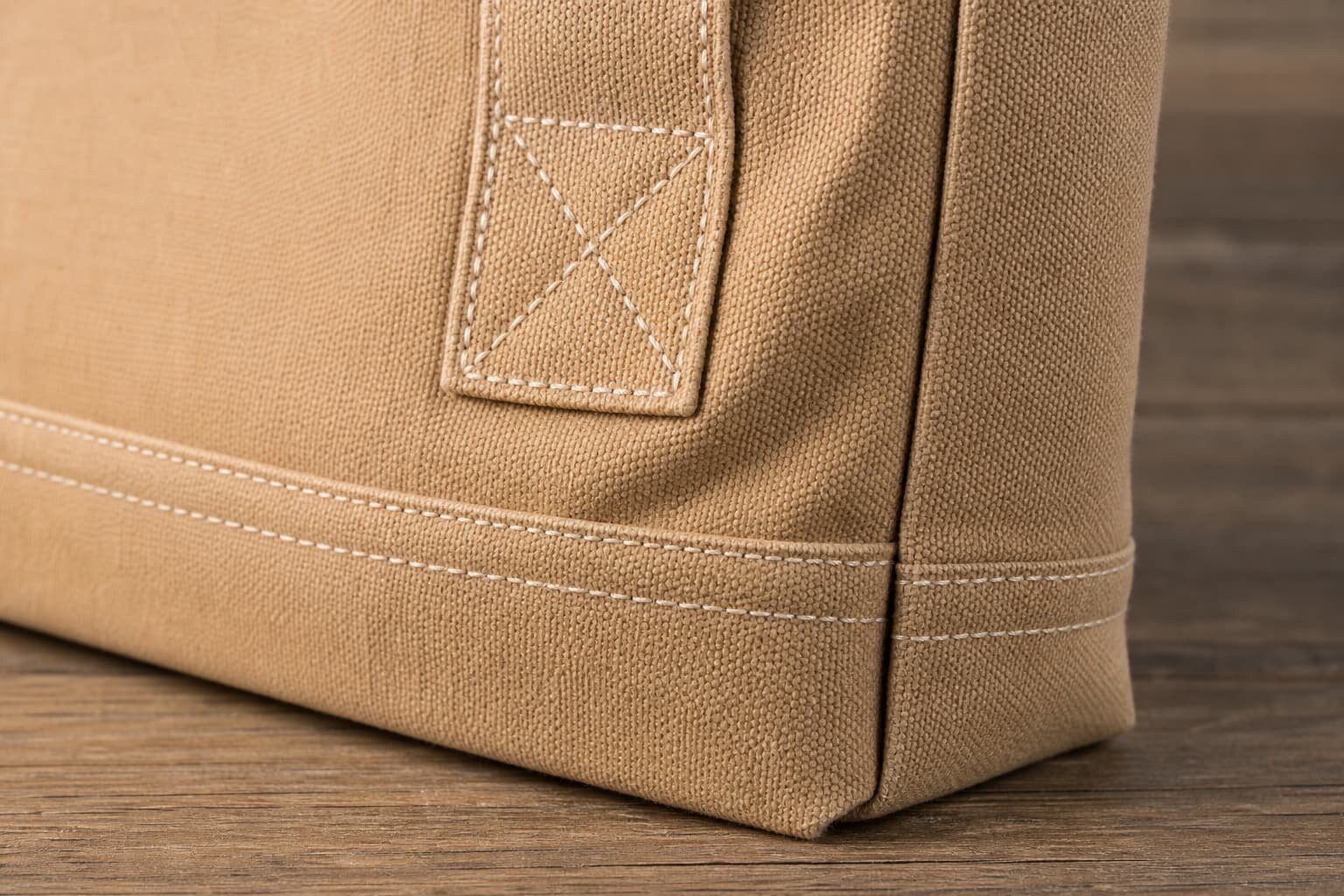
| Construction | Lockstitch seams with reinforced handle cross-stitch or box-X | Reusable totes expected to carry catalogs, bottles, apparel, or groceries | Handle attachment can look fine in photos but fail under load if stitch density is low |
| Logo method | Screen print for 1-3 solid colors on flat panels | Most wholesale cotton canvas tote orders with clean brand artwork | Ink coverage, curing, and fabric texture can change logo sharpness and wash resistance |
| Color fabric | Natural, bleached, dyed, or custom Pantone-dyed canvas | Natural for cost control, dyed canvas for retail color stories | Dyed canvas needs lab dip approval and color tolerance before bulk cutting |
| MOQ logic | Separate MOQ for bag body, dyed fabric, print setup, and packing | Mixed SKU programs with different sizes, colors, or logos | One headline MOQ may hide higher MOQs for custom color, woven labels, or printed cartons |
| Packing | Bulk pack 50-100 pcs per export carton or individual polybag if retail required | Bulk distribution, event programs, ecommerce, or retail shelf packing | Carton weight, barcode position, and polybag warnings are often missing from early quotes |
| Lead time | Sample 5-10 working days, bulk counted after sample, deposit, and artwork approval | Normal seasonal production planning | A quote lead time is not reliable unless approval milestones and material availability are stated |
Buyer checklist before sampling
- Confirm the quoted fabric weight in oz and GSM, including acceptable tolerance and whether the weight is before or after washing or finishing.
- Match bag dimensions to usable capacity, not only flat size; check width, height, gusset, handle drop, and seam allowance.
- Ask whether handles are self-fabric, cotton webbing, or another material, and require reinforcement details at the attachment point.
- Review the print method against artwork, fabric color, logo size, ink coverage, and expected rub or wash performance.
- Separate unit price drivers: fabric, sewing complexity, print setup, label, packing, carton, inland transport, and inspection requirements.
- Check whether the MOQ applies per total order, per color, per size, per artwork, or per packing style.
- Request a pre-production sample using bulk fabric, bulk handle material, approved print ink, and confirmed packing components.
- Confirm carton quantity, gross weight, carton dimensions, barcode placement, polybag requirements, and palletization if needed.
- Define lead time from the correct starting point: after deposit, sample approval, artwork approval, material receipt, or lab dip approval.
- Keep a quote comparison sheet that records supplier assumptions, exclusions, tolerances, and pending approvals.
Factory quote questions to send
- What fabric construction is included in your quote: plain weave canvas, weight in oz and GSM, yarn count if available, and weight tolerance?
- Is the quoted canvas greige, natural, bleached, dyed, washed, or finished, and are shrinkage or colorfastness tests included?
- Which handle material, width, length, and reinforcement stitch are included in the unit price?
- Which print method is quoted, how many colors are included, what is the maximum print area, and is screen setup charged separately?
- Does the MOQ apply per order, per color, per size, per print design, per fabric color, or per packing method?
- Are labels, hangtags, insert cards, barcode stickers, retail polybags, master cartons, and export marks included or quoted separately?
- What sample types are available before bulk production: blank sample, print strike-off, lab dip, pre-production sample, and sealed approval sample?
- What are the quoted production lead time, sample lead time, and the exact approval point that starts bulk production?
- What inspection standard do you recommend for this tote bag, and which defects are normally counted as major defects?
- Can you provide a quote sheet with itemized assumptions so our procurement team can compare it with other supplier offers?
Quality-control points to confirm
- Measure finished bag width, height, gusset, handle length, and handle drop against the approved sample and size tolerance.
- Check fabric weight with a GSM cutter or agreed test method, and compare it with the quoted fabric specification.
- Review fabric defects such as slubs, oil marks, broken yarns, shade variation, and excessive creasing on visible panels.
- Perform handle pull checks and inspect reinforcement stitches for skipped stitches, loose thread, and uneven placement.
- Inspect print position, logo size, color, ink coverage, registration, curing, cracking, and rubbing resistance.
- Check seam strength, stitch density, seam allowance, inside finishing, bartacks, and corner construction.
- Confirm label content, care label, side label, hangtag, barcode, and country of origin marking if required by the buyer.
- Verify packing quantity, carton strength, carton markings, polybag warnings, moisture protection, and carton weight.
- Compare bulk production against the sealed pre-production sample before shipment approval.
- Record defects by SKU, color, logo, and carton range so corrective action is traceable.