Why Supplier Risk Review Matters Before You Chase the Lowest Quote
A canvas tote bag looks simple, so buyers often treat it as a quick quote item. That is where sourcing mistakes start. Two suppliers can quote the same bag size and logo but base their prices on different fabric weights, handle widths, print coverage, packing methods, and inspection assumptions. The cheaper quote may not be cheaper after sample revisions, carton changes, late fabric replacement, or rejected print quality.
A supplier risk review is not about making the RFQ longer for its own sake. It is a structured way to check whether the supplier understands the product, controls the production route, and has quoted the same item you intend to buy. For procurement teams, the goal is to separate a real factory quote from a loose trading quote, identify missing cost items, and prevent unclear specifications from becoming bulk production disputes.
- Use the checklist before issuing a purchase order, not after the first sample fails.
- Compare suppliers on controlled specifications, not only unit price.
- Treat unclear quote lines as risk, even when the supplier sounds confident.
- Record each approved decision so the factory has fewer chances to substitute materials later.
Start With the Fabric Because Most Tote Bag Risk Is Hidden There
Canvas fabric is the biggest cost driver and the most common area for quote mismatch. A buyer may request a 12 oz canvas tote bag, while one supplier quotes a true heavy canvas and another quotes a lighter fabric described casually as 12 oz. Some factories quote by ounces, some by GSM, and some sales teams use market wording that is not measured carefully. For a reliable RFQ, always ask for both oz and GSM, plus the acceptable tolerance.
For most branded canvas tote bags, 8 oz to 12 oz fabric covers the common range. Around 8 oz, the bag is lighter and suitable for promotions where cost and freight matter. Around 10 oz to 12 oz, the tote feels more substantial and works better for retail merchandise. At 14 oz and above, the bag becomes heavier, stronger, and more expensive to sew and ship. If the buyer does not specify the expected use and load, the supplier may choose the cheapest construction that still looks acceptable in photos.
- Ask for fabric weight in oz and GSM, for example 10 oz, approximately 280 GSM.
- Confirm whether the fabric is natural, bleached, dyed, black, recycled, or organic cotton.
- Check if the supplier is quoting stock fabric or fabric that must be woven or dyed for the order.
- Request a fabric swatch from the intended production source, not a random showroom swatch.
- Set a GSM tolerance and color tolerance before bulk cutting starts.
Review Construction Details That Affect Real Use
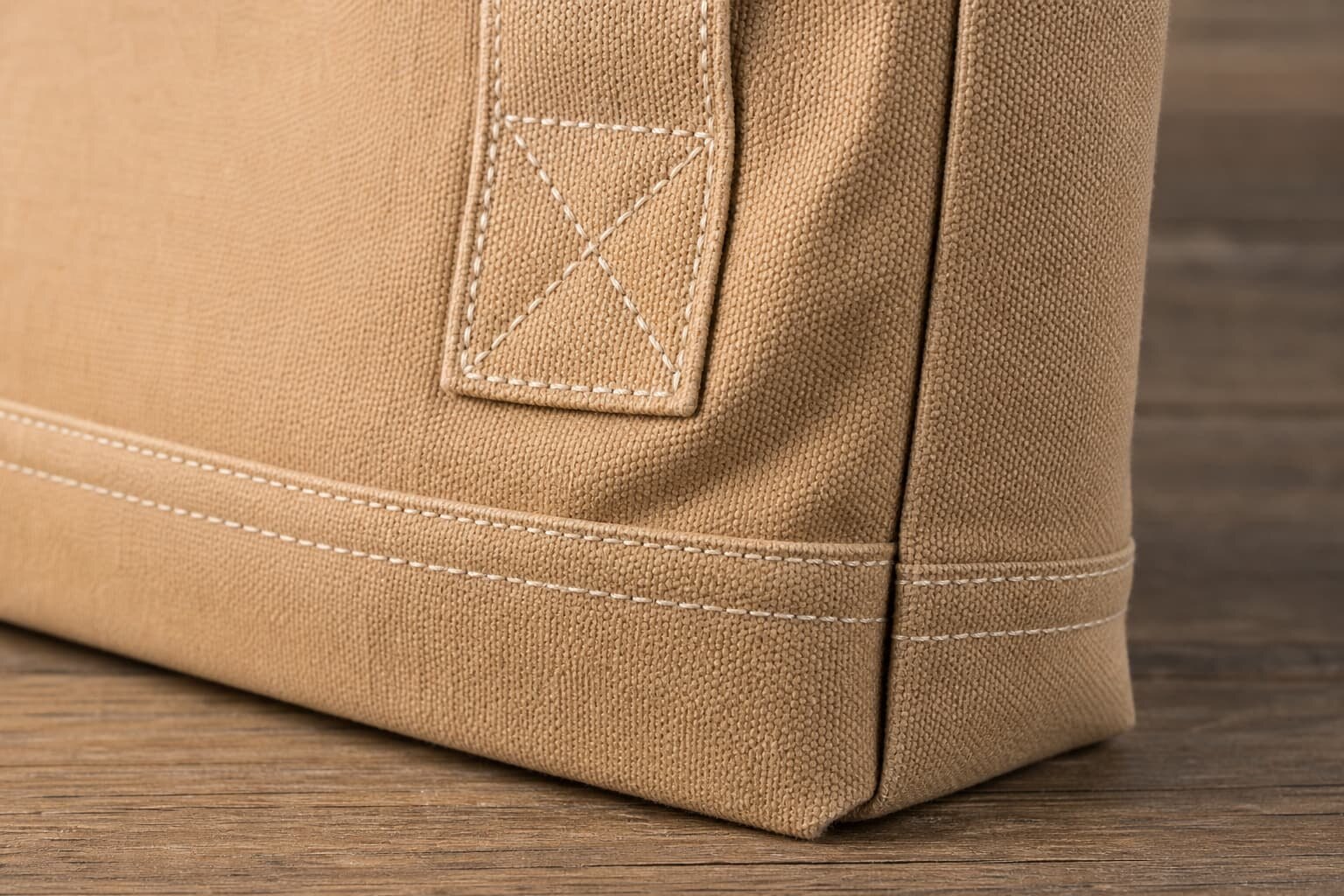
Many canvas tote bag failures happen at the handle joint, top hem, bottom seam, and gusset corner. These areas do not always show clearly in a sales photo, but they decide whether the bag survives retail use. A supplier that only quotes size and fabric weight has not given enough data for a serious comparison. Buyers should define handle width, handle drop, stitch type, reinforcement method, and whether seams are overlocked, folded, or bound.
Handle comfort is also a commercial issue. A narrow handle can reduce cost, but it may feel cheap or cut into the user's shoulder when the bag is loaded. A long handle may be suitable for shoulder carry, while a short handle is better for hand carry or some retail gift bags. If your brand owner, distributor, or retail buyer expects a certain user experience, include that in the RFQ instead of assuming the factory will choose correctly.
- Common handle width: 2.5 cm to 3.8 cm depending on bag size and load requirement.
- Common handle drop: about 25 cm to 30 cm for shoulder carry, shorter for hand carry.
- Preferred reinforcement: box-X stitch, cross stitch, or bartack depending on style.
- Watch for weak points: skipped stitches, loose thread ends, uneven top hem, and shallow seam allowance.
- For heavier bags, ask whether the needle size and machine setup are suitable for thick seams.
Match Print Method to Artwork Instead of Letting Price Decide
Print method selection should be based on artwork, order quantity, fabric color, required handfeel, and durability expectation. Screen printing is usually the practical choice for solid logos, spot colors, and medium to large canvas tote bag runs. It gives a clean result on cotton canvas when the screen mesh, ink, pressure, and curing are controlled. However, screen charges, color count, and registration tolerance must be included in the quote.
For full-color graphics, gradients, or smaller batches, transfer methods such as DTF or heat transfer may be offered. These can solve artwork complexity but create other risks: thicker handfeel, visible transfer edges, cracking, lower breathability, or inconsistent adhesion on coarse canvas. Embroidery and woven labels can work for premium looks, but they change the bag cost and production flow. A buyer should approve the print or decoration on the actual fabric weight, because results on thin cotton and heavy canvas are not the same.
- Screen print works well for 1-4 solid colors and larger repeat orders.
- DTF or heat transfer may fit complex artwork but needs handfeel and adhesion approval.
- Embroidery can look premium but may pucker lighter canvas if backing is not controlled.
- Woven labels reduce print risk but require label MOQ, color approval, and sewing placement control.
- Always define print size, location, color reference, and acceptable position tolerance.
Use MOQ Logic to Detect Whether the Quote Is Realistic
MOQ is not only a sales number. It reflects fabric sourcing, dyeing minimums, print setup, cutting efficiency, sewing line arrangement, and packing labor. If a supplier offers a very low MOQ at a very low unit price for a custom canvas tote bag, procurement teams should ask what is being compromised. The answer may be stock fabric, shared production, simplified packing, limited color control, or a sample that cannot match the final bulk order.
A good supplier can explain why MOQ changes when you adjust fabric color, GSM, print method, or accessories. Natural stock canvas usually has lower MOQ than custom dyed canvas. A one-color screen print has different economics from six-color print or all-over transfer. Individual polybags, hangtags, barcode stickers, and retail carton sorting also affect labor and minimum handling cost. When MOQ logic is transparent, the buyer can decide whether to simplify the product or increase quantity for better consistency.
- Ask for MOQ by fabric type, not only by finished bag style.
- Check whether custom dyeing requires a higher fabric minimum than bag sewing.
- Separate sample MOQ, trial order MOQ, and stable reorder MOQ.
- Confirm whether low MOQ uses stock fabric with limited shade control.
- Ask what cost changes at 500, 1000, 3000, and 5000 pieces if those levels are relevant.
Build a Quote Sheet That Prevents Apples-to-Oranges Comparison
A canvas tote bag quote should contain enough detail for another supplier to reproduce the same product. If the quote only says cotton canvas bag with logo, it is not a controlled quotation. For commercial comparison, require each supplier to list fabric weight, finished size, gusset, handle details, print method, print colors, packing method, carton quantity, sample cost, lead time, payment term, and incoterm. Missing data usually becomes a hidden cost later.
Procurement teams should also separate unit cost from setup and service cost. Screen setup, label development, hangtag printing, barcode stickers, special carton marks, testing, inspection support, and palletization may not be included unless requested. A supplier may look cheaper because these items are excluded. Ask for a quote validity period too, especially when cotton prices, exchange rates, or freight conditions are moving.
- Product data: fabric GSM, bag size, gusset, handle size, construction, and color.
- Decoration data: artwork size, color count, method, placement, setup charge, and strike-off cost.
- Packing data: inner pack, polybag requirement, carton quantity, carton size, gross weight, and marks.
- Commercial data: MOQ, sample fee, tooling, lead time, incoterm, payment term, quote validity.
- Exclusions: testing, inspection, palletizing, special labels, hangtags, and domestic delivery.
Sample Review Should Prove the Production Route
A sample is useful only when it represents the production route. Many sample rooms can make a neat tote bag by hand, but bulk production depends on fabric batch, cutting accuracy, sewing line control, print curing, and packing discipline. For risk review, ask whether the pre-production sample uses the same fabric source, same print method, same handle construction, and same accessories planned for bulk.
Do not approve a canvas tote bag sample only by front photo. Check the inside seams, bottom corners, handle attachment, print edge, fabric odor, lint, and how the bag folds into the carton. Measure the bag after it is laid flat, and record size tolerance. If the bag will carry books, bottles, samples, or retail goods, load it with a realistic weight and inspect whether the handles twist, the bottom distorts, or the stitch holes enlarge.
- Request a blank sample first if construction or fabric handfeel is uncertain.
- Request a print strike-off before the full pre-production sample when color accuracy matters.
- Sign and date the approved sample, or keep a sealed reference with clear photos.
- Check the sample after 24 hours for odor, ink tackiness, and fabric relaxation.
- Reject samples that are correct visually but made from a substitute fabric not planned for bulk.
Control Packing Early Because It Changes Cost and Freight
Packing is often treated as an afterthought, but it affects labor cost, carton volume, warehouse handling, barcode scanning, and plastic compliance. A flat-packed canvas tote bag may ship efficiently, while a folded or individually bagged tote may suit retail presentation but increase labor and carton size. If the buyer needs individual polybags, recycled polybags, paper belly bands, hangtags, or barcode labels, these must be quoted from the beginning.
Carton data should be requested before purchase order confirmation, not at shipment time. Pieces per carton, carton dimensions, gross weight, and shipping marks affect freight estimates and inbound warehouse planning. Heavy canvas totes can make cartons too heavy if packed in high quantities. Light promotional totes may compress well but can arrive wrinkled if packed too tightly. A responsible supplier should recommend a packing count that protects the product and stays manageable for export handling.
- Confirm flat pack, folded pack, individual polybag, master polybag, or retail-ready pack.
- Ask for carton size, gross weight, net weight, and pieces per carton.
- Check whether barcode labels are applied to the bag, polybag, hangtag, or carton.
- Avoid overfilled cartons that crush print surfaces or deform handles.
- For natural cotton canvas, consider moisture control and clean carton storage before loading.
Lead Time Risk Comes From More Than Sewing Capacity
Canvas tote bag lead time depends on fabric availability, dyeing, printing, sample approval, accessory preparation, sewing capacity, inspection timing, and carton readiness. Buyers sometimes calculate lead time from the day they send the purchase order, while factories calculate from deposit, artwork confirmation, fabric approval, and final sample approval. This mismatch causes avoidable delays.
For seasonal retail launches, event campaigns, and distributor replenishment, the RFQ should ask for a milestone schedule. A practical schedule separates fabric booking, lab dip or fabric swatch approval, print strike-off, pre-production sample, bulk cutting, printing, sewing, packing, inspection, and shipment booking. If the supplier cannot provide this breakdown, the quoted lead time may be only an optimistic sales estimate.
- Clarify when lead time starts: deposit, artwork approval, fabric approval, or sample signoff.
- Ask for separate sample lead time and bulk production lead time.
- Confirm whether printing happens before sewing or after sewing for your bag style.
- Reserve inspection time before the planned cargo handover date.
- Ask what happens if fabric shade, print color, or packing proof is not approved on first submission.
Set Acceptance Criteria Before Final Inspection
Final inspection is weak if the buyer has not defined what is acceptable. Canvas is a natural textile, so some slubs, yarn variation, or minor shade difference may exist depending on fabric type. At the same time, oil stains, large weaving defects, poor print curing, broken stitches, wrong size, mixed colors, and incorrect packing are not normal tolerance issues. The purchase order should state the main quality control points and the reference sample.
Acceptance criteria do not need to be complicated, but they must be specific. Define finished size tolerance, print position tolerance, fabric shade reference, acceptable minor defects, and critical defects that require rejection or sorting. If the product is for retail sale, the standard should be tighter than a one-day promotional giveaway. If the buyer needs third-party inspection, the supplier should know this before production so cartons are packed and staged correctly.
- Size tolerance example: width and height within an agreed centimeter tolerance after sewing.
- Print position tolerance example: measured from top edge and side edge according to approved artwork layout.
- Critical defects: wrong fabric, wrong print, broken handle, severe stain, mildew odor, or unsafe foreign object.
- Major defects: obvious print smudge, open seam, incorrect packing, or visible oil mark.
- Minor defects: small thread end, slight fabric slub, or small wrinkle if within agreed standard.
Specification comparison for buyers
| Spec decision | Recommended option | When it fits | Buyer risk to check |
|---|---|---|---|
| Fabric weight | 10 oz to 12 oz cotton canvas, approximately 280-340 GSM | Retail shopping totes, brand merchandise, gift-with-purchase bags needing a stronger handfeel | Supplier quotes 10 oz but uses a loose weave or lower GSM; ask for measured GSM tolerance and fabric swatch |
| Budget fabric | 8 oz cotton canvas, approximately 220-240 GSM | Promotional campaigns, lighter giveaways, lower freight weight requirements | Bag may collapse, print may look less solid, and handle attachment may need reinforcement |
| Heavy-duty fabric | 14 oz to 16 oz canvas, approximately 390-460 GSM | Reusable grocery totes, bookstore bags, tool or event kits with heavier contents | Higher sewing difficulty, thicker seams, longer lead time, and higher carton weight |
| Handle construction | Self-fabric handles with box-X or reinforced cross stitch | Most retail and brand totes where durability is visible to the consumer | Cheap quotes may use narrow handles, weak bartacks, or no reinforcement at stress points |
| Print method | Screen print for solid logos and spot colors | Most cotton canvas tote orders with 1-4 color artwork and medium to large runs | Ink coverage, curing, color tolerance, and print position must be approved before bulk |
| Print method | DTF or heat transfer for complex full-color artwork | Shorter runs, gradients, photo-style graphics, or multi-color promotional designs | Transfer handfeel, wash resistance, cracking, and edge marks need sample approval |
| MOQ logic | MOQ tied to fabric availability, dyeing, print setup, and packing style | Buyers comparing real factory capacity instead of only lowest unit price | Very low MOQ may hide stock fabric substitution, shared production, or higher rework risk |
| Packing | Flat pack in export carton with inner polybag only if required | Retail buyers and importers balancing presentation, carton volume, and plastic reduction | Carton dimensions, barcode label position, moisture control, and packing count must match destination rules |
Buyer checklist before sampling
- Confirm the supplier is quoting the same fabric weight, weave, color, shrinkage tolerance, and handle width across all price options.
- Ask whether canvas is greige, bleached, dyed, or stock natural, because color and shrinkage risk change with each route.
- Require a physical pre-production sample using the actual fabric, actual handle construction, actual print method, and intended packing.
- Check stitch density, handle reinforcement, seam allowance, loose threads, top edge folding, and whether the bag stands square when loaded.
- Approve print size, position, ink color, ink curing, handfeel, registration, and expected tolerance before mass production.
- Compare quote data line by line: fabric GSM, bag size, gusset, handle size, print area, print colors, packing, carton quantity, MOQ, sample fee, tooling, lead time, and incoterm.
- Ask for carton size, gross weight, net weight, pieces per carton, and pallet loading estimate before confirming freight.
- Confirm whether inspection can be done at inline stage and final stage, not only after all cartons are sealed.
- Set acceptance criteria for fabric defects, print defects, size tolerance, color shade, odor, stains, and packing errors.
- Keep one signed sample, one fabric swatch, one print strike-off, and one approved packing photo as the production reference.
Factory quote questions to send
- What exact canvas weight are you quoting in oz and GSM, and what tolerance do you control during bulk production?
- Is the fabric stock natural canvas, custom dyed canvas, bleached canvas, recycled cotton canvas, or organic cotton canvas?
- What is the yarn count or weave description, and can you provide a fabric swatch from the same lot planned for production?
- What are the finished bag dimensions, gusset size, handle width, handle length, seam allowance, and size tolerance?
- Which print method are you quoting, and what is the maximum print area included in the unit price?
- For screen printing, how many screens are included, what ink type will be used, and how will ink curing be checked?
- For transfer printing, what film or transfer type is used, and what wash or rub resistance can be demonstrated by sample?
- What is the MOQ for the quoted fabric color and print method, and what changes if the order quantity is lower?
- What sample stages are included: blank sample, print strike-off, pre-production sample, and packing sample?
- What is the production lead time after artwork approval, fabric approval, deposit, and final sample signoff?
Quality-control points to confirm
- Fabric GSM measured from bulk fabric and compared with the approved swatch before cutting.
- Canvas color shade checked under consistent lighting against the approved sample or Pantone reference where applicable.
- Finished bag size checked for width, height, gusset, handle drop, and handle width after sewing and pressing.
- Handle attachment inspected with pull focus on box-X stitching, bartack length, skipped stitches, and seam tearing.
- Print position measured from top edge and side edge, not judged by eye only.
- Print quality checked for pinholes, smudging, uneven ink, registration shift, transfer edge marks, and poor curing.
- Seam strength reviewed at side seam, bottom seam, gusset corner, and top hem where stress is highest.
- Bag cleanliness checked for oil marks, pencil marks, loose threads, lint, odor, and moisture.
- Packing checked for correct quantity per inner pack and export carton, correct carton mark, and no mixed SKU cartons unless approved.
- Final carton condition checked for board strength, tape sealing, carton weight, and whether cartons are suitable for export handling.