Why a Supplier Readiness File Matters
A canvas tote bag supplier readiness file is the working pack that tells a factory exactly what to quote, sample, produce, inspect, and pack. It is not the same as a simple inquiry email. A normal inquiry may say 12 oz canvas tote, black logo, 5,000 pieces. That is not enough for reliable pricing. Different suppliers may quote different fabric weights, handle construction, print methods, carton packing, and sample assumptions while appearing to answer the same request.
For procurement teams, the readiness file prevents false quote comparison. A low unit price may be based on lighter fabric, shorter handles, one-side printing, no individual packing, or a loose tolerance. A higher quote may include better canvas, stronger reinforcement, and more realistic sampling. Without a readiness file, buyers spend days asking the same clarifying questions and still risk approving a sample that does not represent bulk production.
- Use the file before RFQ release, not after three suppliers have already quoted different assumptions.
- Keep one controlled version of specifications so sourcing, merchandising, design, and quality teams use the same data.
- Treat the file as a quote comparison tool, sample approval record, and production handover document.
- Update it after every approved change, especially fabric GSM, print method, handle drop, and packing.
Start With the Commercial Use Case
Canvas tote bags look simple, but the correct specification depends on how the bag will be sold or used. A tote for a one-day trade show does not need the same structure as a retail bookstore tote or a grocery bag expected to carry bottles. Before asking for prices, define the business purpose in the readiness file. This helps the supplier choose material and construction that match the risk level instead of guessing from artwork only.
Procurement should also state whether the tote is a retail product, promotional giveaway, gift-with-purchase, subscription box insert, event bag, or distributor stock item. Each use case changes the quality threshold. Retail products need cleaner sewing, stable shade, stronger presentation packing, and better label control. Giveaways can sometimes accept simpler seams and bulk packing if the brand and buyer agree before production.
- For retail sale, define expected shelf presentation, hangtag, barcode, individual packing, and visible seam quality.
- For promotional use, define event date, budget ceiling, print visibility, and whether minor fabric slubs are acceptable.
- For grocery or heavy use, define load expectation and request handle seam reinforcement details.
- For distributor stock, define repeat order colors, private label options, and carton labeling needed for warehouse handling.
Fabric Weight and Canvas Specification
The most common quote problem is fabric weight. Buyers often request 12 oz canvas, but suppliers in different markets may interpret ounce weight differently or quote a lighter fabric to win the first round. Always ask for both oz and GSM. As a working reference, 8 oz canvas is often around 270 GSM, 10 oz around 340 GSM, 12 oz around 407 GSM, and 16 oz around 540 GSM. These are practical references, not universal legal standards, so the readiness file should state the target and acceptable tolerance.
The file should also describe fabric color and finishing. Natural cotton canvas, bleached canvas, dyed canvas, washed canvas, and recycled cotton blends do not behave the same in printing and sewing. Natural canvas can have seed flecks and shade variation. Dyed canvas may need higher MOQ because the mill must dye a batch. Washed canvas can shrink and soften, which affects final size. If the bag is quoted only as cotton canvas without these details, the first sample may look acceptable but bulk production can move in shade, handfeel, or shrinkage.
- State fiber content, such as 100 percent cotton canvas or cotton-polyester blend, if acceptable.
- Record fabric weight in oz and GSM, and ask whether GSM is tested before or after finishing.
- State color standard using Pantone, approved swatch, or natural canvas reference photo plus physical swatch.
- Ask if fabric is stock fabric or made-to-order fabric because this changes MOQ and lead time.
- For white or light canvas, ask about dirt control, packing protection, and acceptable visible slubs.
Size, Gusset, Handle, and Sewing Details
A canvas tote bag size should be written as finished width x height x gusset, with measurement method. For example, 38 x 42 cm flat tote and 38 x 42 x 10 cm gusseted tote are different products. The gusset changes fabric consumption, sewing time, carton volume, and how the bag hangs when filled. If a buyer sends only a front-view image, the supplier may quote a flat tote while the brand expects a bottom gusset.
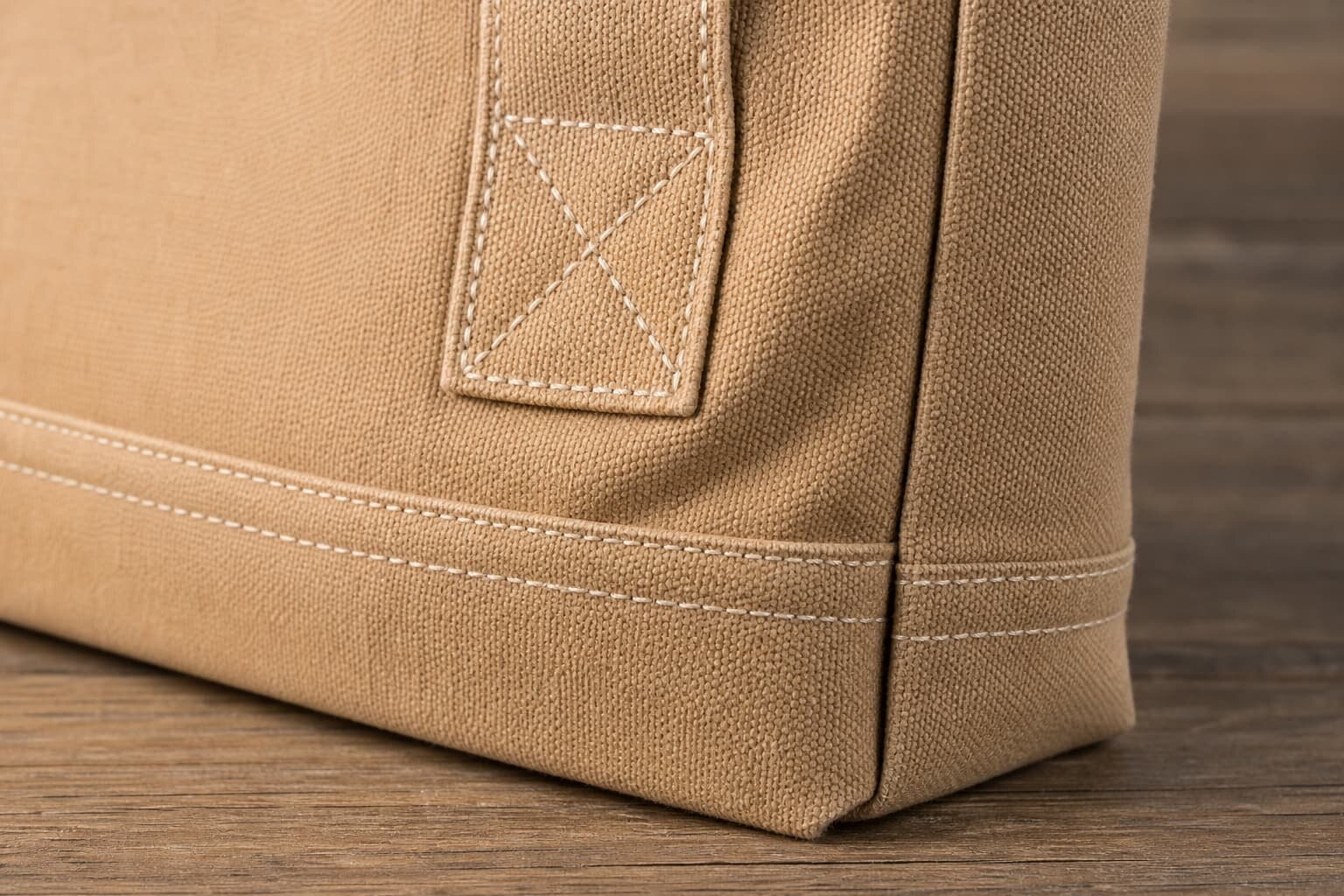
Handle details create many bulk complaints. A tote can have short hand-carry handles, shoulder handles, long crossbody-style handles, or webbing straps. Buyers should state total handle length, handle drop, handle width, material, and reinforcement pattern. Cross-stitch reinforcement is common, but the size and stitch density matter. A small cross-stitch on thick canvas may not be enough for heavy use, while oversized reinforcement may interfere with a clean retail look.
- Define finished bag tolerance, commonly plus or minus 0.5 cm to 1 cm depending on construction.
- Specify handle drop, not only total handle length, because buyers judge comfort by drop.
- Confirm self-fabric handle, cotton webbing, dyed webbing, or contrast handle before costing.
- State whether seams are overlocked, bound, folded, or hidden because seam finishing affects cost and strength.
- For heavier loads, request a simple load test method and sample photo of handle reinforcement.
Print Method and Artwork Readiness
Artwork must be production-ready before RFQ if the buyer wants meaningful quotes. A supplier cannot price printing correctly from a low-resolution logo placed on a bag photo. The readiness file should include vector artwork, print size, print position, color references, number of print locations, and whether the logo crosses seams or is close to the handle. Even a basic one-color logo can create cost differences if it is oversized or printed on both sides.
Screen printing is usually the practical choice for solid logos and medium to large runs. Heat transfer can work for small batches or complex color artwork, but the handfeel and edge durability should be reviewed. Digital printing may help with gradient or multi-color artwork, but canvas texture can reduce sharpness. Embroidery, woven labels, leather patches, or printed side labels change the buying discussion from print cost to trim sourcing, needlework, placement tolerance, and minimum trim quantity.
- Attach vector files such as AI, EPS, or PDF and include a JPG preview for quick checking.
- State print size in centimeters or inches and distance from top edge, side edge, and bottom fold.
- Use Pantone references for spot colors but allow a realistic tolerance on natural canvas.
- Ask for a print strike-off on actual canvas when logo color or ink coverage is important.
- Confirm whether printing happens before or after sewing because this affects placement control.
MOQ Logic That Buyers Should Clarify
MOQ for canvas tote bags is not one fixed number. It depends on fabric availability, fabric color, print method, artwork setup, trim sourcing, and production line efficiency. Natural stock canvas with one-color screen print may support a lower MOQ than custom dyed canvas with woven label, zipper, inside pocket, and individual retail packing. A readiness file should ask the supplier to explain MOQ by cost driver, not just state the lowest number.
This matters when buyers compare quotes from trading companies and factories. One supplier may accept a small MOQ by using stock fabric and manual cutting, while another may quote a higher MOQ because they are reserving a production line and dyeing fabric to order. Neither answer is automatically wrong. The buyer needs to know what is included and whether repeat orders can use the same material, shade, and trims.
- Separate MOQ for natural stock canvas, dyed stock canvas, custom dyed canvas, and special weave canvas.
- Ask if MOQ changes by print color count, print size, or number of print positions.
- Confirm trim MOQ for woven labels, metal snaps, zippers, drawcords, hangtags, and barcodes if used.
- Ask whether sample fabric and bulk fabric come from the same source.
- For launch orders, request a clear reorder MOQ and lead time, not only first-order MOQ.
Quote Data Needed for Real Comparison
A useful quote is more than unit price. For canvas tote bags, the buyer should request a quote sheet that shows specification assumptions, price basis, packaging, carton data, sample terms, lead time, and validity. If one supplier quotes FOB and another quotes EXW, or one includes individual polybags while another packs 100 pieces loose in a carton, the landed cost comparison is not valid.
Ask suppliers to show cost-impact alternatives when practical. For example, quote the same tote in 10 oz, 12 oz, and 14 oz canvas, or quote bulk packing versus individual packing. This does not mean forcing the supplier to reveal factory cost. It means asking for commercial options that help procurement decide where quality is worth paying for and where cost can be controlled without damaging the product.
- Request unit price by order quantity, such as 1,000, 3,000, 5,000, and 10,000 pieces.
- Ask for sample cost, screen cost, artwork setup cost, and whether any charge is refundable after order.
- Require incoterm, currency, payment terms, quote validity, and production location.
- Ask for export carton size, pieces per carton, gross weight, net weight, and estimated CBM.
- Request price differences for fabric weight, print method, packing method, and handle option.
Sample Approval Sequence
Sampling should not be treated as one general sample. A canvas tote order may need several checks: fabric swatch, shade approval, print strike-off, size sample, pre-production sample, and packing sample. If the buyer skips these steps, the final PP sample may become overloaded with decisions and delay the production schedule. A readiness file tells the supplier which approval gates are required and who signs off each item.
The most important approval is the pre-production sample made with bulk-intended fabric, decoration, sewing, labels, and packing. Many early samples are made from available fabric to confirm shape only. That is useful, but it should not be mistaken for production approval. The readiness file should mark samples clearly as reference sample, salesman sample, print strike-off, or PP sample so the factory and buyer do not argue later about what was approved.
- Approve fabric handfeel and GSM before finalizing bulk price when fabric is a major cost driver.
- Approve print strike-off before bulk printing, especially for large solid ink areas.
- Approve one full PP sample before cutting all material when design is new.
- Keep one signed sample at the factory and one with the buyer or inspection team.
- Record any sample changes in writing and update the readiness file before mass production.
Packing, Carton, and Freight Readiness
Packing decisions affect both product condition and landed cost. Canvas totes are often folded, stacked, and packed in export cartons, but the folding method can create creases across the print or distort the bag shape. White, natural, or light-colored canvas needs better dirt protection. If the tote is for retail, the buyer may need individual polybag, belly band, hangtag, barcode sticker, or carton sorting by SKU.
Freight planning starts with carton data. Canvas is heavier and bulkier than many buyers expect, especially at 12 oz and above. A quote without carton size, gross weight, net weight, and pieces per carton is incomplete. If the buyer is shipping by air for an event deadline, heavier canvas and individual packing can create a serious cost shock. The readiness file should make packing and freight data mandatory at quote stage.
- Define whether bags are bulk packed, bundled, individually polybagged, or retail packed.
- State folding method if print creasing or shelf presentation is important.
- Require inner moisture protection for ocean shipment, especially during humid seasons.
- Ask for carton strength, carton marking, SKU separation, barcode placement, and pallet requirement if any.
- Check carton CBM and gross weight before approving a heavy fabric upgrade.
Lead Time and Production Risk Planning
Lead time should be broken into stages. A supplier may say production takes 30 days, but that may exclude artwork confirmation, sample revisions, fabric dyeing, print plate making, final inspection, and export booking. For canvas tote bags, delays often come from fabric sourcing, custom dyeing, print color approval, and trim arrival. The readiness file should ask for a lead time schedule that starts from confirmed artwork, approved sample, and deposit receipt.
Buyers should also identify date-sensitive risks. Event bags, retail launches, and seasonal promotions often have fixed deadlines. If the schedule is tight, avoid unnecessary complexity such as custom dyed fabric, new woven labels, multi-position printing, and special packing unless the supplier confirms feasibility. A readiness file helps procurement see which specification choices are adding days and which are essential to brand value.
- Ask for lead time split by sample, material preparation, printing, sewing, inspection, packing, and shipping handover.
- Confirm whether lead time starts after deposit, artwork approval, PP sample approval, or all three.
- Ask if custom dyed canvas requires lab dip, bulk dye approval, and extra drying or finishing time.
- Build time for buyer review of samples instead of expecting the factory to absorb approval delays.
- For urgent orders, reduce variables before asking suppliers to compress production.
Specification comparison for buyers
| Spec decision | Recommended option | When it fits | Buyer risk to check |
|---|---|---|---|
| Fabric weight | 10 oz to 12 oz cotton canvas, around 340 to 407 GSM | Retail promotional totes, bookstore bags, lifestyle brand merchandise, corporate gift bags | Supplier may quote lighter fabric using oz wording only; ask for GSM, yarn construction, and finished fabric weight tolerance |
| Budget fabric option | 8 oz cotton canvas, around 270 GSM | Large-volume giveaways, light contents, short campaign use, tighter landed cost targets | Bag may collapse, print may show through, and load-bearing seams need stronger reinforcement |
| Premium structure | 14 oz to 16 oz canvas, around 475 to 540 GSM | Retail sale items, heavy grocery use, tool kits, conference bags with catalogs | Higher sewing difficulty, thicker folded seams, longer needle marks, higher freight weight, and higher MOQ for dyed fabric |
| Print method | Screen print for solid logos and larger repeat orders | One to four spot colors, durable brand marks, clean cotton canvas surface | Confirm print size, ink type, curing, color tolerance, and whether seams or handles interrupt print placement |
| Small batch decoration | Heat transfer or digital print depending on artwork and fabric color | Short runs, gradient artwork, multi-color graphics, product testing | Transfers can feel heavy; digital print on dark canvas may need white base and may not match Pantone exactly |
| Handle construction | Self-fabric handles with cross-stitch reinforcement | Standard retail totes and brand merchandise where handle look should match bag body | Handle length, folded edge, stitch density, and reinforcement pattern must be approved before bulk cutting |
| Bottom structure | Flat tote without gusset for low-cost flat packing; 8 cm to 12 cm gusset for retail use | Flat style for inserts and documents; gusseted style for groceries, apparel, bottles, or gift sets | Gusset changes capacity, carton cube, print position, and final hanging appearance |
| Packing method | Individual polybag only when retail or clean presentation requires it; otherwise bulk pack with moisture protection | Retail orders, gift programs, warehouse handling, distributor resale | Overpacking raises cost and plastic use; underpacking can cause creasing, dirt marks, and moisture claims |
| Sample approval | Pre-production sample using bulk-intended fabric, print, handle, and packing | First purchase order, new artwork, new fabric weight, or new supplier | Sales sample may use available fabric; require a PP sample that matches final material and production process |
Buyer checklist before sampling
- Define bag size as width x height x gusset in centimeters or inches, with tolerance and measurement position.
- State fabric type, color, weight in oz and GSM, and whether the weight is before or after washing or finishing.
- Attach artwork at actual size with Pantone references, print position, maximum print area, and acceptable logo tolerance.
- Confirm handle material, handle width, total length, drop length, reinforcement stitch pattern, and load expectation.
- Decide whether the bag needs inside seams, bound seams, overlock seams, bottom gusset, boxed corners, zipper, snap, or pocket.
- List required samples: material swatch, print strike-off, size sample, pre-production sample, and packing sample when needed.
- Ask suppliers to separate unit price, mold or screen charges, sample charges, packing cost, inland freight, and export carton data.
- Set MOQ by fabric color, print color count, and sewing style instead of asking for one vague minimum order quantity.
- Request lead time split into material sourcing, sampling, bulk production, inspection, packing, and export handover.
- Include carton dimensions, pieces per carton, gross weight, net weight, and any retailer label or barcode requirements.
Factory quote questions to send
- What canvas weight are you quoting in both oz and GSM, and what tolerance do you control in bulk production?
- Is the fabric greige, bleached, dyed, washed, or finished, and can the same fabric be reserved for the approved PP sample and bulk order?
- What is your MOQ by natural canvas, dyed canvas, custom color fabric, and printed logo quantity?
- Which print method do you recommend for this artwork and why: screen print, heat transfer, digital print, embroidery, woven label, or patch?
- What is the maximum print area for the requested bag size without distortion near seams, handles, or gusset folds?
- What stitch density, seam type, and handle reinforcement will be used for the quoted bag?
- Can you quote the same design in 8 oz, 10 oz, 12 oz, and 14 oz canvas so we can compare cost and freight impact?
- What samples are included before order confirmation, and which samples are chargeable or refundable after bulk order placement?
- How many days are needed for artwork proof, material sourcing, PP sample, bulk cutting, printing, sewing, inspection, and packing?
- What are the export carton dimensions, pieces per carton, gross weight, and recommended loading quantity for our target shipment method?
Quality-control points to confirm
- Check finished size against approved sample with tolerance stated before production, not after dispute.
- Verify fabric weight using a cut swatch GSM test or supplier fabric report, especially when quotes differ sharply.
- Compare fabric shade under consistent light and keep an approved shade swatch sealed for production reference.
- Confirm print position, color, edge sharpness, curing, adhesion, and rub resistance before bulk sewing when possible.
- Inspect handle length, handle drop, stitch density, cross-stitch placement, and seam strength on random samples.
- Review gusset width, bottom fold symmetry, side seam alignment, and whether the bag stands or folds as intended.
- Check loose threads, skipped stitches, needle holes, oil marks, fabric slubs, creases, and contamination.
- Test packing method by opening a finished carton and checking fold marks, moisture protection, barcode placement, and carton strength.