Why an audit packet matters before you compare tote quotes
A canvas tote bag quote is only useful when every factory is pricing the same product. In real sourcing, the numbers drift because one supplier is quoting 10 oz fabric, another is using 12 oz, one includes a woven label, another leaves it out, and a third is assuming bulk packing with no retail polybag. The result is not a price gap you can trust. It is a spec gap hiding inside the quote. A proper canvas tote bag supplier audit packet closes that gap before your team spends time on revision calls and sample disputes.
The packet should work like a shared sourcing file, not a marketing brief. It needs the finished bag spec, artwork version, construction notes, packing method, and the exact questions you want every factory to answer. If a supplier cannot fill out the same packet cleanly, that is a useful signal. It usually means their estimating process is loose, their production understanding is thin, or they are planning to solve missing details later with change orders. Buyers who standardize the packet get cleaner quote comparisons, fewer surprises in PP samples, and much better control over margin.
- Use one packet for every factory so the quote basis stays consistent.
- Record the latest artwork file name, spec version, and approval date.
- Ask suppliers to state any exclusions in writing, not in a follow-up call.
- Treat vague quotes as incomplete, not as lower-cost offers.
Lock the tote specification before you ask for price
Do not ask for a tote price until the bag is defined in buyer language. At minimum, the packet should state finished size, gusset depth, handle length, handle drop, seam allowance if relevant, closure type, pocket count, and whether the tote is unlined or lined. A factory can quote faster when these basics are clear, and your sourcing team can compare suppliers without guessing what each quote actually covers. For canvas totes, even a small change in handle length or gusset depth can alter fabric yield, labor time, and carton fit.
It also helps to separate finished size from cut size. Many buyers forget that a factory may cut slightly larger to allow for sewing shrinkage or a wash process, then finish to the target dimension. That is normal, but it must be stated. Include tolerance ranges for length, height, and handle drop so both sides know what counts as acceptable. If your brand uses more than one tote format, build each version as a separate line item in the audit packet instead of mixing options into one flexible brief.
- State finished size in inches or millimeters and keep one unit system through the packet.
- Call out any pocket, closure, lining, binding, or insert board as separate features.
- Set tolerance bands for body size and handle drop before sampling starts.
- If the tote has multiple SKUs, give each one a distinct code and spec page.
Choose canvas weight and construction for the use case
Canvas weight is one of the first things a buyer should audit because it drives feel, print appearance, and durability. A lighter canvas around 10 oz or 280-320 GSM may be fine for low-cost promotional use, but it can look limp for retail and may show the contents through the fabric. A standard retail tote often lands around 12 oz or 340-400 GSM, while a premium or heavier-load bag may move to 14-16 oz or 400-450 GSM and above. Those ranges are not just marketing language. They affect stitch pull, drape, and the way the bag sits on a shelf.
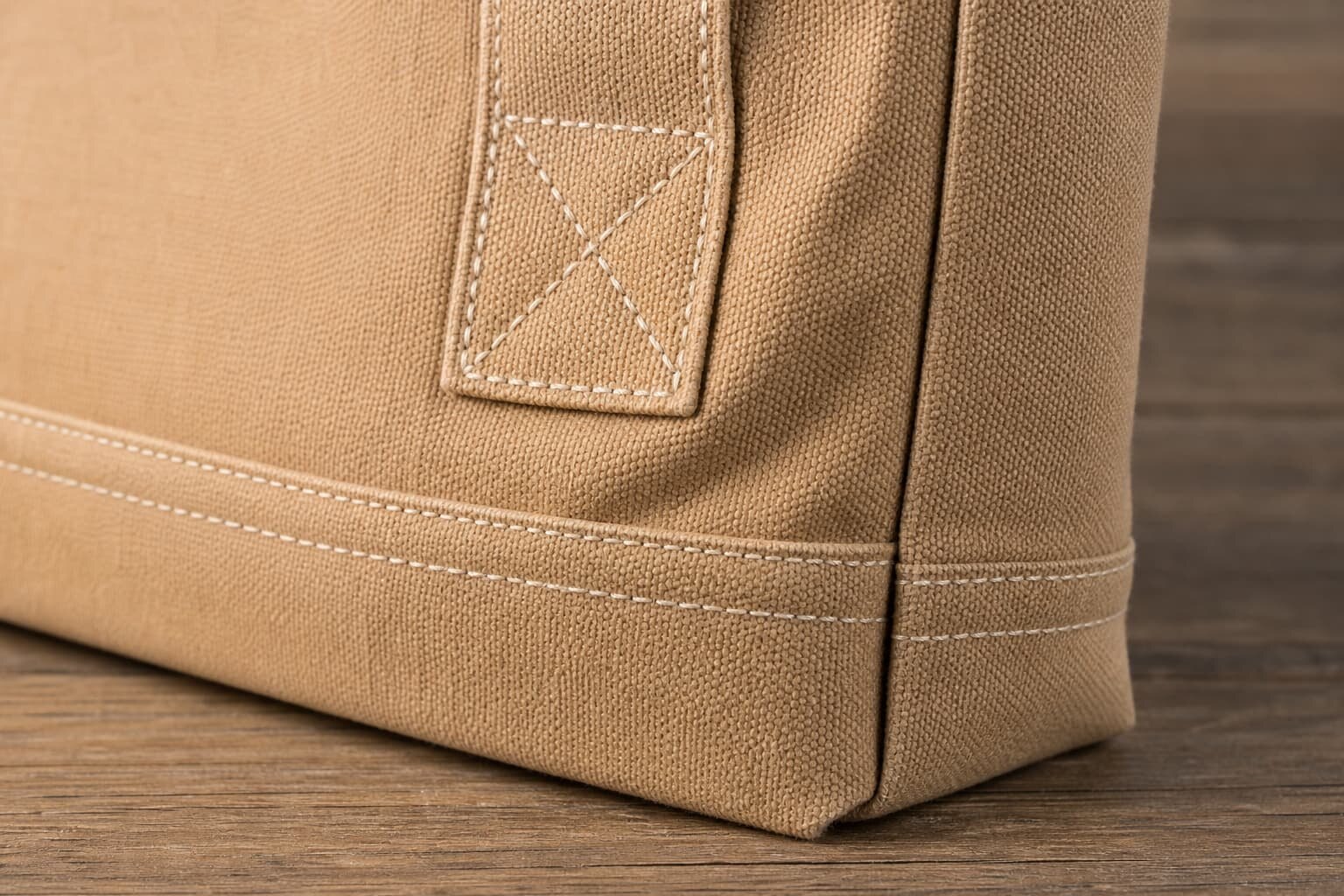
Construction matters as much as fabric weight. Look closely at the handle anchor, bottom seam, side seam, and corner reinforcement. If the tote will carry bottles, books, or sample goods, ask for double stitching and bartacks at load points. If the fabric is brushed, washed, or dyed, ask whether the finish changes dimensions or color stability. A buyer packet should note whether the factory is quoting greige canvas, bleached canvas, dyed canvas, or washed canvas, because each one behaves differently in production and can change the final quote.
- Use 12 oz / 340-400 GSM as a common retail benchmark, then move up or down based on load and brand position.
- Ask whether weight is measured before or after finishing.
- Require reinforcement at handle bases and bottom corners for heavier applications.
- Confirm whether shrinkage has been measured after pressing or wash treatment.
Match the print method to artwork, order size, and risk
Print method is where a lot of tote quotes go wrong. Screen print is usually the safest choice for flat logos, strong opacity, and repeat orders because it is durable and predictable when the art is simple. Heat transfer can work for short runs or more complex graphics, but buyers need to check feel, cracking risk, and wash performance. Embroidery, woven badges, or sewn patches can improve brand presentation, yet they also change cost, lead time, and stitch distortion on softer canvas. The point is not to choose the fanciest method. The point is to choose the method that fits the artwork and the order size.
Your packet should specify Pantone or approved color references, print size, print position, one-side or two-side decoration, and whether the logo must stay away from seams or edge stitches. Ask the factory to quote any setup charges separately, especially screen fees, plates, or patch tooling. For a small order, the decoration setup can dominate the total cost. For a larger order, the wrong print method can create production waste. A good supplier will tell you where the limits are before you approve art.
- Limit spot-color screen print when you want clean, repeatable production.
- Use embroidery or woven patches only if the fabric weight and placement can support them.
- Ask for a strike-off or print sample before approving bulk.
- Confirm curing or drying method so the ink does not crack, offset, or smell after packing.
Build the quote around MOQ and cost drivers
A useful canvas tote bag supplier audit packet forces the factory to show how the price is built. Buyers should ask for the body cost, print setup, labor, trim, packing, carton cost, sample charges, and any special tooling as separate lines or at least as clearly named inclusions. If all of those are blended into one unit number, you cannot tell whether the quote is efficient or just incomplete. The same tote can look cheap on paper and then become expensive once labels, packaging, or print screens are added later.
MOQ logic matters just as much as the unit price. Many factories set a minimum by fabric color, print color count, and packing format, not only by total order quantity. A black tote with one-color print and simple bulk pack may have a very different MOQ from an unbleached tote with a two-color print, hangtag, and individual polybag. Ask the factory to state where the MOQ changes and why. That gives procurement teams a better basis for negotiation and helps brands decide whether to simplify the product or accept the higher setup cost for a better presentation.
- Require a line-item or clearly split quote so hidden adders do not appear later.
- Ask what changes MOQ: fabric color, print color, label type, or packing style.
- Separate sample cost from production cost so sampling does not blur the unit price.
- Treat one-line all-in quotes as a starting point, not as a complete commercial offer.
Treat samples as a production test, not a photo prop
A sample is only useful if it proves the factory can make the tote you actually ordered. Ask for the right sample stage: prototype, pre-production sample, or approval sample, depending on how complex the build is. Then inspect the sample against the packet, not against memory. Measure body size, compare handle drop, inspect seam direction, check print placement, and verify that the label or logo is in the right position. A factory may send a tidy sample that looks good in a photo, but the real question is whether that sample matches the spec that will be used on the bulk line.
Do a simple buyer test that reflects the final use case. Fill the bag with a realistic weight, lift it from the handle, check for stitch distortion, and look for body sag, print cracking, or seam stress. If the tote will be displayed folded, confirm how it refolds and whether the print creases. If it will be sold in retail packaging, check the actual packed appearance, not a loose sample. Ask the supplier to send close-up photos with a ruler, thread color reference, and carton label if the order will ship in bulk. This saves a lot of debate when production starts.
- Measure every critical dimension on the sample, not just the overall bag size.
- Check print alignment, edge sharpness, and ink opacity under daylight.
- Inspect handle bases, side seams, and bottom corners for weak stitching.
- Approve only after the sample matches both the spec sheet and the packing instruction.
Freeze packing and carton details before production starts
Packing is where many tote orders become messy. Some buyers only think about the bag, then discover later that retail packaging, barcode labels, carton marks, and carton dimensions were never agreed. Decide early whether the tote ships bulk-packed, folded in a polybag, wrapped with a belly band, or packed for shelf display. For e-commerce or wholesale replenishment, bulk packing may be enough. For retail, the same tote may need a cleaner presentation with a barcode sticker, hangtag, or inner instruction card. Each choice changes labor and carton density.
The carton spec should also be in the audit packet. Record pieces per carton, carton size, gross weight target, shipping marks, country of origin statement if needed, and whether cartons need palletizing. A tote that packs neatly at 100 pieces per carton in one fabric color may not pack the same way after a label or insert is added. Packing affects freight, warehouse handling, and claim disputes, so do not leave it as a factory default. When the pack is frozen in writing, the buyer can compare landed cost more honestly and avoid overpaying for unnecessary presentation.
- Decide between bulk pack and retail pack before you ask for final price.
- State unit packaging, carton count, and carton dimensions in the packet.
- Confirm barcode, hangtag, and sticker placement if the tote is retail ready.
- Ask whether carton marks and pack counts are checked at the factory or only at ship time.
Compare supplier quotes line by line, not just by unit price
The main job of a canvas tote bag supplier audit packet is to make quotes comparable. Put each supplier on the same basis: same fabric weight, same finished size, same print method, same packing format, same incoterm, and same quote validity period. Then compare inclusions and exclusions with discipline. One factory may include packing and labels, another may leave them out, and a third may quote a lower unit price but add screen charges, sampling fees, or carton extras later. The lower number is not the cheaper number unless the scope is identical.
Look for red flags that suggest a quote is not production ready. Common warning signs include vague language such as 'as per sample' without a reference sample number, no mention of fabric weight, no print method detail, missing MOQ logic, and lead time stated only as a rough promise instead of a start point and finish point. Procurement teams should also compare payment terms, revision limits, and what happens if the artwork changes after approval. A good supplier quote reads like a production plan. A weak quote reads like a placeholder.
- Compare all suppliers on the same incoterm and currency basis.
- Check whether screen charges, labels, and packing are included or excluded.
- Reject quotes that do not state fabric weight, print method, and MOQ logic.
- Use one matrix to compare lead time, sample stage, packing, and exclusions.
Set inspection criteria before you release bulk production
Do not wait until shipment to decide what counts as acceptable. Put the inspection criteria in the packet before the PO moves. At minimum, define fabric weight tolerance, size tolerance, stitch quality, print placement, color matching, and packing accuracy. If your team uses an internal AQL or pass-fail routine, note it here. If not, still write down the buyer standard in plain language so the factory knows what will be checked. This prevents the common dispute where the supplier thinks the bag is acceptable because it looks neat, while the buyer rejects it because the print is off-center or the handle seam is weak.
The best release process is simple: approved sample first, then bulk pilot or first-run check, then full production. Keep dated photos of the approved sample, the carton label, the print strike-off, and the finished packing method. If the factory changes fabric lot, print screen, or carton spec after approval, ask them to confirm the change in writing before continuing. That one habit prevents a lot of late-stage arguments. For a tote bag program that will reorder, this record is worth more than a one-time discount.
- Define fabric, size, stitch, print, and pack standards before bulk release.
- Keep approved sample photos and date them against the final spec version.
- Check the first run against the packet, not just the last carton.
- Require written confirmation if the factory changes any approved production detail.
Make the packet reusable for reorders and seasonal updates
A strong supplier audit packet should become your reorder file. Once the final tote is approved, lock the spec version, artwork file, packing instruction, carton mark, and any special notes about fabric lot or label position. If the product is later updated for a new season, create a new version rather than editing the old one in place. That discipline helps retail buyers, distributors, and brand owners keep track of what changed and why. It also protects you when the factory assigns a new merchandiser or production planner who was not part of the original approval cycle.
For reorders, ask the factory to confirm whether the same fabric, print method, and packing method are still available. That is especially important if the bag uses a specific canvas color, a custom woven label, or a print that was tuned to a certain fabric finish. Reorder drift is one of the most common problems in tote sourcing because teams assume the last order will repeat itself automatically. It will not unless the packet tells the factory exactly what must remain unchanged. Store the final packet, the approval sample photo set, and the production notes together so the next PO starts clean.
- Keep one final master file with version control for each tote SKU.
- Do not let reorder details live only in email threads or chat logs.
- Ask the factory to confirm fabric lot, print screen, and packing method before repeat production.
- Update the packet whenever the tote changes in size, weight, decoration, or pack style.
Specification comparison for buyers
| Spec decision | Recommended option | When it fits | Buyer risk to check |
|---|---|---|---|
| Fabric weight | 12 oz / 340-400 GSM cotton canvas | Retail totes, bookstore bags, trade show bags, and everyday carry | Confirm whether GSM is finished fabric or greige weight, and ask for shrinkage after pressing or washing |
| Handle construction | Self-fabric handles or 25-30 mm webbing with box-X reinforcement | Medium-load bags that will be reused often | Check handle drop, strap width, stitch count, and whether the seam bites into the webbing |
| Print method | 1-3 color screen print or a sewn woven badge for premium branding | Simple logos, repeat orders, and clear art with limited colors | Verify color count, registration tolerance, cure method, and whether a white underbase is needed |
| Internal build | Bottom gusset with double stitching and stress reinforcement at the handle base | Heavier contents, taller bottles, catalogs, or retail use | Look for weak corners, open seam ends, and loose threads near load points |
| Packing basis | Flat-packed, bulk polybagged, carton marked by size/color/SKU | Most import orders where unit count and carton control matter | Check final pack count, carton dimensions, label placement, and whether retail packing is included |
| MOQ logic | Quote separately by fabric color, print colors, and packing style | Custom runs where setup changes affect cost | Watch for bundled MOQ claims that hide separate charges for screens, labels, or special packing |
Buyer checklist before sampling
- Confirm finished size, gusset, handle length, handle drop, and any pocket or closure details before asking for price.
- Lock the fabric basis in GSM or oz and ask whether the number refers to finished fabric or raw cloth.
- Specify print method, number of colors, print area, and artwork version so every supplier quotes the same decoration job.
- Ask each factory to break out body cost, printing, labels, packing, carton cost, and any sample or tooling charges.
- Require a pre-production sample or approved reference sample before bulk release.
- State packing style, unit count per bag or carton, carton marks, and whether retail labels are applied before packing.
- Set tolerances for size, stitch quality, color, and print placement instead of relying on a vague 'good quality' note.
- Keep one final approved packet with version control for reorders and future seasons.
Factory quote questions to send
- What finished size, gusset, handle length, and handle drop are you quoting?
- Is the quoted fabric weight finished GSM or greige weight, and what tolerance do you allow?
- How many print colors are included, and what are the setup charges for screens or other decoration tools?
- What is the MOQ by fabric color, print color, and packing style?
- Are sample charges, courier charges, strike-off charges, or plate charges separate from the unit price?
- What trims are included in the quote: side label, woven label, hangtag, barcode sticker, or care label?
- What packing method and carton size are included in the price, and how many pieces per carton?
- What is the lead time from approved sample and confirmed PO?
- What is excluded from the quote?
- Can you send the last approved sample photo and your production tolerance sheet before we award the order?
Quality-control points to confirm
- Fabric weight matches the approved GSM or oz target and the hand feel is consistent across the lot.
- Finished dimensions, handle drop, and gusset depth stay within the agreed tolerance.
- Handle anchoring, bartacks, and seam ends are secure at all load points.
- Print color, placement, opacity, and edge sharpness match the approved strike-off or pre-production sample.
- Loose threads, stains, oil marks, and sewing skips are removed before packing.
- Fold method, unit count, and unit packaging match the packing instruction sheet.
- Carton marks, SKU labels, and carton counts match the purchase order and shipping docs.
- A filled sample passes the buyer's load check without seam failure or handle pullout.