Why a Seam Load Memo Belongs in the RFQ
A canvas tote bag can look acceptable in photos and still fail in use because the RFQ only described size, fabric weight, and logo. The real load risk is usually at the handle base, side seam, bottom seam, or gusset corner. A canvas tote bag seam load memo puts those stress points into writing before suppliers quote, so procurement teams can compare construction instead of comparing only unit price.
The memo does not need to be complicated. It should say what the bag will carry, where the load is concentrated, what reinforcement is required, how the sample will be checked, and which data must appear in the quote. This is especially important when a retail buyer, distributor, or brand team sends the same artwork to several factories and receives prices that look similar but are built on different seam assumptions.
- Use the memo when the bag may carry books, bottles, event kits, catalogs, food packs, or retail merchandise.
- State a target use load such as 5 kg, 8 kg, or 10 kg as an example, then let the factory confirm what construction is suitable.
- Separate visual approval from strength approval; a good logo print does not prove the seam is safe.
- Attach the memo to the RFQ, sample approval, purchase order, and final inspection file.
Define the Real Load Before Choosing Canvas Weight
Many buyers start with 8 oz, 10 oz, 12 oz, or 16 oz canvas because fabric weight is easy to compare. That is useful, but it is not enough. A 12 oz canvas tote with weak handle stitching may perform worse than a 10 oz bag with better reinforcement. Fabric GSM gives the body strength and handfeel, while seam construction decides whether the bag survives repeated carrying.
For reference, 8 oz canvas is often around 270 GSM, 10 oz around 340 GSM, 12 oz around 400 GSM, and 16 oz around 540 GSM, depending on yarn, weave, finishing, and supplier measurement method. These numbers are not universal guarantees. In the memo, ask the factory to state both oz and GSM, the tolerance, and whether the quoted material is greige, dyed, washed, brushed, or coated.
- Light event tote: 8-10 oz canvas, modest load, low-cost handling, simple folded seams.
- Standard retail tote: 10-12 oz canvas, stronger handfeel, reinforced handle bases, better repeat use.
- Heavy merchandise tote: 12-16 oz canvas, gusset support, stronger thread, careful carton packing.
- Premium resale tote: 14-16 oz canvas, cleaner internal finishing, label details, tighter inspection standard.
Map the Stress Points, Not Only the Bag Dimensions
A typical tote RFQ says 38 x 42 cm with 10 cm gusset and 60 cm handles. That gives the factory a shape, but it does not explain how the bag will fail. A seam load memo should mark the handle attachment, top hem, side seam, bottom seam, gusset fold, and corner intersections. These areas should be discussed before sample cutting because reinforcement changes material consumption, sewing time, and sometimes print placement.
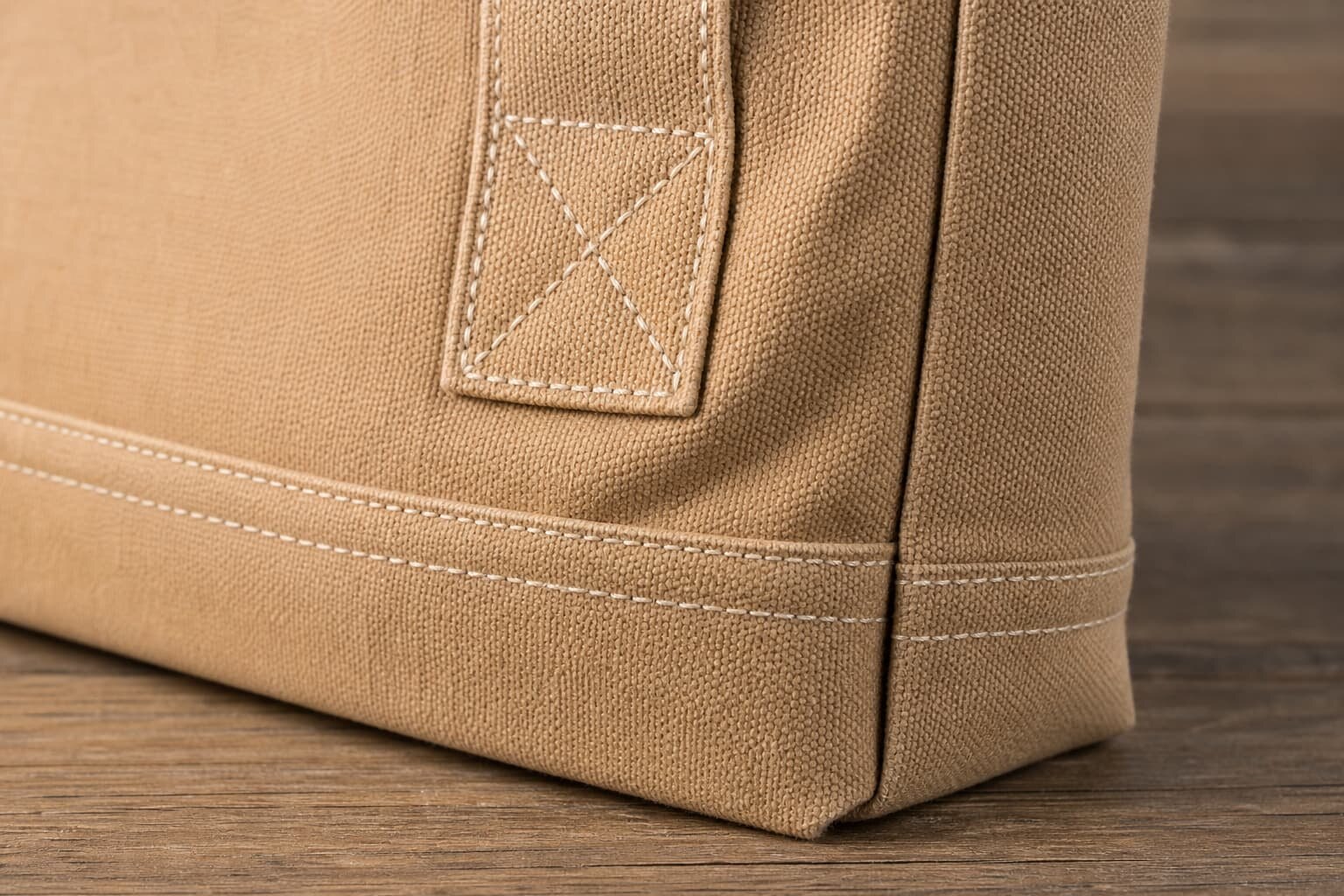
Handle attachment is normally the first point to check. Cross-box stitching spreads force better than a single straight row, and bartacks can improve local strength when used correctly. However, reinforcement must fit the fabric and product style. On a clean retail tote, a large visible cross-box may be acceptable or even preferred. On a minimalist fashion tote, the buyer may want hidden reinforcement or tone-on-tone stitching, but that choice must still meet the load requirement.
- Ask for seam allowance width on side and bottom seams, especially for gusseted bags.
- Confirm whether internal seams are overlocked, bound, folded, or left with trimmed raw edges.
- Check whether the top hem captures the handle ends with enough depth and stitch coverage.
- Require photos of stress points from the sample room, not only front-panel beauty shots.
Choose Reinforcement That Matches the Selling Channel
A tote used as a low-cost conference giveaway does not need the same construction as a tote sold in a museum shop. The mistake is pretending they are the same product because the artwork and dimensions match. Procurement should connect reinforcement to the selling channel, expected load, return risk, and brand positioning. This makes the quote clearer and reduces later arguments about whether the product was made correctly.
For promotional use, double-row stitching at the handle base with a reasonable canvas weight may be enough if the carried weight is low. For retail or distributor programs, cross-box stitching, stronger thread, and cleaner seam finishing are usually worth specifying. For a heavy gusseted tote, the bottom and gusset corners need as much attention as the handles because load settles downward and pushes against the side and bottom seam intersections.
- Giveaway program: keep construction simple but do not remove handle reinforcement just to lower price.
- Retail resale: specify visible stitch quality, thread color, seam straightness, and label placement.
- Heavy kit packing: review bottom seam and carton packing together, because bags may be pre-loaded or tightly stacked.
- Private label program: include woven side label or inside label without weakening the side seam.
Make Print Method Part of the Seam Decision
Print is often approved by the marketing team while seam construction is handled by sourcing. On canvas totes, those decisions overlap. A large screen print placed too close to a side seam may distort after folding. Heat transfer near a thick seam may not press evenly. Embroidery can add local stiffness and needle holes. A sewn label can interrupt the seam if the factory does not plan the operation sequence.
For most canvas tote bulk orders, screen printing is the common choice for solid logos and practical unit cost. Heat transfer may help with detailed artwork or gradients but needs care on textured canvas. Embroidery gives a premium look but can affect drape and may not suit very thin canvas. The seam load memo should tell the supplier where artwork sits relative to top hem, handle bases, side seam, and gusset, then ask whether printing happens before or after sewing.
- Keep important artwork away from seam folds and heavy stitch zones unless the factory confirms feasibility.
- Ask whether the ink curing temperature can affect dyed canvas shade, shrinkage, or fabric handfeel.
- For thick canvas, request a printed sample panel or full sample before approving mass print.
- For woven labels, confirm label size, fold type, seam insertion depth, and pull strength.
Use MOQ Logic Instead of Chasing the Lowest Quantity
MOQ is not only a sales number. It depends on fabric availability, dyeing, printing setup, cutting efficiency, label production, sewing line changeover, and packing format. A natural cotton canvas tote with one-color screen print may have a lower MOQ than a custom dyed 16 oz canvas tote with woven label, inside pocket, and individual retail packaging. If seam reinforcement is upgraded, the MOQ may not change, but sewing cost and lead time can.
Buyers should ask which part of the specification drives MOQ. If the factory says the MOQ is 1,000 pieces, clarify whether that applies to the bag body, fabric color, print color, handle webbing, label, or carton packing. This prevents a common problem: the buyer negotiates MOQ down, then later discovers the factory changed fabric weight, used stock handles, removed internal binding, or simplified reinforcement to make the smaller run workable.
- Stock natural canvas usually supports more flexible MOQ than custom dyed canvas.
- One-color screen print usually has easier setup than multi-color print or heat transfer artwork matching.
- Custom woven labels may have a separate label MOQ that affects reorder planning.
- Retail packing can increase labor and carton volume even when bag MOQ stays the same.
Sample Checks That Catch Seam Problems Early
A sample approval should not stop at size, color, and logo position. Before bulk approval, load the bag with the intended weight and hang it from the handles for a defined time. Then inspect the handle base, top hem, side seam, bottom seam, and gusset corners. The goal is not to run a laboratory test in every case; the goal is to reveal weak construction before the buyer commits to mass production.
For practical sample review, document the test method clearly. For example, load the bag with 8 kg, hang for two hours, then check seam opening, thread breakage, fabric tearing, handle elongation, and stitch distortion. If the bag is intended for heavier use, ask the factory what test level they recommend. Do not accept a vague statement such as 'strong enough' without a weight, time, and inspection result.
- Take close photos before and after loading at each handle base and bottom corner.
- Measure handle drop before and after the load check to see if the handle stretches or distorts.
- Check inside seams for fraying after the load test, not only the outside appearance.
- Keep the approved loaded sample as the comparison standard for production inspection.
Quote Data Needed for Fair Supplier Comparison
If three factories quote the same tote and one price is much lower, the reason may be hidden in the seam details. One supplier may be quoting 10 oz canvas while another uses 12 oz. One may include cross-box stitching and inside binding while another includes only a single folded seam. One may include individual polybags, while another quotes bulk carton packing. A seam load memo forces the missing data into the quote.
Ask each factory to quote against the same construction sheet. The quote should include fabric weight and tolerance, canvas color process, thread type if relevant, stitch density, handle dimensions, reinforcement method, print method, sample charge or sample policy, MOQ, estimated production lead time, packing method, carton details, and any cost options. This helps the buyer compare value instead of simply ranking suppliers from cheapest to most expensive.
- Require a line item for upgraded reinforcement if the factory offers more than one seam option.
- Ask whether the quoted lead time starts after deposit, artwork approval, fabric approval, or sample approval.
- Request carton dimensions and gross weight because heavy canvas can affect freight cost.
- Confirm whether inspection, replacement sample, or revised sample cost is included or separate.
Packing and Lead Time Risks Buyers Often Miss
Canvas tote bags are simple products, but packing can still create commercial problems. Heavy canvas creases when compressed. Dark prints may mark against natural canvas if not cured or separated correctly. Handles can arrive twisted if workers fold too quickly. A premium tote sold in retail needs a different packing standard from a bulk giveaway tote shipped for an event.
Lead time also depends on construction. A standard natural canvas tote with one-color screen print may move quickly if fabric is in stock. Custom dyed canvas, thick 16 oz material, inside pockets, woven labels, embroidery, and retail packing add steps. A practical RFQ should ask for lead time by stage: material preparation, sample making, print approval, cutting, sewing, packing, and final inspection. This gives the buyer a more realistic shipment plan.
- For retail bags, consider paper bands or individual bags only if they protect presentation and match sustainability goals.
- For bulk promotional bags, confirm pieces per carton and whether bags are flat packed or folded.
- Avoid overloading cartons; high carton weight can damage handles and increase warehouse handling issues.
- Ask for packing photos before shipment when the order is time-sensitive or presentation-sensitive.
Acceptance Criteria for the Final Inspection
Final inspection should refer back to the seam load memo. Inspectors should not judge only cosmetic defects. They should check whether the approved seam construction is present in production: same handle reinforcement, same stitch pattern, same seam allowance, same thread color or thread type if specified, same internal finishing, and same label insertion. If the factory repaired weak areas during production, those repairs should be visible in the inspection record.
Acceptance criteria should be measurable where possible. Size tolerance, handle drop tolerance, print placement tolerance, carton quantity, and visible defect limits can be written in the purchase file. For load-related checks, the buyer can define a sampling method and test weight appropriate to the product. Any failed loaded sample should trigger a review of the same production batch, especially at handle bases and gusset corners.
- Reject or hold production if handle stitching differs from the approved sample without written approval.
- Flag skipped stitches, loose thread tails, needle damage, seam puckering, and uneven bartacks at stress points.
- Check printed bags after folding to confirm no cracking, sticking, offsetting, or abrasion marks.
- Match carton labels, item codes, color names, and packing quantity to the purchase order.
Specification comparison for buyers
| Spec decision | Recommended option | When it fits | Buyer risk to check |
|---|---|---|---|
| Everyday retail tote seam spec | 10-12 oz canvas, lockstitch seams, cross-box handle reinforcement | Bookstores, fashion retail, gift-with-purchase, light grocery use | Handle stitch density and thread quality may be weaker than the fabric |
| Heavy promotional tote seam spec | 12-16 oz canvas, double-fold top hem, reinforced side and bottom seam | Trade shows, corporate kits, catalog packs, heavier inserts | Supplier may quote fabric GSM but omit load-bearing seam construction |
| Budget cotton canvas option | 8-10 oz canvas with reinforced handles and limited load claim | Low-weight giveaways, mailer inserts, simple brand events | Thin fabric may pass print approval but fail when loaded at the handle base |
| Printed large-area logo tote | Screen print on 10-14 oz canvas before final sewing when practical | Bold brand artwork, solid color logos, repeat retail programs | Print curing and seam folding may create cracking or misalignment near edges |
| Structured gusset tote | Bottom gusset with bartack or reinforced corner seam depending on load | Retail shoppers, wine and food packs, merchandise bundles | Corner stress points can tear if seam allowance is too narrow |
| Premium private-label tote | 14-16 oz canvas, clean internal binding, woven side label, measured seam load target | Brand stores, museums, lifestyle distributors, resale programs | Factory quote must separate fabric, label, reinforcement, and packing costs |
Buyer checklist before sampling
- Define the intended carried weight in kilograms, not just the bag size and fabric weight.
- Confirm whether the seam load requirement applies to handles, side seams, bottom seam, gusset corners, or all stress points.
- Ask the factory to state fabric weight in oz and GSM, including tolerance after washing or finishing if applicable.
- Specify handle width, handle length, handle fabric layers, and reinforcement pattern before approving the price.
- Request a pre-production sample loaded and hung for a defined time before mass production starts.
- Check that the print method will not weaken folded seams, handle stitch areas, or heat-pressed zones.
- Require carton packing details that prevent heavy canvas bags from being compressed into permanent creases.
- Compare quotes using the same seam construction, thread, packing, sample, and testing assumptions.
Factory quote questions to send
- What seam construction are you quoting for the handles, side seams, bottom seam, and top hem?
- What fabric weight is included in the price in both oz and GSM, and what is the normal production tolerance?
- What thread type and stitch density will be used for the main seams and handle attachment?
- Will the handle reinforcement be cross-box, bartack, double-row stitch, or another method?
- What load test can you perform on the sample, and what weight and hanging time will be used?
- Does the quoted price include inside seam binding, overlock finishing, or raw internal seam allowance?
- How will large-area screen print, heat transfer, embroidery, or woven labels affect seam placement and lead time?
- What MOQ applies to this fabric weight, color, handle style, print method, and packing format?
- What carton size, carton weight, units per carton, and polybag or paper band packing are included?
- Which quote items are estimates and which are fixed after sample approval?
Quality-control points to confirm
- Measure finished bag size, handle drop, gusset depth, and seam allowance against the approved sample.
- Check stitch density and skipped stitches at handle bases, top hem corners, bottom gusset corners, and side seams.
- Load-test approved samples at the agreed weight and inspect for seam opening, thread breakage, fabric tearing, and handle elongation.
- Rub and bend printed areas near seams to confirm curing, adhesion, and no cracking after folding.
- Inspect fabric shade, canvas slub level, shrinkage risk, and GSM consistency across production lots.
- Confirm carton packing keeps handles flat, labels visible where required, and printed panels protected from abrasion.
- Record any repair, re-stitching, or trimming on production inspection reports instead of accepting silent factory correction.
- Compare the bulk shipment to the signed seam load memo, not to verbal promises made during quoting.