What the rollout memo must control
A canvas tote bag retail rollout memo is not a creative brief. It is the working document that connects merchandising intent with factory production, packing, and delivery execution. For a retail launch, the risk is rarely one single defective bag. The bigger risk is that five departments approve five slightly different versions of the same tote: one size in the line sheet, another size in the artwork file, another packing rule in the purchase order, and another barcode list sent to the factory two days before shipment.
The memo should lock the commercial decisions that change cost and lead time. Fabric weight, bag construction, handle reinforcement, print method, labeling, store allocation, and carton packing all affect the quote. If these points are left open, suppliers either quote a safe high price, quote a low price with hidden exclusions, or make assumptions that appear only when the pre-production sample arrives late.
- Use the memo as the source document for RFQ, sample approval, PO, inspection, and packing review.
- Keep one owner for revisions, usually procurement or product development, so factories do not receive conflicting files.
- Add a version number and date to every memo update, especially after artwork, packing, or barcode changes.
- Separate must-have specs from preferred specs; this helps suppliers quote alternatives without changing the core retail requirement.
Start with the retail job of the bag
Before discussing canvas weight or print cost, define what the tote has to do in store. A free-with-purchase tote has different acceptance criteria from a paid merchandise tote. A shopping carrier used at checkout must carry weight reliably and fold quickly at the counter. A bookstore or museum tote sold as a product needs better fabric body, cleaner sewing, and more consistent print position because the customer examines it like apparel.
This decision also affects MOQ logic. Factories do not calculate minimum quantity only by total bag count. They look at fabric color, fabric lot size, print screens, label type, handle material, packing style, and the number of SKU splits. A 10,000 piece order in one natural canvas body with one black print is usually easier than 10,000 pieces split across eight colors, four artworks, and store-specific barcode stickers.
- Free gift: prioritize controlled cost, fast packing, acceptable print clarity, and basic load strength.
- Paid retail item: prioritize fabric handfeel, stitching neatness, label finish, artwork placement, and consistent folding.
- Checkout carrier: prioritize handle comfort, seam strength, carton access, and quick unpacking at store level.
- Launch kit component: prioritize exact packing sequence, clean fabric, barcode accuracy, and protection during assembly.
Choose canvas weight by use, not by habit
Canvas tote bag quotes often become confusing because one supplier quotes 8 oz, another quotes 10 oz, and another writes 12 oz without explaining whether the weight is finished fabric or raw fabric. For procurement comparison, ask for both oz and GSM. As a practical guide, 8 oz canvas is often around 270 GSM, 10 oz around 340 GSM, 12 oz around 410 GSM, and 14 oz around 475 GSM. Actual numbers vary by yarn, weave, finishing, and supplier standard, so the approved swatch matters more than the label alone.
Retail buyers should also consider how fabric weight changes the shelf result. Thin natural canvas may look casual and affordable, but it can show contents through the fabric and may not stand well in product photos. Heavy canvas feels premium but increases sewing difficulty, folded bulk, carton volume, freight cost, and sometimes needle marks around handle reinforcement. The best choice is the lightest fabric that still meets the retail use, appearance, and load requirement.
- 8 oz canvas: suitable for high-volume promotional retail use, but check transparency and seam strength.
- 10 oz canvas: a common middle option for store campaigns where cost and durability both matter.
- 12 oz canvas: better for paid retail totes and brand merchandise with stronger handfeel.
- 14 oz canvas: use when premium structure is needed, but recheck carton CBM and sewing finish before approving.
Match print method to artwork and fabric texture
Most retail canvas tote programs use screen printing because it is cost-effective, stable in bulk, and suitable for solid brand graphics. For one to four spot colors, screen printing on actual canvas is usually the most predictable route. The buyer should provide Pantone references, final artwork size, print position from bag edges, and any tolerance for texture show-through. A print that looks solid on coated paper can look slightly broken on coarse canvas, especially with small type or thin lines.
Digital print and heat transfer can solve artwork problems when the design has gradients, many colors, or short seasonal quantities. They also introduce different risks: handfeel, cracking on folds, edge marks, adhesion, and color variation on natural cotton. If a retailer sells the tote as merchandise, the print test should include dry rubbing, light folding, and a review after the bag has been packed for several days, not just a fresh sample photo.
- For simple logo artwork, ask for screen print pricing by color count and print size.
- For fine type, confirm minimum line thickness before the first strike-off is made.
- For full-color artwork, request a printed sample on the same canvas weight and color.
- For dark fabric, check whether an underbase is needed and whether it changes handfeel or cost.
Define construction details that change the quote
Two canvas totes with the same width and height can have very different costs. A flat tote is faster to sew and packs tightly. A boxed-bottom tote uses more fabric, more sewing steps, and more carton space, but it holds retail purchases better and looks more structured. Internal pockets, zipper closures, snap buttons, lining, contrast binding, and custom labels add practical value, but each one affects MOQ, production time, and inspection points.
Handle specification is another quote driver. Buyers often write only cotton handles or long handles, which is not enough. The factory needs handle material, width, length, drop, color, reinforcement method, and whether the handle is self-fabric or webbing. For a shoulder tote, handle drop is normally more important to the user than total handle length. For heavy retail use, reinforcement method matters more than a neat product photo.
- State whether the bag is flat, bottom-gusseted, side-gusseted, or fully boxed.
- Specify handle width, finished length, handle drop, material, color, and attachment position.
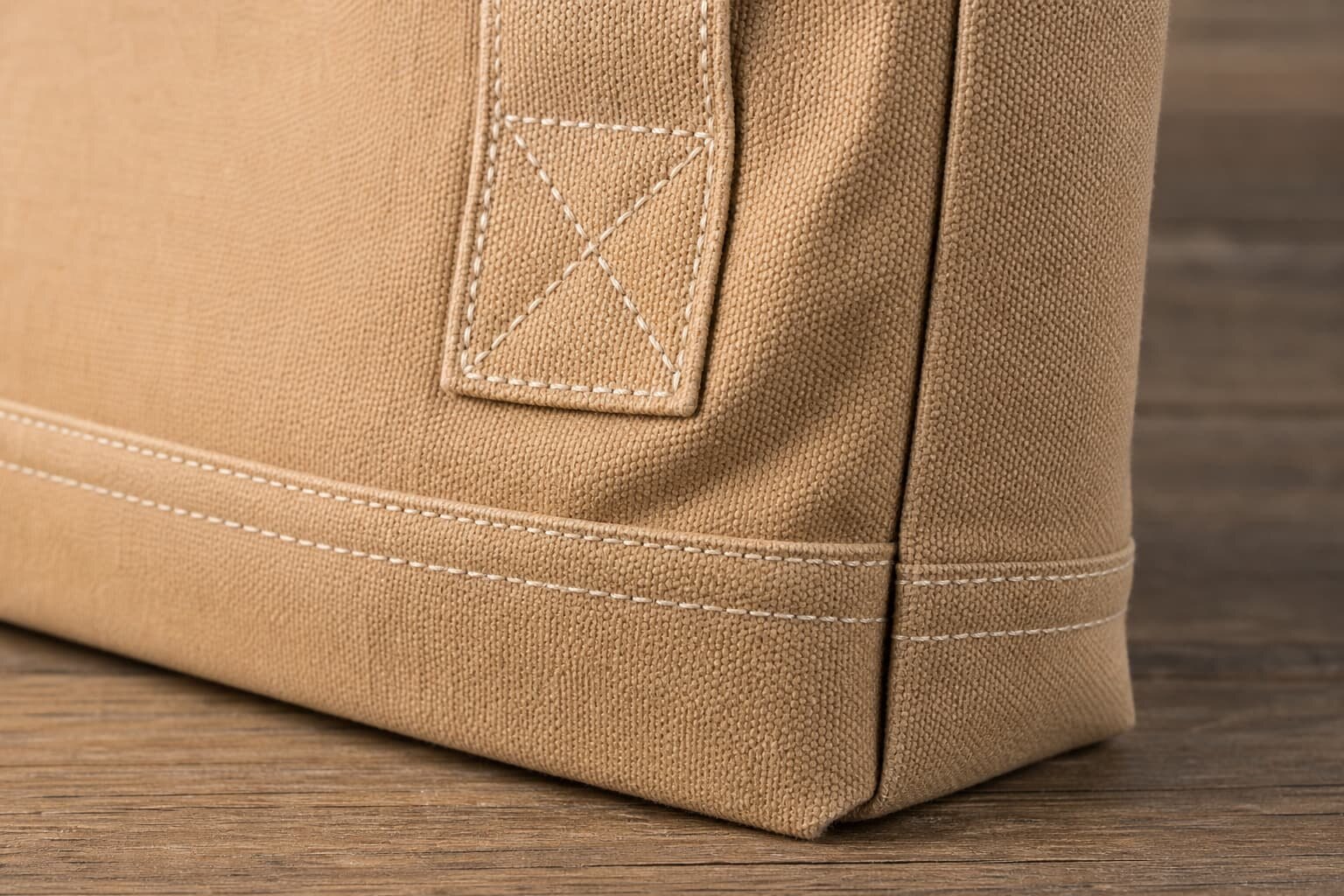
- Confirm reinforcement: X stitch, bar tack, double row stitching, or another approved method.
- List all extras separately so the supplier can show their cost impact instead of hiding assumptions.
Build MOQ logic into the RFQ
A useful RFQ does not ask only for the best price at one quantity. For a retail rollout, ask for price breaks that reflect likely order behavior: launch quantity, replenishment quantity, and any test-store quantity. If the supplier knows the order may repeat, they can explain whether screens, patterns, fabric sourcing, and labels can be reused. This is more useful than pushing for an unrealistic low MOQ that later causes a substitute fabric or delayed production.
MOQ is also tied to material preparation. Natural canvas is usually easier to source than custom dyed canvas. A custom dyed bag may require a fabric dye lot minimum, color approval time, and shade tolerance across batches. A custom woven label, hangtag, or printed barcode sticker may have its own MOQ. When these items are not separated in the quote, the buyer cannot see which part is creating the minimum order problem.
- Ask for pricing at several quantities, such as 1,000, 3,000, 5,000, and 10,000 pieces, if those volumes are realistic.
- Request the MOQ for each fabric color and each artwork, not only for the whole program.
- Ask whether leftover fabric or labels can be reserved for replenishment and for how long.
- Require the factory to identify any subcontracted process with a separate MOQ, such as dyeing, printing, or labels.
Sample sequence for faster approvals
Sampling fails when buyers try to approve too many unknowns in one sample. A cleaner sequence is fabric swatch first, print strike-off second, fit or construction sample third, and pre-production sample last. The PP sample should not be a design exploration sample. It should represent the exact approved material, sewing, print, label, fold, and packing method intended for bulk.
For retail rollouts, sample review should include handling and packing checks, not only appearance. Put the tote on a table as it will appear in store, hang it if it will be displayed on a peg, fill it with the expected weight, fold it as it will go into the carton, and scan the barcode if one is applied. Many problems become visible only during these practical checks: handle drop too short, logo hidden by fold line, barcode on the wrong side, or carton count too heavy for store staff.
- Approve a fabric swatch under the same lighting used for other brand material approvals.
- Approve a print strike-off on actual fabric before the factory prints the PP sample.
- Use the PP sample to lock all details, including thread color, label position, and folding.
- Keep one signed PP sample at the factory and one with the buyer or inspection team.
Packing rules prevent store-level failures
Retail tote launches often fail in the last ten percent of the job: packing, carton marks, barcode stickers, and store allocation. A factory may produce acceptable bags but pack mixed artwork in the wrong carton, fold the logo through the print, place barcode labels where they wrinkle, or use cartons that are too heavy for manual store handling. These mistakes are expensive because they appear after goods enter the distribution system.
The rollout memo should state the packing method in operational language. Bulk pack, individual polybag, paper belly band, hangtag, barcode sticker, inner pack, master carton, and store-ready carton are not interchangeable. If sustainability rules restrict polybags, write the approved alternative and the dirt-protection expectation. Natural canvas soils easily, so the packing plan must protect the fabric without creating unnecessary labor at store level.
- Define pieces per inner pack and pieces per master carton by SKU.
- Confirm whether cartons may contain mixed colors, mixed prints, or mixed store allocations.
- Provide final barcode files and placement rules before PP sample approval.
- Ask for carton dimensions, gross weight, net weight, and CBM before confirming freight estimates.
Lead time must show approval gates
A supplier lead time that says 30 days is incomplete unless it states what starts the clock. For canvas tote bags, timing may depend on fabric availability, dyeing, print screen preparation, sample approval, deposit, label production, packing material, and inspection booking. If procurement sends barcode data late or changes artwork after strike-off, the production calendar changes even if the factory capacity is available.
A practical lead time schedule should separate sample time, material preparation time, bulk sewing time, printing time, packing time, inspection time, and export document time. This helps buyers see which approval is critical. For example, natural 10 oz canvas with one black screen print may move quickly if fabric is in stock, while custom dyed 12 oz canvas with a woven label and store-specific packing can require longer preparation before sewing even begins.
- Ask when the factory needs final artwork to hold the planned shipment date.
- Ask whether printing happens before or after sewing, because this affects rejection and replacement planning.
- Build inspection and rework time into the schedule instead of treating inspection as a same-day formality.
- Confirm whether split shipments or phased store launches require separate packing dates.
Quote data needed for fair comparison
The lowest unit price is not always the lowest landed cost. A quote for canvas tote bags should show the unit price and the data behind it: fabric weight, bag dimensions, print method, color count, handle construction, packing, carton quantity, carton size, gross weight, CBM, screen or setup charges, sample cost, testing cost, and Incoterm. Without this data, procurement cannot compare two suppliers fairly or explain a price difference internally.
Ask suppliers to quote alternatives only when the alternative is clearly labeled. A factory may suggest 10 oz instead of 12 oz canvas, flat construction instead of boxed bottom, or bulk packing instead of individual packing to reduce cost. That can be useful, but it must not be mixed into the base quote without approval. The memo should allow value engineering while protecting the retail requirement.
- Require each quote line to show fabric weight, size, print, packing, and Incoterm.
- Ask for carton data early so logistics can estimate freight and warehouse handling.
- Separate one-time charges from repeat order costs, including screens, patterns, and labels.
- Record any supplier cost-saving proposal as an option, not as an automatic spec change.
Specification comparison for buyers
| Spec decision | Recommended option | When it fits | Buyer risk to check |
|---|---|---|---|
| Main fabric weight | 10 oz to 12 oz cotton canvas, about 340 to 410 GSM depending on weave | Retail tote programs needing a firm handfeel, good shelf presence, and repeat customer use | Confirm whether factory quotes finished fabric GSM or greige fabric GSM; washed, dyed, and coated fabric can change weight and handfeel |
| Budget fabric option | 8 oz cotton canvas, about 270 GSM | Promotional retail add-on, light grocery use, event-linked store launch, or high-volume price-sensitive rollout | Check transparency, seam strength, and handle reinforcement; thin fabric can make dark print look weak and corners collapse |
| Premium fabric option | 14 oz canvas, about 475 GSM, with reinforced cross-stitch handles | Paid retail merchandise, lifestyle brand stores, bookstore totes, museum shops, and premium gift sets | Higher fabric cost, bulkier cartons, longer sewing time, and higher freight volume can offset the perceived upgrade |
| Print method | Spot color screen printing with approved Pantone references | Simple logos, slogans, store artwork, and one to four color retail graphics | Ask for strike-off on actual canvas, not paper; heavy canvas texture can break fine lines and reduce color density |
| Full-color artwork | Digital print or heat transfer after testing adhesion and handfeel | Shorter runs, photographic artwork, seasonal drops, or multi-SKU retail capsules | Confirm wash/rub resistance, edge feel, curing method, and whether the print cracks when folded in carton |
| Bag structure | Flat tote for lowest cost; boxed bottom for retail shape and higher usable capacity | Flat tote suits giveaways; boxed bottom suits store shopping, gift packaging, and resale | Boxed bottom changes sewing labor, folded size, carton count, and visible panel dimensions for artwork |
| Handle construction | Self-fabric or cotton webbing handles with reinforced X stitch or bar tack | Retail use where customers may carry books, apparel, bottles, or packaged goods | Request load test criteria; handle length must match intended shoulder carry or hand carry, not just a drawing |
| Retail packing | Individual fold with belly band, hangtag, barcode sticker, or polybag only if required | Distribution to stores, DC receiving, marketplace fulfillment, or retail shelf display | Overpacking increases labor and plastic use; underpacking causes mixed SKUs, dirty fabric, and barcode receiving issues |
Buyer checklist before sampling
- Define the retail role first: free gift, paid merchandise, shopping carrier, loyalty reward, or launch kit component.
- Confirm finished bag size, gusset, handle drop, fabric GSM, color, shrinkage tolerance, and whether dimensions are measured flat or filled.
- Request fabric swatches in the target weight and shade before approving artwork because natural canvas tone changes print appearance.
- Approve print strike-off on actual production fabric, including logo size, placement tolerance, Pantone target, and acceptable texture breaks.
- Ask the factory to state MOQ by fabric color, print color count, bag size, packing method, and shipment split, not only by total order quantity.
- Require a pre-production sample with final fabric, final sewing, final handle reinforcement, final label, final packing, and scannable barcode if used.
- Set carton packing rules by SKU, color, store allocation, inner pack count, carton mark, carton size, gross weight, and mixed-carton restrictions.
- Check whether the quoted lead time starts after deposit, artwork approval, fabric approval, PP sample approval, or barcode data approval.
- Compare quotes using the same Incoterm, packing method, print process, fabric weight, testing requirement, and delivery split.
- Keep a single retail rollout memo version number so merchandising, procurement, factory, forwarder, and warehouse work from the same spec.
Factory quote questions to send
- What is the quoted fabric weight in GSM or oz, and is it finished fabric weight after dyeing or raw fabric weight before finishing?
- What is the MOQ for this bag if we use natural canvas, dyed canvas, one print color, two print colors, and multiple store barcode stickers?
- Which print method do you recommend for this artwork on the selected canvas, and what line thickness or registration limits should we adjust before sampling?
- Can you quote flat tote and boxed-bottom versions separately, including fabric consumption, sewing labor, carton quantity, and CBM difference?
- What handle material, width, length, and reinforcement stitch are included in your base price?
- How many days do you need for fabric sourcing, sample making, print strike-off, PP sample approval, bulk production, inspection, and packing?
- What packing is included: bulk pack, individual polybag, belly band, hangtag, barcode sticker, inner carton, or store-ready carton allocation?
- What quote data can you provide line by line: unit price, tooling or screen charge, sample cost, packing cost, testing cost, carton dimensions, gross weight, CBM, and Incoterm?
- What production tolerances do you apply for bag dimensions, fabric shade, print placement, print color, stitch density, and carton count?
- Can you keep fabric, thread, handle webbing, and label material from the same approved lots for all retail rollout batches?
Quality-control points to confirm
- Check finished fabric weight with a GSM cutter or agreed lab method and compare with the approved swatch, not only the supplier declaration.
- Measure finished bag width, height, gusset, handle length, and handle drop against the signed spec sheet after the bag is pressed and packed.
- Review print color, opacity, registration, edge sharpness, curing, rubbing resistance, and placement on actual production bags from different cartons.
- Inspect handle attachment using pull testing or agreed manual load test; pay attention to skipped stitches, loose threads, and weak backstitching.
- Open cartons from the beginning, middle, and end of packing to confirm SKU separation, barcode accuracy, insert count, label position, and carton marks.
- Check fabric defects such as slubs, oil marks, weaving lines, dye streaks, mildew smell, and dirty fold marks before accepting retail-ready packing.
- Confirm needle detection, metal contamination control, and broken needle records if the retailer requires them.
- Compare packed carton weight and CBM with quote data because retail distribution cost can change when folding and inner packing are revised.