Why Retail Packout Needs Its Own Checklist
A canvas tote bag can pass sewing inspection and still fail at retail receiving. The problem is usually not the tote body. It is the packout: wrong barcode, unclear carton marks, crushed folds, missing hangtags, mixed SKUs, or a folding method that damages the printed logo. For procurement teams, the retail packout is where product specification, warehouse handling, and store presentation meet. If it is not controlled before production, the buyer pays for rework, repacking, chargebacks, or delayed launch stock.
A useful canvas tote bag retail packout checklist does more than say individual polybag required. It defines how the tote is folded, what must be visible after packing, how labels are applied, how many units go into each carton, how cartons are marked, and what evidence the factory must provide before shipment. This article focuses on that specific buying problem: how to quote, sample, inspect, and release canvas tote bags that are ready for retail or distributor receiving without emergency sorting at the destination warehouse.
- Use one checklist for the tote specification and another for the retail packing specification.
- Approve a packed sample, not only a loose bag sample.
- Treat barcode, hangtag, carton count, and carton marks as controlled production details.
- Ask suppliers to quote packing materials and labor separately when comparing bids.
Start With the Finished Retail Unit, Not the Sewing Line
Many RFQs begin with bag size, fabric weight, and logo size. Those details matter, but a retail program should start with the finished unit that the warehouse or store will receive. A 380 mm x 420 mm canvas tote with 70 cm handles may be correct as a product, but the same bag can require very different packout if it will hang on a peg, sit in a shelf tray, ship in an online order, or arrive as a promotional bundle. The factory needs to know the final unit format before it calculates labor, material waste, carton size, and production flow.
If the finished unit is a folded tote inside a clear polybag with barcode on the back, the fold lines and barcode position need to be approved during sampling. If the finished unit is a paper belly band around a natural canvas tote, the band width and tension matter because canvas thickness changes after pressing and folding. If the tote is packed with an insert card, the card size must fit the folded bag without bending. These packout decisions affect both quote accuracy and production risk.
- Define retail unit size after folding, not just open tote dimensions.
- Confirm whether the logo must be visible through the pack.
- Specify if the barcode is on the unit, hangtag, belly band, inner carton, or master carton.
- Tell the supplier whether goods are for retail store, distributor warehouse, e-commerce fulfillment, or event kits.
Fabric GSM and Structure Affect Folding and Shelf Appearance
For canvas tote bags, fabric weight is not only a durability decision. It changes how the bag folds, how thick the retail unit becomes, how many pieces fit into a carton, and whether the logo creases sharply during storage. A light 6 oz to 8 oz cotton canvas may fold flat and reduce freight volume, but it can feel thin for paid retail merchandise. A 10 oz to 12 oz canvas, roughly 280 to 340 GSM, often gives a better retail handfeel while still allowing clean folding. Heavier 14 oz to 16 oz canvas can look premium but may create bulky packs, higher carton weights, and more visible fold memory.
The buyer should not rely on oz description alone because mills and suppliers may convert differently. Ask for GSM, yarn construction if relevant, and a fabric swatch from the bulk lot. Natural canvas also varies in shade, seed speck level, and stiffness. If the tote will be sold in a clean retail environment, ask the factory how it controls fabric shade lot separation. If the tote will use screen print, heavier canvas texture can affect print edge sharpness, especially with fine type.
- For basic retail totes, request 10 oz to 12 oz canvas and confirm the GSM range in writing.
- For lower-cost giveaways, ask whether 8 oz canvas will still meet your load and opacity needs.
- For premium merchandise, test 14 oz canvas in the final folded pack before approving carton count.
- Confirm whether shrinkage after washing is relevant; most retail packout inspections are on unwashed goods unless otherwise specified.
Print Method Must Match the Packout Method
The best print method depends on artwork, fabric color, order quantity, and how the bag will be folded after printing. Screen printing is usually strong for solid logos, simple artwork, and repeat orders. Heat transfer can handle more detail but should be tested for edge lift and surface feel on canvas texture. Digital print can be useful for short runs or multi-color artwork, but buyers should confirm color fastness, handfeel, and consistency across bulk production. Embroidery can work for premium totes, but it adds thickness and may not fold smoothly in tight retail packs.
Retail packout can damage or expose print problems. A large screen print folded through the center may show a permanent crease or slight ink cracking after carton compression. Fresh ink that is not fully cured can offset onto the inside of a polybag or onto adjacent fabric. Dark ink on natural canvas may look sharp on a flat sample but uneven after folding if the ink layer is thick. The RFQ should ask the factory to show the final print after folding and 24 to 48 hours in the retail pack, especially for heavy ink coverage.
- Set print placement tolerance, such as plus or minus 5 mm, before mass production.
- Ask whether printing occurs before sewing or after sewing because placement accuracy changes.
- Request a folded packed sample to check print cracking, offset, and visibility.
- Avoid folding directly through small text, QR codes, or dense ink blocks when possible.
MOQ Logic: Separate the Bag MOQ From Packout MOQ
A supplier may say the MOQ is 500 pieces or 1,000 pieces, but that number may only apply to the blank canvas tote. Retail packout components often have their own minimums. Woven labels, hangtags, printed paper bands, barcode stickers, insert cards, custom polybags, and custom cartons can each carry separate MOQs or setup charges. This is why two quotes with the same unit price may not be equal. One may include only a blank bag in bulk carton packing, while another includes retail-ready unit packing with labels and carton marks.
For a clear quote comparison, ask the factory to split the price into tote body, logo application, trim and labels, retail packing materials, packing labor, carton material, sample cost, and any artwork or screen charges. This does not mean you will negotiate every line item separately, but it helps identify hidden exclusions. It also helps when your buyer changes the channel from bulk promotional distribution to retail store launch after the first quote.
- Ask for MOQ by component: tote, dyed fabric, print, label, hangtag, insert, polybag, carton.
- Check whether leftover custom packing materials must be paid for or stored.
- Confirm if barcode stickers can be printed in-house by the factory or must be supplied by the buyer.
- Request separate pricing for bulk pack, individual polybag, paper band, and hangtag options.
Sample Approval Must Include the Packout, Carton, and Labeling
A loose pre-production sample is not enough for a retail canvas tote order. The approved sample should show the actual fabric, sewing, print, label, folding method, unit pack, barcode location, hangtag, warning label if applicable, and carton arrangement. If the carton is not available at sample stage, the factory should still provide a packout mock-up with measured folded size and proposed carton count. The buyer should sign off on the unit presentation before the factory buys bulk packing materials.
Sample checks should be practical. Lay the tote flat and measure the finished size. Check handle drop because long handles may protrude after folding. Fold the bag according to the proposed method and see whether the final unit fits the barcode label cleanly. Scan the barcode through the polybag if that is how the item will be received. Put several packed samples under light pressure overnight to see if the print transfers or the retail unit looks crushed. These checks are simple, but they catch problems that are expensive to fix after 20 cartons are packed.
- Approve one open sample and one fully packed sample.
- Photograph the fold sequence and keep it as the factory packing standard.
- Check barcode scanability on curved, wrinkled, or textured surfaces.
- Confirm hangtag string length and placement so it does not tangle during packing.
- Record any approved difference between salesman sample and bulk production sample.
Packing Details That Cause the Most Receiving Problems
Most receiving problems come from small details that were assumed instead of specified. A buyer may request 100 pieces per carton, but the supplier may pack mixed colors to save space. The warehouse may need each color and SKU in a separate carton. A retail team may request individual polybags, but the factory may place the barcode on the wrong side or cover the logo. A distributor may require carton marks on two sides, but the factory may mark only one side. These are not factory quality failures if the RFQ did not define them clearly.
Canvas totes are also sensitive to compression and moisture. Natural cotton canvas can pick up carton odor or humidity if stored poorly. Overpacked cartons can crush folded retail units and create hard creases in the printed area. Underfilled cartons can collapse in stacking. If the goods will travel by ocean freight, ask the factory about inner poly liner, desiccant use if appropriate, carton strength, and maximum carton weight. Avoid creating cartons so heavy that warehouse teams cut into bags when opening them.
- Set carton quantity by SKU and color, not only total pieces per carton.
- Require carton marks to match the packing list exactly.
- Confirm whether mixed cartons are allowed and how they must be labeled.
- Specify tape method, carton grade, inner liner, and maximum gross weight.
- Ask for final carton photos before shipment release.
Quote Data Buyers Should Require Before Comparing Suppliers
A proper canvas tote bag quote should give enough data for the buyer to compare production reality, not just unit price. At minimum, request finished size, fabric weight, fabric type, handle details, print method, print size, print color count, label details, retail packing method, carton quantity, carton size, estimated gross weight, sample lead time, bulk lead time, and payment or shipment terms. If one quote misses carton dimensions and another includes them, the second quote is often more useful even if the unit price looks slightly higher.
Lead time should also be broken into stages. Sample making, sample shipping, fabric procurement, cutting, printing, sewing, trimming, packing, inspection, and export documentation all take time. Retail packout can add labor days, especially when every unit needs folding, barcode scanning, hangtagging, and individual bagging. During peak season, printing and packing are often the bottlenecks, not sewing. Ask the factory where the bottleneck is likely to be for your order.
- Require quote validity because cotton fabric and freight-related costs can move.
- Ask whether lead time starts after deposit, artwork approval, sample approval, or material arrival.
- Request carton CBM so your logistics team can estimate freight impact.
- Ask for a quote note listing what is excluded, such as inspection, palletizing, or special labels.
- Compare suppliers using landed handling risk, not only FOB unit price.
Inspection Criteria for Retail-Ready Canvas Tote Bags
Inspection should cover both product quality and packout accuracy. Product checks include fabric defects, stains, shade variation, measurement, stitching, handle reinforcement, loose threads, print position, print color, and print curing. Packout checks include folding, barcode, label placement, hangtag, insert, polybag sealing, suffocation warning if needed, unit count, carton marks, carton condition, and SKU separation. If the order has multiple artwork versions, inspection should verify that the correct artwork is packed under the correct SKU.
Set acceptance criteria before the inspector arrives. For example, define critical issues such as wrong barcode, wrong SKU in carton, unsafe packing, mold, wet cartons, or missing country label. Define major issues such as incorrect print position beyond tolerance, open seams, broken handles, missing hangtags, or carton count mismatch. Define minor issues such as loose thread not affecting function or slight fold variation within approved appearance. This helps avoid arguments when defects are found.
- Use AQL or a defined random sample size for both tote inspection and packout inspection.
- Scan barcodes from actual packed units, not only from a PDF file.
- Open sealed cartons during inspection and re-count units.
- Check first cartons, middle cartons, and last cartons packed to catch process drift.
- Keep defect photos tied to carton number and SKU.
A Practical Workflow From RFQ to Shipment Release
The cleanest workflow is to lock the retail packout before bulk materials are ordered. First, issue an RFQ with product specification, artwork, packing requirement, label files, barcode data, carton rules, and target ship date. Second, request a line-item quote that separates product, logo, packing, and carton data. Third, approve a physical sample that includes the final retail unit. Fourth, release production only after the factory confirms bulk material, print files, label files, and packing materials. Fifth, inspect finished goods against both the tote specification and packout checklist.
Shipment release should not depend on trust alone. Ask the factory for final packout photos, packing list, carton dimensions, carton count, and any deviation notes. If the buyer approved a change, such as a different carton quantity or label position, that change should be written into the release file. The goal is not paperwork for its own sake. The goal is to make sure the goods your warehouse receives are the same goods your team approved during sampling.
- RFQ: send product, artwork, label, barcode, and packout requirements together.
- Sample: approve loose tote and packed retail unit before bulk production.
- Production: confirm fabric, print, sewing, and packing standards at start.
- Inspection: check product defects and retail receiving details in the same visit.
- Release: compare final packing list, carton marks, and photo evidence before shipment.
Specification comparison for buyers
| Spec decision | Recommended option | When it fits | Buyer risk to check |
|---|---|---|---|
| Fabric weight | 10 oz to 12 oz cotton canvas, roughly 280-340 GSM | Retail totes that need structure but still fold cleanly for shelf or e-commerce packing | Supplier may quote lighter 8 oz canvas unless GSM, tolerance, and finished feel are confirmed |
| Print method | Screen print for solid logos, heat transfer for detailed artwork, digital print for short color runs | Brand programs with repeat artwork and clear color requirements | Ink cracking, color shift after folding, print offset inside polybags, and wrong curing time |
| Retail unit packing | Folded tote in individual OPP, PE, paper band, or belly band according to channel | Distributors, gift shops, museum stores, promotional retail kits, and online fulfillment | Bag folded through the print area, barcode hidden, suffocation warning missing, or pack size not matching shelf plan |
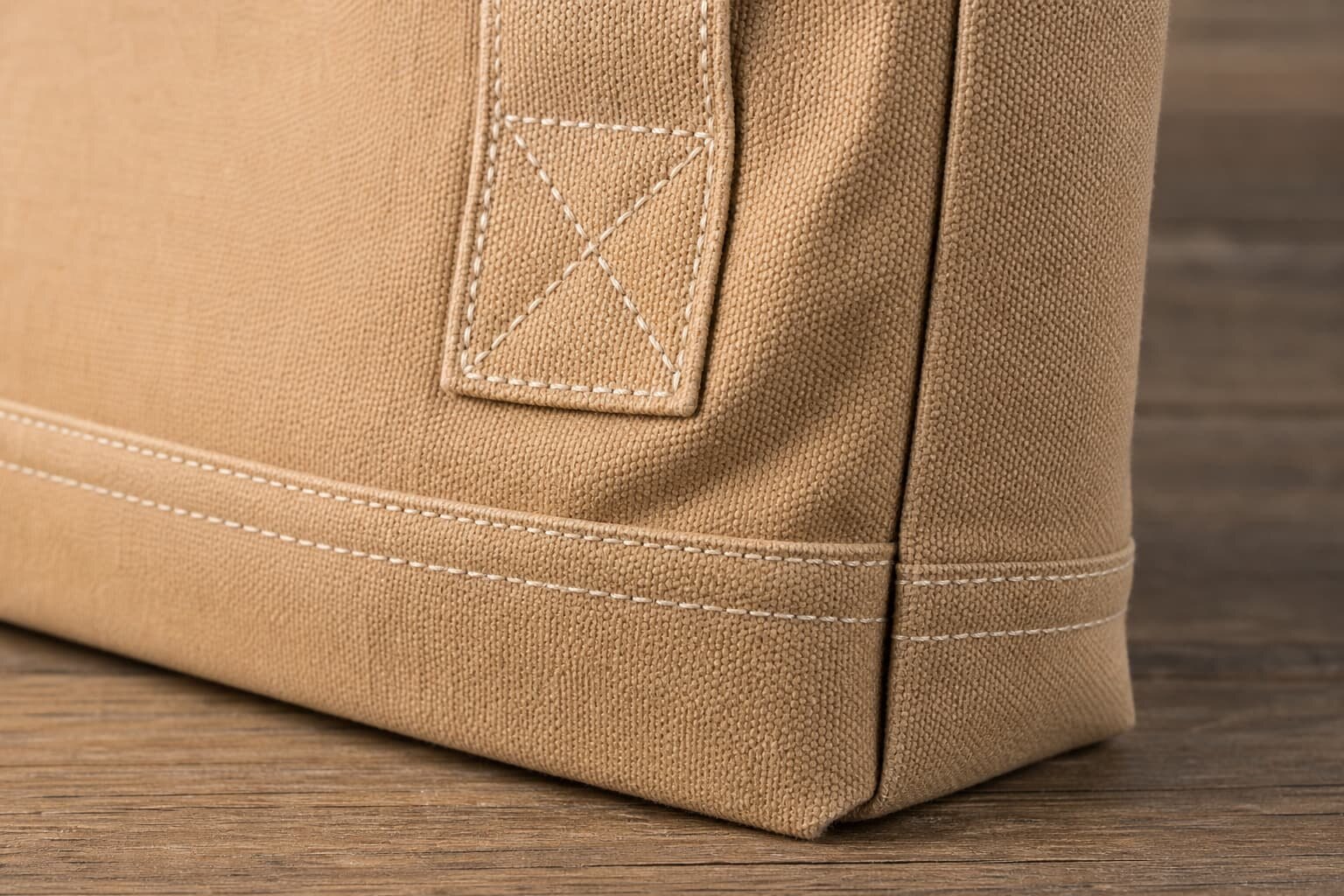
| Handle construction | Self-fabric handles with box stitch or cross stitch reinforcement | Everyday shopping, brand merchandise, and giveaway bags with moderate carrying weight | Weak stitch density, handle length variation, and reinforcement hidden under label or print |
| Carton plan | Retail units packed by fixed quantity, same orientation, with carton marks and barcode if required | Retail DC receiving, FBA-style prep, and distributor warehouse intake | Mixed colors in same carton, inaccurate carton weight, crushed bags, or missing inner carton count |
| MOQ logic | One MOQ for blank tote body, separate MOQs for fabric dyeing, print colors, labels, and retail packing materials | Buyers comparing several supplier quotations with different customization levels | Low unit price may exclude label, barcode, insert card, master carton test, or repacking labor |
Buyer checklist before sampling
- Confirm finished tote size, handle drop, seam allowance, gusset, fabric weight in GSM or oz, fabric color, and shrinkage tolerance before sampling.
- Approve a pre-production sample packed exactly as retail goods will ship, not only a loose tote sample.
- Check whether the quoted MOQ applies to blank bag production, dyed fabric, printing, woven labels, paper hangtags, inserts, and individual retail packing separately.
- Set the folding method before mass production and confirm that folds do not cut through the main logo or crease heavy ink coverage.
- Confirm print method, ink type, Pantone target, curing process, print position tolerance, and whether artwork is printed before or after sewing.
- Specify retail unit components: polybag or paper sleeve, hangtag, insert card, barcode sticker, price sticker, suffocation warning, country of origin label, and SKU label.
- Request carton dimensions, gross weight, net weight, unit quantity, carton marks, pallet plan if needed, and maximum carton weight acceptable to your warehouse.
- Require a packout photo set from the factory showing flat tote, folded tote, retail unit pack, inner carton if used, master carton, carton marks, and final loaded cartons.
- Define AQL level or inspection sample size for sewing, printing, labeling, barcode scanning, carton count, and packaging appearance.
- Hold shipment release until the factory shares final packing list, carton count, carton measurements, production photos, and any approved deviation records.
Factory quote questions to send
- What exact fabric weight will you use for this canvas tote bag, in both oz and GSM, and what tolerance do you control in bulk production?
- Is the quoted price based on greige cotton canvas, bleached canvas, dyed canvas, organic cotton, recycled cotton blend, or another fabric construction?
- Which print method is included in the quote, how many print colors are included, and what is the print size limit without extra cost?
- Can you quote the same tote with loose bulk packing, individual retail polybag packing, paper band packing, and hangtag packing as separate line items?
- What MOQ applies to the tote body, custom fabric color, print artwork, woven side label, hangtag, barcode label, insert card, and retail polybag?
- Will you make a packed pre-production sample using the final folding method, barcode, warning label, hangtag, and carton count before bulk production?
- What carton quantity, carton size, gross weight, and carton material grade are you quoting for this packout?
- How do you control barcode readability and SKU separation during packing, especially for multiple colors or artwork versions?
- What is the normal lead time for sample approval, fabric preparation, printing, sewing, retail packing, final inspection, and export document preparation?
- Which quote items are optional extras, and which are included in the unit price, tooling cost, sample charge, and packing charge?
Quality-control points to confirm
- Measure fabric GSM from approved bulk fabric and compare it with the signed sample, not only with the supplier quote.
- Inspect finished tote dimensions after sewing and pressing, including body width, height, gusset depth, handle width, and handle drop.
- Check print placement against a marked template, including distance from top edge, side seam, gusset, and handle attachment.
- Rub test the print surface after curing and check for ink transfer when folded inside retail packaging.
- Pull-check handle reinforcement and verify stitch density, backstitching, loose thread trimming, and skipped stitches.
- Scan barcode labels from packed units and carton labels using the buyer's expected scanning distance where possible.
- Open random packed units to confirm the correct hangtag, insert, country label, warning label, and SKU sticker are present.
- Verify carton quantity by count, not estimate, and reconcile master carton marks with the packing list before shipment release.
- Check carton compression, tape closure, moisture protection, and whether heavy cartons can survive export handling without crushing the retail packout.
- Record all accepted deviations in writing before shipment, including fabric shade, pack quantity, carton size, or label position changes.