Why repeat orders fail even when the first order worked
A canvas tote bag repeat order looks simple on paper: same bag, same logo, same supplier, place the PO again. In practice, this is where many buyers lose control. The first order may have been approved from a sample, then produced with one fabric lot, one print setup, one sewing team, and one packing method. On the next order, a factory may quote from memory, a new merchandiser may interpret the spec differently, or procurement may only compare the unit price and miss the production details that actually keep the bag consistent.
The problem is not usually a dramatic defect. It is small drift: a slightly softer canvas, a handle that feels longer than the last shipment, a print that shifts a few millimeters, or cartons that no longer match the warehouse receiving pattern. For retail buyers and distributors, those small changes create real cost. They trigger rework, relabeling, relining shelves, complaints from brand teams, or slower receiving at the DC. A good repeat-order checklist turns the re-buy into a controlled refresh instead of a new sourcing project.
- Repeat orders should lock the old approval, not reopen the whole design.
- Small changes in fabric, print, or packing create the biggest hidden costs.
- The buyer's job is to make the factory quote compare to the last approved spec, not to a memory of the bag.
Freeze the golden spec before you ask for a new quote
Start with the last golden sample and the exact PO that matched it. If you do not have both, ask the factory for the production spec sheet, cutting pattern, print file, and carton packing record from the previous run. For a repeat order, those documents matter more than a fresh sales description. You want the supplier to quote against a fixed baseline: body size, handle length, fabric weight, stitch type, logo placement, folding method, and shipping marks. If the old order sold well, the goal is to reproduce it with as little variation as possible.
This is also the moment to separate what is truly fixed from what can be improved. Some buyers want to adjust the tote bag to lower cost, but they should do that as a controlled revision, not as a silent repeat. If you change from 14 oz canvas to 12 oz canvas, or from screen print to woven label, you are not reordering the same item. You are creating a variant, and the factory should quote it that way. The more clearly you freeze the baseline, the easier it becomes to compare proposals and avoid quote games.
- Use the last approved sample as the visual reference, not a sales photo.
- Match the old PO number to the old spec sheet so revisions stay traceable.
- Treat any fabric, print, or packing change as a new version, even if the bag looks similar.
Check fabric weight, weave, and construction details first
For canvas tote bags, fabric is the first point where repeat orders drift. Buyers often ask for "same canvas" when they really need the same GSM, weave count, yarn feel, and shrink behavior. In the common range, a 12 oz canvas is around 340 GSM, a 14 oz canvas is around 475 GSM, and a 16 oz canvas is around 545 GSM. Those are practical reference points, not a universal standard, because yarn thickness, weave density, and finishing all affect how the bag looks and performs. Still, the GSM number gives procurement a language the factory cannot easily hand-wave away.
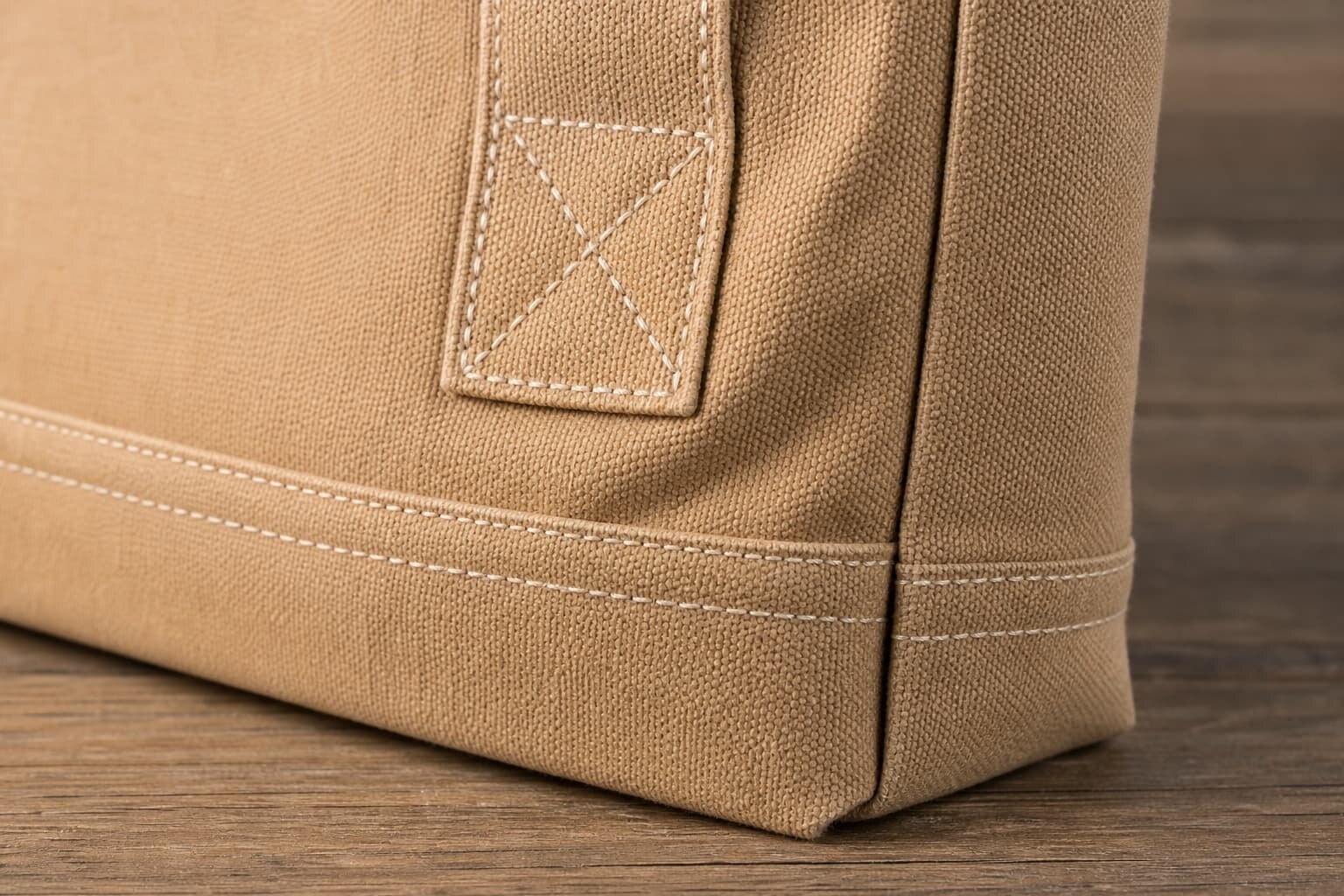
Construction matters just as much as fabric. If the first order used a self-fabric handle with bar-tacks at the top edge, keep that exact construction unless you have approval to revise it. If the bag had a gusset, a reinforced base, or X-box stitching at the handle joint, those details should be repeated or intentionally upgraded. For repeat orders, ask the factory to confirm the seam allowance, the stitch density, and any pre-shrinking or pressing step. A tote can look the same from five feet away while still being materially different in use.
- Ask for GSM plus weave description; do not accept "thick canvas" as a spec.
- Confirm whether the bag is unwashed, pre-washed, enzyme washed, or pre-shrunk.
- Lock the handle type, handle width, and reinforcement stitch pattern.
- Request size tolerances for body width, body height, gusset depth, and handle drop.
Lock the print method and artwork controls so the logo stays stable
Repeat orders often fail on branding before they fail on the bag itself. The original run may have used one screen print setup, one Pantone match, and one placement reference from the bag center line. On a reorder, the factory may reuse the artwork file but remake the screen, adjust curing, or interpret color by eye. That is how logos drift from crisp and clean to slightly heavy, slightly pale, or slightly off-position. If the art is simple and flat, screen print is usually the most repeatable method. If the logo has fine detail, small text, or multi-color registration, you need the factory to restate the print method and any limits before production starts.
The buyer should also decide whether the repeat order keeps the same branding system or introduces a different one. A woven side label, embroidery, embossed patch, or printed logo may all be acceptable on a canvas tote bag, but they do not behave the same in bulk. Woven labels can be excellent for consistency, yet they add a trim component and can change MOQ. Embroidery can look premium, but it can distort fine letters on a soft bag panel. The quote should tell you exactly which parts are reusing existing tools and which parts require new setup.
- Specify logo placement from the center line, top edge, and side seam.
- Require the same Pantone reference or a written visual tolerance if exact Pantone matching is not possible.
- Confirm whether the factory is reusing screens, plates, digitizing files, or label tooling.
- Ask for a photo of the first print-off from production, not only the pre-production sample.
Understand MOQ logic and lead time before you commit the reorder
Repeat orders can sometimes lower risk, but they do not always lower MOQ. The MOQ is usually tied to fabric roll usage, color batching, print setup, sewing efficiency, and whether the factory can reuse existing materials. If the prior order used the same canvas roll stock and the same print screens, a factory may be more flexible. If the reorder changes fabric color, adds a new label, or splits into multiple sizes, the MOQ may stay high or even increase. The buyer should ask the supplier which part of the order is driving the minimum, because that answer matters more than the headline unit price.
Lead time should be counted from the actual gatekeeper, not from the PO date alone. For a repeat order, that gatekeeper is usually final artwork approval, sample approval, or deposit receipt, depending on the supplier's process. If material is in stock, the order may move quickly; if canvas, webbing, or labels need to be woven or dyed, the timeline resets. Procurement teams should also ask whether the factory runs repeat orders in a dedicated line or folds them into a new production queue. That affects whether the quoted lead time is realistic for the season.
- Ask whether MOQ is driven by fabric rolls, print setup, or accessory packaging.
- Confirm whether all colors can be produced in one batch or must be split.
- Use lead time from approval to shipment, not from inquiry to shipment.
- Build a buffer if the order depends on custom dyeing, special labels, or busy-season capacity.
Compare quotes line by line instead of chasing the lowest unit price
A repeat order quote only helps if every supplier is pricing the same tote bag. The most common mistake is comparing one unit price against another while the hidden assumptions differ: one quote includes the same GSM and same print method, while another quietly changes the canvas weight, excludes packaging, or assumes a simpler folding method. For a canvas tote bag reorder, ask the factory to break out the quote in the same structure every time: fabric, cutting, sewing, print or decoration, packing, carton spec, sample charge, and any setup item. That gives procurement a clean comparison and exposes where the real difference sits.
If one supplier is cheaper, make them prove why. Are they using the same fabric lot? Are they quoting from leftover stock? Are they omitting a side label, a tag, or carton compression testing? Are they assuming a looser size tolerance or a different fold? The cheapest quote is often the one with the most ambiguity. The best quote is the one that can be traced back to the previous order and then checked against the actual bulk line items. When the buyer compares quotes this way, negotiation becomes specific instead of emotional.
- Require the same quote format from every supplier so line items can be compared cleanly.
- Ask for inclusion and exclusion notes, especially on packaging and branding extras.
- Check whether the quoted price assumes stock materials, new materials, or a new print setup.
- Treat a lower price as a change request until the supplier explains the cost basis.
Use samples to verify drift before bulk production starts
For repeat orders, sampling should be short and targeted. You do not need a full design process if the bag is already approved, but you do need a clear checkpoint to catch any change before bulk cutting. A pre-production sample or a first-off sample should confirm the same fabric hand feel, the same size, the same print placement, and the same packing method as the previous order. If the factory says the same sample is impossible because of material availability, that is a signal to examine whether the reorder is still truly the same item.
The buyer should inspect the sample like a production engineer, not like a consumer. Measure the bag flat and loaded. Check handle drop on both sides. Fold it the way the warehouse will fold it. Verify the logo under good light, because a print that looks fine on a bench may fail when compared against the last order. If you accept a deviation, write it down in one line and attach it to the PO. Verbal approval is how small changes become silent defaults.
- Compare the new sample to the last approved sample in the same lighting.
- Measure body size, handle length, and logo position instead of relying on visual judgment alone.
- Check stitch consistency at the handle attachment and top edge.
- Approve any deviation only after the factory documents it in writing.
Control packing, carton marks, and warehouse receiving details
A tote bag can be produced correctly and still create trouble at receiving if the packing spec changes. For repeat orders, the fold direction, inner pack, polybag choice, insert card, barcode label, and carton count should match the last shipment unless the buyer has a new warehouse requirement. If a bag was previously packed 100 pieces per carton with a specific gross weight and carton size, do not let the factory silently change to 120 pieces per carton just because the new carton estimate looks efficient. That change can break pallet planning, freight calculations, and store replenishment counts.
The receiving team also needs consistency in marks and traceability. Carton marks, SKU codes, color codes, and order references should follow the same logic as the earlier order so the DC can book the goods quickly. If you are distributing to multiple regions or retail channels, ask for the same outer carton format and label layout. Repeat orders often move through the business faster than first orders, so packing mistakes become expensive in a different way: they delay put-away, confuse inventory teams, and create relabeling work after the containers arrive.
- Match pcs per carton, carton size, and gross weight to the previous approved shipment unless there is a written change.
- Confirm whether the bag ships flat folded, polybagged, or with tissue and inserts.
- Keep carton marks and barcodes consistent with the buyer's warehouse system.
- Ask for carton photos before shipment if the pack structure changed at all.
Release the PO only after the change-control list is closed
The safest repeat order is one where every meaningful variable has been checked off before the PO is released. That means the buyer has compared the new quote to the last order, confirmed that the fabric and print method are unchanged, verified packing details, and understood the MOQ and lead time logic. If anything changed, the team should treat it as a controlled revision with written approval, not as a quiet repeat. This is especially important when multiple people touch the order: merchandising wants the same look, procurement wants the same cost, and logistics wants the same carton profile. Those three goals only stay aligned when the spec is visible to all parties.
The final release should be a short internal control step, not a debate with the factory. Ask the merchandiser or brand owner to confirm the visual sample. Ask procurement to confirm the commercial terms. Ask logistics to confirm packing and carton data. Then keep the approved set in one place and send it with the PO. That way the factory knows exactly what to make, and your team has a clean record if the bulk order ever drifts. The repeat order checklist is not paperwork for its own sake; it is the cheapest insurance against avoidable production error.
- Freeze the spec, compare the quote, verify the sample, then release the PO.
- Do not approve a reorder if the supplier cannot explain every difference from the last order.
- Store the golden sample, artwork, and packing spec together for the next reorder cycle.
- Use written change control for any deviation in fabric, print, trim, or carton data.
Specification comparison for buyers
| Spec decision | Recommended option | When it fits | Buyer risk to check |
|---|---|---|---|
| Fabric weight | 12 oz to 14 oz canvas, roughly 340 to 475 GSM | Most retail, promo, and brand reorders that need structure without extreme bulk | Vendors may say "canvas" without stating GSM, weave density, or shrinkage range |
| Heavy-use upgrade | 16 oz canvas, roughly 545 GSM, with reinforced seams | Premium carry capacity, longer wear, or a more rigid retail feel | Higher sewing difficulty, heavier cartons, and possible dimension drift after washing or pressing |
| Handle build | Self-fabric handles with bar-tack or X-box reinforcement, or webbing for load stability | Self-fabric for a softer brand look; webbing for consistent strength and less stretch | Handle length, fold width, and stitch count can change between orders if not frozen in the spec |
| Print method | Same method as the last approved order, usually screen print for larger flat logos | Repeat orders where color, position, and cost must stay stable | Color shift, registration drift, or hidden setup costs if the factory changes screens or inks |
| Packing format | Same fold method, inner pack, carton count, and shipping mark as the prior order | Warehouse replenishment, retail distribution, or repeat imports that must match receiving records | Carton size, pcs per carton, and barcode changes can break pallet planning and receiving |
| Branding add-on | Woven label, side flag, or small embroidery only if the artwork and stitch density are already approved | Premium reorders or line extensions with the same core bag | Extra trims can affect MOQ, lead time, and needle damage if they were not in the previous release |
Buyer checklist before sampling
- Pull the last approved PO, spec sheet, golden sample, and carton pack data before asking for the new quote.
- Confirm fabric composition, GSM, weave, and any wash or shrinkage notes match the prior order.
- Verify finished size, handle length, seam allowance, and reinforcement points against the approved sample.
- Check whether the print method, artwork file, Pantone references, and print placement are unchanged.
- Ask the factory whether the same fabric roll, dye lot, screens, or embroidery program will be reused.
- Confirm MOQ by color, size, and artwork, not just the total bag count.
- Lock lead time from final approval or deposit date, and ask what happens if materials are not in stock.
- Review packaging details: fold method, polybag yes or no, insert card, inner pack, carton count, and carton dimensions.
- Request a pre-production sample or clear inline photos if any material, print, or packing change is unavoidable.
- Write down who has authority to approve deviations so the factory cannot substitute parts without signoff.
Factory quote questions to send
- What exactly is identical to the last order, and what has changed?
- What fabric weight, weave, and shrinkage range are included in this quote?
- Which print method, number of colors, and setup items are included in the price?
- Is the MOQ based on fabric roll minimums, print setup, or packaging constraints?
- What is the lead time from artwork confirmation, sample approval, or deposit?
- Are carton size, carton marks, and pcs per carton included in the quoted packing spec?
- Will the same screens, plates, embroidery file, or label tooling be reused?
- What tolerances do you accept for size, handle length, and print placement?
- What sample stage is available before mass production, and is the sample charge refundable or credited?
- What line items are excluded from the quote, such as hangtags, inserts, special folding, or barcode labels?
Quality-control points to confirm
- Fabric GSM and weave density match the approved baseline sample.
- Finished dimensions stay within the agreed tolerance for body width, body height, gusset, and handle length.
- Handle attachment is reinforced consistently with bar-tack, X-box, or another approved stitch pattern.
- Print placement, print size, and color density match the approved artwork proof.
- Seam allowance is consistent and no raw edges, skipped stitches, or puckering appear at stress points.
- Inner folding method, tissue, inserts, and polybag or no-polybag packing match the packing spec.
- Carton count, carton dimensions, gross weight, and shipping marks match the booking and warehouse plan.
- Sample lot, bulk lot, and carton labels can be traced back to the same production run.
- Odor, stains, loose threads, and fabric flaws are checked before cartons are sealed.
- Any substitution in fabric, ink, label, or carton material is documented and approved in writing.