Why Reorders Still Need Forecast Control
A canvas tote bag reorder looks simple because the buyer already has artwork, a previous PO, and a sample. In practice, repeat orders fail when the forecast is treated as a copy-and-paste job. Cotton fabric lots change, print screens age, labor capacity shifts, carton cube is recalculated, and retail calendars move faster than factory production calendars.
The purpose of a canvas tote bag reorder forecast checklist is to decide when to place the next order, what quantity to lock, and which specifications must be reconfirmed. It is not only an inventory planning tool. It is also a supplier communication tool that prevents vague quote requests such as same as last time, which can produce very different results if the factory does not have the same material, same operator notes, or same packing record.
- Use the previous PO as a reference, not as the full specification.
- Forecast from required warehouse date backward, not from the date your team remembers ordering last year.
- Reconfirm material, print, sewing, and packing even if the style code is unchanged.
- Separate sales demand risk from production lead time risk in your planning sheet.
Start With Depletion, Not Last Order Quantity
Many buyers reorder the same quantity as the last purchase because it feels safe. That is often wrong. The last quantity may have included launch stock, a one-time event, distributor pipeline fill, or emergency air replenishment. A better method is to calculate average weekly depletion by channel and then add confirmed future demand that has not yet appeared in sales history.
For a canvas tote bag used in retail packaging, merchandise sales, events, or welcome kits, demand can be uneven. A distributor may order 3,000 pieces one month and none the next. A retail buyer may need inventory before a seasonal launch but sell slowly afterward. Your reorder forecast should show regular consumption, known spikes, backorders, and safety stock separately so the factory can understand whether you need one stable production run or staggered shipments.
- Record weekly usage from warehouse issues, not only invoice sales.
- Separate domestic backorders from future promotional demand.
- Mark event deadlines, retail launch dates, and distributor allocation dates.
- Keep a minimum stock level based on the longest realistic replenishment cycle.
- Use a higher safety stock when the tote uses dyed canvas, custom webbing, or complex printing.
Build the Reorder Calendar Backward
A factory lead time of 25 or 35 days does not mean your goods will be usable in your warehouse within that time. The reorder calendar should begin with the latest acceptable arrival date at your warehouse or customer distribution center. Then work backward through ocean or air transit, customs, inland delivery, final inspection, packing, mass production, material preparation, and sample approval.
For repeat canvas tote bags, buyers sometimes remove the sample stage to save time. That is reasonable only when fabric lot, print ink, artwork, label, and packing are unchanged and the factory still has a reliable sealed production sample. If any of those points changed, a reorder confirmation sample or at least a print strike-off can prevent a full batch of bags with the wrong shade, wrong logo position, or weak handle sewing.
- Sample approval: allow time for making, shipping, review, and buyer comments.
- Material preparation: include greige fabric booking, dyeing or washing if applicable, and shrinkage control.
- Production: separate cutting, printing, curing, sewing, trimming, and packing.
- Inspection: schedule inline checks before all bags are packed.
- Shipping: add time for booking, customs documents, port handover, transit, and local delivery.
Fabric GSM and Canvas Lot Reconfirmation
Canvas tote bag reorders are sensitive to fabric changes. A buyer may specify 12 oz canvas, while the supplier may convert that into a local GSM range based on fabric width and finishing. One factory may treat 12 oz as around 340 GSM, while another fabric source may feel lighter or stiffer at a similar nominal weight. For a reorder, ask the factory to quote the exact GSM range, fabric width, color, finishing, and whether the fabric is natural, bleached, dyed, or washed.
Natural canvas is not a single shade. It can look cream, beige, grayish, or speckled depending on cotton source and processing. Dyed canvas has its own risks because small reorders may not reach the dye house's efficient batch quantity. If the bag is sold as a retail item or part of a brand packaging system, request a swatch from the current fabric lot before bulk cutting.
- Common retail tote range: 10 oz to 12 oz canvas, roughly 280 to 340 GSM depending on weave.
- Heavy-duty shopper range: 14 oz to 16 oz canvas, often used when structure and durability matter more than low freight cube.
- Promotional budget range: 6 oz to 8 oz cotton canvas, useful for light loads but less premium in handfeel.
- Reorder risk: same ounce description but different stiffness, shrinkage, surface hairiness, or color tone.
- Acceptance point: approve a current lot swatch against the retained production sample.
Print Method Stability Across Reorders
Most repeat canvas tote bag programs use screen printing because it is stable, efficient, and cost-effective for solid logos and simple artwork. The reorder risk is not only the artwork file. It is the screen condition, mesh, ink formula, print operator settings, curing temperature, fabric absorbency, and print placement jig. If a screen has been discarded or the artwork size changed, the quote should state whether new setup charges apply.
For multi-color logos, buyers should check registration and color tolerance before bulk production. For natural canvas, ink can absorb differently between fabric lots. For dyed canvas, light ink may need a base layer to reach opacity. Digital print, heat transfer, embroidery, and woven labels may be suitable for certain designs, but each method changes MOQ, lead time, and inspection criteria.
- Screen print: best for solid spot colors, repeat logos, and efficient bulk production.
- Heat transfer: useful for detailed artwork, but check handfeel, edge durability, and heat marks.
- Embroidery: premium look, but confirm backing, stitch density, puckering, and needle damage on canvas.
- Woven label: good for subtle branding, but confirm label MOQ and sewing placement.
- Acceptance point: keep an approved print strike-off or first-bulk panel from every reorder.
MOQ Logic for Repeat Tote Programs
MOQ is rarely one number. A canvas tote bag reorder can have separate minimums for fabric purchase, dyeing, printing setup, label production, packing material, and carton mark versions. A quote for 5,000 pieces in one natural canvas body with one screen-printed logo is very different from 5,000 pieces split across ten logos, three bag colors, and two packing instructions.
Procurement teams can reduce cost and lead time by grouping specifications. If several departments need the same tote body, consider placing one body order with controlled logo versions or scheduled releases. If distributors need different carton marks, ask whether the factory can pack by destination at the end of the line without interrupting production. The goal is to avoid a reorder that looks large in total but behaves like many small custom orders.
- Ask MOQ per fabric color, not only per total order.
- Ask MOQ per print design and per print color count.
- Ask whether mixed carton marks create extra handling cost.
- Ask whether labels, hangtags, or barcodes have their own minimums.
- Ask whether a larger fabric booking can be split into scheduled shipments.
Quote Data Your RFQ Should Include
A reorder RFQ should let the factory quote without guessing. Include the previous PO, photos of the approved sample, size, fabric GSM, handle specification, gusset, print method, print size, print color reference, label details, packing, delivery terms, and required cargo ready date. If your internal item code changed, include both the old and new codes so the factory can trace the correct production record.
Ask for quote data in a format that helps your team compare suppliers or compare the new quote against the previous order. The cheapest unit price may be less useful if the carton quantity changes, the CBM increases, the sample lead time is longer, or the supplier excludes a setup cost that will appear later. For import buyers, the quote should support landed cost calculation, not only purchase price approval.
- Unit price by quantity break, such as 3,000, 5,000, 10,000, and 20,000 pieces.
- Fabric weight and material description used for the quote.
- Print setup cost, screen cost, label cost, and packing material cost if charged separately.
- Sample cost and sample lead time, even for a repeat order.
- Production lead time after sample approval and deposit or order confirmation.
- Carton size, pieces per carton, gross weight, net weight, and total CBM.
- Quote validity and assumptions for cotton fabric, exchange rate, and packing material.
Sample Checks Before You Release Bulk
A reorder sample does not need to repeat every development step, but it must confirm the points that can drift. Check the sample against the sealed previous production sample, not only against the digital artwork. Measure finished dimensions after pressing or normal finishing. Canvas can shrink during washing, steaming, or heat curing, and a small dimension change can affect retail display, insert fit, or perceived value.
For production approval, look at the complete bag as a buyer would receive it. A perfect front print is not enough if the handles are shorter, the bottom gusset collapses, the label is on the wrong side, or the folding creates a crease through the logo. If packing is important for your warehouse, ask for a packed sample or at least photos showing folding method, inner bag if used, carton layout, and carton mark.
- Measure bag width, height, gusset, handle drop, and handle width.
- Check print size, print position, color, opacity, and curing.
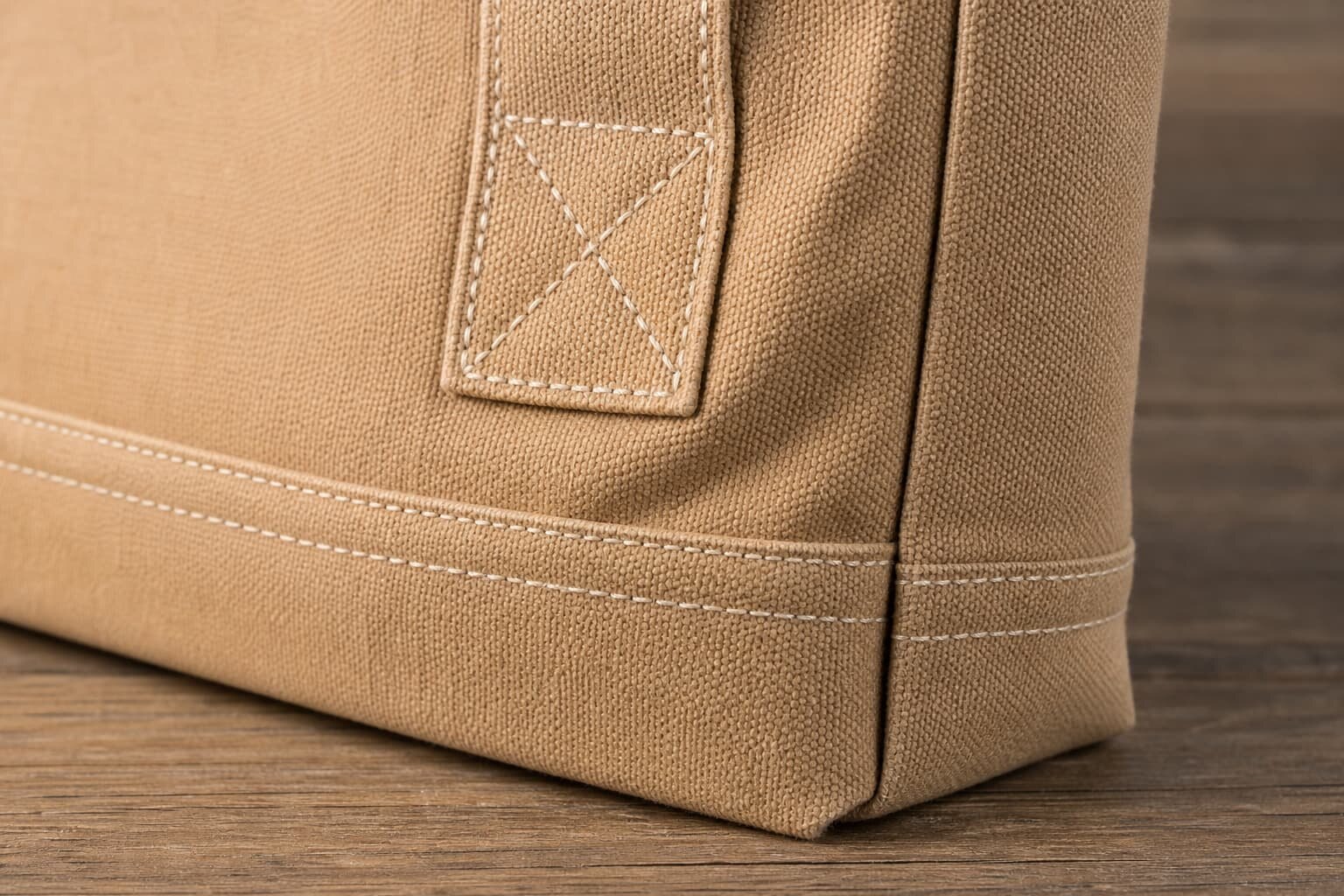
- Pull handles firmly and inspect box stitching or cross stitching.
- Compare fabric handfeel, shade, surface texture, and thickness.
- Confirm label position, hangtag, barcode, care label, and side label if used.
- Review folding, polybag need, carton quantity, and carton mark before mass packing.
Packing, Carton Cube, and Warehouse Fit
Packing is part of the reorder forecast because carton cube affects freight cost and warehouse receiving. Canvas tote bags can be packed flat, half-folded, rolled, or bundled, depending on bag size, print method, and destination requirements. A heavier canvas with long handles may create bulky cartons even if the piece count is unchanged. If the previous order was shipped by air and the reorder will move by ocean, carton strength and moisture control may also need review.
Over-compression is a common mistake. It can create hard fold lines, print blocking, distorted handles, or cartons that burst during inland handling. Under-packing wastes freight cube. The buyer should ask for updated carton dimensions and a packing photo before confirming shipment. For retail or distributor programs, confirm whether cartons need SKU labels, destination labels, mixed SKU warnings, or pallet restrictions.
- Confirm pieces per inner bundle and pieces per master carton.
- Request carton dimensions in centimeters and inches if your freight team uses both.
- Check gross weight per carton against warehouse handling limits.
- Confirm whether bags are individually polybagged, bundled, or bulk packed.
- Ask whether desiccant is recommended for long ocean transit or humid seasons.
- Confirm carton mark layout, PO number, SKU, color, quantity, and country of origin marking.
A Practical Forecast Workflow for Procurement Teams
The best reorder process is short but disciplined. Start with inventory and sales data, then create the required in-warehouse date, then send the RFQ with a complete spec package. Once the factory replies, compare not only unit price but also MOQ split, sample requirement, production lead time, carton cube, and quote validity. This workflow helps procurement explain to sales or marketing why a reorder must be placed before inventory looks dangerously low.
Keep a reorder control file for each canvas tote bag program. It should contain the final artwork, approved sample photos, fabric swatch record, print strike-off, PO history, inspection reports, carton data, and notes from any production issue. This file becomes more valuable with every reorder because it reduces supplier guessing and protects the buyer if staff changes on either side.
- Step 1: calculate depletion, future demand, and safety stock.
- Step 2: set the latest acceptable warehouse date and work backward.
- Step 3: confirm whether the previous specification is still valid.
- Step 4: request quote data with quantity breaks and packing data.
- Step 5: approve reorder sample or current lot swatch before bulk cutting.
- Step 6: inspect early production before the full quantity is packed.
- Step 7: store a sealed sample and production notes for the next reorder.
Specification comparison for buyers
| Spec decision | Recommended option | When it fits | Buyer risk to check |
|---|---|---|---|
| Reorder trigger point | Forecast from average weekly usage plus supplier lead time plus safety stock | Repeat retail, trade show, subscription, and distributor replenishment programs | If the trigger uses sales order date only, it may ignore ocean transit, customs, relabeling, and warehouse receiving time |
| Fabric weight | 10 oz to 12 oz cotton canvas, or roughly 280 to 340 GSM depending on weave | Most promotional retail totes, bookstore bags, and brand merchandise | Same ounce weight from another mill can feel different; request GSM, yarn count if available, and approved swatch reference |
| Print method | Screen print for solid logo repeats; heat transfer or DTG only when artwork requires it | Stable brand logos, one to four spot colors, medium to large repeat orders | Old screens, changed ink brand, and unconfirmed Pantone references can cause visible reorder color drift |
| MOQ planning | Consolidate colorways and print versions around fabric batch and setup logic | Buyers with several departments or distributors ordering similar tote bodies | Too many small logo versions may fall below efficient setup quantity and increase unit cost or lead time |
| Sample check | Approve one reorder confirmation sample against sealed previous production sample | When the style is unchanged but material lot, print ink, or packing changes | Skipping the sample because it is a repeat order can miss shrinkage, handle drop, print position, or fabric shade changes |
| Packing method | Carton quantity based on bag size, folded thickness, print curing, and destination warehouse limit | Importers managing freight cube, FBA-style receiving, or distributor pick-pack operations | Over-compressed cartons can create print blocking, deep fold marks, and warehouse rejection |
| Lead time assumption | Separate material booking, sample confirmation, mass production, QC, packing, and vessel or air schedule | Seasonal campaigns, event deadlines, and planned retail launches | A simple factory production days number is not a delivered-date forecast |
Buyer checklist before sampling
- Confirm the exact previous order reference, approved sample date, artwork version, and carton mark format before requesting the reorder quote.
- Calculate reorder quantity from real weekly depletion, confirmed future campaigns, distributor backorders, and safety stock, not only last order quantity.
- Check whether the same fabric GSM, weave, color, and finishing process are still available from the original fabric source.
- Ask whether print screens, heat transfer films, embroidery files, or woven label tooling are still usable and whether any reset cost applies.
- Verify handle length, handle width, stitching pattern, side gusset, bottom gusset, and finished bag tolerance against the sealed sample.
- Confirm whether MOQ applies per bag body, per fabric color, per logo, per print color, per packing version, or per shipping destination.
- Request updated carton dimensions, pieces per carton, gross weight, net weight, and estimated CBM before confirming freight mode.
- Build a calendar using approval sample date, material ready date, production start, inline inspection, final inspection, cargo ready date, and latest acceptable warehouse date.
- Reserve time for incoming warehouse checks, retail ticketing, kitting, relabeling, or distributor allocation after arrival.
- Keep one approved production sample from each reorder batch to control the next replenishment.
Factory quote questions to send
- Can you quote this reorder against our previous PO number and confirm whether the bag body, fabric GSM, handle material, print method, and packing are unchanged?
- Is the original fabric still available, and if not, what is the closest substitute by GSM, weave, shrinkage, color tone, and handfeel?
- What MOQ applies separately to natural canvas, dyed canvas, each logo artwork, each print color, and each carton mark version?
- Are the previous print screens, color formulas, cutting patterns, label dies, or sewing guides still stored and usable?
- What sample do you recommend for this reorder: counter sample, print strike-off, pre-production sample, or full packed sample?
- How many production days should we allow after sample approval, and which part of the schedule is most likely to move if fabric or print capacity is tight?
- Can you provide carton quantity, carton size, gross weight, net weight, and CBM for the planned quantity before we place the order?
- What tolerance do you use for finished bag size, handle drop, print placement, print color, and fabric weight?
- Will production be from one fabric lot and one print run, or should we expect shade or print variation across batches?
- What quote validity should we use for cotton fabric, dyeing, printing, labor, and freight-related packing materials?
Quality-control points to confirm
- Compare bulk fabric against the sealed swatch for GSM, color tone, weaving density, odor, stains, slubs, and finishing handfeel.
- Measure finished bag width, height, gusset, handle drop, and handle width against the approved reorder sample and agreed tolerance.
- Check print position from top edge and side seam, print color against Pantone or approved strike-off, ink coverage, curing, wash or rub resistance when required.
- Inspect handle attachment with box stitch or cross stitch strength, bar tack consistency, and whether reinforcement matches the approved construction.
- Review seam allowance, stitch density, loose threads, skipped stitches, needle holes, puckering, and inside seam finishing.
- Confirm label placement, care label content if used, hangtag attachment, barcode readability, and carton mark accuracy.
- Perform packing checks for pieces per polybag or master carton, folding method, desiccant use if needed, carton strength, and export carton tape quality.
- Pull samples from early, middle, and late production to check whether fabric shade, print color, and sewing quality remain stable through the run.