Use the memo to freeze the reorder standard
A canvas tote bag reorder approval memo is the buyer's control record for a repeat PO. It tells procurement, QC, logistics, and the factory which version of the tote must be repeated and which details are allowed to change. Without that record, a reorder can slowly become a new development order: fabric weight shifts, handle drop changes, packing is simplified, or the supplier quotes from an old artwork file.
Start the memo by naming one approved standard. Reference the last accepted PO, final sample ID, artwork version, carton spec, and inspection notes. If the first order had several sample rounds, do not attach every draft as equal evidence. Mark the final approved version clearly and say whether the new order is same as prior order or same except for listed changes.
- Name the product, size, color, and decoration version exactly as approved.
- Identify the golden sample or sealed sample ID used as the control standard.
- Attach the final artwork, final photo set, final pack spec, and last accepted inspection report if available.
- Separate approved changes from historical comments so the factory does not follow an obsolete note.
Write the base tote spec in factory terms
The base spec should describe how the tote is cut, sewn, finished, and measured. Use finished dimensions, not catalog language. Record width, height, gusset depth, handle length, handle drop, seam allowance if critical, and tolerances. A bag described only as medium natural canvas tote leaves too much room for substitution, especially when the next order is placed months after the first run.
Canvas weight needs the same precision. Buyers often compare 10 oz, 12 oz, and 16 oz canvas, but oz and GSM are not always quoted consistently. Ask for the finished fabric weight and include both units when possible. Also define whether the canvas is natural, bleached, dyed, washed, coated, or pre-shrunk. These details affect structure, print opacity, shade, shrinkage, and carton cube.
- Record finished size and tolerance in cm or mm, not only in inches or rough descriptions.
- State whether measurements are taken flat, open, before packing, or after pressing.
- Define fabric weight as finished oz and GSM, not only greige fabric target.
- Call out canvas finish, shade reference, shrinkage expectation, and acceptable hand-feel variation.
Control decoration as its own approval track
Decoration is often where repeat tote orders drift. A supplier may reuse the bag body spec but change screen mesh, ink coverage, transfer film, patch placement, or label stitching. The memo should state the decoration method, artwork file name, version number, print size, color reference, position, and number of sides. If the program has several logos or channel versions, each version should have its own line item.
For screen print, confirm the number of colors, Pantone target, print dimensions, print placement from seams or top edge, and whether underbase is required. For heat transfer, request edge-lift and rub checks. For embroidery, patches, and woven labels, specify size, placement, orientation, stitch method, and thread color. Decoration approval should happen on the same canvas weight and color as the bulk order, not only on paper proofs.
- Lock artwork file name and revision number before the quote is accepted.
- State one-side or two-side decoration and whether front and back are identical.
- Measure print position from fixed points such as top edge, side seam, or center line.
- Require a new proof when print method, canvas color, artwork size, or logo placement changes.
Make supplier quotes comparable
A reorder quote is useful only if every supplier is pricing the same tote. Ask suppliers to quote against the memo and to identify any exception in writing. The price should not hide a lighter fabric, a simplified handle stitch, fewer labels, bulk packing instead of retail packing, or a different carton count. If a lower price depends on a changed spec, the buyer can still consider it, but the change must be visible before approval.
Break the quote into practical cost drivers: fabric, cutting and sewing, decoration setup, labels, hangtags, packing materials, cartons, QC, and freight terms if included. MOQ should be equally specific. A factory may set MOQ by fabric color, print design, label version, carton mark, or shipment split. One total MOQ number can hide setup charges that appear later.
- Ask suppliers to list all deviations from the memo in a separate quote note.
- Confirm whether the quote uses stock canvas, reserved fabric, or a new fabric run.
- Separate one-time setup charges from repeat unit cost.
- Check MOQ by color, artwork, label version, carton mark, and destination split.
Decide which changes need a new sample
Not every reorder change carries the same risk. The memo should sort changes before production starts so the factory knows when to stop and ask. High-risk changes include fabric GSM, bag size, handle drop, handle reinforcement, print method, print placement, and carton quantity. These can affect sellability, user experience, warehouse acceptance, or brand consistency.
Medium-risk changes may include label material, polybag thickness, hangtag paper, folding method, or carton artwork. Low-risk changes might include an internal thread color that is not visible in use, as long as strength is not affected. This classification prevents unnecessary delays while still protecting the features that buyers, retailers, and end users notice.
- Require a physical or pre-production sample for fabric, size, handle, print, or visible finish changes.
- Use photo approval only for clearly defined low-risk details such as carton mark correction or hidden trim updates.
- Treat pack count, barcode placement, and carton size as commercial controls, not minor factory choices.
- Write every approved deviation into the memo with date, owner, and reason.
Review samples against measurable acceptance rules
A reorder sample should prove the factory can still make the approved tote under current material and production conditions. Compare it with the sealed sample and the memo, not with memory. Measure body size, gusset, handle length, handle drop, print size, print location, label position, and carton-ready fold. Check how the tote stands, whether seams pull, and whether the handle anchoring looks identical to the approved run.
Set tolerances before sample review. For many standard canvas totes, buyers use practical bands such as plus or minus 0.5 cm for main body dimensions and handle drop, with tighter or wider limits depending on size and construction. Print placement tolerance may be only a few millimeters for retail branding. If the tote will carry weight, perform a simple loaded carry check and reinspect handles, bartacks, and bottom seams.
- Measure the sample with a ruler or tape and record results in the approval memo.
- Inspect both handles for equal drop, equal tension, and matching reinforcement.
- Check print opacity, ink edge quality, rub resistance, and color on the actual bulk canvas.
- Reject vague sample comments such as looks okay when a measurable tolerance is available.
Protect packing and warehouse receiving
Packing is a common source of reorder disputes because it is often treated as an operational afterthought. The memo should define folding method, inner pack quantity, master carton quantity, polybag use, dust or moisture protection, carton dimensions, gross weight, carton marks, and barcode placement. If the prior order passed warehouse receiving, repeat those details unless there is a deliberate improvement.
Packing choices affect cost, damage risk, and freight cube. A polybag adds labor and material but may protect natural canvas from dirt. Insert boards improve presentation but increase carton volume. A changed carton count can disrupt receiving, allocation, and distributor chargeback rules. If a reorder includes mixed colors, mixed logos, or split destinations, the mix ratio and carton marking rules must be written into the memo.
- State whether cartons are single-style, mixed-style, single-color, or mixed-color.
- Confirm folding direction and handle placement inside the carton to reduce creasing and scuffing.
- List carton marks, barcode rules, country-of-origin marks, and any retail label requirements.
- Ask the supplier to confirm carton dimensions and gross weight before bulk packing starts.
Tie lead time to the actual critical path
Repeat orders are fast only when the inputs are already controlled. The memo should show the approval sequence: sample approval, fabric reservation, artwork confirmation, print setup, sewing start, inline inspection, final inspection, packing, and ex-factory date. If the factory says lead time is unchanged, verify that fabric, labels, screens, cartons, and production capacity are actually available.
Small changes can reopen the schedule. A revised Pantone, new label, new carton mark, different warehouse split, or added barcode can delay production even when the bag body is unchanged. The memo should define what counts as complete approval and who can authorize a date change. This prevents the factory from starting with missing information or waiting silently for a decision.
- Record the approval date that releases bulk production.
- Identify the critical path: fabric, print, labels, packing, inspection, or shipment booking.
- Add a revision number whenever a change affects cost, quality, or lead time.
- Keep artwork, packing, and shipment changes in the memo instead of scattered email threads.
Plan QC around the failures that cost money
The most expensive reorder failures are not always dramatic. A lighter canvas can pass a quick visual check but fail brand expectations. A shorter handle drop can make the bag uncomfortable. A missing bartack can create returns. A changed carton count can trigger warehouse rejection. QC should focus on the features that affect sellability, service performance, and receiving compliance.
Inspection should sample across cartons, colors, artwork versions, and fabric lots where applicable. Check dimensions, fabric shade, hand feel, odor, print quality, stitch strength indicators, label accuracy, packing count, and carton marks. If a defect is found, document the affected quantity, carton numbers, photos, and proposed disposition. Do not approve shipment based only on a corrected top sample if bulk goods were already packed.
- Inspect multiple cartons, not only the first carton offered by the factory.
- Check for oil stains, mildew odor, dirt transfer, broken stitches, skipped stitches, and loose threads.
- Scan barcodes and verify label data against the buyer's retail or distributor requirements.
- Record approved concessions in writing before shipment, including quantity and cartons affected.
Keep the memo usable after handoff
A good reorder approval memo is short enough to use and specific enough to enforce. Give it an owner, approver, revision number, date, sample ID, and file location. Store it with the PO, artwork, quote, sample photos, inspection report, and pack spec. The next buyer should be able to understand what was purchased without rebuilding the order history from emails.
The memo also protects the supplier. When the factory can see the approved standard, allowed changes, packing rules, and inspection points, it can quote more accurately and avoid preventable rework. The strongest canvas tote bag reorder approval memo does not repeat generic procurement language. It gives the exact production decisions needed to release a repeat order with fewer surprises.
- Assign one document owner in procurement and one supplier contact for revisions.
- Keep old revisions visible but mark the current approved version clearly.
- Use the memo as the basis for quote comparison, sample review, QC inspection, and shipment release.
- Do not approve the PO until open spec, price, MOQ, packing, and lead-time questions are closed.
Specification comparison for buyers
| Reorder control point | Recommended memo detail | When it matters most | Buyer risk to check |
|---|---|---|---|
| Fabric weight | State finished canvas weight in oz and GSM, for example 12 oz / about 400-430 GSM | Retail, distributor, and brand programs where hand feel and structure must match the first order | Confirm the number is finished fabric weight, not greige target, and ask whether washing or finishing changes GSM |
| Fabric color and finish | Define natural, bleached, dyed, washed, or coated canvas with a reference sample or approved lab dip | Programs where first and second deliveries may sit together in retail or warehouse stock | Check shade tolerance, lot variation, shrinkage, odor, and whether replacement stock fabric is being substituted |
| Bag dimensions | Record finished width, height, gusset, handle length, handle drop, and tolerance in cm or mm | Any reorder where fit, capacity, or shelf presentation affects acceptance | Clarify whether measurements are taken flat, open, before packing, or after pressing |
| Print method | Lock screen print, heat transfer, embroidery, patch, or label method with artwork version and Pantone target | Repeat logos, campaign graphics, licensing, and private-label programs | Verify print size, placement, screen count, color count, one-side versus two-side printing, and setup charges |
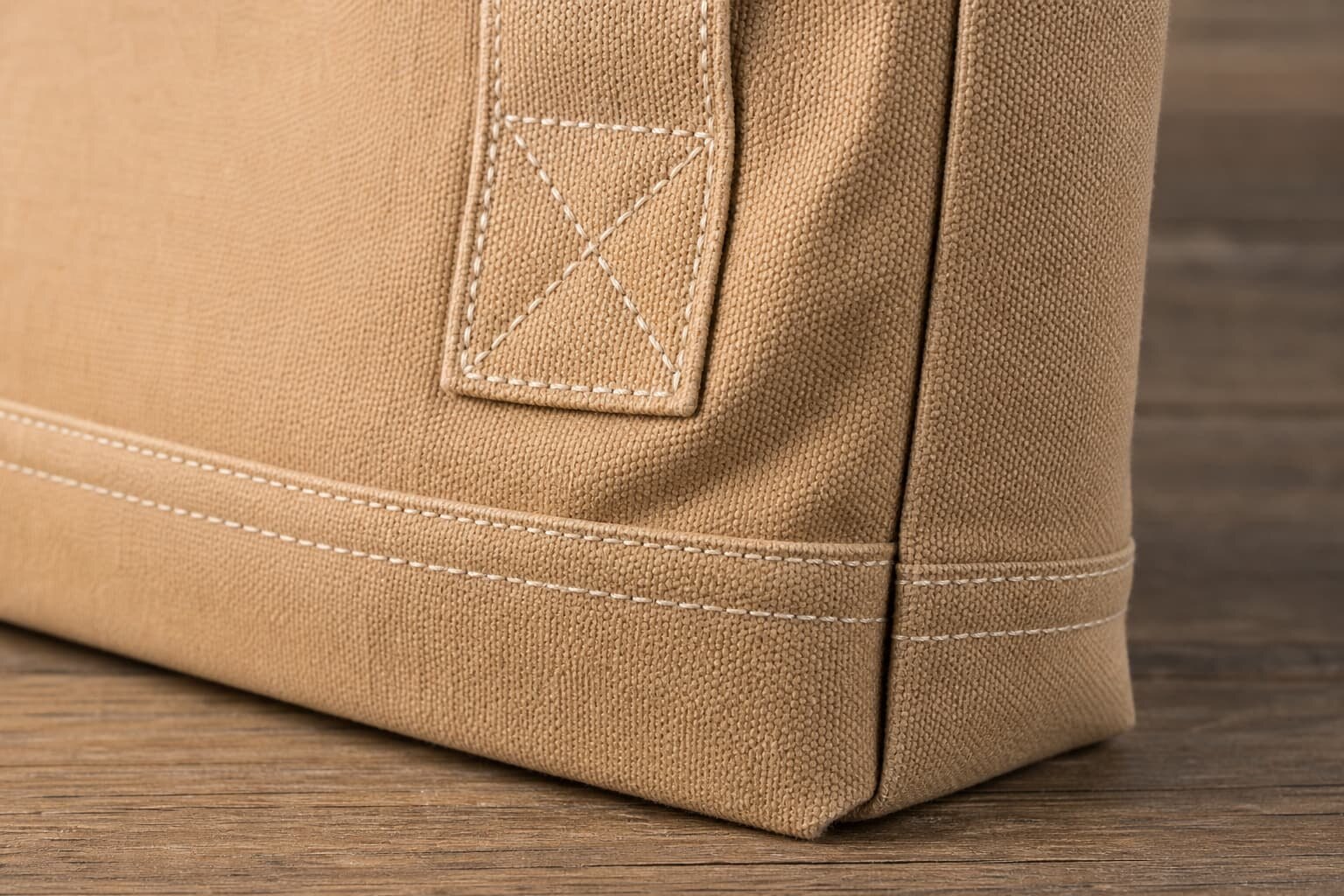
| Handle construction | Specify self-fabric or webbing handles, width, drop, stitch pattern, and bartack or X-box reinforcement | Bags used for groceries, events, retail merchandise, or heavier fill weights | Inspect handle symmetry, stitch density, pull strength expectations, and whether reinforcement matches the sealed sample |
| Top and seam finish | Define folded hem, double topstitch, side seam type, bottom seam, and any inside binding | Totes where the buyer expects a clean retail edge and repeatable shape | Check puckering, skipped stitches, needle damage, seam allowance, and loose threads on thick seam intersections |
| Labels and compliance marks | List woven label, care label, country of origin, hangtag, barcode, and placement | Retail, distributor, corporate gifting, and import programs with receiving rules | Confirm label artwork, language, barcode scannability, placement, and whether labels are included in unit price |
| Packing and cartons | State folding method, inner pack count, polybag use, carton quantity, carton marks, dimensions, and gross weight | Warehouse receiving, export shipment planning, and retail replenishment | Check carton cube, moisture protection, mixed-style packing rules, barcode location, and whether the supplier changed carton size |
| MOQ and price basis | Require MOQ by fabric color, print design, artwork version, carton mark, and shipment split | Small reorders, multi-logo programs, and buyers comparing suppliers | Identify whether low MOQ depends on stock fabric, shared screens, simplified packing, or a changed material assumption |
Buyer checklist before sampling
- Attach the final approved sample photo set and identify the physical golden sample or sealed reference sample ID.
- State whether the reorder is exactly the same as the prior PO or the same except for listed approved changes.
- Confirm finished bag width, height, gusset, handle length, handle drop, and measurement tolerance in cm or mm.
- List canvas weight in oz and GSM, plus finish details such as natural, bleached, dyed, washed, coated, or pre-shrunk.
- Lock artwork file name, version number, print method, Pantone target, print size, and print position from seams or top edge.
- Define handle construction, stitch pattern, bartack or X-box reinforcement, thread color, top hem, and seam finish.
- Confirm woven labels, care labels, hangtags, country-of-origin marks, barcode stickers, and placement requirements.
- Write the exact packing method, folding method, inner pack, carton quantity, carton marks, carton size, and gross weight target.
- Ask for MOQ by color, by print design, by carton mark, by shipment split, and by fabric lot where applicable.
- Record sample approval date, bulk production start date, inspection window, ex-factory date, and ship window.
Factory quote questions to send
- Which approved sample ID and spec revision are you quoting against?
- What finished fabric weight, weave, color, and canvas finish are included in the unit price?
- Is the fabric from stock, reserved greige fabric, a new weaving lot, or a new dye lot?
- What shrinkage, color variation, or hand-feel tolerance should we expect versus the previous order?
- How many print colors, screens, plates, or setup charges are included?
- Does the price cover one-side printing, two-side printing, or multiple artwork versions?
- What handle material, handle width, handle drop, stitch pattern, bartack count, and thread spec are included?
- Are woven labels, care labels, hangtags, barcode stickers, inserts, and country-of-origin marks included or charged separately?
- What MOQ applies by fabric color, print design, label version, carton mark, and shipment destination?
- What packing method, inner pack, carton quantity, carton size, and gross weight are you pricing?
Quality-control points to confirm
- Compare bulk goods against the sealed sample, not only against photos or the previous PO description.
- Measure finished width, height, gusset, handle length, and handle drop against the memo tolerance.
- Verify fabric weight, shade, surface cleanliness, odor, and hand feel across multiple cartons and fabric lots.
- Check handle anchoring, bartack or X-box reinforcement, stitch density, and symmetry on both handles.
- Inspect top hem, side seams, bottom seams, seam allowance, skipped stitches, needle damage, and loose thread trimming.
- Confirm print color, coverage, registration, size, placement, rub resistance, and edge quality on the actual canvas.
- Check woven labels, care labels, hangtags, country-of-origin marks, barcode stickers, and retail data accuracy.
- Verify folding method, polybag or dust protection, inner pack, carton quantity, carton marks, carton dimensions, and gross weight.
- Look for oil stains, water marks, mildew odor, dirt transfer, scuffing, creasing, broken stitches, and mixed-style packing errors.
- Document any approved deviation with photos, carton numbers, quantity affected, and buyer sign-off before shipment.