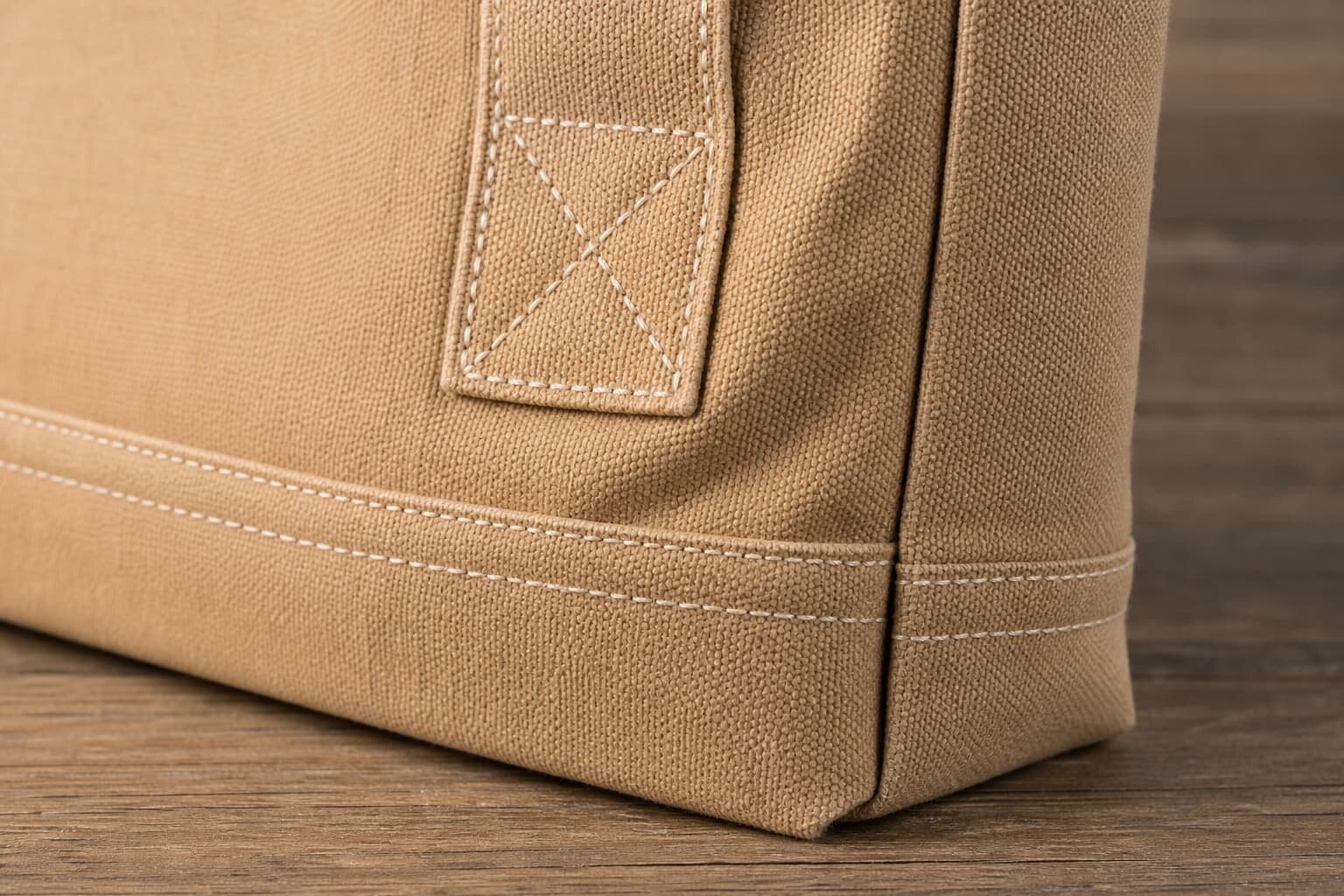
Why canvas tote quotes become hard to compare
A canvas tote bag looks simple, but factory quotations often hide different assumptions. One supplier may quote 8 oz cotton, another may quote 12 oz canvas, and a third may include a gusset, inner pocket, and individual packing without making the difference clear. If procurement compares only the unit price, the lowest quote may simply be a thinner bag with a smaller logo, cheaper handles, or no packing cost included.
The practical goal of a quote checklist is to make every supplier price the same bag. A good RFQ should tell the factory what to quote, but it should also force the factory to show where cost is coming from. Fabric weight, fabric color, print coverage, handle length, sewing reinforcement, MOQ, packing, and lead time are the normal reasons two quotes for the same canvas tote bag can differ by a large margin.
- Ask for a line-by-line quote instead of one lump-sum unit price.
- Do not accept a quote that says only cotton canvas without weight and construction.
- Require a finished bag size drawing or measurement table before sampling.
- Compare price on the same incoterm, packing method, artwork, and MOQ.
- Treat very low quotes as incomplete until the factory confirms every cost driver.
Start the RFQ with finished bag use, not only dimensions
Factories can recommend better construction when they know what the tote must carry. A tote for folded T-shirts at a retail counter does not need the same fabric weight as a tote for books, wine accessories, trade show catalogs, or grocery products. If the supplier only receives width and height, they may quote the easiest construction instead of the right one.
Your RFQ should describe the expected loading, sales channel, and handling condition. State whether the bag is a gift-with-purchase item, retail product, event giveaway, subscription packaging, or reusable shopping bag. This helps the factory choose fabric weight, handle reinforcement, stitching, and carton packing. It also gives procurement a reason to reject a cheaper quote that does not match the intended use.
- For light promotional use, ask if 7 oz to 8 oz canvas is enough and request a sample to confirm hand feel.
- For retail resale or repeated use, 10 oz to 12 oz canvas is usually a safer starting point.
- For heavy contents, books, or premium sets, review 14 oz to 16 oz canvas and reinforced handles.
- For a boxed product insert, ask whether the tote must be folded to a specific size.
- For supermarket or distributor programs, confirm handle drop and load comfort, not only visual appearance.
Define fabric weight in a way factories cannot misread
Canvas fabric is often discussed in ounces, but the buying team should also request GSM. Some suppliers quote fabric in ounces per square yard, while others use local market naming that may not match the actual weight. A tote described as 12 oz by one supplier can feel different from another supplier's 12 oz if yarn count, weave density, finishing, and washing are not the same.
A clear quote should state fabric material, fabric weight, color, finishing, and tolerance. For example, a practical line could read: 100 percent cotton canvas, natural color, 12 oz per square yard, approximately 407 GSM, unwashed, finished bag size tolerance plus or minus 1 cm. If the bag is dyed black, navy, or custom Pantone color, ask if shrinkage after dyeing has already been considered in the pattern.
- Ask the factory to quote both oz and GSM to avoid conversion confusion.
- Confirm whether fabric weight is before or after dyeing, washing, coating, or finishing.
- Request fabric swatches for natural, bleached, dyed, and recycled cotton options if shade matters.
- For natural cotton, define acceptable seed specks and shade variation before approval.
- For colored canvas, check colorfastness and rubbing risk when the bag may contact light clothing.
Quote the construction details that affect real cost
Small construction choices can change the unit price more than buyers expect. A flat tote without gusset is faster to sew than a boxed-bottom tote. Self-fabric handles may cost more than webbing handles depending on width and folding method. An inner pocket, magnetic snap, zipper closure, lining, or bound seam adds labor steps and increases inspection points.
Procurement should list the construction clearly before asking for a final price. If the product is still under development, ask suppliers to quote two or three controlled options rather than letting each factory choose its own version. This keeps the comparison useful and may reveal which upgrade adds value and which upgrade only adds cost.
- State flat tote, bottom gusset, side gusset, or full boxed construction.
- Confirm handle material, width, length, drop height, and reinforcement method.
- Specify seam finishing, such as overlock, bound seam, French seam, or folded seam.
- List closures, pockets, lining, labels, and hangtags as separate quote items.
- Ask whether bartack, cross-stitch, or double stitching is included at handle stress points.
Choose the print method before comparing unit prices
Logo decoration is one of the most common sources of quote mismatch. A one-color screen print on natural canvas is not the same cost or risk as a full-color print on black canvas. The factory must know artwork size, number of colors, placement, coverage, and acceptable hand feel. Without this data, some suppliers quote a basic print and later increase the price after seeing the artwork.
For most canvas tote bag orders, screen printing is practical for solid logos and repeat production. Digital print can work for full-color artwork or smaller test runs, but it may have a different hand feel and higher unit cost. Heat transfer can reproduce complex graphics but needs checking for edge marks and durability. Embroidery gives a premium look but may pucker thinner canvas and is less suitable for large filled areas.
- Send vector artwork when possible and include Pantone references for spot colors.
- State print size in centimeters, not only print position on a visual mockup.
- Ask whether the quoted price includes screen setup, color matching, and artwork adjustment.
- For dark fabric, ask if an underbase layer is needed and whether it changes cost or hand feel.
- For large coverage prints, request a printed panel sample before approving bulk production.
Understand MOQ logic before pushing for a lower number
MOQ is not only a sales rule. It usually comes from fabric purchasing, dyeing minimums, printing setup, sewing line efficiency, and packing labor. A factory may accept a lower total quantity if the fabric is stock natural canvas and the logo is simple. The same factory may require a much higher MOQ for custom dyed canvas, multiple print designs, or retail packing with barcode labels.
When buyers ask for a lower MOQ, they should also ask which part of the specification must change. Sometimes the solution is using stock fabric, reducing colorways, combining shipment windows, or accepting a sample surcharge. Procurement should record MOQ by total order, per color, per size, and per artwork. This prevents a common problem where the quote looks acceptable at 3,000 pieces but becomes expensive when split into six SKUs of 500 pieces.
- Ask MOQ per fabric color, not only total order MOQ.
- Confirm MOQ per print design when several logos or retailer versions are involved.
- Check whether sample cost can be refunded after bulk order or remains separate.
- For custom dyeing, ask about lab dip cost, dye lot minimum, and shade tolerance.
- For trial orders, ask the factory to quote both the small quantity and the efficient production quantity.
Separate unit price from hidden quote items
A useful canvas tote bag quote should show more than unit price. Procurement needs to know what is included and what will appear later as an extra charge. Common missing items include screen charges, sample fees, special labels, hangtags, individual polybags, carton marks, barcode stickers, moisture control materials, palletization, and inland freight to port.
Ask suppliers to show the price basis clearly. If the quote is FOB, request the port name. If it is EXW, remember that local transport and export handling are not included. If the supplier quotes CIF or DDP, confirm the shipping assumptions because carton volume and gross weight can change after sample approval. The more complex the packing, the more important it is to lock carton data before booking freight.
- Request unit price by quantity tier, such as 500, 1,000, 3,000, and 5,000 pieces.
- Separate sample charge, screen cost, mold cost, lab dip cost, and courier cost.
- Ask for carton size, pieces per carton, gross weight, and estimated CBM.
- Confirm whether retail labels, UPC stickers, care labels, and hangtags are included.
- Ask if the price changes when packing shifts from bulk pack to individual polybag.
Use samples to approve production, not just appearance
A sample is not only a photo for management approval. It is the physical standard for fabric, sewing, print, size, handle comfort, and packing. The best sample for approval is made with actual bulk fabric and actual decoration method. If timing does not allow that, the factory should clearly mark which sample parts are substitute materials and what will change in bulk production.
Buyers should measure and test the sample before approving it. Put actual contents inside the tote, pull the handles, check the print surface, fold it as it will be packed, and compare the fabric hand feel with the target product level. If the sample is approved only by appearance, bulk production may pass visually but fail in use because the handles are too short, the canvas is too soft, or the print cracks on folded areas.
- Measure finished width, height, gusset, handle length, and handle drop.
- Check print position from top edge and side seams with a ruler.
- Load the tote with realistic weight and inspect handle stress points.
- Fold the sample into proposed packing and check crease marks on print.
- Sign or seal one approved sample and keep one matching standard at the factory.
Set lead time based on approvals and production steps
Lead time should not be counted from the first email. A factory can only plan correctly after artwork, fabric, sample, deposit, and packing details are approved. Canvas tote bag production may involve fabric purchasing, cutting, printing, drying or curing, sewing, thread trimming, inspection, packing, carton marking, and export delivery. Custom dyed fabric, large print coverage, and multiple SKUs add time and coordination risk.
A better RFQ asks the factory to break down sample lead time and bulk lead time by milestone. This helps procurement see where delays may happen. For example, artwork confirmation and lab dip approval can take longer than sewing if brand teams respond slowly. Packing approval can also delay shipment if barcode labels or retailer carton marks are missing.
- Ask for sample lead time after artwork and fabric confirmation.
- Ask for bulk lead time after pre-production sample approval and deposit receipt.
- Confirm whether lead time changes during peak season or before major holidays.
- Request the latest date for final artwork, labels, and packing instructions.
- For urgent orders, ask which specification can be simplified without creating quality risk.
Write acceptance criteria before final inspection
Quality disputes often happen because the buyer and factory did not define what is acceptable. Canvas is a natural textile, so minor slubs, seed flecks, and shade variation may occur, especially on natural cotton. But loose handles, wrong print color, major stains, broken stitches, incorrect packing, and unreadable barcodes are not normal variation. The inspection standard should separate natural fabric character from functional defects.
Before production starts, set practical acceptance criteria for size tolerance, print tolerance, sewing quality, fabric defects, stains, packing, and labeling. If a third-party inspection company will check the goods, send the approved sample, spec sheet, artwork file, packing guide, and defect classification. This makes the inspection fair and reduces arguments at shipment time.
- Set size tolerance, commonly plus or minus 0.5 cm to 1 cm depending on construction.
- Set print position tolerance from top edge, side edge, or center line.
- Classify broken stitching, detached handles, severe stains, and wrong logo as major defects.
- Define acceptable natural cotton specks before production if using unbleached fabric.
- Check packed carton count and shipping marks as part of final inspection, not only bag quality.
Specification comparison for buyers
| Spec decision | Recommended option | When it fits | Buyer risk to check |
|---|---|---|---|
| Fabric weight | 10 oz to 12 oz cotton canvas for standard retail totes | Brand merchandise, bookstore bags, promotional retail, and repeat-use shopping bags | Confirm whether supplier quotes oz per square yard or GSM, and ask for actual fabric weight tolerance |
| Budget fabric | 7 oz to 8 oz cotton canvas or heavy cotton sheeting | Event giveaways, low-load promotional campaigns, short-term use | Thin fabric may show contents, wrinkle more, and lose shape after washing or shipping compression |
| Premium structure | 14 oz to 16 oz canvas with reinforced stress points | Retail product bags, corporate gift sets, heavier contents, longer service life | Higher fabric weight increases unit cost, carton weight, needle marks, and drying time after dyeing |
| Logo printing | Screen print for solid-color logos and common brand graphics | Most B2B orders with 1 to 4 spot colors and stable repeat production | Quote must state print size, color count, print position, ink type, and whether setup cost is included |
| Full-color artwork | Digital print or heat transfer depending on fabric color and artwork coverage | Gradient artwork, photographic designs, small batch testing, or multi-SKU assortments | Check hand feel, wash resistance, edge marks, and whether the quoted MOQ applies per design |
| Packing method | Flat packed in export carton with optional individual polybag or paper band | Most importer shipments where carton efficiency and clean presentation matter | Ask for carton dimensions, gross weight, pieces per carton, and whether packing affects creasing |
Buyer checklist before sampling
- State finished bag size, gusset size, handle length, and measurement tolerance instead of only sending a photo.
- Specify fabric construction and weight, such as 10 oz cotton canvas, and ask whether the quoted weight is before or after washing, dyeing, or finishing.
- Confirm fabric color, dyeing method, and whether natural cotton shade variation is acceptable for your brand.
- Send vector artwork with Pantone references, print dimensions, print position, and the required print method if already decided.
- Ask the factory to separate unit price, mold or screen cost, sample cost, packing cost, inland freight, and export carton details.
- Clarify MOQ by order, color, size, artwork, and shipment split because each condition can change the production price.
- Request a pre-production sample using actual bulk fabric, actual logo method, actual handle construction, and actual packing if timing allows.
- Define inspection level, acceptable defects, color tolerance, print tolerance, seam strength expectation, and carton drop or packing checks.
- Confirm lead time from artwork approval, sample approval, deposit receipt, and final packing confirmation, not from the first inquiry date.
- Check whether the quote includes labels, hangtags, care labels, barcode stickers, recycled polybags, master carton marks, or retailer routing requirements.
Factory quote questions to send
- What fabric weight are you quoting, in oz and GSM, and what is the normal tolerance during bulk weaving or purchasing?
- Is the fabric greige, bleached, dyed, washed, or finished after sewing, and will that affect shrinkage or bag dimensions?
- What MOQ applies to the total order, each fabric color, each print design, and each size?
- Which print method do you recommend for this artwork, and why is it better than screen print, digital print, heat transfer, or embroidery?
- Does the unit price include screen charges, artwork adjustment, sample making, label attachment, individual packing, and export carton packing?
- What is the expected sample lead time and bulk lead time after sample approval and deposit receipt?
- Can the pre-production sample be made with actual bulk fabric and actual printed logo, or only with available stock fabric?
- What seam type, stitch density, handle reinforcement, and stress-point bartack are included in the quoted construction?
- How many pieces per carton, what carton size, and what gross weight are estimated for freight calculation?
- What QC records can you provide before shipment, such as inline inspection photos, final random inspection report, carton weight check, and packed carton photos?
Quality-control points to confirm
- Measure finished width, height, gusset, and handle drop on samples and bulk goods against the approved specification sheet.
- Check fabric GSM or oz weight by cutting and weighing a known fabric area when the order value justifies the test.
- Compare bulk fabric shade against approved sample under consistent light, especially for natural, black, navy, and dyed custom colors.
- Inspect print registration, ink coverage, cracking, pinholes, edge bleeding, and position tolerance on multiple panels, not only on the top sample.
- Pull handles and inspect bartacks, X-stitching, or reinforced stitching at stress points where failures usually happen first.
- Check inside seams for loose threads, skipped stitches, broken needles marks, and uneven overlock or binding.
- Review label placement, care label content, hangtag attachment, barcode readability, and carton shipping marks before packing is complete.
- Confirm carton packing count, polybag or paper band use, moisture control, carton strength, and gross weight before release.
- Keep an approved sealed sample or signed photo standard for the factory, buyer, and third-party inspector to reduce argument during final inspection.