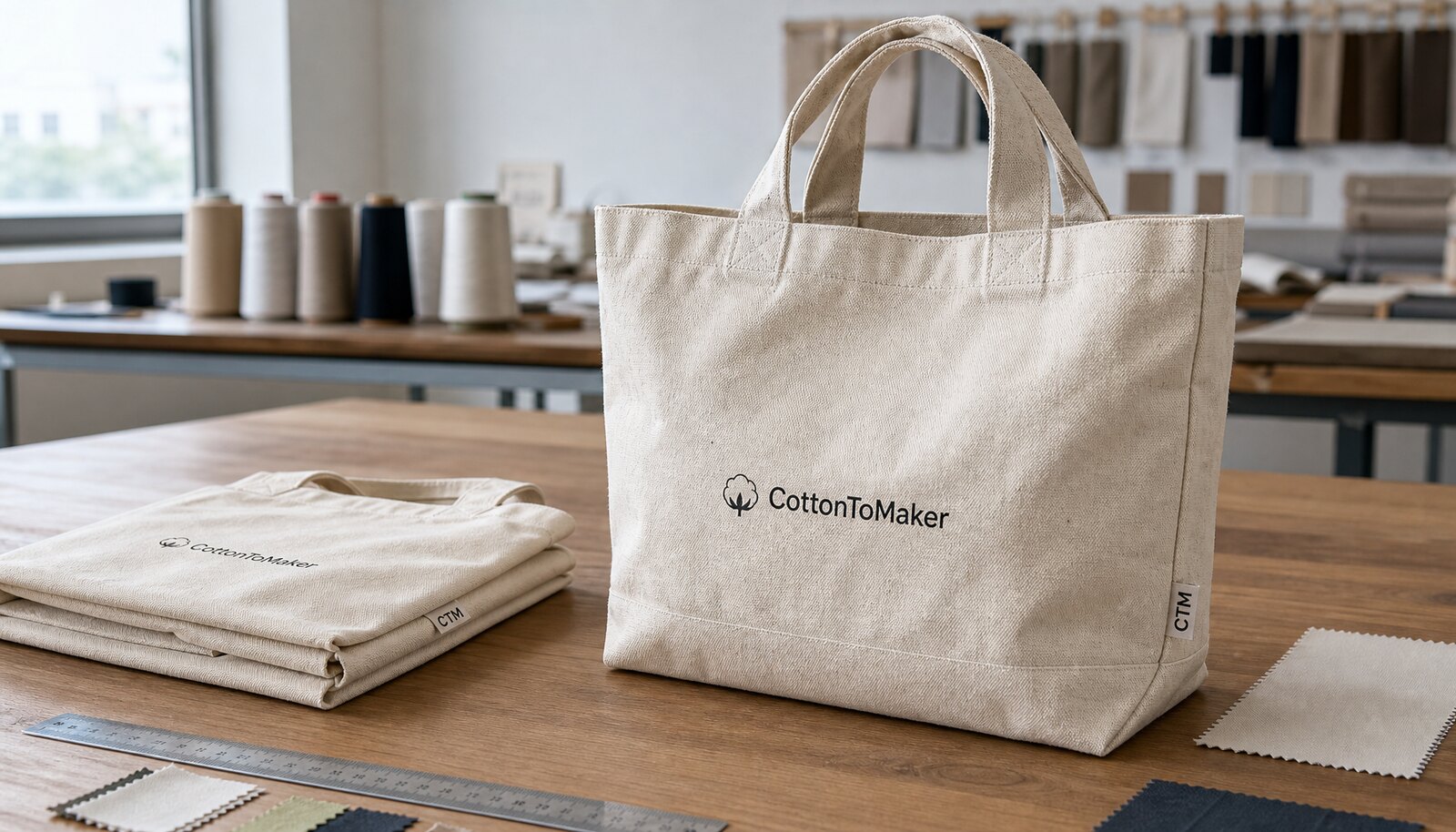
1. The buying risk is not the tote bag itself, but the missing specification
Most canvas tote bag purchasing problems start before the factory cuts the first panel. A buyer asks for a simple canvas tote, several suppliers quote quickly, and the prices look easy to compare. In reality, each quote may be based on a different fabric weight, handle length, seam construction, print method, carton quantity, and packing assumption. The risk is not that canvas totes are difficult to produce. The risk is that the RFQ is too open, so every supplier fills the gaps in its own favor.
For wholesale buyers, the correct purchase-risk checklist should force every supplier to quote the same bag. That means the buyer must define usage, weight loading, fabric GSM, print process, finish, label, packing, and inspection standard before comparing unit prices. If the bag is for a paid retail program, you also need more control over handfeel, color, stitching, and packaging. If the bag is for a short-term event giveaway, cost and delivery speed may matter more, but you still need minimum quality limits.
- Do not ask only for a canvas tote bag price; ask for price against a controlled specification.
- Do not compare natural canvas, dyed canvas, and washed canvas as if they are the same material.
- Do not approve bulk production from artwork only; approve fabric, print, sewing, and packing together.
- Do not treat packing as an afterthought; it changes freight cost, warehouse receiving, and retail presentation.
2. Start with the intended use and loading expectation
A canvas tote used for a conference handout does not need the same construction as a reusable grocery bag or bookstore retail tote. Before fabric weight is selected, procurement should define what the bag is expected to carry. Documents and apparel can use lighter construction. Books, canned goods, wine, and heavy catalogues need stronger fabric, better handle reinforcement, and more careful bottom seam control.
This use case also affects how strict the inspection should be. A promotional tote can tolerate small natural cotton specks, slight slub variation, or minor print variation if the brand accepts that look. A retail tote hanging in a shop cannot. Buyers who skip this decision often receive technically usable bags that still fail commercially because the customer expected a different handfeel or retail appearance.
- Event or promotion: often flat tote, 8 oz to 10 oz canvas, simple screen print, bulk packing.
- Retail merchandise: usually 10 oz to 14 oz canvas, cleaner sewing, better print registration, hangtag or barcode.
- Reusable grocery: often boxed bottom, stronger handle reinforcement, 12 oz to 16 oz canvas depending on load.
- Premium brand packaging: fabric handfeel, shade, label placement, and finishing are as important as strength.
- Heavy contents: request handle pull testing or at least an agreed load test method with sample approval.
3. Fabric GSM and canvas weight: where many quotes stop being comparable
Canvas tote fabric is commonly described in ounces, GSM, or both. A typical wholesale range is 8 oz to 16 oz, with many practical retail and merchandise totes falling around 10 oz to 12 oz, roughly 280 to 340 GSM. Heavy-duty bags may use 14 oz to 16 oz, roughly 400 to 455 GSM. These ranges are examples, not fixed rules, because cotton count, weave density, finishing, dyeing, and washing can change the final handfeel.
The buyer risk is that fabric weight can be quoted loosely. One supplier may quote greige canvas before finishing. Another may quote finished fabric. Another may simply call it 12 oz because it looks close. If the fabric is dyed or washed, shrinkage and finishing can affect both measurement and cost. For a serious wholesale order, request a swatch or cutting from the intended production fabric and ask the supplier to identify weight, composition, color status, and finish on the quotation.
- Ask for both oz and GSM where possible, then keep the same unit across all supplier quotes.
- State whether natural, bleached, dyed, washed, or recycled cotton canvas is required.
- For natural canvas, approve the level of cotton seed specks and shade variation before bulk.
- For dyed canvas, request lab dip approval and confirm colorfastness requirements if the bag may rub against clothing.
- For washed canvas, expect more relaxed handfeel but also more shrinkage control work and possible shade variation.
4. Construction details that decide whether the bag survives real use
A low-priced canvas tote can look acceptable in a photo and still fail at the handle joint after repeated use. Construction should be written into the RFQ, not left to the factory default. The key items are handle width, handle drop, reinforcement pattern, seam type, stitch density, gusset or boxed bottom, and whether inside seams are overlocked, folded, or bound. These are not decorative details; they directly affect strength and perceived quality.
Handle measurement is a common source of mistakes. Some suppliers measure total handle length, while buyers often think in handle drop. A shoulder tote usually needs enough drop for comfortable carrying over a coat, while a short-handled shopping tote may be designed for hand carry. If the purchase order only says long handle, the final product may pass the factory interpretation but fail the buyer use case.
- Specify handle drop, not only total handle length.
- Confirm handle width, usually around 2.5 cm to 3 cm for many standard canvas totes.
- Request cross-stitch, box-stitch, bartack, or another named reinforcement method at handle joints.
- Define flat bottom, gusset, or boxed bottom with drawings and measurements.
- Confirm stitch density and thread color, especially for contrast stitching or premium retail bags.
- Check whether thick 14 oz to 16 oz canvas creates bulky folded seams that need heavier sewing equipment.
5. Print method selection should follow artwork, not supplier habit
For most wholesale canvas tote bags, screen printing is the practical choice for solid logos, simple graphics, and clean brand marks. It gives good opacity on natural canvas when the ink and curing are controlled. Heat transfer can handle gradients, photos, and full-color artwork, but the handfeel, edge durability, and washing performance must be checked. Digital printing may suit lower volumes or complex artwork, while embroidery works better for small premium logos than for large coverage designs.
Printing risk increases when the buyer sends only a JPG and asks the supplier to make it work. The factory needs vector artwork, print size, placement, Pantone references, number of colors, and whether the print must survive washing, rubbing, folding, or retail handling. On heavy canvas, ink coverage and texture can influence the final look. On dark dyed canvas, white underbase and opacity must be discussed before price comparison.
- Screen print: best for solid logos and economical repeat orders; ask for screen charges and color count.
- Heat transfer: useful for gradients or small-batch graphics; check edge feel and long-term adhesion.
- Digital print: flexible for complex designs; confirm color accuracy and canvas texture impact.
- Embroidery: premium appearance for small logos; not ideal for very large filled artwork on lightweight canvas.
- Woven label or side label: good for subtle branding; confirm label size, fold type, position, and sewing method.
- Always approve a print strike-off or pre-production sample before bulk printing.
6. MOQ logic: low quantity is possible, but not always low risk
Many buyers ask for the lowest MOQ first. That is understandable, but canvas tote MOQ is not only a factory policy. It is tied to fabric availability, dyeing minimums, cutting efficiency, print setup, label production, packing style, and production line changeover. A natural canvas tote using stock fabric and one-color screen print can often be produced in a lower quantity than a custom dyed canvas tote with four print designs, woven labels, barcodes, and individual retail packing.
When a supplier offers a very low MOQ, ask what compromises are included. The factory may be using available stock fabric with limited shade control, charging higher print setup cost, accepting wider tolerances, or excluding testing and custom packing. Low MOQ can be a good sourcing tool for market testing, but procurement should make the hidden trade-offs visible before issuing a purchase order.
- Clarify MOQ by fabric color, not only total order quantity.
- Clarify MOQ by print artwork; each design may need separate screens, setup, and inspection.
- Clarify MOQ by label and packing, because custom labels or barcode stickers may have separate minimums.
- Ask whether the supplier can combine colorways in one production run without shade or sewing inconsistency.
- For trial orders, define whether the approved sample can become the standard for repeat bulk orders.
7. Sampling: what to approve before bulk production
A good sample process reduces disputes because it turns a written specification into a physical standard. For canvas tote bags, a photo is not enough. Buyers need to feel fabric weight, check handle drop, examine seam bulk, test print handfeel, and confirm packing presentation. If the order has brand color requirements, a lab dip or print strike-off may be needed before the full pre-production sample.
The most useful approval sample is a pre-production sample made from the correct fabric, correct print method, correct handle construction, correct label, and intended packing. If the factory cannot make the exact sample before bulk because material is not available, the buyer should clearly mark what is approved and what is still pending. Otherwise, both sides may later claim the sample means different things.
- Development sample: checks size and structure, but may use substitute fabric or print.
- Fabric swatch: checks GSM, color, weave, handfeel, and finishing before cutting.
- Print strike-off: checks color, size, opacity, registration, and curing before bulk printing.
- Pre-production sample: final approval standard for fabric, sewing, print, label, and packing.
- Sealed factory sample: kept at the factory for production and inspection reference.
- Buyer retained sample: used by procurement, brand team, or third-party inspector for comparison.
8. Quote data: the information needed to compare suppliers fairly
A useful canvas tote bag quote is more than a unit price. It should state the fabric, dimensions, print method, number of print colors, label details, packing, carton data, lead time, Incoterm, loading port, payment terms, quote validity, and sample charges. Without these details, procurement cannot know whether a lower price is truly better or simply missing cost items.
Ask suppliers to separate one-time charges from unit costs. Screen charges, artwork adjustment, sample cost, custom label setup, testing, special carton marks, palletization, and courier charges may not belong in the unit price, but they affect the total landed cost. For a distributor or retail buyer, carton size and gross weight are also critical because a slightly cheaper bag may create higher freight or warehouse handling cost.
- Fabric: composition, weight, GSM, finish, source status, and color.
- Bag details: dimensions, gusset, handle drop, reinforcement, seam method, tolerance.
- Decoration: print method, artwork size, color count, placement, label or patch.
- Packing: unit packing, inner bundle, master carton quantity, carton dimensions, gross weight.
- Commercial terms: MOQ, unit price, Incoterm, currency, loading port, payment terms, validity.
- Timing: sample lead time, bulk lead time after approval, inspection window, shipping readiness date.
- Extras: screen charge, sample fee, test fee, barcode label, hangtag, desiccant, pallet, document fee.
9. Packing and shipping risks buyers often notice too late
Packing decisions affect cost, product condition, and downstream handling. Bulk packing is economical for event giveaways and many distributor orders. Individual polybags protect each bag and help retail picking, but they add material cost, labor, carton volume, and sometimes sustainability concerns. Paper bands, hangtags, barcode stickers, and carton labels may be required by retail buyers but should be specified early because they change the packing line process.
Canvas absorbs moisture more easily than synthetic bags, so export packing should be practical. Cartons should be strong enough for stacking and long transit. If bags are packed too tightly before ink is fully cured, prints can mark or stick. If cartons are underfilled, bags may move and crease heavily. If carton marks are wrong, warehouse receiving can fail even when the product itself is good.
- Confirm pieces per carton and whether bags are folded once, twice, or flat packed.
- Check whether individual polybags are required or whether bulk packing is acceptable.
- Request carton dimensions and gross weight before confirming sea or air freight estimates.
- Use desiccants or moisture protection when shipping in humid seasons or long ocean routes if required.
- Confirm barcode, SKU, color, size, purchase order number, and carton mark format.
- Avoid packing printed bags before curing and cooling are complete.
10. Lead time, inspection, and acceptance criteria before final payment
A reliable lead-time plan separates each step: artwork confirmation, fabric approval, sample making, sample courier time, lab dip or print strike-off approval, material procurement, printing, sewing, packing, final inspection, and export booking. A quote that says 25 days may sound good, but it may only count bulk production after every approval is complete. For seasonal retail programs or event deadlines, this difference can decide whether the order succeeds.
Acceptance criteria should be agreed before production. Procurement should define critical, major, and minor defects, or use an AQL inspection plan if appropriate. Critical issues include unsafe materials, wrong product, severe print contamination, broken handles, wrong logo, and wrong packing for a compliance shipment. Major issues include visible print defects, uneven handles, open seams, incorrect measurements beyond tolerance, and carton quantity errors. Minor issues may include small thread ends, slight natural cotton specks, or minor creases if accepted by the brand.
- Build approval time into the schedule; buyers often lose more days on internal artwork approval than factories lose on sewing.
- Book final inspection when goods are 100 percent produced and at least 80 percent packed, or follow your company inspection rule.
- Use the approved sample, purchase order, artwork, and packing instruction as inspection reference.
- Define measurement tolerance, print placement tolerance, and acceptable natural fabric variation before inspection.
- Confirm how rework, replacement, discount, or short shipment will be handled if inspection fails.
- Keep payment milestones tied to sample approval, production completion, inspection result, and shipping documents.
Specification comparison for buyers
| Spec decision | Recommended option | When it fits | Buyer risk to check |
|---|---|---|---|
| Fabric weight | 10 oz to 12 oz cotton canvas, roughly 280 to 340 GSM | Retail giveaways, bookstore totes, brand merchandise, light grocery use | Confirm whether the quoted weight is greige fabric, finished fabric, or supplier estimate; ask for GSM test result or cutting sample |
| Heavy-duty fabric | 14 oz to 16 oz canvas, roughly 400 to 455 GSM | Premium retail bags, reusable shopping programs, tools, books, wine and heavier contents | Check sewing machine capability, needle marks, folded seam bulk, carton weight, and higher freight cost |
| Bag structure | Flat tote for low-cost events; boxed bottom for retail and grocery use | Flat shape suits documents and apparel; boxed bottom improves volume and shelf presentation | Do not compare quotes unless width, height, gusset, bottom style, and seam allowance are identical |
| Handle construction | Self-fabric handles, cross-stitch reinforcement, 2.5 cm to 3 cm width | Most wholesale canvas tote orders needing acceptable strength and simple branding | Ask whether handle length is measured total length or drop length; weak bartack position often causes returns |
| Print method | Screen print for solid logos; heat transfer for gradients; embroidery for premium small marks | Brand logos, conference designs, private label retail, lifestyle graphics | Confirm artwork size, print position tolerance, color matching method, curing process, and wash/rub resistance |
| MOQ logic | MOQ based on fabric availability, dyeing need, print setup, and packing style | Buyers comparing stock natural canvas with custom dyed or complex printed bags | A low MOQ may hide stock fabric limits, higher unit cost, mixed shade risk, or no room for production losses |
| Sample approval | Pre-production sample using correct fabric, handle, print, label, and packing | Any repeatable wholesale order where the buyer needs a controlled bulk standard | Photo approval alone is risky for fabric handfeel, shrinkage, color, stitching density, and print thickness |
| Packing | Individual polybag only when needed; otherwise bulk pack with inner bundle and export carton | Retail orders need barcode and unit protection; promotions often need lower-cost bulk packing | Packing can change carton size, freight cost, moisture risk, warehouse handling, and retail compliance |
| Lead time | Separate material lead time, sample lead time, production time, inspection time, and transit buffer | Importers planning launches, events, retail drops, or distributor replenishment | A single lead-time number usually ignores artwork approval, lab dip approval, holiday capacity, and inspection booking |
Buyer checklist before sampling
- Define the intended use: promotion, retail sale, grocery, bookshop, wine, apparel packaging, or corporate merchandise.
- Confirm bag dimensions in width, height, gusset, and handle drop, including acceptable tolerance.
- Specify fabric type: natural cotton canvas, dyed canvas, recycled cotton canvas, organic cotton canvas, or blended canvas.
- State fabric weight in oz and GSM, and request a physical swatch or cutting from actual bulk fabric.
- Confirm whether fabric is pre-shrunk, washed, dyed, bleached, or unbleached.
- Choose print method based on artwork: screen print, digital print, heat transfer, embroidery, woven label, or patch.
- Provide Pantone or brand color references and state the acceptable color tolerance before bulk printing.
- Ask for print size, placement, registration, curing, wash resistance, and rub resistance standards.
- Define handle material, width, length, stitching method, and reinforcement pattern.
- Confirm seam type, stitch density, boxed bottom or flat bottom, and whether inside seams are overlocked or bound.
Factory quote questions to send
- What exact fabric are you quoting, including composition, weave, oz weight, GSM, finish, and whether it is stock or made to order?
- Is the quoted canvas weight measured before or after dyeing, washing, or finishing?
- What is your minimum order quantity by fabric color, print design, label style, and packing method?
- Can you provide a fabric swatch or cutting from the material you plan to use for bulk production?
- What bag dimensions are included in the quote, and what tolerance do you apply after sewing?
- How are the handles constructed, and what reinforcement stitching will be used at the handle joint?
- Which print method are you quoting, and how many colors, screens, or print passes are included?
- Are Pantone color matching, lab dips, strike-offs, or print proofs included in the price?
- What sample types do you offer: development sample, print strike-off, size sample, and pre-production sample?
- How many days are needed for sample making after artwork and material approval?
Quality-control points to confirm
- Fabric GSM and handfeel match the approved sample and purchase order.
- Bag dimensions stay within agreed tolerance after sewing and finishing.
- Canvas shade is consistent within the shipment and acceptable against approved lab dip or swatch.
- Print color, position, size, edge sharpness, and curing match the approved strike-off.
- Handles are centered, equal length, correctly reinforced, and free from twisted construction.
- Stitching is straight, dense enough for the fabric weight, and free from skipped stitches or loose thread ends.
- Seams are secure at stress points, especially handle joints, side seams, and bottom corners.
- Boxed bottom or gusset is symmetrical and matches the ordered capacity.
- Labels, hangtags, barcodes, and carton marks match the buyer instruction sheet.
- Packing quantity per carton, carton strength, and moisture protection are suitable for export handling.