Why the Trim Sheet Controls the Quote
A canvas tote bag private label trim sheet is not a decoration list. It is the buyer's cost and risk control file for every non-body component that affects price, appearance, lead time, and inspection. For a tote bag, the body fabric may be the biggest cost item, but the trim sheet often decides whether two supplier quotes are truly comparable. One factory may include a woven side label, printed care label, hangtag, zipper pull, and individual polybag. Another may quote only the blank bag with one front print. On paper the second quote looks cheaper, but it is not the same product.
Procurement teams should issue the trim sheet before asking for final pricing, not after samples come back. A good trim sheet lets the factory engineer confirm construction, the merchandiser check MOQ, and the buyer compare apples to apples. It also prevents the common bulk problem where the approved sample has one label or packing detail, but the purchase order only describes the canvas tote bag in general terms. If the PO and trim sheet are weak, the supplier may treat missing trims as optional add-ons.
- Use the trim sheet to lock visible branding, functional trims, and retail packing components.
- Separate the base bag specification from private label trims so cost changes are visible.
- Ask suppliers to quote against the same trim sheet revision number.
- Do not approve bulk production from photos only when labels, webbing, zipper pulls, or hangtags are custom.
Define the Base Canvas Before Listing Trims
Private label trims cannot be judged correctly unless the base canvas is fixed. A 10 oz natural canvas tote and a 12 oz dyed canvas tote may use the same logo label, but the finished look, print coverage, seam thickness, and carton weight will differ. Buyers should state fabric weight in ounces and GSM when possible. In export bag production, 10 oz often sits around 280 GSM, 12 oz around 340 GSM, and 14 oz around 400 GSM, but this varies by weave and finishing. Do not assume every factory uses the same conversion.
The trim sheet should reference the fabric condition: natural unbleached, bleached white, dyed color, pigment dyed, enzyme washed, or laminated. Natural canvas has cotton seed flecks and shade variation, which may be acceptable for eco retail brands but not for a clean cosmetic or fashion promotion. Dyed canvas adds lab dip approval and usually raises MOQ. Washed canvas changes shrinkage and hand feel, and may affect print sharpness. These decisions belong in the same sourcing package because they directly affect which trims are suitable.
- Record fabric weight as 10 oz/12 oz/14 oz plus approximate GSM.
- State whether the canvas is natural, bleached, dyed, washed, laminated, or organic if applicable.
- Confirm bag size, gusset size, seam allowance, and shrinkage expectation before approving print placement.
- Ask whether fabric is stock available or needs weaving/dyeing after deposit.
Build the Private Label Trim List by Function
The fastest way to build a practical trim sheet is to group trims by function: brand identification, carrying function, closure function, internal organization, decoration, compliance information, and retail packing. This prevents missing small parts that become expensive later. For example, a buyer may remember the front screen print but forget the woven side label, inside care label, hangtag string, or barcode sticker. Each forgotten item can delay sample approval because a custom label may have its own artwork, mold, yarn, or printing schedule.
For each trim, the sheet should state material, size, color, placement, supplier responsibility, artwork reference, and approval status. If the factory is sourcing the trim, ask for the trim supplier MOQ and lead time. If the buyer is supplying trims, state delivery address, quantity allowance, and cut-off date before bulk sewing. Buyer-supplied trims can reduce brand control risk, but they can also stop production if they arrive late or in the wrong quantity.
- Brand trims: woven side label, inside printed label, care label, logo patch, zipper pull logo, hangtag.
- Functional trims: handle webbing, zipper, magnetic snap, button, drawcord for inner closure, D-ring, key clip.
- Decoration trims: embroidery patch, leather-like patch, contrast binding, contrast stitching, rivet, applique.
- Packing trims: tissue, belly band, barcode sticker, hangtag string, individual polybag, inner carton label.
Specify Logo Application Without Guesswork
Most canvas tote bag private label mistakes happen around logo execution. The RFQ should not say only "print our logo on front." It should state print method, print size, number of colors, Pantone references, placement, print hand feel, and expected durability. Screen print is usually the most stable option for solid spot-color logos on cotton canvas. It has good coverage and predictable cost when artwork is simple. For multicolor graphics, heat transfer or digital print may be considered, but the buyer should test edge sharpness, rubbing, cracking, and film visibility on the chosen canvas weight.
Logo placement also needs engineering details. If the tote has a gusset, the flat panel center may not be the same as the visual center after the bag opens. If the bag has a pocket, zipper, or handle reinforcement, the logo may need to shift. The trim sheet should include a technical placement drawing with measurements from top seam, side seam, and bottom fold. A tolerance such as plus or minus 5 mm is more useful than a vague instruction like "centered."
- Provide vector artwork in AI, PDF, or EPS when possible, plus a JPG for visual reference.
- State logo width and height in millimeters, not only percentage of bag size.
- Use Pantone references for solid color print, and approve a strike-off before bulk printing.
- Define whether print is allowed over seam thickness, pocket layers, or folded gusset areas.
- For natural canvas, accept that cotton flecks can show through light ink unless heavier ink coverage is specified.
Control Labels, Patches, and Care Information
A private label canvas tote often carries more than one label. A woven side label may show the brand externally, an inside label may show material composition, and a hangtag may carry retail storytelling or barcode information. These items look small, but they can create quote gaps. Woven labels have yarn color limits, cut-and-fold methods, minimum quantities, and sample charges. Printed cotton labels may be cheaper and softer, but small text can blur after washing or rubbing.
The trim sheet should show label artwork at actual size and specify fold type. Common options include center fold, end fold, Manhattan fold, or straight cut. Placement must be defined clearly: side seam, top seam, inside back panel, pocket seam, or handle base. If the label is inserted into a seam, the factory must receive it before that sewing operation. Late label approval may force the factory to hold cut panels or resew finished bags, which creates cost and quality risk.
- State label type: woven polyester, printed cotton, printed satin, recycled polyester, cork, paper, or leather-like patch.
- Record finished label size and unfolded size separately.
- Specify fold direction, visible face, stitch color, and distance from the top edge or side seam.
- Check spelling, logo proportion, country of origin wording, fiber content, and care symbols before ordering label bulk.
- Ask whether label overage is required because trim suppliers may ship short or damaged pieces.
Handles, Webbing, and Reinforcement Details
Handles are both a trim and a performance part. A buyer may choose self-fabric handles for a clean retail look or cotton webbing handles for strength and production efficiency. Webbing width commonly ranges from 2.5 cm to 3.8 cm, with heavier styles used for grocery, bookshop, or utility totes. The trim sheet should state handle length as total cut length or finished drop length, because these are not the same. A 60 cm handle may produce a different shoulder drop depending on seam allowance and attachment style.
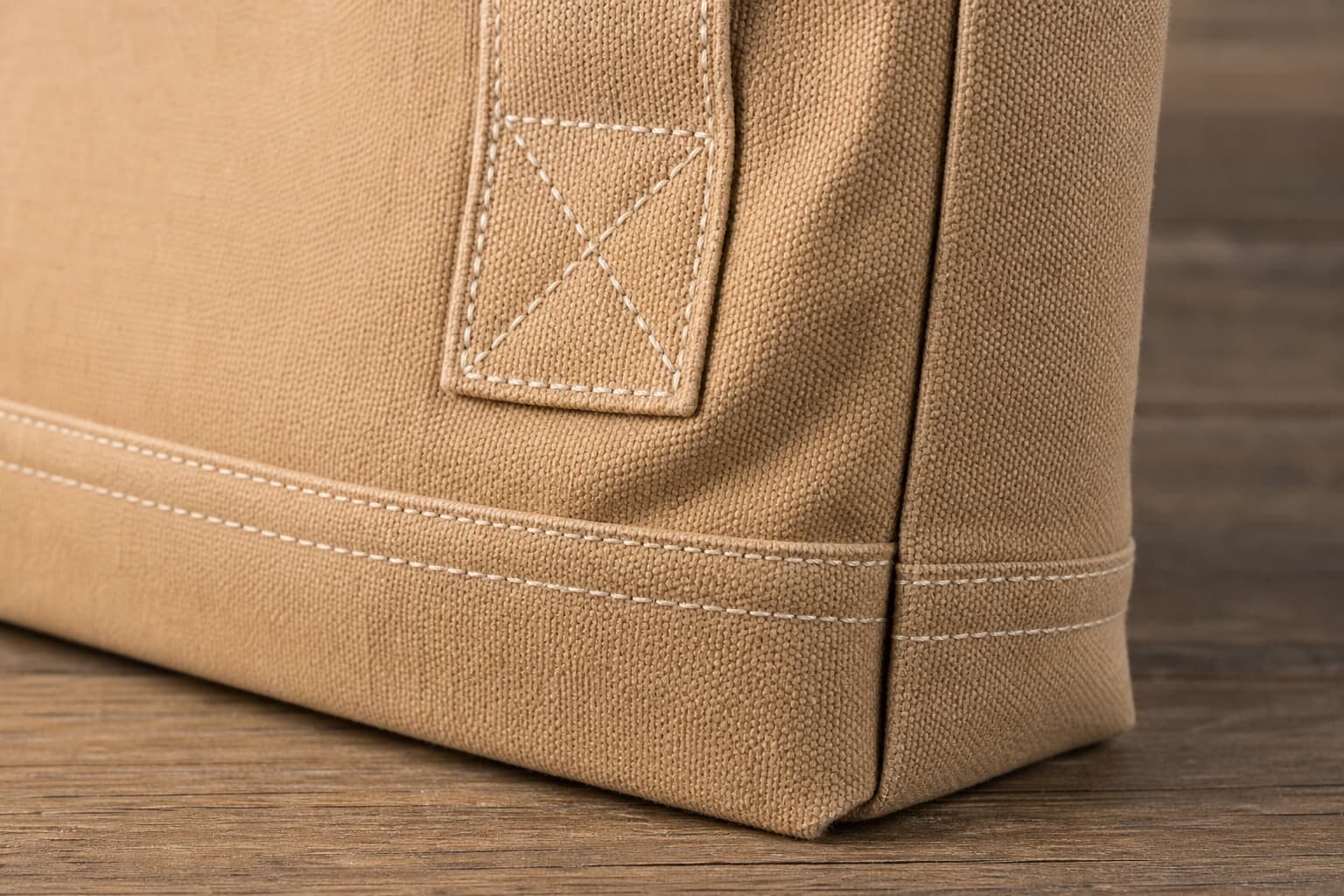
Reinforcement stitching should be specified because it changes labor time and load performance. X-box stitching, bar tack reinforcement, double row stitching, or hidden reinforcement tape may all be quoted differently. For heavier 14 oz or 16 oz canvas, the factory must choose suitable needles, thread, and stitch density to avoid skipped stitches or needle holes. If the bag is expected to carry laptops, books, wine bottles, or grocery weight, the RFQ should state a target load for sample testing rather than assuming a standard tote construction is enough.
- Define handle material: self-fabric canvas, cotton webbing, polyester webbing, jute webbing, or blended tape.
- Specify handle width, thickness or GSM, finished drop, and color match requirement.
- State reinforcement style: X-box, cross stitch, bar tack, double row, or hidden tape.
- Ask for load test method and failure point on the approved sample.
- Check whether handle ends are folded, raw, bound, or heat sealed for synthetic webbing.
Closures, Pockets, and Interior Trim Decisions
Not every canvas tote needs a closure, but if a closure is required it must be treated as a costed trim item. A zipper top adds security and retail value, but it increases sewing time and can change the opening width. A magnetic snap is cleaner and faster, but it may not suit airport, electronics, or child product channels without additional checks. Button-and-loop closures can fit natural brand styling but must be tested for repeated use and alignment after the bag is loaded.
Interior pockets also need trim decisions. A slip pocket may use self-fabric, lining fabric, binding tape, zipper, or hook-and-loop closure. If the buyer wants a phone pocket, card pocket, or bottle sleeve, the trim sheet should include pocket size, placement, fabric weight, opening reinforcement, and whether it affects the front logo position. Many quote disputes happen when the buyer's reference sample has a pocket but the written RFQ does not describe it fully.
- For zipper closures, specify zipper type, tape color, teeth color, slider finish, puller shape, and opening length.
- For snaps, specify magnetic snap size, finish, corrosion resistance expectation, and backing reinforcement.
- For pockets, define finished size, opening direction, stitch pattern, and whether pocket fabric matches the main canvas.
- Check whether metal trims require needle detection, anti-rust packing, or separate testing for the sales market.
- Confirm closures on the pre-production sample before bulk cutting because panel dimensions may need adjustment.
MOQ Logic for Trims and Private Label Parts
A realistic RFQ separates the MOQ of the bag from the MOQ of each custom trim. The sewing factory may accept 500 or 1,000 tote bags, but a woven label supplier may require 3,000 or 5,000 labels. A custom zipper color may need a dye lot MOQ. Dyed canvas may require a fabric mill MOQ that is higher than the buyer's launch order. If these quantities are not discussed early, the buyer may receive a unit price that assumes leftover trims, shared stock parts, or later surcharge.
Procurement teams should ask the factory to show MOQ logic instead of only one final number. A first order may use stock natural canvas, stock cotton webbing, and custom screen print to keep MOQ manageable. A mature reorder may switch to dyed canvas, woven label, custom hangtag, and retail barcode packing. This staged approach lets brand owners validate demand without overbuying custom materials that cannot be reused.
- Base bag MOQ may depend on cutting efficiency, fabric availability, and sewing line setup.
- Fabric MOQ may change if color dyed, washed, coated, or custom woven.
- Print MOQ is affected by screen setup, number of colors, and artwork changes by SKU.
- Woven label MOQ may exceed bag MOQ; decide whether to hold extra labels for reorders.
- Packing MOQ can apply to custom hangtags, belly bands, printed polybags, and retail cartons.
Sample Approval Workflow That Prevents Bulk Errors
A private label canvas tote should not move from first sample directly to bulk production unless the trim sheet is simple and all trims are stock. A better workflow uses a proto sample to check construction, a trim approval set to check labels and packing parts, and a pre-production sample to seal the final standard. The pre-production sample should be made with the correct fabric weight, approved print method, final label type, correct handle trim, and actual packing if possible.
Buyers should request physical trim cards for custom components. A trim card attaches the approved fabric swatch, webbing, thread, zipper, label, snap, hangtag, and packing material to one approval board or file. Photos are useful for communication, but they do not show true fabric weight, print hand feel, zipper smoothness, or label edge quality. Once approved, the trim card becomes the reference for incoming material inspection before bulk sewing.
- Proto sample: checks bag size, fabric hand feel, handle drop, and general construction.
- Print strike-off: checks logo color, coverage, edge sharpness, and curing on actual canvas.
- Trim card: checks physical labels, webbing, thread, zipper, snap, hangtag, and packing materials.
- Pre-production sample: confirms all approved trims assembled in the correct finished bag.
- Sealed sample: kept by buyer, factory, and inspector when possible to reduce interpretation gaps.
Packing, Carton, and Retail Readiness Details
Packing is often treated as an afterthought, but for distributors and retail buyers it is part of the private label product. A canvas tote may be shipped flat, folded once, folded into a belly band, inserted into an individual polybag, or bulk packed without individual bags. Each method affects carton size, freight cost, crease marks, barcode access, and shelf handling. Heavy canvas folded too tightly can hold creases, especially if the bags remain compressed during ocean freight.
The trim sheet should define the retail presentation and carton standard. If a barcode sticker is required, state the barcode type, sticker size, placement, and whether the factory must scan test it. If hangtags are attached, specify string material, attachment point, and whether the tag should face the front logo. For importers shipping to multiple distributors, carton marks and inner pack counts should be written clearly so warehouse teams do not need to open cartons to identify SKUs.
- State folded size or flat pack method, not only "standard export packing."
- Define individual polybag thickness if used and confirm suffocation warning requirements by market.
- Specify inner quantity, master carton quantity, carton dimensions target, and maximum gross weight.
- Provide carton mark artwork with SKU, color, quantity, PO number, and destination if required.
- Ask for packed carton photos and one carton drop check if the order will travel through mixed handling.
Specification comparison for buyers
| Spec decision | Recommended option | When it fits | Buyer risk to check |
|---|---|---|---|
| Main fabric weight | 10 oz to 12 oz cotton canvas, or 280-340 GSM equivalent | Retail giveaway, bookstore tote, brand merchandise, light daily carry | Confirm whether supplier quotes ounces per square yard or GSM; two factories may describe the same fabric differently |
| Heavy-duty fabric option | 14 oz to 16 oz canvas with reinforced seams | Premium retail tote, grocery bag, conference kit with heavier contents | Higher fabric weight increases cost, shipping weight, needle marks, and minimum cutting quantity |
| Front logo print | Screen print for solid spot colors | Simple private label logo, repeat orders, strong color coverage | Ask for print size, Pantone, ink type, curing method, and acceptable color tolerance on natural canvas |
| Detailed artwork | Heat transfer or digital print after sample testing | Gradient artwork, small text, multicolor brand graphics | Check hand feel, wash/rub resistance, edge cracking, and whether transfer film is visible on coarse canvas |
| Brand label | Woven side seam label or inside care label | Retail private label orders where branding must remain visible after use | Define label size, fold type, stitch position, and whether label cost is included in unit price |
| Handle trim | Self-fabric handle or cotton webbing handle, 2.5-3.8 cm width | Self-fabric for matching look; webbing for stronger utility bag | Handle length, webbing GSM, and reinforcement stitch pattern change both cost and load performance |
| Closure trim | Magnetic snap, zipper, or no closure depending on channel | Retail tote may need zipper; low-cost promotion usually has no closure | Closure adds sewing time, metal detection concerns, and packing deformation if not specified |
| Packing trim | Hangtag, barcode sticker, tissue, belly band, or individual polybag | Retail and distributor orders needing scan-ready cartons | Many quote gaps come from hangtag string, barcode application, inner pack count, and carton mark requirements |
Buyer checklist before sampling
- List every visible private label part: main print, woven label, care label, hangtag, barcode sticker, zipper pull, snap button, webbing tape, and retail packing item.
- State main fabric in both ounces and GSM where possible, and confirm whether the fabric is greige, dyed, bleached, washed, or unwashed natural canvas.
- Attach artwork files with exact print size, Pantone references, placement distance from seams, and whether the logo must align to bag center or panel center.
- Define handle length, handle width, fabric or webbing material, reinforcement stitch style, and expected carrying load instead of only saying standard handles.
- Separate sample requirements from bulk requirements: proto sample, pre-production sample, trim approval sample, and sealed production sample.
- Ask the factory to itemize trim costs that are not included in the base bag price, especially woven labels, hangtags, zippers, snaps, and retail barcode work.
- Confirm MOQ for the bag body, fabric dyeing, printed artwork, woven labels, zipper color, and custom carton or retail packing separately.
- Include packing method: folded or flat, individual polybag or bulk pack, inner carton quantity, master carton size limit, carton mark layout, and pallet requirement if any.
- Set acceptance criteria for print color, label position, seam strength, loose threads, shade variation, packing count, and barcode scanability before bulk production starts.
- Require the quote to show lead time by stage: material booking, trim development, sample approval, bulk cutting, printing, sewing, final inspection, and shipment handover.
Factory quote questions to send
- Which fabric construction are you quoting: yarn count, weave, GSM, and ounce weight before or after washing?
- Is the quoted canvas in stock, made to order, dyed to order, or purchased after deposit?
- What is the MOQ for the canvas color, printed logo, woven side label, care label, zipper color, and hangtag separately?
- Can you provide a trim card with physical fabric, webbing, label, zipper, snap, thread, and packing materials attached for approval?
- Which print method are you quoting, and what are the setup charges, film charges, color limits, and production tolerance?
- Is the woven label included in the unit price, or quoted as a separate trim with its own MOQ and sample lead time?
- What handle reinforcement stitch is included, and what carrying load has been tested on a similar bag construction?
- How many days are required for proto sample, revised sample, pre-production sample, and bulk production after final approval?
- What packing is included in the quote: individual polybag, hangtag attachment, barcode sticker, inner carton, master carton, and carton marks?
- What documents will be supplied before shipment: packing list, carton measurements, final inspection photos, material composition statement, or test reports if requested?
Quality-control points to confirm
- Check fabric weight by cutting and weighing a measured sample area, not only by reading the supplier's purchase record.
- Compare bulk fabric shade against the approved swatch under consistent light before cutting starts.
- Measure logo placement from fixed seam references and record tolerance in millimeters, especially on gusseted bags.
- Rub test the print on natural and dyed canvas because coarse yarns can reduce ink coverage at high points.
- Inspect woven label position, fold direction, spelling, stitching capture, and frayed edges before approving bulk sewing.
- Pull test handles and reinforcement stitches using the intended load level plus a safety margin agreed in the RFQ.
- Check zipper opening smoothness, snap alignment, and metal trim finish if closures are part of the private label design.
- Verify individual packing, barcode scanability, carton count, carton mark layout, and carton weight before shipment release.