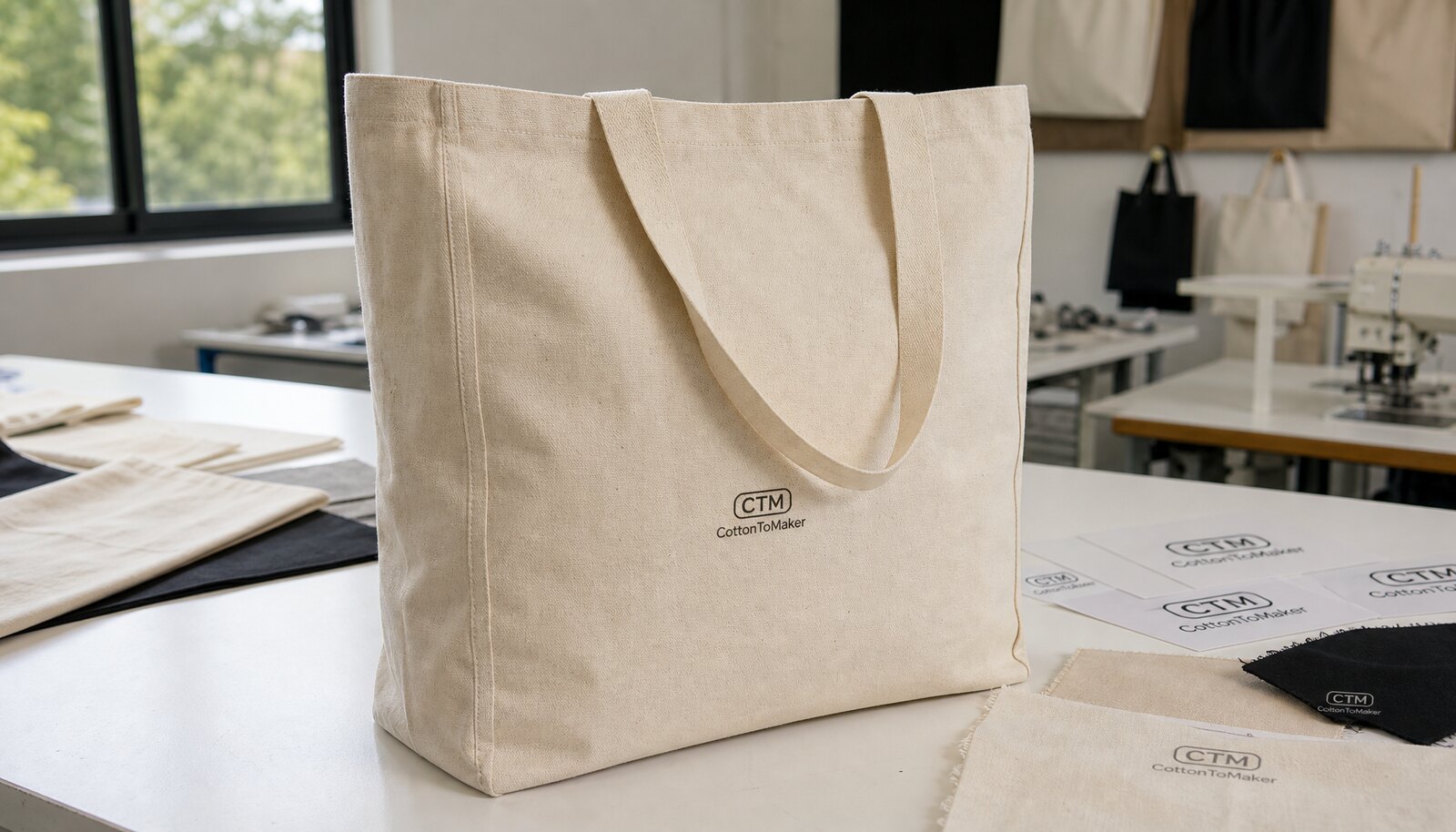
Start with the buying decision, not the artwork
Canvas tote bag printing is often treated like a simple decoration job. For procurement, it is a finished-product purchase with a bag body, a print process, a packing standard, and a supply route. If the RFQ only says "canvas tote with logo," the supplier will fill in the blanks with its own default. That is how quotes become impossible to compare and why the first production lot sometimes arrives lighter, smaller, or less durable than expected.
A better buying sequence starts with use case. A branded resale tote, a bookstore bag, and a conference giveaway all need different economics. The retail tote needs stronger hand feel, tighter color control, and better packing presentation. The event giveaway can tolerate a simpler build if the unit price stays aggressive. Once the use case is fixed, the rest of the spec becomes easier to write and easier to defend internally.
- Define the end use before you ask for price.
- Treat the bag body, print method, and packing standard as separate buying decisions.
- Use the first RFQ to force supplier assumptions into writing.
Choose the tote structure by use case and sell-through risk
Canvas weight is the first commercial decision because it drives both perception and carry performance. For many B2B programs, 240-280 GSM is the lower-cost band for short-life giveaways. 280-340 GSM is a common middle ground for general promotion. 340-420 GSM works better for retail shelves, repeat use, and a more premium feel. Above that, the tote starts behaving like a structured product, which usually means tighter sewing control, more careful packing, and a higher unit price.
Finish matters as much as weight. Raw canvas gives a natural, rugged look, but the shade and absorbency can vary more from lot to lot. Bleached or dyed canvas gives a more controlled print base. Pre-shrunk or enzyme-washed canvas can reduce dimensional movement after production, but it can also change how the ink or transfer sits on the cloth. If the supplier cannot state the finish clearly, the sample is not enough to predict bulk behavior.
Construction details should be explicit in the spec sheet. A gusset changes usable volume. Webbing handles change comfort and cost. A lining, pocket, baseboard, or reinforced seam changes the quality tier and the failure points. For procurement, the important point is not whether the tote is "nice." It is whether the construction matches the intended load and the perceived value of the program.
- Ask for GSM or ounce weight, not a vague phrase like "heavy canvas."
- Match finish to the print path: raw for rustic branding, bleached or dyed for cleaner color control, pre-shrunk when dimensional stability matters.
- List gusset, lining, pocket, base insert, and handle construction so the quote reflects the real product.
Match the print method to the artwork and the reorder pattern
Screen printing remains the default route for many canvas tote bag printing programs because it is durable and economical for simple logos. For one to three spot colors, especially on natural canvas, it often gives the best balance of cost, opacity, and repeatability. The tradeoff is setup. Every color adds registration risk and more opportunity for operator variation, so complexity should be justified by the brand need, not by habit.
Transfer methods, including DTF or comparable systems, are useful for multicolor art, variable names, or shorter runs where screen setup would be too expensive. They make it easier to change artwork, but they shift the risk to cure quality, edge lift, and feel on textured canvas. The right method is not the one a supplier prefers. It is the one that fits the artwork, volume, and durability requirement you actually need.
For repeat programs, the real issue is not whether a method can make one good sample. It is whether the same result can be repeated on the next batch and the batch after that. If the design will be reordered, favor a method and a factory setup that can lock in the same color logic, placement, and cure conditions over time.
- Use screen print for bold logos, flat colors, and stable repeat orders.
- Use transfer methods for complex art or short runs, but require physical proof on the exact canvas.
- Do not pay for a complex print path if the artwork will change every season.
Shortlist suppliers by factory type and capability tier
Not all suppliers are the same, and procurement gets better leverage when the supplier type is matched to the job. A direct bag factory is usually the strongest option when the tote structure, print placement, and repeat consistency matter. That factory type is best when you want one owner for cutting, sewing, and packing, and when you can accept a cleaner but more disciplined buying process. A local decorator working with imported blanks is useful when speed matters more than exact bag construction, but then the blank tote becomes the hidden variable.
Trading companies and sourcing agents can help when the order mixes bag styles, trims, or other categories. They reduce coordination burden, but they also add an extra layer between the buyer and the actual process owner. That is fine only if the agent can identify the real factory, explain who prints and who inspects, and write down who is accountable for each step. If that is unclear, the route is not procurement-ready.
Region also matters, but not as a stereotype. In lower-cost sourcing regions, you may find both capable factories and thin-process workshops. The difference is usually capability tier, not geography alone. Buyers should distinguish between a sewing-led factory that outsources printing, a full-service factory that controls more of the process, and a trading setup that assembles parts of the supply chain. These are different risk profiles and should not be priced as if they were the same.
- Use a direct factory when the tote spec is fixed and replenishment is likely.
- Use a local decorator when speed matters and blank quality has been checked already.
- Use a trading company only if it can identify the actual process owner and write responsibility into the order.
Write the RFQ so quotes are truly comparable
A usable RFQ makes the supplier price the same article you intend to buy. That means finished size, fabric weight, handle construction, print area, number of colors, packing format, carton count, and delivery terms. If any of those are missing, the supplier will substitute its own standard and the price will look better than it really is. A quote is only useful when it survives line-by-line comparison.
The strongest RFQs separate the cost drivers instead of hiding them in one unit price. Ask for the bag body, print setup, sample charges, packaging, carton, and any label or insert cost as separate lines. This matters because a tote quote can look cheap for the wrong reason: a lighter canvas body, a smaller print area, a less protective packout, or a simplified color method. The buyer should also state the artwork file version and the approved Pantone reference so color expectations are not renegotiated after award.
A good RFQ also gives the supplier a chance to reject unworkable specs before the quote is issued. If the artwork has very fine details, ask the supplier to confirm the smallest printable line width. If the tote is unusually large or the print is oversized, ask whether the factory can keep the placement centered through bulk production. This is not administrative overhead. It is quote hygiene.
- Require the supplier to restate the full spec before quoting.
- Keep artwork, size, and packing identical across every supplier in the bid set.
- Separate setup, sample, bag-body, and packing charges so the total cost is visible.
Use samples as a gate, not as a courtesy
The sample stage should remove ambiguity before bulk production starts. A printed tote sample needs to confirm more than color. It should confirm bag dimensions, handle balance, seam alignment, print placement, cure quality, and how the canvas behaves after handling. If the print is slightly off-center, the handles twist, or the ink feels brittle, the sample is already telling you where the bulk risk sits.
For color-sensitive programs, a digital proof is only a layout tool. It does not show how the artwork will look on real canvas or how the ink or transfer behaves after curing. Ask for a physical strike-off on the actual fabric and keep a signed approval sample if the order is meaningful. If the factory cannot produce a sample that matches the bulk process, approval should stop there.
Approval language should be precise but practical. Identify which sample was accepted, which artwork version it represents, which fabric lot or fabric spec it reflects, and what cannot change without reapproval. That is better than broad language like "sample approved," which gives little protection if the bulk result drifts.
- Approve the bag body and the print as separate checkpoints when the process allows it.
- Check the actual print placement against a placement map, not against memory.
- Do not approve a sample with vague language if the order is brand-critical.
Set QC thresholds that are defensible and calibrated
Procurement QC for canvas tote bag printing should be measurable, but it should also be realistic. Overly exact numbers without context create false confidence. The right approach is to tie each threshold to the approved sample, the print method, and the end use. For example, a placement check should reference the signed placement map. Rub and wash performance should reference the supplier's method and the expected consumer treatment. Seam performance should reference the tote's intended load, not a generic test from another product.
The useful question is not whether the factory can say "pass." The useful question is what it is passing against. Ask for the method, the result, and the basis of comparison. If the supplier uses an internal standard, ask to see it. If the factory has a historical standard for the same bag family, ask whether the current batch is aligned to that standard or a special buyer requirement. This reduces the risk of importing invented thresholds that sound precise but are not operationally meaningful.
If a buyer needs a numeric starting point, use it as a calibration point, not a universal law. Placement can be kept tight on centered logos and slightly looser on large graphics. Rub and wash should be set against the selected print method. Seam checks should be done against the intended use case. The purpose is to prevent avoidable defects, not to create a lab report that no factory can actually replicate.
- Write placement, rub, wash, and seam controls before production starts.
- Ask for the test method and the numeric result, not just a pass/fail note.
- Tie the seam check to the tote's intended working load and use case.
Compare landed cost by scenario, not by factory price alone
The unit price for a printed tote is only one part of landed cost. Fabric weight, print setup, packing, carton volume, freight density, duties, and the cost of any rejects all change the real number. A heavier tote can raise the factory price but reduce complaints and improve retail acceptance. A lighter tote can look cheaper on paper and still cost more once rework, replacement, or customer dissatisfaction is included.
A useful landed-cost review starts with a simple comparison model. The table below is not a universal pricing formula; it is a buyer's way to see which variables move the final number.
| Cost driver | What it changes | Buyer takeaway | | --- | --- | --- | | Fabric GSM | Base material cost, hand feel, weight, and freight density | A higher GSM usually raises FOB price and freight per carton, but may lower rejection and improve perceived value | | Print method | Setup, durability, and artwork flexibility | Screen print is often best for simple repeats; transfer methods can raise variability if cure control is weak | | Packing format | Carton fill, damage risk, and receiving labor | Individual polybags or inserts can protect print but increase packaging and freight volume | | Freight mode | Transit time, carton density, and handling risk | Air is faster but punishes volume; sea is cheaper but requires better lead-time planning | | Duties and inland transport | True landed cost to warehouse | Two quotes with the same factory price can land very differently depending on origin and delivery term | | Quality loss rate | Rework, replacement, and admin cost | A slightly higher unit price may be cheaper if the factory consistently ships fewer defects |
A worked example makes the point clearer. Suppose a buyer is comparing 10,000 printed totes with the same logo and finished size. Factory A quotes a lighter canvas, a lower setup charge, and cheaper FOB price. Factory B quotes a heavier canvas, more controlled print, and better packing. On the invoice, Factory A looks cheaper. On landed cost, Factory B may be close or even lower if fewer units are damaged, carton density is better, and the buyer does not need to sort, relabel, or replace weak bags. The lesson is simple: compare the complete shipment, not the catalog price.
The best procurement habit is to normalize all quotes to the same basis before judgment. Use the same currency, the same Incoterm, the same carton count, the same packing format, and the same freight assumption. Then add a line for expected quality loss, even if it is only a conservative internal estimate. That is the only way to compare the business result instead of the supplier headline.
- Compare quotes on identical size, GSM, artwork, and packing assumptions.
- Add freight volume and carton count before choosing the cheapest offer.
- Include a quality-loss assumption for brand-sensitive orders.
Protect the print through packing, transit, and reorders
Packing can undo good printing if it is not controlled. Fresh or insufficiently cured ink can offset when bags are stacked tightly, and printed faces can scuff during transit. Buyers should specify whether bags ship flat, single-fold, double-fold, or individually polybagged. The right choice depends on the print method, the retail presentation standard, and how much post-arrival handling the warehouse can absorb. The cheapest fold is not always the cheapest program if it causes handling damage.
Carton details matter because they affect both protection and receiving efficiency. Define carton count, carton dimensions if known, outer carton marks, barcode label location, and whether the factory must use dividers or internal protection. If the order includes insert cards or hangtags, specify placement and orientation. This prevents mismatch at receipt and reduces repacking work later. The same logic applies to reorders: if the first order is packed one way and the reorder arrives another way, the warehouse cost can jump even when the unit price stays flat.
For recurring programs, keep one approved master sample, one artwork version, and one packing standard. That makes the reorder easier to release and easier to inspect. If the supplier wants to change fabric source, ink type, or packing style, ask for a controlled deviation request. The point is not to make procurement rigid. It is to stop small changes from becoming silent quality drift.
- Specify the fold style and whether printed faces may contact each other in transit.
- Set carton count and carton marks in the PO so receiving matches the paperwork.
- Require a packing check for print transfer after stacking and movement.
Specification comparison for buyers
| Buyer scenario | Best route / print path | Cost and lead-time tradeoff | What to verify before award |
|---|---|---|---|
| Retail merch or branded resale | Direct factory with in-house cutting, sewing, and screen printing | Best repeat consistency and color control; setup takes longer, but reorders are easier to stabilize | Confirm the factory owns sewing and printing, keeps a golden sample, and can repeat the same fabric lot or an approved substitute |
| Conference giveaway or short campaign | Blank tote plus local decoration, or a low-MOQ factory with transfer print | Fast launch and lower setup friction, but fabric weight and decoration durability can vary | Check blank GSM, handle construction, print durability, and who is actually responsible for decoration |
| Seasonal art with full-color graphics | Factory with DTF or transfer capability on the exact canvas finish you plan to buy | Lower setup cost for multicolor art and easier artwork changes, but more cure and edge-lift risk | Ask for a physical strike-off on the final fabric, plus rub and wash evidence on the same method |
| Premium tote with structure | Heavier canvas from a bag factory with controlled sewing and screened branding | Higher unit cost and longer sewing lead time, but better shelf presence and load retention | Verify GSM, seam reinforcement, handle attachment, carton protection, and whether the tote holds shape after packing |
| Multi-SKU or multi-component program | Trading company or sourcing agent coordinating bag and print vendors | Simplifies admin across products, but margin, ownership, and accountability can become opaque | Request the actual factory identity, process owner, and written responsibility for bag, print, packing, and QC |
| Stable repeat program | Direct factory with locked artwork and one approved master sample | Best unit economics over time if the spec stays frozen; the first approval cycle matters more than the lowest quote | Lock the artwork file, color target, placement map, packing format, and carton marks before first production |
Buyer checklist before sampling
- Define the use case first: retail resale, corporate gifting, event giveaway, bookstore merchandising, or grocery carry. The working load, visual standard, and acceptable defect rate are not the same.
- Set the finished size, gusset depth, handle width, handle drop, and print area before asking for quotes. Suppliers will otherwise price their own standard bag.
- Choose a fabric target by use case. A practical starting range is roughly 240-280 GSM for low-cost giveaways, 280-340 GSM for general promo, 340-420 GSM for retail use, and 420 GSM+ for structured premium totes.
- State the fabric finish clearly: raw, bleached, dyed, enzyme washed, or pre-shrunk. Finish affects shrinkage, hand feel, and how the print sits on the cloth.
- Provide vector artwork, number of colors, Pantone targets, and a minimum line-width rule. If the art is too fine for the process, the supplier will simplify it.
- Specify the print placement, but also specify a placement tolerance so the factory knows what is acceptable.
- Ask the supplier to restate the full spec in writing before quoting. That is the fastest way to catch missing assumptions.
- Require a physical sample or strike-off for color-sensitive orders, and a pre-production sample before bulk release when the order matters to the brand.
- Separate quote line items for bag body, print setup, sample cost, packaging, and carton charges so hidden costs do not disappear into a single unit price.
- Compare all quotes on the same Incoterms, currency, carton count, and packing format, or the numbers are not comparable.
Factory quote questions to send
- What is the exact finished specification in your quote, including size, gusset, handle length, handle width, seam type, and fabric GSM or ounce weight?
- Is the canvas raw, bleached, dyed, enzyme washed, or pre-shrunk, and what shrinkage range should we expect after curing or washing?
- Which print method are you quoting, how many colors are included, and what setup charges apply for screens, plates, films, or transfers?
- Is printing done in-house or subcontracted, and can you show a photo or short video of the print line, curing area, and inspection station?
- What is the minimum order quantity per color, per design, and per size, and can multiple colors share the same print setup?
- What is the exact artwork file format you need, who approves the final color target, and do you keep a signed master sample or golden sample?
- What packing format is included: flat, single-fold, double-fold, individual polybag, insert card, barcode sticker, or bulk packed by count?
- What are the sample charges for a development sample, strike-off, and pre-production sample, and are any charges refundable against bulk?
- What checks do you use for rub, wash, placement, seam integrity, and carton count, and can you share the actual method or acceptance basis rather than only a pass/fail note?
- What is the bulk lead time after sample approval, what are the main delay risks, and what process changes would trigger a new approval?
Quality-control points to confirm
- Finished size should stay close to the approved sample and spec sheet. For most buyer programs, a practical tolerance is about +/-5 mm on height and width, with handle length and symmetry checked against the approved master sample rather than a universal number.
- Logo or artwork placement should be checked against a placement map. A common procurement control is tighter tolerance for centered logos and a wider tolerance for large full-front prints, but the actual limit should be agreed with the supplier based on the print method and bag size.
- Dry rub and wet rub should be set against the print method and end use, not copied from another product. Ask the supplier what method they use, what result they achieve on this canvas, and what result they can repeat in bulk.
- Wash testing should be tied to the consumer scenario. If the tote is expected to be washed, require a small pilot test on the actual print and fabric. If it is not intended for washing, focus more on scuff resistance, edge lift, and color transfer during packing.
- Handle attachment and side seams should be checked against the tote's intended working load and the approved sample. A static load test is useful, but the acceptance basis should be the agreed use case and the supplier's established bag standard rather than a generic universal number.
- Fabric GSM should stay close to the approved target, because a lighter substitute changes hand feel, print behavior, and carry performance. The exact tolerance should be negotiated around the approved sample and confirmed by a test method the factory can repeat.
- Ink coverage should be even with no pinholes, ghosting, major bleed, or visible edge lift. The acceptable visual standard should be judged against a signed master sample or approved strike-off.
- Packed goods should show no print-to-print transfer, fold mark damage, or carton crush. The packing check should be done after the factory's normal fold and carton method, not on a special hand-packed sample.
- Carton count, barcode labels, and outer carton marks should match the purchase order exactly. For retail programs, miscounts are a receiving problem, not a minor factory issue.
- Any QC threshold that sounds too exact to be realistic should be tied to the supplier's method, the approved sample, and the commercial consequence of failure. If it cannot be explained in those terms, recalibrate it before award.