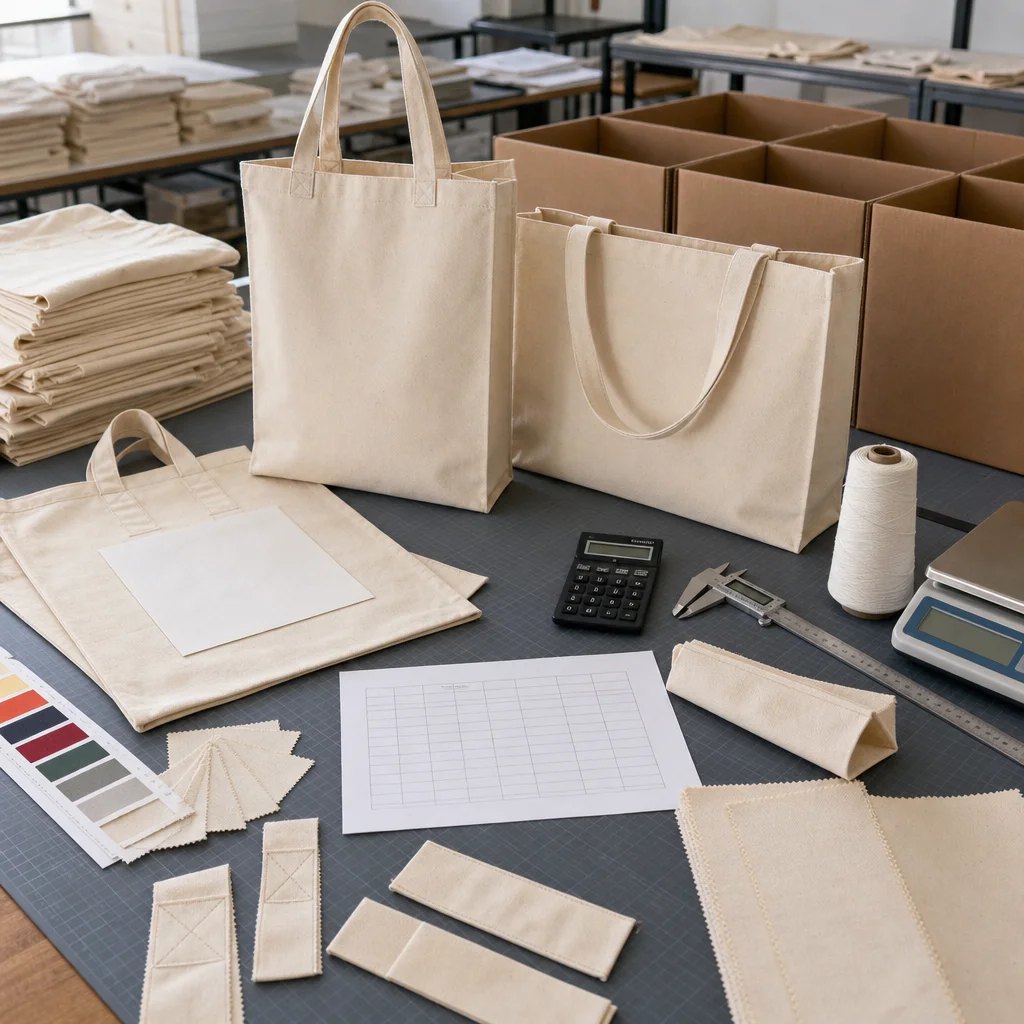
Pricing Problem
A canvas tote bag for a book fair seems easy to price until the quotes land in different formats. One supplier may include the bag and print in a single line. Another may use a lighter cotton tote but still call it canvas. A third may include export packing and leave out setup, sample courier, inspection, freight, duty, tax, or final delivery to the venue. The unit price can look clean while the buying risk sits in the missing details.
A useful worksheet turns the bag into a shared buying specification. Finance needs landed cost. Marketing needs artwork control. Receiving needs carton data. The event team needs goods that arrive before the fair opens and can be handled at the venue. For a book fair, the worksheet should cover fabric, finished size, handles, sewing reinforcement, print method, sample approval, carton packing, lead-time gates, landed cost, and final QC. The goal is not the cheapest-looking tote. The goal is a tote that carries books comfortably, presents event or sponsor artwork properly, and reaches the fair without avoidable surprises.
- Use the worksheet before supplier selection so every quote is compared against the same product and delivery assumptions.
- Treat terms such as standard canvas, premium canvas, or heavy duty canvas as incomplete until the supplier gives measurable specification data.
- Separate confirmed supplier terms from buyer assumptions such as estimated freight, duty, tax, event overage, and receiving labor.
- Attach approved sample notes and carton details to the worksheet so purchasing, receiving, and event teams inspect against the same reference.
Book Fair Use Case
Book fair totes face a different workload from many light promotional bags. Attendees may carry paperbacks, hardcovers, catalogs, notebooks, bookmarks, stationery, sponsor inserts, school materials, or small retail items from several booths. That load often stresses the handle attachment, mouth opening, bottom seam, side seams, and gusset before the flat front panel shows a problem. An empty tote can photograph well and still feel wrong once books are inside it.
Start the worksheet with the commercial role of the bag. A giveaway tote may need controlled cost, simple decoration, and predictable packing. A resale tote needs better hand feel, cleaner stitching, stronger presentation, and fewer visible defects. A sponsor tote depends on artwork placement, print color, and carton sorting because review teams may care about how the brand appears at distribution. A fundraiser tote has another tension: it should feel good enough to keep using after the fair, but the buyer should avoid leftover dated stock that becomes hard to sell.
- Giveaway tote: focus on canvas basis, handle strength, artwork size, and efficient carton packing.
- Retail tote: raise expectations for fabric hand, sewing consistency, print finish, folding, and packed appearance.
- Sponsor tote: lock artwork approval, color target, placement tolerance, carton sorting, and receiving date before release.
- Fundraiser tote: balance landed cost against sell-through risk, reorder feasibility, and whether the artwork remains useful after the event.
Worksheet Structure
A procurement-grade worksheet should do more than rank unit prices. Split the total into the real cost drivers: body fabric, handles, sewing construction, decoration, setup, label or hangtag, sample, courier, packing, export carton, inspection if used, freight, duty or tax to verify, domestic delivery, receiving labor, and contingency. Once those lines are visible, procurement can see whether a supplier is truly more competitive or has simply left out items that another supplier included.
Keep supplier-confirmed data away from internal planning assumptions. Confirmed fields should reflect the exact tote being quoted: same fabric weight, same size, same handle, same print, same packing, same delivery basis. Assumption fields can hold estimated resale price, event overage, freight placeholders, or receiving labor, but mark them as assumptions until carton data, shipping route, delivery address, and receiving window are known. That small discipline prevents a planning model from being mistaken for a purchase-order-ready landed cost.
- Quote fields: bag price, print price, setup charge, sample charge, courier charge, packing charge, inspection charge if applicable, confirmed MOQ, and payment terms.
- Specification fields: fabric weight, composition, finished size, gusset, handle drop, handle width, handle material, print size, print method, carton quantity, and tolerance.
- Schedule fields: artwork deadline, proof date, sample date, approval deadline, bulk production window, inspection point, shipping date, arrival date, and event buffer.
- Risk fields: supplier exclusions, open buyer assumptions, approval dependencies, likely rework causes, substitute-material risk, and items that need physical sample review.
Fabric And Construction
The Bodrum Crafts excerpt in the source set describes canvas as a thicker woven cotton that feels heavier and more solid than thin cotton or non-woven materials, with use cases that include books, shopping, school, and office. That framing is helpful, but it is still not enough for an RFQ. Ask for fabric weight in gsm or oz, fabric composition, finished bag weight, fabric color, dyeing status, and the basis for the stated weight. A quoted weight may refer to greige fabric, finished fabric, or an internal product name unless the supplier states it clearly.
Construction needs the same precision. Write the finished width, finished height, gusset, mouth opening, handle material, handle width, handle drop, attachment pattern, stitch consistency, seam allowance, bottom construction, and mouth hem into the worksheet. Self-fabric handles may look neat because they match the body. Cotton webbing may feel better in the hand. Either option can fail if handle ends are weak, stitch lines are uneven, or the mouth hem is poorly finished. Measure finished dimensions after sewing, not from cutting dimensions or catalog copy.
- Ask for fabric weight by unit and basis, then compare the sample against the written specification before bulk production.
- Record finished dimensions and tolerances for bag width, bag height, gusset, mouth opening, handle drop, and handle width.
- Inspect stress points at side seams, bottom seams, gusset seams, handle ends, and the mouth hem because book loads reach those areas first.
- Keep the approved fabric swatch or full sample as the control reference for bulk production, carton checks, and dispute handling.
Print Method Choices
For many book fair programs, limited-color screen printing is the practical baseline. Event names, school marks, sponsor graphics, publisher messages, and reading campaign artwork are often simple enough for repeatable bulk decoration. Even so, the worksheet should separate setup, color count, print size, print side, placement tolerance, ink requirement, color target, and proofing method. A base quote may cover only a narrow decoration scope, and the price can change once the artwork grows, moves to a second side, or needs tighter registration.
Digital print, transfer print, embroidery, and specialty inks can still be the right choice when the artwork demands gradients, fine illustration, short-run flexibility, or a premium surface effect. They bring different approval risks. Digital and transfer methods can change hand feel and rub behavior. Embroidery can pucker lighter canvas if backing, stitch density, and placement are not controlled. Specialty inks may need extra curing review. When the fair date is fixed, schedule higher-risk decoration earlier and release bulk production only after written approval.
- Use screen print as the baseline quote for simple, repeatable, bulk-oriented artwork.
- Use digital or transfer print when artwork complexity justifies the cost, proofing time, and hand-feel review.
- Use embroidery selectively for premium programs and verify backing, stitch density, puckering, and finished weight impact.
- Record artwork size, placement tolerance, print side, color target, proofing method, and curing or rubbing expectations in the worksheet.
MOQ And Quantity Logic
The source set gives useful quantity context from two buying routes. Pamusan's supplied excerpt, positioned as a wholesale tote guide and retrieved on 2026-07-11T16:22:08+00:00, states that wholesale tote buying usually starts at 50 to 100 pieces and that the sweet spot for many small-to-medium businesses is 100 to 500 units. TheCraftMap's supplied excerpt, published 2026-05-11, says Amazon and AliExpress can be workable for small-batch testing or when 12 to 50 blanks are needed. These are third-party market contexts, not CottonToMaker prices, minimums, or promises.
For a book fair, quantity should come from demand planning before it comes from a supplier's favorite price break. Use expected attendance, sponsor commitments, staff or volunteer needs, resale forecast, bundle plan, and reorder feasibility. Then add event overage as a labeled buyer assumption. If the artwork includes a year, location, sponsor, or school-specific message, leftover stock may lose value quickly. If the artwork is evergreen and storage is available, a higher tier may be reasonable, but only if the landed-cost reduction remains real after freight, handling, and inventory exposure.
- Compare supplier price breaks using the same bag size, canvas weight, handle construction, print method, packing method, and delivery terms.
- Keep supplier MOQ separate from planned order quantity so procurement can see where the buyer is accepting inventory exposure.
- Ask whether sample charges, setup charges, artwork charges, or screen charges are waived, credited, repeated, or changed on reorder.
- Label event overage as an internal planning assumption until merchandising, sponsor, finance, and operations teams approve it.
Quote Comparison
A clean comparison makes exclusions visible. Supplier A may offer a lower bag price but exclude screen setup, sample courier, carton marks, inspection, and freight. Supplier B may appear more expensive while including export packing, a physical pre-production sample, and clearer carton data. Supplier C may quote a stock blank with domestic printing, reducing schedule risk but limiting fabric and construction choices. Without normalized fields, procurement may approve the cheapest line and find the real cost only after artwork approval, sample comments, or freight booking.
Calculate both product unit cost and landed cost per usable bag. Usable bag matters because late delivery, wrong artwork, weak handles, odor, stains, short counts, carton damage, or packing deformation can reduce the supply available for the fair. If the tote will be resold, keep retail price and gross margin in planning fields, separate from factory cost. TheCraftMap's supplied excerpt published on 2026-05-11 gives an example in which a canvas tote costing USD 8 in materials and labor and selling for USD 24 holds a 66 percent gross margin. That is a third-party example calculation, not a factory quote for a book fair tote.
- Product cost: stock blank or custom sewn tote, depending on the sourcing route.
- Decoration cost: setup, screen charge, color charge, second-side print, digital print, transfer, embroidery, specialty finish, and proofing.
- Approval cost: sample, courier, remake, artwork adjustment, internal review time, and any replacement sample required after comments.
- Logistics cost: carton packing, freight, duty or tax to verify, warehouse receiving, local redistribution, and fair-site delivery.
- Commercial buffer: event overage, late freight contingency, rejected-unit allowance, unsold inventory exposure, and cash tied to higher MOQ tiers.
Sample Approval
A physical sample protects the buyer from false confidence in the spreadsheet. For a book fair tote, the sample should answer practical questions. Does the canvas feel substantial enough for books? Does the handle work by hand or over the shoulder? Does the bag deform when loaded? Does the mouth opening stay usable? Does the bottom sit correctly? Does the print stay clean after folding? A photo can confirm rough artwork position, but it cannot fully confirm fabric hand, odor, handle comfort, seam quality, or retail presentation.
The approval form should mirror the pricing worksheet. If the approved sample has a wider handle, heavier fabric, larger print, different fold, or better carton packing than the original quote, the supplier should revise the quote before bulk production. Also define what kind of sample is being approved. A sales sample, blank stock sample, strike-off, pre-production sample, and random bulk sample do not carry the same meaning. For a fixed fair date, approval comments should be specific enough to correct the issue without creating multiple vague revision rounds.
- Measure finished width, height, gusset, mouth opening, handle drop, handle width, and print placement, then record actual values on the approval sheet.
- Photograph the sample flat, loaded, folded, and packed so receiving teams can compare bulk goods quickly.
- Check print hand feel, edge definition, ink coverage, curing, registration, placement, and color target under consistent light.
- State whether approval covers fabric only, print only, full pre-production sample, packing presentation, or complete production standard.
Packing And Delivery
Packing belongs in the cost model. Book fair receiving windows, school or venue storage, and volunteer handling can be tight. The worksheet should request bags per carton, carton dimensions, gross weight, net weight if available, folding method, bundle method, carton marks, and whether cartons must be sorted by design, sponsor, school, booth, or delivery location. A carton plan that works for a warehouse may be awkward at a crowded venue. A retail tote may also need cleaner folding than a basic giveaway bag.
Break lead time into stages rather than accepting one broad promise. Artwork preparation, supplier proofing, sample making, sample transit, buyer comments, bulk cutting, sewing, printing, inspection, packing, freight, customs if applicable, and final delivery are separate activities. The quote should say when the production clock starts, which buyer approvals pause the schedule, and what happens if sample revisions are needed. For a fixed opening date, include an arrival buffer for count checks, replacement decisions, and local redistribution before the fair begins.
- Request carton dimensions, gross weight, carton quantity, and pack method before freight or fair-site handling is treated as final.
- Choose flat pack, folded pack, bundled pack, or individual packing based on storage, presentation, and distribution workflow.
- Confirm whether carton labels need routing details, design names, sponsor references, school names, or receiving marks without adding unapproved logos.
- Set a receiving deadline that leaves time for inspection, count reconciliation, issue resolution, and redistribution before the fair opens.
Evidence And Publication Notes
This article uses the supplied source research set retrieved on 2026-07-11T16:22:08+00:00 as third-party market context. TheCraftMap was used for craft fair sales context, the USD 8 materials-and-labor to USD 24 retail example, the 66 percent gross margin statement, and the 12 to 50 blank small-batch sourcing context. Pamusan was used for wholesale MOQ context, including the 50 to 100 piece starting range and the 100 to 500 unit small-to-medium business sweet spot stated in the excerpt. Bodrum Crafts was used only for general canvas material context. None of these figures is treated as CottonToMaker pricing, certification, testing, capacity, load rating, customer result, or lead time.
Vincent Xi is the Editorial Author. His articles use cited public sources and distinguish documented claims from buyer checks that require current verification.
- Treat third-party MOQ, sales, and margin figures as planning context, then verify exact quote terms with the supplier.
- Do not treat any sourced margin, sales, or MOQ statement as a guarantee for a specific book fair order.
- Tie the final purchase decision to the approved specification, physical sample, carton plan, inspection standard, delivery plan, and confirmed landed cost.
- Request current compliance documents only when they are relevant to the destination market, buyer policy, purchase order date, or product claim.
Specification comparison for buyers
| Spec decision | Recommended option | When it fits | Buyer risk to check |
|---|---|---|---|
| Canvas weight | Quote by measurable fabric weight in gsm or oz plus finished bag weight, not by words such as standard or heavy duty. | Book fair attendees may carry books, catalogs, notebooks, stationery, and sponsor inserts for several hours. | A low quote may substitute lighter cotton while still using the word canvas; request fabric weight basis, finished bag weight, composition, and a physical control sample. |
| Finished size | Use a book-friendly portrait or landscape tote sized from the fair's real merchandise mix and confirmed after sewing. | Works for paperbacks, hardcovers, flyers, catalogs, and small retail add-ons without creating unnecessary carton cube. | Oversizing increases fabric consumption, print area, folding bulk, carton volume, and freight exposure; verify usable internal dimensions, mouth opening, and gusset. |
| Handle construction | Specify handle material, width, drop, attachment pattern, stitch density expectations, and reinforcement method. | Needed when the bag is expected to carry multiple books or remain useful after the fair. | Short drops reduce comfort, narrow handles dig into the hand, and weak handle ends can fail even if the body fabric is acceptable. |
| Print method | Use limited-color screen print as the baseline for simple event or sponsor artwork; quote digital, transfer, or embroidery only when artwork requires it. | Fits most bulk book fair programs using school marks, publisher messages, sponsor graphics, or reading campaign artwork. | Extra colors, larger art, second-side print, specialty inks, and complex registration can add setup cost, proofing time, remake risk, and curing checks. |
| MOQ route | Compare the supplier's real price breaks with the exact same specification across every tier. | Best for comparing domestic stock blanks, overseas custom production, and uncertain event demand. | Low MOQ can raise unit cost; high MOQ can create leftover stock after a date-specific or sponsor-specific fair. |
| Sample approval | Approve fabric, sewing, handle drop, print placement, color target, print hand feel, folding method, and carton presentation before bulk release. | Important when the tote is sold, sponsored, bundled, or used as a visible brand item at the fair. | Photo approval may miss fabric hand, odor, bag weight, handle comfort, seam quality, and packing deformation; use a physical sample when timing allows. |
| Packing plan | Quote carton quantity, carton dimensions, gross weight, folding method, bundle method, and carton marks before final landed-cost approval. | Helps procurement plan receiving, school or venue storage, volunteer handling, and fair-site distribution. | Unspecified packing can create local handling cost, short-count disputes, crushed print panels, mixed-design cartons, or freight changes. |
| Lead time basis | Break the schedule into artwork review, proofing, sample, sample transit, bulk production, inspection, packing, freight, and final delivery. | Needed for fixed book fair opening dates, sponsor approval windows, school calendars, and catalog launch schedules. | A single lead-time promise may exclude buyer artwork revisions, sample remake, customs clearance, remote delivery, or receiving-window limits. |
Buyer checklist before sampling
- Define the commercial role of the tote: giveaway, resale merchandise, sponsor gift, school fundraiser item, staff kit, VIP attendee bag, or bundled ticket item.
- List the target contents by size and expected use: paperbacks, hardcovers, catalogs, notebooks, bookmarks, stationery, flyers, sponsor inserts, or mixed event materials.
- Request fabric weight in gsm or oz, finished bag weight, composition, fabric color, dyeing status, and whether shrinkage is expected if the bag may be washed.
- Confirm finished width, height, gusset, mouth opening, seam allowance, handle length, handle width, handle drop, and acceptable finished-size tolerance after sewing.
- Ask suppliers to quote MOQ tiers while separating blank bag or sewing cost, printing, setup, label or hangtag, packing, sample, courier, inspection, freight, duty, and tax lines.
- Specify print method, artwork dimensions, number of print colors, color target, print position, second-side print if required, and curing or rubbing expectations for the decoration method.
- Require a pre-production sample or equivalent approval reference for fabric hand feel, print color, handle reinforcement, stitch quality, odor, stains, folding, and packed presentation.
- Clarify bags per carton, carton size, gross weight, inner bundle or polybag method, carton marks, and whether cartons need routing labels for school, booth, sponsor, or venue distribution.
- Build a landed-cost worksheet that separates confirmed supplier prices from buyer assumptions such as event overage, estimated freight, taxes, duties, receiving labor, and contingency.
- Keep a written approval trail for artwork, sample comments, revised quote, production schedule, carton plan, packing list, inspection findings, and final release decision.
Factory quote questions to send
- What canvas weight is being quoted in gsm or oz, and does that figure refer to greige fabric, finished fabric, or only a supplier product name?
- What are the finished width, height, gusset, mouth opening, handle drop, handle width, handle material, and normal tolerance after sewing?
- What stitch type, reinforcement pattern, seam allowance, and handle attachment method are included in the quoted construction?
- Which print method is included in the base quote, and how does the price change for extra colors, larger artwork, tighter placement, second-side print, or specialty ink?
- What MOQ tiers are available for this exact canvas weight, finished size, handle construction, print method, packing method, and delivery schedule?
- Does the quote include artwork adjustment, screen or setup charge, sample charge, courier, label charge, carton marking, export packing, inspection, and document fees?
- What is the sample lead time after artwork confirmation, and what is the bulk production lead time after pre-production sample approval?
- How many bags are packed per carton, what are the carton dimensions and gross weight, and are bags flat packed, folded, bundled, individually packed, or mixed by design?
- Which inspections are performed before shipment for fabric weight, dimensions, print placement, seam quality, handle attachment, stains, odor, count, carton marks, and packing condition?
- Which quote items are estimates to verify before purchase order release or shipment, such as freight, duty, tax, remote delivery, warehouse receiving, or fair-site handling?
Quality-control points to confirm
- Measure finished bag width, height, gusset, mouth opening, handle drop, handle width, and print placement against the approved sample and written tolerance.
- Weigh fabric or finished bag samples to check whether the quoted canvas grade appears consistent with the approved reference and has not been substituted with a lighter material.
- Inspect handle attachment for skipped stitches, loose thread, uneven bartacks, weak reinforcement, exposed handle ends, and mismatched handle length.
- Check side seams, bottom seams, gusset seams, and mouth hems for stitch consistency, seam allowance, puckering, raw edges, broken thread, and loose trimming.
- Rub the printed area with a clean dry cloth and inspect for flaking, ink dust, tackiness, ghosting, registration movement, weak coverage, or poor curing.
- Compare print color against the approved target under consistent light, especially when sponsor colors, school colors, publisher marks, or campaign artwork are involved.
- Open cartons at random to check folding method, odor, moisture marks, stains, mixed designs, short counts, overcounts, carton damage, and carton labeling.
- Load a sample tote with representative book fair contents and carry it by the handles to review deformation, comfort, mouth opening stress, handle stress, and bottom seam stress.
- Verify final carton quantity, gross weight, packing list, shipping marks, delivery address, and receiving window before balance payment or shipment release.