1. Start With the Buying Decision, Not a Standalone MOQ
For canvas tote bags, the weakest RFQ question is still the most common: “What is your MOQ and best price?” It produces a number, but not a reliable buying decision. A supplier may quote 1,000 pieces based on stock natural 10 oz canvas, one-color screen print, bulk packing, and a standard shoulder handle. Another may quote 3,000 pieces because the buyer requested custom dyed 14 oz canvas, two artwork versions, woven side labels, and individual barcode packing. Both quotes may be logical, but they are not comparable.
A brand owner may think it is buying one tote bag program. A factory may see several production units: two fabric colors, three prints, two barcode stickers, and separate carton marks. MOQ and price change when the order is split this way. Minimums can be driven by fabric roll quantity, dye house batch size, print setup, label supplier MOQ, packing labor, cutting efficiency, or sewing-line planning.
The goal is not always to push MOQ to the lowest possible number. The goal is to expose the MOQ logic, then decide which specification creates the best commercial result. A slightly higher MOQ using stock fabric and stable production may be safer than a low-MOQ promise built around leftover fabric, untested printing, or vague packing assumptions.
- Ask for MOQ by fabric color, bag size, artwork version, label version, and packing style.
- Compare equal specifications before comparing unit price.
- Request price ladders so buyers can see where cost improves meaningfully.
- Treat unusually low MOQ carefully when the bag uses custom dyed fabric, complex artwork, or retail packing.
- Use the first quote round to identify cost drivers, not to select the cheapest supplier immediately.
2. Build a Factory-Ready Specification Before Requesting Prices
A canvas tote bag quote is only as accurate as the specification behind it. If the RFQ says “standard canvas tote with logo,” the factory must fill in the missing details. Those assumptions may include thinner fabric, shorter handles, single-side printing, no woven label, simple stitching, or bulk packing. That may be acceptable for a basic giveaway, but it is risky for retail merchandise or repeat brand programs.
Start with the intended use. A conference tote for brochures has different requirements from a reusable grocery bag, bookstore tote, gift-with-purchase item, or paid accessory. If the bag must carry books or bottles, handle reinforcement and seam strength matter. If it will be packed inside a subscription box, folded thickness and print rub resistance matter. If it will sit on retail shelves, barcode placement, shade consistency, and presentation packing matter.
A strong specification also aligns internal teams. Marketing may care most about artwork size and brand color. Logistics may care about carton weight, carton marks, and warehouse intake rules. Procurement should turn both into one written spec sheet so every supplier quotes the same product.
- Finished size: width x height x gusset, with measurement tolerance and unit of measure.
- Fabric: canvas type, oz, approximate GSM, color, finish, and any recycled or organic requirement.
- Handles: length, width, handle drop, material, insertion depth, and reinforcement stitch type.
- Construction: top hem, side seams, bottom gusset, inner seam finishing, stitch density, and thread color.
- Decoration: print method, number of colors, number of sides, print size, and exact placement.
- Branding: woven label, printed label, side tag, care label, hangtag, or no label.
- Packing: bulk, individual bag, paper band, retail sleeve, barcode sticker, carton marks, and SKU separation.
- Compliance notes: country-of-origin marking, material claims, plastic packaging rules, and importer labeling requirements where relevant.
3. Fabric Weight and Color: The Biggest Cost and Perception Drivers
Fabric usually drives both cost and perceived value. Buyers often use words like “heavy,” “premium,” or “thick,” but factories need measurable targets. Common commercial canvas tote bags range from about 8 oz to 16 oz, roughly 230 to 500 GSM depending on weave and finishing. Because ounce and GSM conversions vary, ask the supplier to confirm both the commercial oz description and approximate GSM, plus the tolerance controlled in bulk.
Heavier is not automatically better. A 16 oz tote can feel substantial and retail-ready, but it increases material cost, sewing difficulty, carton weight, and freight exposure. An 8 oz tote can work for high-volume promotional use, but on a large panel it may look weak, collapse too much, or show contents and dark artwork through the fabric. For many brand owners, 10 oz to 12 oz is the practical middle ground because it offers credible hand feel without the landed-cost penalty of very heavy canvas.
Color has its own MOQ logic. Natural, black, and common stock shades are easier to source than custom dyed brand colors. Natural canvas is not always identical from lot to lot; shade can vary because of cotton, weaving, bleaching, and finishing. Custom dyed canvas requires lab dips, shade approval, and enough quantity to make dyeing efficient. If color continuity matters for replenishment, state it early and ask whether one fabric lot can cover the full order.
- Use 8 oz only when bag size, load expectation, and brand positioning allow a lighter hand feel.
- Use 10 oz to 12 oz for many standard retail, event, and brand merchandise programs.
- Use 14 oz to 16 oz when premium feel and load strength justify higher cost and freight weight.
- Approve physical fabric swatches before sample approval when hand feel or shade matters.
- For custom colors, request lab dips and confirm whether MOQ is controlled by the dye house.
- Ask whether fabric weight is measured before or after dyeing, washing, or finishing.
4. MOQ Logic: Find Out What Is Splitting the Order
MOQ is not only a negotiation position. It reflects the smallest practical quantity for the factory and its upstream suppliers. A sewing factory may accept 500 pieces, but the fabric supplier may require a larger roll quantity, the dye house may require a minimum dye batch, or the label maker may have its own MOQ for woven labels. When the order is split into many SKUs, the real minimum can become much higher than the headline MOQ.
The most common MOQ trap is artwork and SKU multiplication. A 2,000-piece order sounds simple until it includes two fabric colors, two bag sizes, and five print designs. That creates twenty combinations. Cutting, printing, packing, carton marking, and warehouse documentation become more complex. The supplier may raise price, require a higher MOQ per combination, or accept the order with greater risk of mix-ups.
Instead of only asking for a lower MOQ, ask what would reduce MOQ pressure. The answer may be to use stock fabric, choose one size, reduce artwork versions, use a printed label instead of a woven label, or bulk pack instead of individual retail packing. This makes cost reduction controlled rather than vague.
- Stock natural or black canvas usually gives more MOQ flexibility than custom dyed fabric.
- One bag size and one fabric color improves cutting efficiency and reduces leftover material.
- Every artwork version may require separate screen setup and production tracking.
- Custom woven labels, hangtags, or barcode stickers can create separate supplier minimums.
- Retail packing may split MOQ when SKU stickers or language versions differ.
- A price ladder at 500, 1,000, 2,000, 3,000, and 5,000 pieces is more useful than one MOQ number.
- If demand is uncertain, launch one core specification first, then add colors or artwork versions after reorder data is available.
5. Pricing and Landed Cost: Normalize the Quote Before Choosing
A low unit price is useful only if the included specification is clear. One supplier may include printing, screen charges, export cartons, and normal trimming. Another may quote only the blank bag and add print setup, labels, packing, or courier charges later. For a reliable comparison, request an itemized quote that separates the base bag, decoration, labels, packing, samples, setup charges, and logistics assumptions.
Canvas tote bags need landed-cost thinking because fabric weight and packing method affect carton volume and gross weight. A heavier canvas or bulky gusset may look acceptable at FOB level but become expensive after ocean freight, air freight, warehousing, or parcel fulfillment. Individual polybags, retail sleeves, or hangtags may improve presentation but can increase carton volume and handling time.
Use thresholds instead of chasing every cent. If the tote is a free event insert, lighter fabric and bulk packing may be acceptable. If it is paid merchandise, saving a few cents by weakening handles or reducing seam finishing can create returns, complaints, or brand damage. If the program will be reordered, consistency and supplier responsiveness may be worth more than the lowest first-order quote.
- Confirm whether price is EXW, FOB, CIF, DDP, or another term, and specify the port or delivery point.
- Separate blank bag cost, print cost, label cost, packing cost, screen/setup cost, sample cost, and courier cost.
- Request pieces per carton, carton dimensions, gross weight, and CBM for freight comparison.
- Check whether one-side or two-side printing is included.
- Confirm whether cartons meet your warehouse maximum weight and size rules.
- Ask the quote validity period, especially when cotton prices, exchange rates, or freight costs are moving.
- Before removing quality features, simplify SKU count, print colors, packing, or fabric customization first.
6. Decoration Choices: Match Artwork to the Right Print Method
Most canvas tote bag programs use screen printing because it works well for logos, slogans, and solid spot colors. It is efficient at moderate to large quantities and produces strong visual results on cotton canvas. However, each color or artwork version can add setup cost. On natural canvas, colors may look warmer or less bright than on a white digital proof, so brand color expectations should be set with a physical strike-off.
Complex artwork can change the sourcing plan. Gradients, photographic images, many colors, or small detailed lines may push the supplier toward DTF, heat transfer, digital print, or embroidery. These methods can be useful, but they have trade-offs. Transfers may feel like a film on the fabric. Digital print can be affected by canvas texture and base color. Embroidery can look premium for a small logo but may pucker lightweight canvas or add cost for dense designs.
Do not let artwork break the budget after the supplier has quoted. Send final or near-final artwork during RFQ, ask which method is being quoted, and request decoration samples before bulk approval when color, hand feel, or durability is important.
- Screen print: best for simple logos, solid areas, and limited spot colors.
- DTF or heat transfer: useful for complex multicolor artwork, but test hand feel, edge bonding, and folding behavior.
- Digital print: useful for detailed images, but evaluate color on the final fabric, not only on white proofing material.
- Embroidery: suitable for small premium logos, but check puckering, reverse-side finish, and added lead time.
- Ask for minimum line thickness and spacing requirements for the selected method.
- Define print placement using measurements from bag edges, not only a visual mockup.
- For two-sided printing, confirm whether the second side adds cost, time, and inspection points.
- Request a print strike-off when Pantone match or ink durability is important.
7. Construction Details That Separate a Cheap Tote From a Reliable Tote
Two canvas totes can look similar in a front-facing photo but perform very differently in use. The difference is often construction: top hem width, seam allowance, inner seam finishing, handle material, handle insertion depth, reinforcement stitch pattern, bottom corner sewing, and stitch tension. These details affect load performance, appearance, folding, and inspection results.
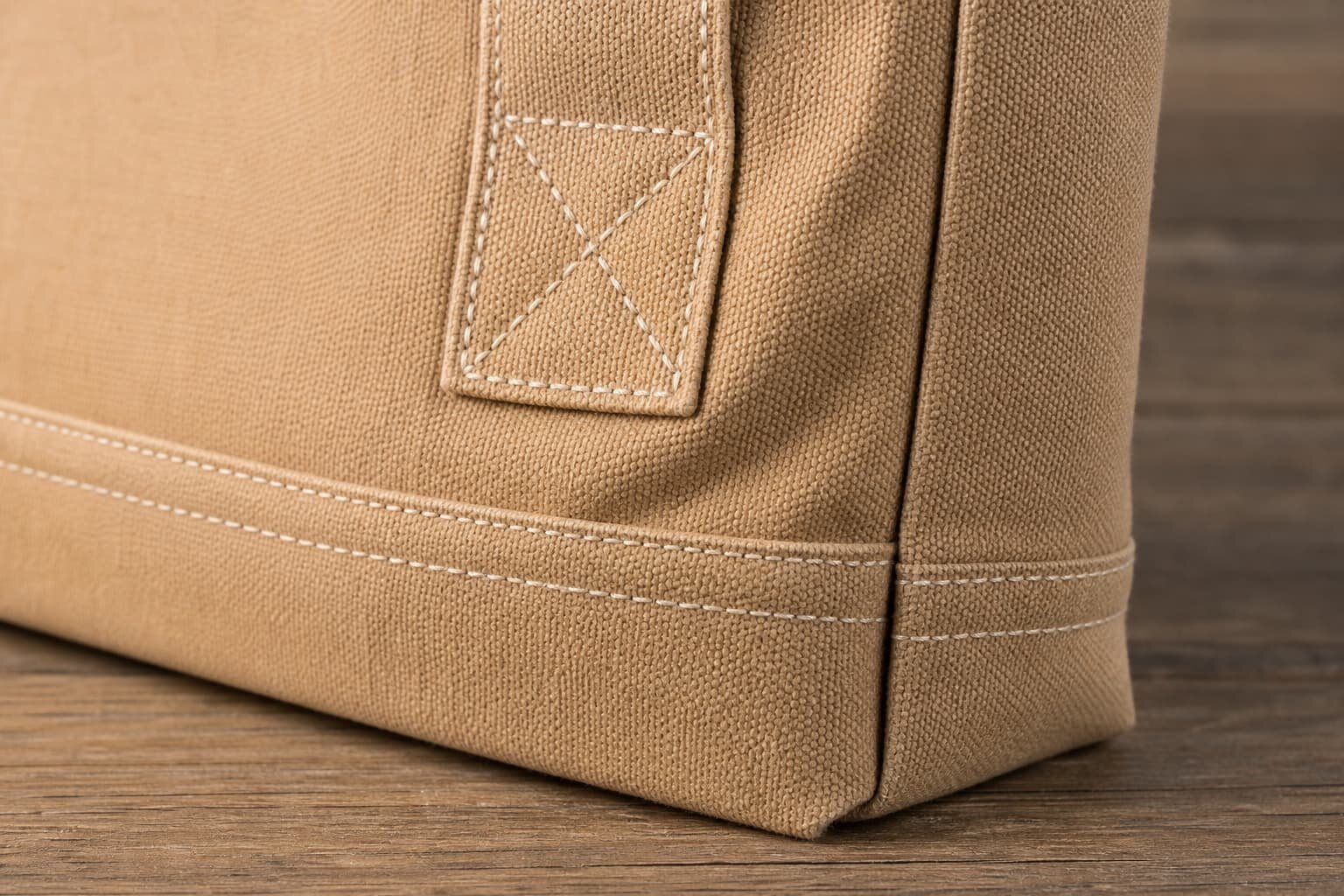
Handles deserve special attention because they are a common failure point. A supplier can lower cost by using narrower handle tape, reducing handle length, inserting less material into the top hem, or simplifying reinforcement. The bag may still look acceptable in photos, but it may twist, feel uncomfortable, or fail under load. For retail merchandise or reusable shopping, specify box stitching, cross stitching, or another approved reinforcement method, and define handle drop based on actual use.
Gusset construction also changes performance and cost. A bottom gusset increases capacity and helps the bag carry packaged goods, but it adds sewing operations and carton bulk. Side and bottom gussets create more volume but require clearer tolerances. If the bag is intended to fold flat inside another package, confirm the folding method before approving a large gusset.
- Top hem: a folded top hem is cleaner and stronger than a raw overlocked upper edge.
- Handle attachment: specify box stitch, cross stitch, bartack, or another approved reinforcement pattern.
- Handle drop: confirm hand carry, shoulder carry, or both; do not rely on “long handle” wording.
- Handle width: wider handles can improve comfort but may cost more and change appearance.
- Inside seams: overlocking reduces fraying and gives a cleaner internal finish.
- Stitch density: define a practical range and inspect skipped stitches, loose tension, and broken thread.
- Bottom corners: inspect for bulky seams, weak points, and uneven shape.
- Thread color: match, contrast, or specify exactly if it affects brand appearance.
8. Sampling, Approval, and Lead Time Control
Sampling is not just a presentation step. It freezes the buying standard. Depending on the program, the approval path may include a fabric swatch, custom color lab dip, blank prototype, print strike-off, sales sample, and pre-production sample. Not every order needs every sample stage, but a first order, custom dyed fabric, complex artwork, or retail packing program should not move directly from digital mockup to bulk production.
Approve samples with written comments. Avoid vague approvals such as “approved with small changes” unless every change is listed and acknowledged by the supplier. A sealed approved pre-production sample should be kept as the inspection reference. Photos are helpful for communication, but they cannot confirm fabric hand feel, actual GSM, print curing, odor, handle strength, or packing density.
Lead time should be broken into stages. Sampling may take one schedule, fabric purchase or dyeing another, and printing plus sewing another. Delays often come from late artwork, slow lab dip approval, unclear barcode files, rejected samples, or late deposit payment. Ask the supplier which approvals are on the critical path and what date bulk materials must be released to meet the ship date.
- Confirm sample type, sample cost, sample lead time, courier cost, and whether fees are refundable after bulk order.
- Approve lab dips before custom dyed fabric is produced.
- Approve print strike-offs on the actual fabric when color, detail, or hand feel matters.
- Freeze final artwork, Pantone references, print size, and placement before screen making.
- Request a production timeline showing material preparation, cutting, printing, sewing, packing, inspection, and shipment handover.
- Book inspection based on realistic production completion, not only the target ship date.
- Keep one sealed approved sample with procurement or QC and ensure the factory keeps the same reference.
9. Compliance and Quality Control: Define Acceptance Before Production
Quality control should be defined before production starts, not after defects appear. Finished bag size will have normal tolerance. Natural canvas may have minor slubs. Screen print can have a practical color tolerance. These limits should be agreed in writing so inspection decisions are fair and fast. The inspection checklist should classify critical, major, and minor issues in a way the supplier can understand and rework.
Compliance requirements depend on destination market, sales channel, and brand claims. If the bag carries claims such as organic cotton, recycled cotton, azo-free dyeing, or plastic-free packing, ask what documentation can support the claim. If the product is sold through retail or e-commerce channels, check barcode accuracy, country-of-origin marking, care or composition labeling where applicable, and any customer-specific packaging rules.
Inspection should compare bulk goods to the sealed pre-production sample and written spec, not to a digital mockup. Check dimensions, fabric, print, stitching, labels, packing, carton marks, and quantity. If defects are found, the report should include photos by defect type so the supplier can rework specific problems before shipment.
- Measure width, height, gusset, handle length, handle width, handle drop, and print placement.
- Check fabric surface for stains, holes, oil marks, shade variation, odor, and excessive slubs beyond the agreed standard.
- Inspect print coverage, edge sharpness, color direction, curing, cracking, stickiness, and rubbing risk.
- Pull test handle attachment areas according to an agreed internal method or customer requirement.
- Open the bag to check inside seams, overlocking, top hem, bottom corners, loose threads, and fraying.
- Check labels, hangtags, barcode readability, SKU sticker placement, and country-of-origin marking if required.
- Review folding, carton quantity, moisture control, carton strength, carton marks, mixed SKU accuracy, and carton weight.
- Use inspection results to decide rework, acceptance, discount discussion, or shipment release based on agreed criteria.
10. Supplier Comparison and Final RFQ Decision Framework
Supplier selection should combine price, capability, communication, and risk control. A good canvas tote supplier does not only quote quickly; it asks clarifying questions, identifies cost drivers, explains MOQ splits, and provides samples that match the written specification. If a supplier accepts every request without discussing fabric availability, print limitations, or packing details, the quote may be incomplete.
Create a simple comparison sheet for shortlisted suppliers. Include MOQ by component, price by quantity tier, included charges, excluded charges, sample plan, lead time, carton data, compliance support, inspection acceptance, and communication quality. This keeps the decision from becoming a lowest-unit-price contest when two quotes are not based on the same assumptions.
The final decision should match risk level. For a simple low-risk promotional order, stock fabric and standard screen print may be enough. For a retail program, choose a supplier that can manage pre-production samples, barcode packing, SKU separation, and third-party inspection. For custom dyed canvas or complex artwork, prioritize technical clarity and sample accuracy over the lowest opening price.
- Shortlist suppliers that can quote the same written specification, not only similar-looking bags.
- Ask whether production is in-house, subcontracted, or mixed, especially for printing and dyeing.
- Evaluate sample accuracy: size, fabric, print, handles, labels, and packing should match the RFQ.
- Reject comparisons where one supplier includes setup, packing, and export cartons while another excludes them.
- Score freight impact using carton CBM and gross weight, not only FOB unit price.
- Prefer suppliers that propose controlled cost alternatives instead of quietly removing quality features.
- Freeze the final spec sheet before bulk material purchase or production deposit.
- Release production only after sample approval, lead time confirmation, payment terms, inspection plan, and shipment terms are documented.
Specification comparison for buyers
| Procurement decision | Typical option | Best-fit buying situation | Decision threshold or buyer risk |
|---|---|---|---|
| Fabric weight | 8 oz canvas, roughly 230-260 GSM | High-volume promotional campaigns, event giveaways, lightweight inserts, budget-sensitive distribution | Use only when the bag size and expected load are modest. Check transparency, handle pull, and print show-through before approval. |
| Fabric weight | 10 oz to 12 oz cotton canvas, roughly 280-360 GSM | Most brand merchandise, bookstore totes, trade show bags, subscription add-ons, and reusable retail bags | Often the best balance of hand feel, cost, sewability, and freight weight. Ask whether GSM is controlled before or after dyeing and finishing. |
| Fabric weight | 14 oz to 16 oz canvas, roughly 400-500 GSM | Premium retail totes, heavy-use shopping bags, paid merchandise, and bags expected to carry books or packaged goods | Higher material cost, heavier cartons, more sewing stress, and possible higher MOQ if fabric is not stocked. Confirm seam bulk, needle marks, and carton gross weight. |
| Fabric color | Stock natural, black, or common dyed canvas | First order, test launch, smaller MOQ requirement, or short delivery window | Lowest sourcing friction. Natural shade can vary by lot, so approve a physical swatch and define acceptable variation. |
| Fabric color | Custom dyed canvas | Brand-color program, seasonal collection, or retail range requiring a specific color direction | MOQ may be driven by dye house lot size. Require lab dip approval, shade band tolerance, and extra lead time. |
| Printing | Screen print for 1-4 spot colors | Logos, slogans, simple graphics, most B2B and retail brand orders | Clarify number of colors, number of print sides, screen charges, Pantone target, print size, and curing standard. |
| Complex artwork | DTF, heat transfer, digital print, or embroidery depending on fabric and design | Gradients, photo artwork, many colors, small logo badges, limited runs, or detailed retail graphics | Check hand feel, edge durability, folding behavior, rub resistance, and whether the method suits textured canvas. Do not approve from digital mockup only. |
| Construction | Folded top hem, overlocked inner seams, reinforced handle stitching | Commercial tote programs where the bag must survive normal daily use | Low prices may remove reinforcement, reduce stitch density, narrow the handles, or shorten handle drop. Put construction in the spec sheet. |
| Packing | Flat bulk pack in export carton | Events, warehouse distribution, B2B replenishment, and lowest packing cost | Efficient and lower cost, but less retail-ready. Define carton quantity, SKU separation, carton marks, and maximum gross weight. |
Buyer checklist before sampling
- Confirm finished bag size as width x height x gusset, with measurement tolerance and whether the gusset is bottom only or bottom plus side.
- Specify fabric by both oz and approximate GSM, and state natural, bleached, dyed, recycled, organic, or conventional cotton according to the program requirement.
- Define fabric color standard: stock shade, Pantone direction, lab dip approval, acceptable shade variation, and whether shade continuity is required for reorders.
- Define handle length, handle width, handle material, attachment depth, reinforcement stitching, and whether the target use is hand carry or shoulder carry.
- Provide vector artwork where possible and state print method preference, Pantone references, print size, print position, number of sides, and artwork version count.
- Ask whether MOQ applies to total order quantity, fabric color, bag size, print design, label version, packing style, or SKU barcode.
- Request a price ladder at realistic quantities such as 500, 1,000, 2,000, 3,000, and 5,000 pieces, instead of one quantity only.
- Ask the factory to separate unit price from sample charge, screen charge, label charge, packing charge, inland handling, and any export documentation cost.
- Request estimated pieces per carton, carton dimensions, gross weight, CBM, and carton marks so freight and warehouse handling can be compared.
- Set acceptance criteria for fabric weight tolerance, size tolerance, print color tolerance, stitch defects, stains, odor, handle strength, and packing accuracy.
Factory quote questions to send
- What is your MOQ for this canvas tote bag by total quantity, fabric color, artwork version, bag size, label, and packing style?
- Is the quoted fabric in stock, greige, yarn-dyed, piece-dyed, custom dyed, natural unbleached, bleached, recycled cotton, or organic cotton?
- What is the exact fabric weight in oz and approximate GSM, and what tolerance do you control during bulk production?
- Can you provide fabric swatches from current stock and confirm whether the same lot can support the full order quantity?
- Does the price include printing on one side or two sides, and how many colors are included in the quoted unit price?
- Which print method are you quoting, and what artwork file format, minimum line thickness, trapping, and color reference do you require?
- Are handle reinforcement stitches, inner seam overlocking, top hem folding, bottom gusset sewing, thread trimming, and pressing included in the quoted construction?
- What sample types are available: fabric swatch, lab dip, blank prototype, print strike-off, sales sample, and pre-production sample?
- What are the sample cost, screen or setup cost, courier cost, and whether any charge is refundable after the bulk order is placed?
- What is the estimated lead time for sampling, bulk material preparation, printing, sewing, packing, inspection, and shipment handover?
Quality-control points to confirm
- Measure finished bag width, height, gusset, handle length, handle width, handle drop, and print placement against the approved sample and written tolerance.
- Check fabric weight from bulk roll or cut panels where possible, not only from the supplier's commercial fabric description.
- Inspect fabric surface for oil marks, weaving slubs beyond agreed level, stains, holes, uneven dyeing, shade variation, and strong odor.
- Check print position, print size, ink coverage, edge sharpness, color match, curing, cracking, stickiness, and dry or wet rubbing risk as appropriate.
- Pull test handle attachment areas according to an agreed internal method, and inspect reinforcement stitching for skipped stitches, broken threads, loose ends, and needle damage.
- Open the bag and inspect inside seams, overlocking, top hem, bottom corners, seam allowance, loose thread trimming, and fabric fraying.
- Check labels, hangtags, barcode readability, SKU sticker placement, care or composition labels if used, and country-of-origin marking if required by the buyer.
- Review individual packing or bulk packing for correct folding, quantity, moisture control, carton strength, carton marks, mixed SKU accuracy, and carton weight.
- Compare bulk goods to the sealed approved pre-production sample, not to a digital mockup or an earlier rejected sample.
- Record defect photos by category so the supplier can rework issues before shipment rather than debate vague comments after delivery.