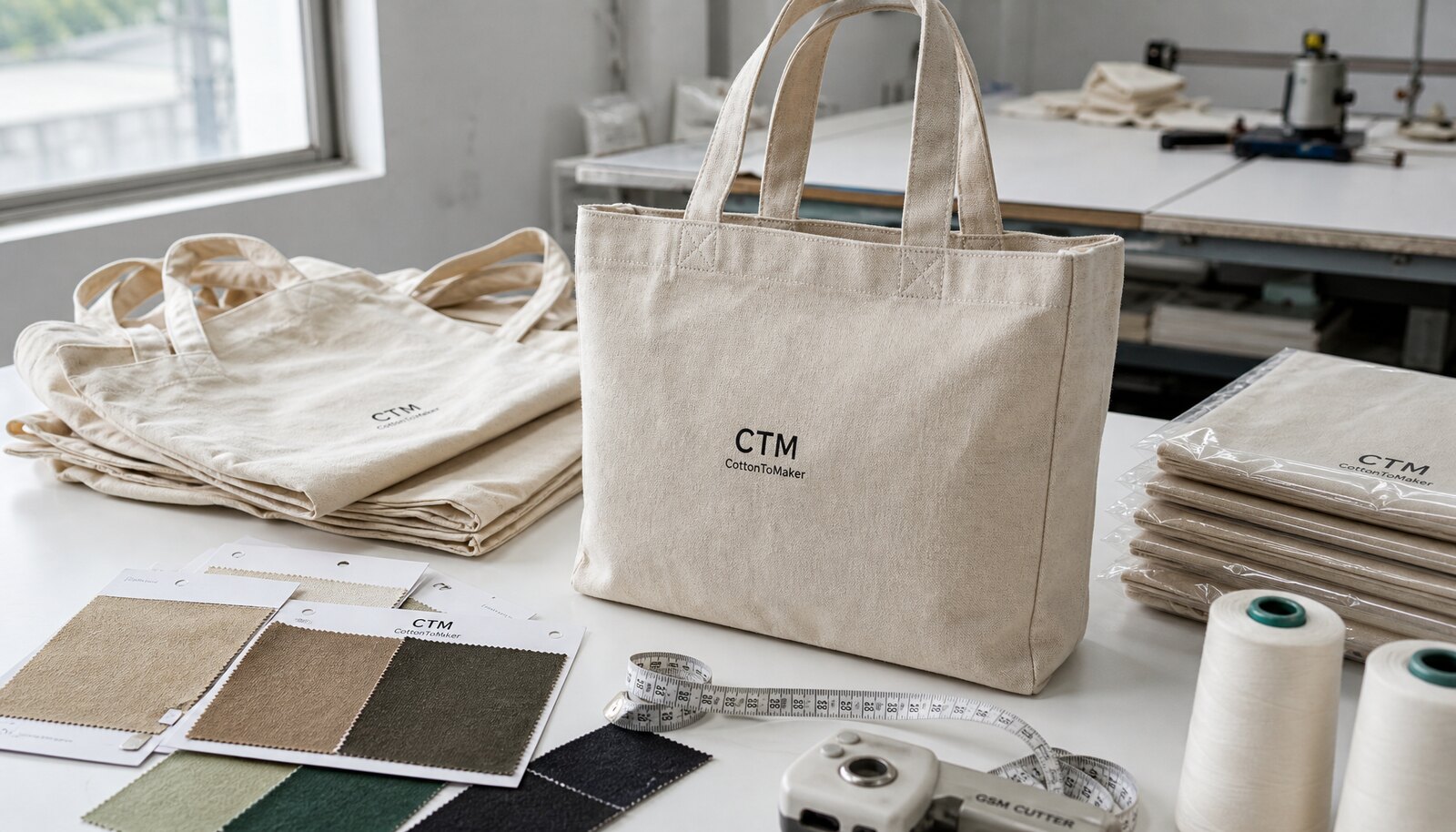
Why MOQ Planning Matters Before You Ask for Price
A canvas tote bag MOQ planning guide is useful because most price confusion starts before the supplier ever quotes. Buyers often send one target quantity, one logo file, and one bag photo, then receive prices that are impossible to compare. One factory may quote 8 oz natural canvas with screen print and bulk packing. Another may quote 12 oz dyed canvas with individual bags and reinforced handles. Both prices look valid, but they are not quoting the same product.
MOQ is not only a sales rule. In canvas tote production, it is connected to fabric sourcing, dyeing, cutting efficiency, printing setup, sewing line changeover, label purchase, packing material, and export carton planning. If your RFQ separates these drivers, the factory can explain where the quantity limit comes from. If your RFQ only asks for the lowest price at 500 pieces, you may receive a thin fabric, simplified packing, or a supplier who accepts the order but struggles during production.
- Plan MOQ by SKU, not by total order value.
- Ask what creates the MOQ instead of arguing only about the number.
- Keep fabric, print, packing, and size stable when comparing quotes.
- Use tiered quantity quotes to see where the real cost break happens.
- Treat sample approval as part of MOQ planning, not a separate afterthought.
Start With SKU Logic, Not a Random Quantity
For procurement teams, the first MOQ decision is how many finished SKUs you are creating. A natural canvas tote bag with one black logo is one SKU. The same bag in natural, black, and navy is three SKUs. If each color has two print designs, you now have six SKUs. A total order of 3,000 pieces may sound efficient, but if it is divided into six SKUs at 500 pieces each, the factory must manage more fabric lots, screens, packing labels, and production records.
Brand owners and distributors should separate launch quantity from forecast quantity. A factory can support a first order of 500 pieces for testing, but the cost structure may be different from a reorder of 5,000 pieces. If the buyer shares both the firm quantity and realistic annual forecast, the supplier can advise whether to use stock canvas, reserve fabric, or adjust the first order to reach a better cutting or printing batch.
- List each SKU with size, fabric color, handle color, logo artwork, and packing.
- Do not combine different artworks into one MOQ unless the factory confirms it.
- Ask for price breaks at practical levels such as 300, 500, 1,000, 3,000, and 5,000 pieces.
- If retail allocation is uncertain, reduce SKU count before reducing fabric quality.
- For distributor programs, ask whether blank stock can be printed later for repeat orders.
Fabric Weight and Color Usually Drive the Real MOQ
Canvas tote bag buyers often specify fabric by ounces, while mills and inspectors may work in GSM. As a practical reference, 6 oz canvas is often around 180 to 200 GSM, 8 oz around 230 to 250 GSM, 10 oz around 280 to 300 GSM, and 12 oz around 330 to 360 GSM. The exact number depends on yarn, weave, finishing, and moisture. For RFQ purposes, give both oz and target GSM range, then ask the supplier to confirm the quoted fabric standard.
Natural cotton canvas usually allows lower MOQ than custom dyed canvas because it is easier to source and does not require a special dye lot. Stock colors such as black may also be easier if the factory or fabric supplier carries them regularly. Pantone dyed canvas is different. The fabric mill may require a minimum dye quantity, lab dip approval, and extra lead time. If a buyer asks for five custom colors at 300 pieces each, the MOQ problem is usually not sewing; it is fabric dyeing.
- Use 6 oz to 8 oz for lightweight promotions where cost is the main driver.
- Use 10 oz to 12 oz for retail-quality totes with better hand feel and structure.
- Use 14 oz or heavier only when the design needs a premium, sturdy body and higher freight cost is acceptable.
- Confirm whether fabric is natural, bleached, reactive dyed, pigment dyed, washed, or undyed.
- Ask for shade tolerance and whether one order may contain fabric from more than one lot.
Logo Method Changes MOQ More Than Many Buyers Expect
A simple one-color screen print is usually the most efficient option for many canvas tote orders. The setup cost is manageable, print speed is good, and the result works well on natural canvas. However, each additional print color may require another screen, more setup time, and more registration control. If the order has several small SKUs, four-color screen printing can become inefficient even when the total order quantity looks acceptable.
Digital print, DTF, heat transfer, embroidery, woven labels, and leather or PU patches can all be suitable, but each has a different MOQ logic. Digital and transfer methods can help when the artwork has gradients or many colors, but buyers should check hand feel, wash resistance, and edge appearance. Embroidery can add perceived value, but dense stitching on light canvas may cause puckering. Woven labels and patches may have their own material MOQ, separate from bag production.
- For flat logos under 3 colors, request screen print and specify Pantone colors.
- For artwork with gradients, request digital print or transfer samples before approval.
- For premium retail bags, compare embroidery, woven side label, or sewn patch options.
- For dark canvas, check white underbase requirements and print opacity.
- For all methods, confirm print size, position from top edge, and tolerance in millimeters.
Use Tiered Quotes to See the Real Cost Break
A useful canvas tote bag MOQ plan does not ask only for one price. It asks for tiered pricing with the same specification. For example, quote 500, 1,000, 3,000, and 5,000 pieces for one bag size, one fabric, one print, and one packing method. This shows where the factory cost curve changes. Sometimes the difference between 500 and 1,000 pieces is large because setup and fabric purchasing are spread across more bags. Sometimes the difference between 3,000 and 5,000 pieces is small because the production is already efficient.
When comparing supplier quotes, check whether the tiered prices include the same items. One supplier may include screen setup, sample fee, export carton, and individual polybag. Another may list those as separate charges. Neither approach is automatically wrong, but the buyer must normalize the quote. The goal is not just to find the lowest unit price; it is to understand total landed cost and production risk at the planned MOQ.
- Request unit price by quantity tier with the exact same specification.
- Ask the supplier to separate mold, screen, sample, label, and packing charges if applicable.
- Ask whether setup charges apply again for reorder with the same logo.
- Compare total order cost, not only unit price.
- Add estimated freight impact from carton CBM and gross weight before final supplier selection.
Sample Planning Should Match MOQ Risk
For a very simple natural canvas tote with one-color print, buyers may approve a material swatch, print strike-off, and pre-production sample. For a heavier dyed canvas tote with pocket, zipper, custom label, and retail packing, a blank sample alone is not enough. The sample process should prove the exact risks created by the MOQ decision. If your MOQ is low but the bag has many custom parts, sampling becomes more important because there is less production volume to absorb mistakes.
A good pre-production sample uses actual or production-equivalent fabric, correct fabric weight, approved logo method, final handle length, final label, and intended folding method. Buyers should measure and record the approved sample instead of only saying approved by photo. The factory should keep a sealed reference sample on its side. This avoids arguments during inspection when size, handle drop, logo position, or fabric hand feel is questioned.
- Check finished width, height, gusset, and handle drop with tolerance.
- Check fabric hand feel against approved swatch, not only fabric weight on paper.
- Check print color under consistent lighting and compare with Pantone or approved proof.
- Check handle reinforcement, stitch density, and loose thread trimming.
- Check folding and packing because it affects carton size and presentation.
Packing Decisions Can Raise MOQ and Freight Cost
Packing is often treated as the last detail, but it can affect MOQ and landed cost. Bulk packing may be acceptable for event distribution or internal promotional use. Retail buyers may need individual polybags, paper belly bands, hangtags, barcode stickers, carton assortment, or store-ready master cartons. Each extra packing component may have its own purchase minimum and setup requirement. If those details are added after price approval, the order may become more expensive or slower.
Carton quantity also matters. A 12 oz large canvas tote with gusset takes more space than a flat 6 oz promotional tote. Individual folding increases labor but may create better presentation and more predictable carton counts. Importers should ask for carton dimensions, gross weight, net weight, and CBM at quote stage. This data helps freight forwarders estimate shipping cost and helps warehouse teams plan receiving.
- Define bulk pack, individual polybag, paper band, or retail pack in the RFQ.
- Confirm barcode sticker size, placement, and whether it is on bag, polybag, hangtag, or carton.
- Ask for pieces per carton before approving the final price.
- Specify moisture protection if shipping by sea or storing in humid conditions.
- Confirm carton mark content, including SKU, quantity, gross weight, net weight, and destination code.
Lead Time Planning for Low and Medium MOQ Orders
Canvas tote lead time depends on material readiness more than sewing speed alone. Natural canvas with simple screen print may move quickly if fabric is available. Custom dyed fabric, custom handles, special labels, embroidery patches, or retail packaging can add waiting time before cutting starts. Buyers should avoid assuming that a lower MOQ automatically means faster delivery. A 500-piece order with custom dyed fabric may take longer than a 3,000-piece order using stock natural canvas.
For planning, separate the timeline into artwork confirmation, material sourcing, sample making, sample approval, bulk material preparation, cutting, printing, sewing, trimming, inspection, packing, and export handover. This structure helps procurement teams identify the real critical path. If launch date is fixed, the buyer may need to simplify color, reduce the number of SKUs, or approve stock fabric rather than forcing a risky compressed schedule.
- Ask when lead time starts: deposit date, artwork approval, sample approval, or material arrival.
- Build time for lab dips if custom fabric color is required.
- Do not approve mass cutting before logo size and placement are confirmed.
- Ask whether printing happens before or after sewing, because it affects inspection flow.
- Confirm final inspection date at least several days before cargo handover.
Quote Data Buyers Should Require for Clean Comparison
A professional canvas tote quote should include enough data for procurement, merchandising, logistics, and quality teams to review. Unit price alone is not enough. The quote should state fabric weight, size, handle length, logo method, number of print colors, packing method, carton quantity, carton size, estimated weight, sample fee, setup fee, production lead time, payment terms, and quote validity. Without this data, a cheap quote may only be cheap because several costs are missing.
Buyers should also ask the supplier to identify assumptions. For example, if artwork is not final, the supplier may quote based on one-color screen print. If the buyer later sends a full-color illustration, the print method and price can change. If packing is not specified, the supplier may quote bulk packing. A clear assumption list protects both sides and reduces renegotiation after the purchase order is issued.
- Ask for fabric description with oz, GSM range, color, and finishing.
- Ask for bag dimensions with tolerance and whether measurements are flat or filled.
- Ask for logo process, print colors, print size, and setup charge.
- Ask for packing details, carton data, and estimated CBM.
- Ask for sample lead time, production lead time, and what approval starts the clock.
Common MOQ Mistakes and How to Prevent Them
One common mistake is asking for too many custom colors at low quantity. The buyer may receive either a high MOQ from a careful factory or a low commitment from a supplier who plans to approximate colors from available fabric. If brand color is important, decide which colors deserve true custom dyeing and which can use stock fabric. This is a commercial decision, not only a design decision.
Another mistake is changing artwork after the MOQ and price are agreed. A logo that changes from one-color screen print to full-color artwork changes cost, setup, sampling, and sometimes minimum quantity. Buyers should freeze the artwork before final quote approval or ask the factory to quote multiple logo methods from the start. MOQ planning is strongest when product design, artwork, and packing are aligned before negotiation.
- Do not split a small order into many colors unless each SKU still meets factory efficiency.
- Do not compare 8 oz and 12 oz quotes as if they are the same product.
- Do not approve a photo sample without checking measurements and material.
- Do not add retail packing after price confirmation without expecting cost and lead time changes.
- Do not ignore carton CBM, especially for bulky heavy canvas totes.
Specification comparison for buyers
| Spec decision | Recommended option | When it fits | Buyer risk to check |
|---|---|---|---|
| Fabric weight for standard retail tote | 10 oz to 12 oz cotton canvas, about 280 to 340 GSM | Gift-with-purchase, bookstore, museum shop, lifestyle retail, reusable shopping bag | Confirm finished GSM after dyeing or washing, not only greige fabric weight |
| Fabric weight for low-cost promotion | 6 oz to 8 oz cotton canvas, about 180 to 240 GSM | Event giveaway, light carrying use, limited campaign stock | Thin fabric may show contents, crease more, and reduce perceived retail value |
| MOQ planning by fabric color | Natural canvas at lower MOQ; dyed custom color at higher MOQ | Natural, black, and common stock colors where factory has fabric access | Pantone dyed fabric often requires fabric mill MOQ and longer lab-dip approval |
| Logo method for 300 to 1,000 pcs | Screen print in one or two spot colors | Simple brand mark, campaign artwork, flat color logo | Ask if screen setup charge is separated and whether reorders reuse the screen |
| Logo method for photographic artwork | DTF, heat transfer, or digital print depending on hand feel requirement | Small batches, multi-color art, short promotional runs | Check wash/rub fastness and whether transfer film edge is visible on canvas |
| MOQ planning by size | One main body size per order, with shared handle and packing spec | Retail buyer wants clean comparison across suppliers | Multiple sizes split the quantity and may push each SKU below efficient MOQ |
| Packing for ecommerce or retail | Individual polybag or paper belly band with carton quantity fixed by bag size | Direct-to-DC, retail store allocation, marketplace prep | Packing method can change carton CBM, freight cost, and barcode placement work |
| Sample approval before mass production | Pre-production sample using actual fabric, actual print, actual stitching | Any order with custom GSM, dyed color, logo, pocket, zipper, or retail label | Do not approve only a blank size sample when logo placement and fabric shrinkage matter |
Buyer checklist before sampling
- Define the order by SKU first: size, fabric color, GSM, handle style, logo method, packing, and destination.
- Separate confirmed launch quantity from forecast quantity, because factories quote differently for firm order and potential reorder.
- Ask the supplier to state MOQ by finished SKU, not only total order quantity.
- Confirm whether the MOQ is driven by fabric purchase, dyeing, printing setup, sewing line efficiency, packing materials, or export carton minimum.
- Specify fabric as oz and approximate GSM, and ask whether the value is before or after dyeing, washing, or finishing.
- Decide whether natural canvas, stock color, or Pantone custom dyed fabric is commercially acceptable before requesting many color quotes.
- Keep early MOQ planning to one or two body sizes unless the buyer has confirmed allocation for each size.
- For logos, send vector artwork, Pantone references, print size, print position, and whether the reverse side needs artwork.
- Ask for carton quantity, carton size, gross weight, net weight, and estimated CBM at the quote stage.
- Build sample approval time into the schedule, including artwork proof, material swatch, pre-production sample, and any revised sample.
Factory quote questions to send
- What is your MOQ for this canvas tote bag by SKU, fabric color, and logo design?
- Is the MOQ based on fabric mill order, printing setup, cutting efficiency, sewing line arrangement, or packing material purchase?
- Can you quote natural canvas, stock dyed canvas, and custom Pantone dyed canvas separately?
- What fabric weight are you quoting in oz and GSM, and is it measured before or after dyeing or finishing?
- What is the shrinkage tolerance after dyeing, washing, or heat press, if applicable?
- Which logo method do you recommend for this artwork and order quantity, and what are the setup costs?
- At what quantity does the unit price change, for example 300, 500, 1,000, 3,000, and 5,000 pcs?
- What sample types are included before mass production: material swatch, logo strike-off, blank sample, or pre-production sample?
- What is the estimated sample lead time and mass production lead time after final approval?
- How many pieces fit per export carton, and what are carton size, gross weight, net weight, and CBM?
Quality-control points to confirm
- Fabric weight is checked by GSM cutting test or supplier mill report, with buyer acceptance range agreed before production.
- Finished bag size is measured flat after sewing, with clear tolerance for width, height, gusset, and handle drop.
- Logo print is checked for color, placement, edge sharpness, opacity, adhesion, and rubbing resistance.
- Handle attachment is inspected for stitch density, reinforcement pattern, and pulling strength suitable for intended loading.
- Side seams, bottom seams, and gusset corners are checked for skipped stitches, open seams, puckering, and loose thread trimming.
- Color shade is compared against approved swatch under consistent lighting, especially for dyed canvas and dark colors.
- Packing is checked for correct folding method, barcode or label placement, carton quantity, carton mark, and moisture control.
- Random carton checks verify that mixed SKUs are not packed together unless the packing plan requires assortment cartons.