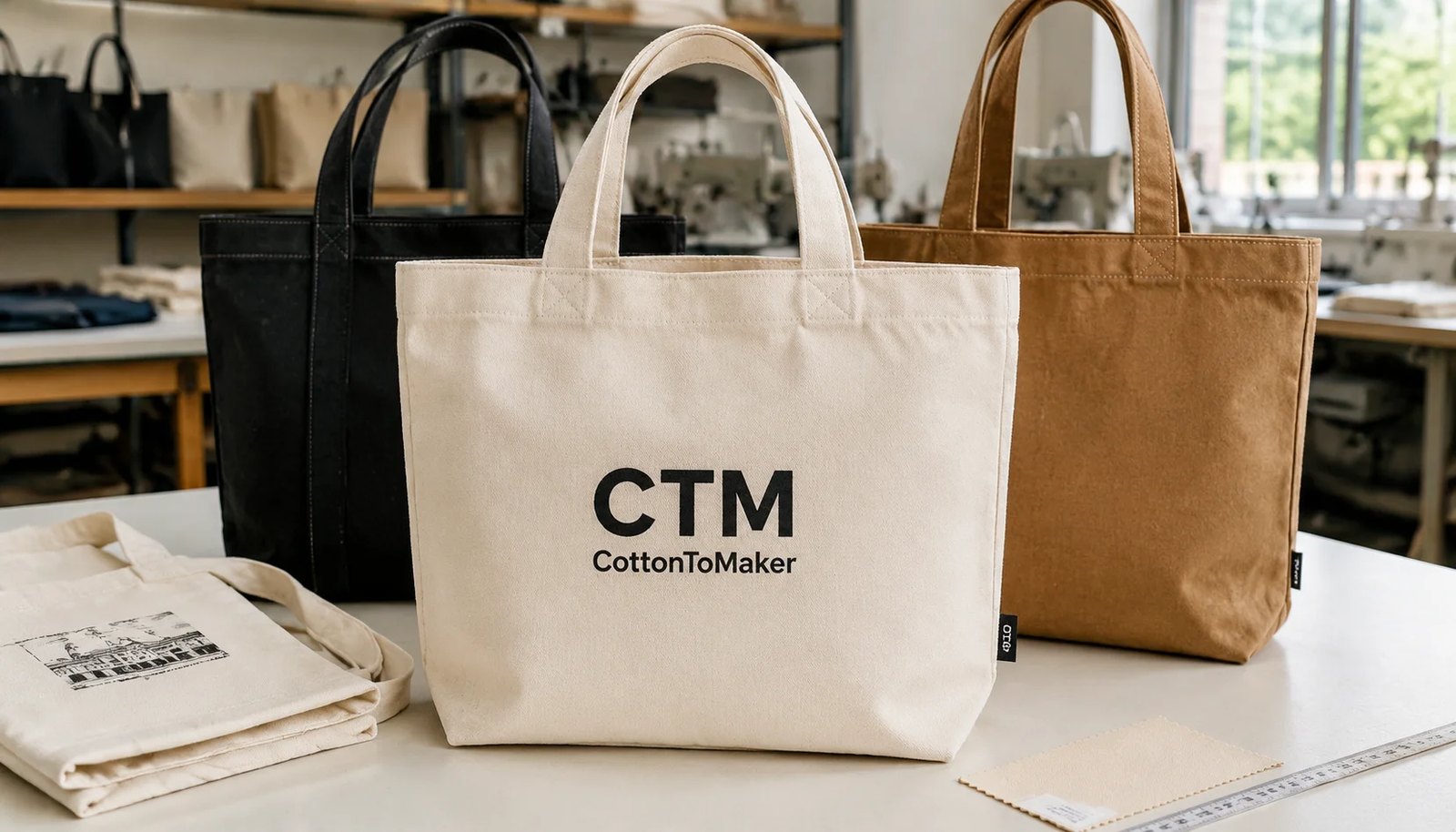
Why MOQ planning matters for museum shops
Canvas tote bag MOQ planning is not a purchasing formality. For museum shops, it is the point where retail ambition meets manufacturing reality. A tote that looks simple on a shelf can carry a lot of hidden decisions: canvas weight, stitch count, handle style, print method, size, label placement, and retail packing. Each one can move the minimum order quantity up or down. If those choices are not locked before a quote is requested, the buyer ends up comparing numbers that do not refer to the same product.
That matters more in museum retail than in many other channels because tote programs usually serve a specific commercial purpose. Some totes are evergreen store items that should reorder cleanly across seasons. Others are tied to a temporary exhibit, a donor campaign, or a gift-shop refresh with limited sell-through time. The MOQ should match the sales plan. A buyer who orders too much ties up cash and storage. A buyer who orders too little may miss the demand window and lose the ability to replenish at the original spec.
The practical rule is simple: decide what the tote has to do in the shop before deciding how many units to make. Is it a low-cost souvenir bag, a premium retail accessory, or a utility tote that needs to carry books and catalogues? Once the use case is clear, MOQ becomes a planning tool instead of a guess. That is the difference between a quote that can actually be approved and one that forces another round of questions.
For procurement teams, MOQ also affects vendor evaluation. A supplier that offers a low headline price but hides print, packing, or label charges is not giving a useful comparison. A quote should be built from the same spec sheet every time. Without that discipline, the buyer cannot judge whether one factory is genuinely more efficient or simply quoting a thinner version of the product.
- Define the tote’s retail role before asking for minimums.
- Treat MOQ as a function of spec complexity, not just factory policy.
- Use the same spec sheet across all quote requests so suppliers are compared fairly.
- Plan separate logic for launch quantity, seasonal quantity, and replenishment quantity.
Start with the product spec, not the order quantity
The most reliable way to control canvas tote MOQ is to spec the bag first. A museum shop usually gets the cleanest commercial result from a 10 oz to 12 oz canvas tote with a finished size that can carry books, brochures, and a few impulse purchases without looking bulky. That range is common because it balances structure, retail feel, and sewing efficiency. A lighter bag may save cost, but it can read as a promotional giveaway. A heavier bag may feel premium, but it also adds labor, sewing resistance, and freight weight.
Finished dimensions matter as much as fabric weight. A tote that is too small will not function for a museum customer carrying a catalogue or gift item. A tote that is too large increases fabric usage and can look awkward at retail unless it is designed as an oversized merchandise piece. Buyers should specify both nominal size and tolerance. For example, the factory should know whether the body width, body height, and gusset have tight tolerance requirements or standard commercial tolerance is acceptable. If the supplier does not know how much dimensional drift is allowed, it is difficult to quote correctly.
Handle design is another spec lever that directly affects MOQ. Self-fabric handles can be cost-effective and visually unified, but webbing handles often feel sturdier and can support heavier loads. Handle length and drop also matter. Museum shop totes are often carried in hand or over the shoulder, so the buyer should state the intended use instead of leaving the factory to choose a default. If the handle anchor is not reinforced properly, the product may survive a visual approval but fail after retail use.
Buyers should also clarify whether the tote needs a gusset, inner pocket, closure, or lining. Each one changes cutting, sewing, and inspection time. In many cases, the right decision is to keep the first version simple: one base color, one logo placement, no extra trim, and a robust stitch schedule. That keeps MOQ lower and allows the museum to validate sell-through before approving a more elaborate version.
- 10 oz canvas: lower cost and lighter hand feel; useful for entry-price souvenir tote programs.
- 12 oz canvas: stronger structure and better retail perception; often the safest museum-shop default.
- 14 oz and above: better load bearing, but only worth it when the tote is expected to carry heavier goods.
- Specify finished size, handle drop, and tolerance ranges before asking for minimums.
How print method changes MOQ and cost
Print method is one of the biggest drivers of both MOQ and quote reliability. For museum tote bags, screen print is usually the most practical choice because it is durable, legible, and efficient for repeat orders. A one-color screen print on canvas typically keeps production straightforward. Once the artwork moves into two colors, smaller text, tighter registration, or more complex placement, the quote usually changes because setup and inspection become more demanding. That is normal, but it must be visible in the quote rather than discovered later.
The buyer should decide whether the design is brand-led or illustration-led. If the tote only needs a museum name or a simple exhibit mark, screen print is usually the best fit. If the artwork includes fine lines, halftones, gradients, or small copy, the supplier needs to see the final vector art and confirm whether the image will hold on the selected canvas and ink system. A web mockup can hide issues that appear immediately on woven fabric, such as fill-in, blur, or loss of edge definition.
Artwork placement is another control point. A centered print on the front panel is easier to produce than a print that wraps around a seam or sits very close to an edge. If the museum wants a precise brand treatment, measure the print position from the top edge and side seam and include that in the approval record. That reduces the risk of a line operator making a judgment call on the floor. It also protects the buyer from receiving bags where the logo is technically present but visually off-balance.
When comparing methods, do not ask only what the supplier can do. Ask what the artwork needs to succeed. Screen print is often right for simple museum retail graphics. Digital or transfer methods can be useful for highly detailed art, but they may bring tradeoffs in durability, surface feel, and unit cost. The right choice depends on what the tote has to communicate and how long it needs to stay in the assortment.
- One-color screen print is usually the lowest-risk choice for MOQ control.
- Two-color print raises setup and inspection demands; ask for the price impact up front.
- Confirm artwork tolerance, mesh count, and print placement before sample approval.
- Use the exact final vector file, not a presentation mockup, when requesting a production quote.
MOQ logic by sourcing route
A direct factory quote usually gives the most trustworthy minimum because the factory owns the cutting, sewing, printing, and packing steps. That makes it easier to tie MOQ to the actual production line. If the order is custom and the museum expects to reorder, a direct factory also gives better visibility into whether the same fabric, ink, and trim can be held for a second run. That matters when the tote becomes a core store item rather than a one-time campaign piece.
A trading company or sourcing agent can be useful when the buyer needs help managing multiple suppliers or wants a lower-friction communication path. The risk is that the quoted minimum may not reflect the true production minimum. The factory behind the agent can still impose the real limit based on fabric booking, printing setup, or packing labor. Procurement should therefore ask who actually manufactures the bag, who approves the sample, and who owns corrective action if the bulk order drifts from the approved sample.
Stock-supported sourcing can reduce lead time, but it narrows control. It may be appropriate for a fast museum event or urgent replenishment, especially if the tote needs only a light customization. The tradeoff is that stock routes often limit fabric choice, size variation, and brand-specific packing. They can be useful operationally, but they should not be mistaken for a fully custom supply program.
The most important internal split is between first-order MOQ and replenishment MOQ. A museum may need a larger launch order to populate shelves, then much smaller repeat orders after demand is proven. Suppliers often price the first run differently because they absorb setup costs there. If the buyer does not state the reorder expectation, the factory may quote a one-off minimum that is not suitable for a recurring retail item. The fix is to ask for both launch pricing and repeat-run assumptions in the same conversation.
- Direct factory: best when you need repeatability, cost control, and clear accountability.
- Trading route: useful when project coordination matters, but confirm the real production minimum.
- Stock route: faster, but usually less flexible on branding and packing.
- Separate launch MOQ from replenishment MOQ in the RFQ.
Use a quote comparison structure that exposes hidden cost
The main reason tote quotes are hard to compare is that many suppliers use different assumptions. One may include basic sewing only. Another may include inner polybagging, barcodes, master carton marks, and export packing. A third may be quoting a slightly different canvas weight or a looser size tolerance. The lowest number is not necessarily the best value if it omits things the museum shop actually needs. Procurement teams should force every quote into the same structure before ranking vendors.
A useful comparison should capture the same variables every time: fabric weight, finished size, print count, print position, handle type, packing format, carton count, label requirements, sample type, and lead time. If any of those fields are missing, the quote is incomplete. Museum buyers should also ask whether the price changes by quantity band, because the step between 300, 500, and 1,000 units can reveal how much setup cost the supplier is absorbing. That makes it easier to judge whether the MOQ is commercially workable.
The table below is a practical buyer lens for reviewing options. It is less about picking a winner and more about making sure the supplier is quoting the same bag you intend to sell. If the supplier cannot answer the buyer-risk column clearly, the quote is not ready for internal approval.
Use the note field in your internal review to capture what the quote includes and what it excludes. For example, a quote may include printing but exclude cartons, or include carton packing but exclude barcode application. Those exclusions are where budget overruns tend to appear.
- Compare quotes only after aligning fabric, size, print, packing, and label assumptions.
- Request quantity breaks so you can see how MOQ affects unit cost.
- Ask for explicit inclusions and exclusions in the written quotation.
- Use the same RFQ template with every supplier to keep comparisons clean.
What to put in the sample request
A serious sample request is a technical instruction, not a casual note. For a museum tote, the request should name the finished size, fabric weight, handle length, print method, label position, and packing expectation. The reason is simple: the sample is not only there to show a logo on a bag. It is there to prove that the full production spec can be made repeatably. If the sample is vague, the factory may make assumptions that do not survive bulk production.
The sample should be close to production materials. A sales sample that uses substitute canvas, generic ink, or a temporary label can misrepresent hand feel, color, and print sharpness. That creates a false approval. The better approach is to request a pre-production sample after artwork is locked and before the full order is released. That sample should reflect the final construction, not a shortcut version made for initial sales discussion.
Museum shops often care about presentation as much as utility. If the tote is going into a retail assortment, the buyer should specify whether it needs a woven side label, a printed inside mark, a hangtag, or barcode placement. Those details change sample approval because they affect the product’s shelf read. If the supplier is expected to apply a CTM/CottonToMaker mark or other private label element, that should be called out in the sample request so the factory knows the exact approval standard.
The sample approval note should be written as a list of checked points, not as a general thumbs-up. Record the measured print position, the handle drop, the seam condition, and any acceptable variation. That keeps later production conversations grounded in evidence rather than memory.
- Use a pre-production sample after artwork lock, not a casual sales sample.
- State the exact fabric weight, size, handle length, and label position.
- Require the sample to show the final print method and final packing style.
- Approve the sample with dated notes and measurements, not just a visual comment.
Sample approval points that prevent bulk mistakes
Sample approval should test how the tote behaves, not just how it looks flat on a table. Load the sample with a realistic museum use case such as a hardcover book, a catalogue, or a combination of gift-shop items, then check whether the bag hangs correctly and whether the handles pull evenly. A tote that looks acceptable empty can still distort when filled. For procurement, that matters because the final customer judges the bag under use, not in a photo.
The buyer should inspect more than the printed face. Turn the bag inside out if needed and check reinforcement at the handle anchor, thread trimming, side seam construction, top edge finish, and any label attachment. Crooked seams or loose threads may seem minor, but they are the kind of detail that can create a poor retail impression and later warranty complaints. If a sample has those defects, the bulk run will likely have them too unless the line is corrected before production starts.
Pay close attention to logo placement, especially when the museum artwork has strict brand rules. A print that is slightly too low, too small, or too close to the seam may look fine in a digital proof but wrong in a retail setting. The sample sign-off should record the approved measurements so there is no ambiguity later. The same logic applies to bag proportion. If the bag silhouette looks right in the sample, capture the approved size and construction details in writing so the operator does not improvise during production.
If a tote is being ordered for a major exhibit opening or a season with no room for delay, the buyer should ask whether the supplier can provide first-off inspection photos before the full run continues. That gives procurement a chance to stop an issue early. It is not a substitute for a pre-production sample, but it is a useful production control on higher-value orders.
- Load-test the sample with a realistic retail weight.
- Measure logo placement, handle drop, and seam alignment.
- Inspect stitching, trimming, and reinforcement at stress points.
- Write down the final approved dimensions and print position before bulk release.
Packing, cartons, and barcode details affect MOQ economics
Packing choices influence both cost and minimum quantity. A tote that is bulk packed in master cartons is usually simpler and cheaper to produce than one that requires individual polybags, inserts, barcode stickers, or hangtags. For a museum shop, the right choice depends on how the product will be received, stored, and sold. If the tote goes straight into backroom inventory, bulk pack may be enough. If the bags are going onto a retail wall or into multiple locations, retail-ready packing may be worth the extra labor.
Barcodes and item labels should be decided before quote comparison. If the museum uses internal item codes or retail scanning, the supplier should know the label format and placement early. Otherwise, the factory may quote the bag itself and add labeling later as a separate charge. That leads to an underpriced first quote and a higher final invoice. Procurement should ask for packing labor, label application, carton marks, and export carton details to be shown separately whenever possible.
Carton configuration also matters. The number of bags per carton changes handling efficiency, freight density, and storage convenience. A quote should state carton count and carton size, not merely total quantity. That is especially important for museum operations that replenish smaller retail fixtures. A clear carton spec helps the buyer know whether the delivery can be received and shelved without repacking.
The practical buyer move is to ask for the landed-cost version of the quote, not just the sewing cost. When the supplier shows where packaging, labels, and cartons sit in the price, the buyer can decide whether a cleaner retail presentation is worth the increase. That is a better decision than approving a low unit cost and then discovering the real handling cost after goods arrive.
- Bulk pack is usually the lowest-cost option.
- Individual polybags and retail labels add labor and material cost.
- Ask for carton size, count per carton, and barcode placement in the quote.
- Treat packing as part of MOQ economics, not as a post-order detail.
Lead time and schedule risk in museum retail calendars
Museum retail calendars are unforgiving. Tote programs often need to land before a show opening, seasonal traffic peak, or donor event, which means the schedule has to be built backward from the shelf date. That backward plan should include sample approval, material booking, print setup, production, inspection, packing, and freight booking. If any one of those steps is compressed, the final date can slip. For a buyer, the main mistake is assuming production lead time is the only time that matters.
Canvas availability is a real schedule variable. Natural canvas is not identical across mills, and some weights or shades are harder to source at short notice. If the supplier must wait for a specific canvas lot or color shade, the schedule can move even if the sewing line is ready. Buyers should ask whether the fabric is standard stock, mill-ordered, or reserved against the program. They should also ask what shade tolerance is acceptable and how the supplier checks it before cutting.
Artwork approval can also extend lead time. Every new print color may require additional screen preparation, and any revision to the placement or copy can reset that work. The buyer should not leave artwork changes open after sample approval if the tote is tied to a fixed launch date. If the design is still moving, the schedule should assume that the quote and MOQ will be revisited. That is not a supplier problem; it is a planning problem.
A strong procurement request asks for lead time by step, not just a single number. The supplier should state sample lead time, material booking time, production time, inspection time, and packing time. That gives the museum a real schedule to manage rather than a vague promise. It also makes it easier to spot which vendor is genuinely more organized and which one is simply optimistic.
- Build the schedule backward from the shelf date.
- Separate sample, production, inspection, and packing time in the quote.
- Confirm whether the canvas is stock-held or mill-ordered.
- Ask what changes if artwork or packing approval is delayed.
Quality control standards buyers should write into the order
QC is where tote sourcing becomes procurement instead of guesswork. Buyers should write the acceptance standard into the order before production begins. The standard should cover fabric weight, color shade, print clarity, stitch quality, seam alignment, handle reinforcement, carton count, and packaging accuracy. If the museum cares about a polished retail look, the QC note should also mention thread trimming, clean edges, and consistent silhouette. The goal is not to over-engineer the bag. The goal is to prevent disputes about what “acceptable” means.
A practical QC plan starts with the sample. The approved sample becomes the reference point for bulk production. The buyer should keep a dated record of the sample photos and measured notes. Then the production order should state the tolerance ranges for size and print placement. If the bag is intended to carry heavier items, load-bearing points need special attention. If the bag is sold as a premium item, the buyer should also check for corner symmetry, wrinkle level, and the consistency of print opacity across the run.
It is worth being explicit about what is not acceptable. Skipped stitches, loose thread ends, smudged ink, crooked handles, twisted side seams, and patchy fabric are not small issues in a museum shop context; they change how the product is perceived on the shelf. The factory should know these defects will be rejected. When the buyer writes that into the spec, the inspection conversation becomes shorter and more objective.
For larger orders, ask how the supplier inspects. Do they check the first off-line pieces, random cartons, or only a final bundle before shipment? Who signs off on defect corrections? A good supplier will have a clear answer. A vague answer is a warning that the buyer may need a stronger inspection plan or an independent third-party check.
- Make the approved sample the production reference.
- Define unacceptable defects in writing before bulk starts.
- Add tolerance ranges for size and print placement.
- Ask the supplier how first-off, in-line, and final inspection are handled.
Specification comparison for buyers
| Spec decision | Recommended option | When it fits | Buyer risk to check |
|---|---|---|---|
| Fabric weight | 10 oz to 12 oz canvas | Core museum retail tote with a good hand feel and a cost structure that can still work at gift-shop price points | Too light can look promotional; too heavy can raise sewing time, freight weight, and landed cost |
| Print method | 1 to 2 color screen print | Simple museum logo, exhibit mark, or recurring store item with stable artwork | Fine detail may fill in; confirm mesh count, ink opacity, and artwork tolerance before approval |
| MOQ route | Standard factory run with one colorway | Buyer wants a lower unit cost and can accept one base spec for the launch or first season | Shade, print placement, and trim changes can trigger a new minimum |
| Sampling route | Pre-production sample after artwork lock | Programs where retail launch depends on exact logo placement, seam quality, and handle length | A low-cost sales sample often ignores final construction details and can mislead approval |
| Packing format | Bulk packed by inner polybag and master carton | Wholesale distribution, backroom storage, or shelf replenishment where speed and cost matter | Retail-ready sets, barcode labels, or hangtags can add labor and change the quote |
| Handle construction | Self-fabric or reinforced cotton webbing | Museum bags carrying catalogs, merchandise, or heavier retail purchases | Unreinforced handles can twist, stretch, or fail at stress points |
| Closure choice | Open top or simple snap | General retail tote where speed and price matter more than added features | Extra closures increase sewing time, add parts, and slow output |
| Supplier route | Direct factory with confirmed tote experience | Buyer wants cost control, clearer accountability, and repeatability | A trading route may hide the real factory minimum and the real QC standard |
| Quote comparison method | Price tied to full spec sheet and packing detail | When comparing multiple suppliers or regions | A low quote without carton, print, and label detail usually gets revised later |
Buyer checklist before sampling
- Lock the finished size, fabric GSM or ounce weight, handle length, and seam reinforcement before requesting quotes.
- Define artwork color count, print position, and whether the logo must match museum brand standards exactly.
- State the packing format, barcode needs, carton count, and whether individual polybags are required.
- Separate first-order MOQ from replenishment MOQ so the supplier knows whether the program is launch-only or recurring.
- Request a pre-production sample or full sample with the final fabric, print method, and label construction.
- Ask for lead time by step: sample, material booking, production, inspection, and export packing.
- Compare quotes only after confirming whether prices include printing, packing, cartons, and domestic delivery to port or warehouse.
- Ask the supplier to confirm what triggers a new MOQ: fabric color change, print color change, label change, or packing change.
- Request a measured spec sheet with tolerance ranges for size, seam alignment, and handle length.
- Confirm whether the supplier can hold the same fabric lot or shade range for future reorders.
Factory quote questions to send
- What is your MOQ for this exact canvas weight, size, print count, and packing format?
- Is the quoted price based on screen print, digital print, or heat transfer, and what changes if the artwork adds a second color?
- Does the unit price include inner polybag, master carton, carton marks, and barcode label application?
- What fabric weight will you source, and what is the acceptable tolerance on shrinkage, color shade, and GSM?
- Can you confirm handle length, stitch count at stress points, and whether the handle is self-fabric or webbing?
- Will you make a pre-production sample with final materials before mass production starts?
- What is your realistic production lead time after sample approval, and what factors usually extend it?
- Which part of the quote changes if I revise only the logo placement but keep all other specs the same?
- Can you show how the price changes at 300, 500, 1,000, and 3,000 units for the same tote spec?
- Do you keep the same canvas source and ink system for repeat orders, or do those change by batch?
Quality-control points to confirm
- Fabric weight must match the agreed GSM or ounce range, with no visible patchy weave or uneven coating if a coated finish is used.
- Print registration must stay within an agreed tolerance, and ink should not crack when the bag is folded at the print area.
- Handle stitching should be even, secure at the anchor points, and free from skipped stitches or loose thread ends.
- Top edge and side seams must be straight, with no twisting that makes the bag sit crooked when loaded.
- Finished size should stay within the buyer-approved tolerance after production wash or steam if that step is part of the process.
- Carton count, carton mark, and barcode placement must match the packing instruction sheet exactly.
- A pre-production sample must confirm fabric hand feel, logo placement, label position, and overall silhouette before bulk release.
- Inspect the first off-line units against the approved sample before the full run continues.
- Check for thread trimming, fabric stains, ink smudges, misaligned handles, and weak reinforcement at load points.
- Require random carton checks for count accuracy, packing consistency, and product orientation before shipment release.