The Real Buying Problem: GSM Alone Does Not Define Quality
Many canvas tote bag sourcing mistakes start with one line in the RFQ: 12 oz canvas tote bag with logo. That line looks clear, but it leaves too much room for interpretation. One factory may quote a soft 12 oz natural cotton canvas with loose weave. Another may quote a tighter fabric, a different finishing process, and stronger handle reinforcement. Both quotations may say 12 oz, but the finished bag can feel different, print differently, and pack into very different carton volumes.
For procurement teams, the goal is not to buy the highest GSM. The goal is to match material, construction, print method, packing, and delivery plan to the selling channel. A grocery tote, a fashion retail tote, a conference giveaway, and a bookshop merchandise bag should not use the same canvas specification unless the usage, budget, and brand position are truly similar.
- Use GSM or oz as the starting point, not the final quality definition.
- Compare finished bag weight, handle construction, and stitching with fabric weight.
- Ask suppliers to quote the same size, same print, same packing, and same reinforcement before comparing unit prices.
- Approve a physical sample because fabric handfeel and structure cannot be judged from a quotation sheet.
How Canvas Weight Changes Cost, Feel, and Performance
Canvas tote bag material is commonly described by ounces per square yard, such as 6 oz, 8 oz, 10 oz, 12 oz, or 16 oz. Many international buyers also request GSM. As a rough reference, 6 oz canvas is often around 180 to 200 GSM, 8 oz around 240 to 270 GSM, 10 oz around 300 to 340 GSM, 12 oz around 360 to 400 GSM, and 16 oz around 500 GSM or above. Exact conversion depends on fabric construction and finishing, so buyers should request the mill specification rather than relying only on a conversion table.
Higher weight usually gives a stronger handfeel and better perceived value, but it is not always the right choice. Heavy canvas increases raw material cost, sewing time, needle wear, freight weight, and carton volume. For large promotional orders, an 8 oz or 10 oz canvas may be more commercially suitable. For retail merchandise that must sit upright, carry books, or support a premium price, 12 oz to 16 oz may be justified.
- 6 oz to 8 oz: light giveaways, simple shopping totes, mailer inserts, and cost-sensitive campaigns.
- 10 oz to 12 oz: general retail, event merchandise, bookstores, apparel stores, and corporate programs.
- 14 oz to 16 oz: premium structured totes, heavy daily use, fashion merchandise, and higher load applications.
- Above 16 oz: possible for specialty bags, but check sewing capability, MOQ, needle marks, and freight impact.
Natural, Bleached, Dyed, and Recycled Canvas: What Changes in Production
Natural canvas is often the safest option for buyers who want a practical, lower-risk tote with an eco-oriented appearance. It normally has small cotton seed specks and a warmer cream shade. This is not a defect if it is agreed in advance. The risk appears when a buyer expects perfectly clean white fabric but approves natural cotton wording in the order. For printed brand logos, the base fabric shade also affects the final print color.
Bleached and dyed canvas give more controlled visual results but require tighter approval steps. Bleached canvas can look cleaner for fashion or cosmetics brands, while dyed canvas supports brand colors and seasonal programs. Dyed fabric adds lab dip approval, color fastness checks, and more MOQ pressure because the dye house may require a minimum fabric quantity. Recycled cotton or blended recycled canvas can be useful for sustainability positioning, but buyers should expect more variation in shade, fiber texture, and yarn consistency unless the supplier controls the source well.
- Natural canvas: approve seed specks, base shade, and shade tolerance before production.
- Bleached canvas: check whether optical brighteners affect brand color appearance.
- Dyed canvas: require lab dip approval and rubbing fastness checks, especially for dark colors.
- Recycled canvas: ask for composition, batch consistency, and whether the fabric can support your print method.
Weave, Finish, and Handfeel Matter More Than Buyers Expect
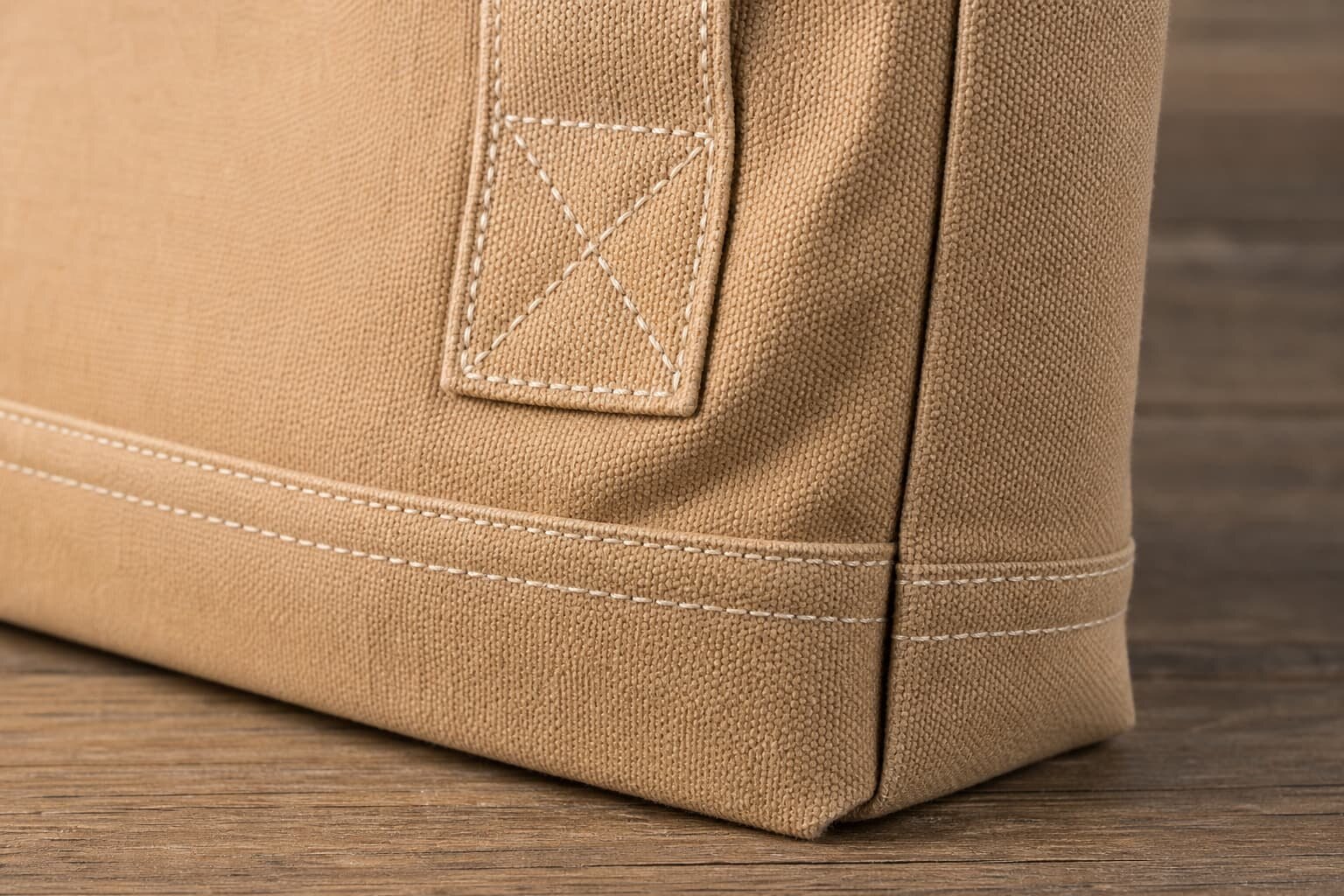
Two canvas fabrics with the same GSM can behave differently because of yarn count, weave tightness, finishing, and washing treatment. A tighter weave usually supports sharper screen printing and better shape retention. A looser weave may feel softer but can absorb more ink, distort fine artwork, or show more slubs. If the bag requires a clean retail appearance, the buyer should review both close-up fabric texture and the finished bag structure.
Finishing also changes the commercial result. Calendering can make the surface smoother for printing. Washing can soften the handfeel but may increase shrinkage and wrinkle risk. Pre-shrinking helps control finished dimensions, which matters when the tote has zipper closure, lining, gusset panels, printed borders, or artwork close to seams. If the supplier changes fabric mill or finishing route after sample approval, the buyer may receive bags that technically match the GSM but do not match the approved sample.
- Ask whether the canvas is plain weave or another construction and whether it is calendered, washed, or pre-shrunk.
- Check print sharpness on the actual fabric, not on paper or a different cotton sample.
- For structured totes, review whether the bag can stand or hold shape after packing.
- For soft lifestyle totes, confirm whether washing treatment changes dimensions or print durability.
Match Material to the Print Method Before You Approve Artwork
Print quality is not only a print room issue. It begins with fabric choice. Screen printing is usually the most stable method for solid logos, slogans, and one to four color artwork on cotton canvas. It works well for bulk orders because setup cost can be spread over quantity. However, rough canvas texture can break fine lines, and heavy ink on folded areas may crack if curing is poor.
Heat transfer, DTF, and digital printing can support more colors or gradient artwork, but buyers should check handfeel and durability carefully. On heavy canvas, a large transfer panel can feel stiff and plastic compared with the fabric. Embroidery gives a premium look for smaller logos, but it can pucker lightweight canvas and may require backing. Woven labels or sewn side labels are useful when the main panel needs a clean design, but the label material, fold, stitch color, and placement should be specified.
- Screen print: best for bold logos, larger quantities, and controlled unit cost.
- Digital or DTF print: useful for complex artwork, but check handfeel, edge quality, and wash resistance.
- Embroidery: premium for small logos, but test puckering and backing visibility.
- Woven or cotton label: good for subtle branding, but specify exact size, fold type, and seam position.
MOQ Logic: Why the Same Tote Has Different Minimums
Canvas tote bag MOQ is not only a factory policy. It depends on fabric availability, dyeing quantity, print setup, cutting efficiency, and accessory sourcing. If the buyer selects natural stock canvas and a one-color screen print, MOQ can be lower because the factory may already hold fabric or can purchase it from regular suppliers. If the buyer needs a custom dyed canvas, special width, recycled composition, heavy weight, zipper, lining, or metal fittings, MOQ may increase because upstream suppliers have their own minimums.
When comparing quotes, separate bag MOQ from material MOQ and print MOQ. A factory may agree to produce 500 pieces, but the fabric mill may require enough dyed canvas for 1,000 pieces. The extra fabric cost must be absorbed somewhere. For repeat buyers, it may be possible to keep leftover fabric for the next order, but this should be documented, labeled, and time-limited. Otherwise, the buyer may think they are receiving a better unit price while actually paying for unused material.
- Stock natural canvas usually supports lower MOQ and faster sampling.
- Custom dyed canvas often requires lab dip, bulk dyeing, and higher fabric MOQ.
- Multi-color screen print may require separate screens, setup charges, and longer pre-production time.
- Special handles, zippers, snaps, lining, and labels can create separate accessory MOQs.
Cost Breakdown Buyers Should Request Instead of One Flat Price
A flat unit price is easy to read but difficult to analyze. If one supplier is 12 percent cheaper, the saving may come from lower fabric weight, shorter handles, fewer stitches, weaker packing, or a different print process. Procurement teams should ask for a practical cost explanation, not necessarily a full open-book costing. The supplier should be able to confirm what is included in the quoted price and where changes will affect cost.
The most useful comparison is a quote matrix with controlled variables. Keep the same bag size, material, handle, print, packing, and incoterm, then ask suppliers to quote optional upgrades separately. This allows the buyer to decide whether a 12 oz canvas is worth the premium over 10 oz, whether an inside pocket is commercially necessary, and whether individual polybags are required for the retail channel.
- Fabric: weight, composition, color, finishing, shrinkage control, and waste allowance.
- Making: cutting, sewing, reinforcement stitching, pocket, gusset, lining, zipper, and trimming.
- Branding: screen charges, ink type, print colors, embroidery stitches, labels, and strike-off cost.
- Packing: polybag, tissue, hangtag, barcode label, master carton, carton marks, and pallet request.
- Logistics data: carton size, pieces per carton, net weight, gross weight, and estimated CBM.
Sample Approval: What to Check Before Bulk Production
The approved sample should lock the material and construction, not only the logo position. Buyers should keep the sample, fabric swatch, lab dip, print strike-off, and any accessory approvals together. If the bag has a zipper, pocket, lining, snap, or special handle, those parts should be included in the pre-production sample. A beautiful salesman sample made from available fabric is not enough if bulk fabric will be different.
Sample checking should be measurable. Do not approve by saying looks good if the PO later depends on exact size, handle length, print position, or carton packing. Measure the sample flat, record tolerances, photograph key details, and mark any accepted deviations. If the tote will carry heavy contents, request a simple load test or handle pull test. For printed bags, fold the printed area, rub the ink surface, and check whether the print cracks, flakes, or transfers.
- Measure width, height, gusset, handle length, handle width, and print placement.
- Check fabric weight, shade, surface texture, and whether the sample matches the approved swatch.
- Inspect stitch density, seam allowance, bartack, cross-stitch, and loose threads.
- Test print adhesion with tape, dry rub, fold pressure, and light scratching.
- Confirm packing fold lines do not damage print or create unacceptable creases.
Packing and Lead Time Risks That Affect Material Decisions
Packing is often treated as the last step, but it should be considered when choosing canvas material. Heavy canvas folded tightly can create hard creases, especially on dyed fabric or printed panels. Light canvas can wrinkle badly if cartons are over-compressed. If the tote is retail-facing, flat packing, tissue paper, or controlled folding may be worth the additional cost. If the order is for event distribution, efficient bulk packing may be more suitable.
Lead time also changes with material choice. Stock natural canvas with a simple print can move faster than custom dyed heavy canvas with lab dips, print strike-offs, zipper sourcing, and retail packing. Buyers should calculate lead time from the last approval, not from the first inquiry. Material booking, sample revision, artwork confirmation, deposit, peak season capacity, inspection, and export documentation can all affect the final shipment date.
- Ask whether lead time starts after deposit, artwork approval, sample approval, or material arrival.
- Confirm carton packing method before bulk production because it affects wrinkles and freight cost.
- For dark dyed canvas, use packing that prevents rubbing and color transfer during transit.
- For coated or thick prints, avoid folding directly across the main logo area when possible.
- Request carton drop strength suitable for export if cartons are heavy due to high GSM canvas.
A Practical Sourcing Workflow for Comparing Supplier Quotes
The cleanest way to source canvas tote bags is to control the specification first, then compare suppliers. Start with the intended use and selling channel. Choose a target fabric weight range, bag size, handle type, print method, and packing method. Send the same RFQ package to each supplier. If you allow every supplier to recommend their own material without a comparison format, you will receive prices that look competitive but are not technically equal.
After receiving quotations, shortlist by technical fit before negotiating price. Check whether the supplier answered the material questions, provided realistic MOQ logic, and identified risks in your design. A factory that warns about print cracking, dyed fabric MOQ, or handle reinforcement is often giving you useful engineering input. The lowest quote is not always wrong, but it must be checked against fabric weight, construction, packing, and lead time assumptions.
- Step 1: define use case, target retail value, required load, and expected reuse frequency.
- Step 2: issue one RFQ with fixed size, material range, print artwork, packing, and incoterm.
- Step 3: request fabric swatches or available sample photos before paying for custom samples.
- Step 4: compare quote inclusions, MOQ drivers, carton data, and sample lead time.
- Step 5: approve pre-production sample and keep it as the inspection standard.
Specification comparison for buyers
| Spec decision | Recommended option | When it fits | Buyer risk to check |
|---|---|---|---|
| Fabric weight for standard retail tote | 10 oz to 12 oz canvas, about 300 to 380 GSM | Good balance for book bags, event totes, retail merchandise, and repeat daily use | Confirm finished bag weight, not only fabric GSM, because lining, handles, and pocket specs change freight and carton weight |
| Fabric weight for low-cost promotion | 6 oz to 8 oz cotton canvas, about 180 to 260 GSM | Giveaways, light shopping, conference handouts, and short campaign use | Thin fabric may show print-through, wrinkle more after packing, and feel weak if the handle is not reinforced |
| Fabric weight for premium tote | 14 oz to 16 oz canvas, about 450 to 540 GSM | Brand merchandise, bookstores, cosmetics, fashion retail, and higher perceived value programs | Higher GSM increases sewing difficulty, needle marks, carton CBM, and may require stronger handle attachment |
| Natural vs bleached canvas | Natural unbleached canvas for most eco-positioned programs | Organic-looking retail totes, grocery bags, lifestyle brands, and minimalist artwork | Natural cotton shade varies by batch; approve a shade tolerance instead of expecting paper-white consistency |
| Dyed canvas | Reactive dyed canvas with buyer-approved lab dip | Brand color totes, seasonal retail ranges, and private label collections | Color fastness and shade variation need testing, especially for dark colors rubbing against light garments |
| Print method | Screen print for solid logos and large quantities | One to four color artwork, bold brand marks, promotional orders, and repeat SKUs | Ask whether ink is water-based, pigment, plastisol, or discharge, and test cracking after folding |
| Print method for detailed artwork | DTF, heat transfer, or digital print depending on fabric and order size | Gradients, photo-style graphics, small runs, and multi-color designs | Transfers can feel plastic on heavy canvas and may lift if heat pressure, curing, or wash resistance is poor |
| Handle construction | Self-fabric canvas handles with cross-stitch reinforcement | Most retail and promotional totes carrying books, apparel, groceries, or samples | Handle width, length, and stitch pattern affect load performance more than fabric GSM alone |
| Shrinkage control | Pre-shrunk or sanforized canvas when dimensional accuracy matters | Retail sets, printed artwork near seams, bags with zipper, gusset, or structured shape | Uncontrolled shrinkage can distort print placement and finished size after washing or steaming |
Buyer checklist before sampling
- Define the intended load, retail price level, and expected reuse frequency before asking suppliers to quote GSM.
- Specify fabric weight in oz and GSM if possible, and require tolerance such as plus or minus 5 percent.
- Confirm whether the quoted canvas is natural, bleached, dyed, recycled, organic, or blended cotton.
- Request a physical fabric swatch from the same production source before approving the bag sample.
- State finished bag size, gusset, handle length, handle width, pocket, zipper, lining, and reinforcement details in the RFQ.
- Match the print method to the fabric surface, artwork detail, color count, and expected durability.
- Approve lab dips for dyed canvas and print strike-offs for every logo color before bulk production.
- Check handle pull strength, seam allowance, stitch density, and bartack or cross-stitch reinforcement on samples.
- Ask for carton dimensions, pieces per carton, gross weight, net weight, and packing method with the quotation.
- Keep one signed pre-production sample and compare bulk goods against it during inspection.
Factory quote questions to send
- What is the exact canvas weight in GSM and oz, and what tolerance do you use in bulk production?
- Is the fabric natural, bleached, dyed, recycled, organic, or blended, and can you provide a swatch from current stock?
- Is the quoted fabric greige stock, made-to-order dyed fabric, or a regular mill item with stable availability?
- What is the minimum order quantity for this material, this color, and this print method separately?
- Which print method do you recommend for our artwork, and what are the setup costs or screen charges?
- Can you provide a print strike-off on the actual canvas before making the pre-production sample?
- What shrinkage, color fastness, and rubbing test results can you support for this fabric and color?
- What handle reinforcement method is included in the quote, and what load test can the sample pass?
- How many pieces per export carton, what carton size, and what gross weight should we expect?
- What lead time applies after sample approval, deposit, artwork confirmation, and material availability are all completed?
Quality-control points to confirm
- Measure fabric weight from a cut swatch or approved test report, not only from the supplier's quotation sheet.
- Check finished bag dimensions after pressing and packing, with a tolerance agreed before production.
- Inspect fabric shade under consistent lighting and compare against the approved swatch or lab dip.
- Check print position from top edge, side seam, and bottom seam rather than judging by eye only.
- Perform tape test, rub test, and fold test on printed areas before approving bulk shipment.
- Pull-test handles and inspect whether reinforcement stitching catches all fabric layers.
- Check skipped stitches, loose threads, seam puckering, needle holes, and uneven topstitching.
- Confirm cartons are not overfilled and printed panels are protected from ink transfer or sharp creases.
- Verify polybag, hangtag, barcode, inner pack, and carton mark requirements against the purchase order.
- Retain approved sample, fabric swatch, lab dip, and print strike-off for final inspection reference.