Why a line release memo matters before the factory cuts cloth
A canvas tote bag factory line release approval memo is the document that tells the supplier production can start on the exact approved version, not a loose interpretation of the sample. For a simple tote, that may sound excessive. In practice, it is one of the cheapest ways to prevent expensive mistakes, because most tote claims come from small spec gaps: a handle that is 2 cm short, a print that shifted a few millimeters, a fabric that was quoted by eye instead of by finished GSM, or a packing method the buyer never saw until cartons arrived.
For procurement teams, the memo is not just an internal form. It is the last controlled handshake between sourcing, quality, and the factory line. If the memo is written well, it becomes the reference point for disputes, rework, and delivery scheduling. If it is vague, the supplier can honestly say they produced what they understood. That is why the memo should always point to a specific sample, a specific artwork file, and a specific packing version before the first cut order is released.
- Use the memo after pre-production sample approval, not after a verbal green light.
- Reference the exact sample ID, revision date, and approved sign-off names.
- Treat the memo as a production control document, not a marketing spec sheet.
What the approval memo should actually freeze
A useful memo freezes the details that affect cost, fit, print, and pack-out. For a canvas tote bag, that means body dimensions, fabric weight, handle length, stitch construction, print method, artwork version, label type, and final packing instructions. If any of those items are still open, the line release is premature. The best memo format is short enough to use, but detailed enough that the factory can hand it to the line supervisor without asking the buyer for clarification.
Do not assume the sample alone is enough. Samples can be made by a different operator, with hand-cut parts, manual alignment, or more attention than the main line will ever get. The memo should state what the factory must replicate at scale and what tolerances are acceptable. If the approved sample is the benchmark, the memo is the translation layer between that sample and mass production reality.
- Identify the approved sample and attach a photo or file reference.
- List the exact product dimensions and any allowed tolerance.
- Specify what is locked and what is still open, if anything, before release.
Fabric weight and construction details buyers should lock first
Canvas tote bag buyers often compare quotes that are not actually comparable. One factory may price 8 oz canvas, another 10 oz, and a third may call a lightweight fabric canvas even if the hand feel is closer to a cotton drill. That is why the line release memo should state fabric weight in both oz and gsm when possible. A practical range for many retail totes is 8 oz to 12 oz, or roughly 270 gsm to 400 gsm, depending on desired body structure and price point. If the bag is meant for heavier carry, the memo should also call out whether the fabric is pre-shrunk or whether shrinkage allowance is included in the finished size.
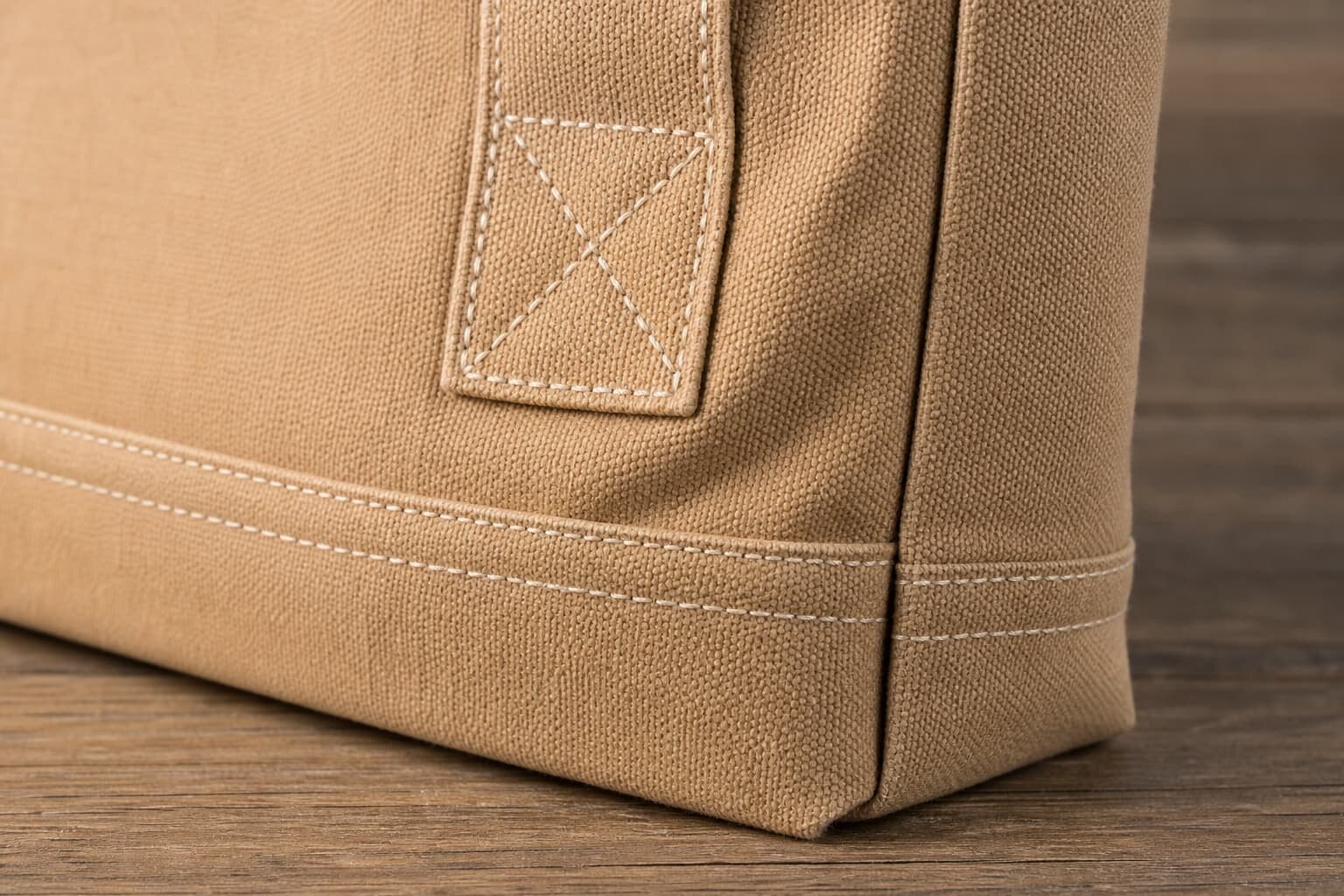
Construction details matter just as much as the fabric. A tote with self-fabric handles behaves very differently from one with cotton webbing handles and reinforced bar-tacks. The factory should know whether the bottom is a single seam, boxed, or gusseted, and whether the side seams are turned in or overlocked. These details change labor time, sewing speed, and failure risk. The memo should also define acceptable stitch density, seam allowance, and whether raw edges may be visible on the inside.
- Quote fabric by finished GSM and oz so overseas suppliers do not translate it loosely.
- State handle material, width, length, and reinforcement method.
- Note whether the body is flat, gusseted, or boxed bottom, because that changes both cost and load performance.
Print method and artwork control are where tote disputes start
Print issues are one of the fastest ways to turn a simple canvas tote into a claim. Screen print, heat transfer, embroidery, woven patch, and direct-to-garment style decoration all behave differently on canvas. For many branded totes, screen print is still the most stable choice for simple one- or two-color artwork because the cost scales well and the look is repeatable. But if the artwork has many small details, gradients, or fine text, the memo should force a different conversation about line thickness, registration, and the realistic print area.
The approval memo must name the print file version and the placement dimensions. A factory can only match what it can measure. Buyers should define the maximum print width and height, the distance from the top edge, and the acceptable shift tolerance if the artwork sits off-center. If the bag has a woven label or side label instead of a printed logo, the memo should still specify size, thread colors, attachment method, and placement. The rule is simple: no visual assumption should remain when the line starts.
If the quote includes multiple print colors, ask the factory to break down the added cost by color count and screen count. That makes it easier to compare suppliers and understand where the price changes are coming from. A buyer who approves the art without asking how many screens or passes are involved is usually the one who discovers later that the order cannot stay on budget.
- Lock the artwork file name, revision number, and approved placement dimensions.
- Ask the factory to state the print method and whether the quote includes screens, plates, or setup fees.
- Require a sample print approval before line release if the design has fine text or tight registration.
MOQ logic should be written into the memo, not guessed
MOQ on canvas tote bags is rarely a single number. It can change by color, fabric weight, print complexity, label type, or packing method. A supplier may accept a lower MOQ for a blank tote, then require a higher MOQ once a logo, woven label, or custom hangtag is added. Buyers should ask the factory to quote MOQ by configuration, not by product name alone. Otherwise, the order may look workable at inquiry stage and become impossible once artwork and packing are finalized.
Lead time should be treated the same way. A realistic production schedule is not just sewing time. It includes fabric booking, print preparation, sample confirmation, line release, production, in-line inspection, packing, and carton dispatch. If fabric is stock-supported, the order may move faster; if the fabric must be woven or dyed to order, the lead time changes immediately. The memo should separate the approval date from the promised ship date so the team can see how much time was lost or gained in the release process.
When comparing suppliers, ask them to state quote data in the same structure: fabric spec, artwork spec, handle spec, packing spec, and lead time assumption. That is the only way to compare a factory that is offering a low unit price with another that is including more complete work in the quote.
- Require MOQ by color, design, fabric weight, and packing configuration.
- Separate material lead time from sewing lead time and shipping lead time.
- Never compare quotes unless the factories are quoting the same spec sheet.
Packing and carton data belong in the approval memo too
Packing changes the real cost of a canvas tote bag order more than many buyers expect. A tote may be flat-folded, folded with tissue, polybagged, inserted with a card, or packed in bulk without inner bags. Each option affects labor, carton density, and the final warehouse experience. If the product is for retail, e-commerce, or club store distribution, the memo should define the packing style clearly and include the target inner pack count and carton count. If those details are missing, the factory may pack in the most convenient way for the line, not the most useful way for the buyer.
Carton data should also be frozen before release. That includes carton dimensions, gross weight target, carton marks, and whether mixed sizes or mixed colors are allowed. A tote with a generous body size can suddenly create a CBM problem if the fold method is not controlled. The memo should note whether the bags must be folded to the same dimension before carton loading and whether the factory may compress them. This matters for both freight planning and shelf readiness. Buyers who ignore carton data often end up with good bags in bad logistics.
- State inner pack quantity, master carton quantity, and whether polybags are required.
- Approve carton dimensions and expected carton weight before production starts.
- Specify the fold method so the factory does not invent a new pack format.
Acceptance criteria for the first line run should be measurable
The best line release memo does not just say approved or rejected. It states what the factory must show in the first production run before bulk sewing continues. For canvas tote bags, that usually means a pilot batch or first run check covering fabric shade, print placement, stitch quality, handle symmetry, and measurement accuracy. The buyer should define how many pieces will be checked and what conditions trigger a stop. If the first run is wrong, the factory should correct the line before the whole order is committed.
Acceptance criteria should be written in plain language. For example, the body width should match the approved sample within the agreed tolerance, the print should sit within the approved placement window, and the handles should be within the approved length range and centered correctly. If there is a special concern, such as heavy load use or premium retail appearance, it should be called out explicitly. The memo should also state whether minor cosmetic variation is acceptable or whether the order is intended for a tighter visual standard. That prevents a factory from using generic bulk tolerance when the buyer expected premium consistency.
If the buyer does not define line-release acceptance criteria, the factory will define them by routine. That may be fine for commodity promos, but it is not enough for retail programs, brand launches, or repeatable replenishment orders.
- Check the first run before bulk production continues.
- Use numeric tolerances for measurements whenever possible.
- Write the stop condition clearly so the factory knows when production must pause.
Use a comparison sheet so suppliers quote the same tote
A line release memo is strongest when it sits on top of a clean comparison sheet. The buyer should ask every factory to quote the same canvas tote bag spec so the pricing difference reflects actual efficiency, not spec drift. For example, one supplier might quote a 10 oz canvas bag with screen print and cotton webbing handles, while another quietly uses lighter fabric, a smaller print area, or a simpler inner pack. Without a side-by-side comparison, the procurement team may choose the lowest number without seeing what was removed from the build.
A practical comparison sheet for canvas tote bags should track the spec decisions that change cost and risk. The fabric weight, print method, handle construction, packing style, and approval gate should all be visible in one view. That helps brand owners judge whether a cheaper quote is actually a different product. It also helps importers explain to downstream stakeholders why one supplier is more expensive but may be safer for retail launch or reorders.
Use the table in the RFQ pack and make the factories quote against it. Then, when the sample comes back, the line release memo becomes a formal confirmation that the quoted version and the approved version are the same item.
- Ask each factory to quote against the same spec matrix.
- Compare not only unit price but also what is included in setup, labeling, and packing.
- Use the approved sample to verify that the quote and the real product match.
Common mistakes that create disputes after release
The most common problem is a vague memo. Phrases like standard canvas, normal print, or buyer approved sample are not enough when the order hits the line. Another common mistake is mixing sample versions. A buyer may approve one sample for look, then change the handle length or label placement by email and forget to update the release memo. When the factory follows the latest email but the procurement team remembers the original sample, both sides think they are right. The fix is simple: one source of truth with one revision history.
A second category of mistake is packing drift. The tote may be correct, but the bag is folded differently, carton counts change, or labels move to a new position. That creates warehouse problems even when the sewing is fine. A third mistake is underestimating fabric variation. Canvas is a natural material, and shade, hand feel, and surface texture can vary by lot if the buyer does not define acceptable limits. The memo should not pretend variation does not exist; it should define what variation is allowed.
If the order includes a new print method, a new fabric weight, or a new packing style, write a short risk note into the memo and require a first-run checkpoint. That tiny step prevents the most expensive class of late-stage surprises: production starting under the wrong assumption.
- Do not let email comments override the signed memo.
- Treat packing as a controlled spec, not a warehouse afterthought.
- Define shade, size, and print tolerance before the line is released.
How to use the memo as a final procurement sign-off
The line release approval memo should end the buying discussion, not restart it. Once the memo is signed, procurement, quality, and the factory should all be aligned on one version of the canvas tote bag. If someone wants to change the fabric, artwork, packing, or dimensions after release, the change should move through a written revision. That discipline matters because even a small change can shift cost, lead time, or carton count. A good memo prevents hidden scope creep from becoming a production dispute.
For buyers, the value of the memo is not just control; it is speed. When the release process is clean, the factory can start with confidence, the merchandiser can forecast more accurately, and the import team can plan inspection and freight with fewer surprises. The memo becomes especially useful on repeat programs, where the buyer wants stable replenishment and a known spec. If the factory starts asking questions after release, that is usually a sign that the memo was not complete enough. The goal is to make the release so clear that the production line can move without interpretation.
For canvas tote bag sourcing, this is the practical standard: approve the sample, freeze the spec, confirm the quote basis, lock the pack, and release the line only when the signed memo matches the job ticket exactly.
- Require a fresh revision for any post-approval change.
- Keep the memo, sample photo, and quote sheet in the same order file.
- Use the memo as the final check before the factory commits labor and materials.
Specification comparison for buyers
| Spec decision | Recommended option | When it fits | Buyer risk to check |
|---|---|---|---|
| Body fabric | 10 oz / about 340 gsm cotton canvas | Most retail, promotional, and everyday carry totes | Confirm finished GSM, shrinkage allowance, and whether the quote includes pre-shrunk fabric |
| Print method | Screen print for simple 1-2 color logos | Longer runs with clean artwork and repeat orders | Check ink hand feel, registration tolerance, and whether flash curing can change fabric shade |
| Handle build | Cotton webbing with bar-tack reinforcement | Totes that need better load strength and a cleaner retail look | Verify handle length, stitch count, and whether the bar-tack pattern matches the approved sample |
| Packing style | Flat-folded with defined inner pack and carton count | E-commerce, retail distribution, and mixed-warehouse shipping | Confirm fold method, polybag use, carton marks, and whether the factory mixes sizes or colors |
| Approval gate | Signed line release memo after pre-production sample approval | Any order where lead time or liability matters | Make sure the memo references the exact sample, print file version, and packaging version |
Buyer checklist before sampling
- Confirm the approved sample ID, artwork file name, and revision date before line release.
- Lock fabric weight in both oz and gsm, plus the allowed tolerance range.
- State finished size, handle length, seam allowance, and any gusset or base width.
- Approve the print method, color count, placement, and acceptable registration tolerance.
- Specify packing method, inner pack quantity, carton quantity, and carton marking format.
- Ask the factory to confirm MOQ by size, color, fabric weight, and print version.
- Record line release sign-off from both buyer and factory production owner.
- Require a first-run inspection checkpoint before the factory commits to full mass production.
Factory quote questions to send
- What exact fabric construction are you quoting: weave, finished GSM, and any pre-shrink or washing treatment?
- Is your MOQ based on total order quantity, per color, per print design, or per fabric weight?
- Which print method are you pricing, and what changes if the artwork adds more colors or larger coverage?
- What is the quoted lead time for material booking, sample approval, line release, production, and packing?
- What measurement tolerances do you follow for body width, body height, handle length, and gusset depth?
- What packing details are included in the quote: polybag, insert card, carton count, and carton dimensions?
- What inspection or proof can you provide for first-run approval, such as in-line photos or pre-pack checks?
- Which parts of the quote are excluded, such as label development, barcode stickers, testing, or freight cartons?
Quality-control points to confirm
- Fabric weight matches the approved spec and the tolerance is written in the memo.
- Canvas shade is consistent within the agreed lot and does not drift between panels.
- Print placement, color density, and registration match the signed sample.
- Handle length, symmetry, and bar-tack reinforcement match the approved construction.
- Stitch density is even, with no skipped stitches, loose threads, or puckering at stress points.
- Top edge, side seams, and bottom seam allowance follow the approved measurement sheet.
- Packing count is correct per inner pack and carton, with no mixed SKUs or unlabeled cartons.
- Carton marks, barcode placement, and buyer item code match the shipping file.
- First production piece is checked before bulk release, not after the whole line is finished.
- The memo is signed only after all changes from comments have been closed in writing.