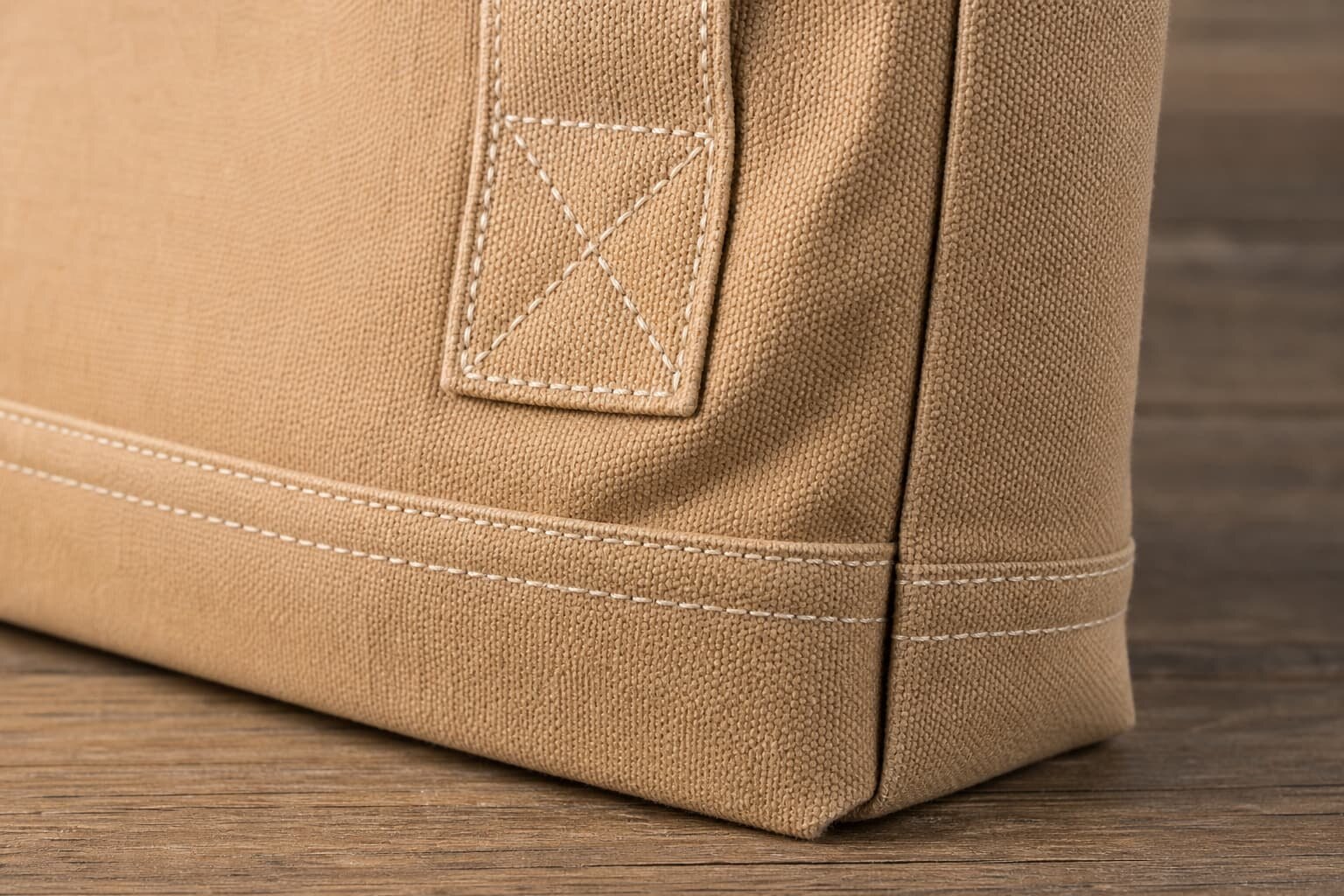
Why Handle Stitch Approval Deserves Its Own Line in the RFQ
Many canvas tote bag RFQs describe body size, fabric weight, print color, and packing, but leave handle stitching as a factory default. That is risky because the handle attachment carries the load, receives the most repeated stress, and is one of the first details a retail buyer or distributor notices during inspection. A tote with a clean front print can still fail if the handle boxes are crooked, weak, puckered, or inconsistent across cartons.
Handle stitch approval is not just a cosmetic decision. It affects labor time, thread consumption, sewing machine setup, fabric cutting allowance, sample lead time, and sometimes MOQ. If you want comparable supplier quotes, state the required handle construction clearly. Otherwise, one supplier may quote a simple rectangular stitch while another includes a reinforced X-box stitch, and the lower price may not represent the same product.
- Treat handle stitch construction as a costed specification, not a minor sewing detail.
- Ask the factory to quote the same stitch type and handle material across all price comparisons.
- Approve the handle stitch on a physical sample when the bag is intended for retail, grocery, book, bottle, or merchandise carrying.
- Keep the approved handle stitch photo in the purchase order file so QC and merchandising teams use the same reference.
Define the Canvas Body Before Approving the Stitch
Handle stitching cannot be approved properly without knowing the canvas weight and structure. A 6 oz promotional cotton tote, a 10 oz retail tote, and a 16 oz heavy canvas utility tote do not respond the same way under the needle. Lighter fabric can tear if the stitch density is too aggressive. Heavier fabric can create bulky seams, skipped stitches, or uneven tension if the needle, thread, and machine are not matched.
Buyers should specify finished fabric weight, not only greige fabric or supplier naming terms. Some factories describe cotton fabric by oz, some by GSM, and some use loose labels such as canvas, cotton canvas, or duck canvas. For practical sourcing, 8 oz canvas is often used for lighter promotional bags, 10 oz to 12 oz for branded reusable totes, and 14 oz or above for heavier retail or workwear-style bags. The correct handle stitch must be reviewed against the final fabric used in production.
- For light 6 oz to 8 oz cotton bags, check whether reinforcement is needed to avoid tearing at the handle base.
- For 10 oz to 12 oz canvas, X-box stitching is usually a safer retail-grade option than a simple straight stitch.
- For 14 oz to 16 oz canvas, confirm needle size, thread thickness, and whether the top hem becomes too bulky.
- If the canvas is dyed, washed, laminated, or enzyme finished, request the finished GSM tolerance after processing.
Choose the Right Handle Construction for the Use Case
A canvas tote handle can be made from the same body fabric, cotton webbing, polyester webbing, jute blend tape, or contrast decorative tape. Self-fabric handles look more premium and consistent with fashion or retail packaging bags, but they require cutting, folding, and extra sewing. Webbing handles are more efficient for bulk production and can be stronger, but buyers must approve texture, color, width, and edge feel.
Handle drop is another commercial decision. Short hand-carry handles may use less material and reduce carton bulk. Shoulder-carry handles require a longer drop and put different stress on the stitch area because the bag swings and twists during use. When comparing quotes, make sure the handle drop is measured the same way, usually from the top edge of the bag to the highest inside point of the handle when laid flat.
- Use 2.5 cm cotton webbing for economical promotional totes where cost and simple handling matter.
- Use 3 cm to 3.8 cm webbing or self-fabric handles for heavier retail bags and better hand comfort.
- Specify handle drop separately from total handle length to avoid misunderstandings in cutting.
- Check whether the handle end is hidden inside the top hem or attached on the outside panel with visible reinforcement.
What to Approve: Box Stitch, X-Box Stitch, or Bar Tack
The most common buyer mistake is approving a nice-looking tote sample without naming the handle stitch. A simple box stitch may look acceptable in photos, but an X-box stitch adds diagonal reinforcement and spreads stress better across the handle attachment area. A bar tack can be useful for certain webbing constructions, but it may look too technical or may not cover enough surface area on soft cotton canvas unless placed correctly.
For many branded canvas tote bags, an X-box stitch with secure back tack is the preferred approval standard. It is visible, inspectable, and familiar to factories. The buyer should define the approximate box size, thread color, and stitch density, then allow the factory to propose practical adjustments based on fabric thickness. If contrast thread is used as a design feature, the tolerance for crooked stitching must be much tighter because every deviation becomes visible.
- Box stitch: cleaner and faster, suitable for lighter use if the fabric and handle are not heavily loaded.
- X-box stitch: stronger visual and functional reinforcement for retail, grocery, and merchandise totes.
- Bar tack: efficient for webbing, but confirm whether it meets the buyer's appearance standard.
- Double row top hem plus handle insertion: useful when the handle end is concealed inside the hem, but harder to inspect after sewing.
Set Measurable Acceptance Criteria for Sewing Quality
Approval should not rely on subjective comments such as good stitching or strong handle. Procurement teams need measurable acceptance criteria that can be used by the factory QC team, third-party inspectors, and buyer-side receiving teams. The main points are stitch density, box dimensions, symmetry, seam tension, and thread security. These criteria do not need to be complicated, but they must be written before bulk production starts.
For a typical 10 oz to 12 oz canvas tote, buyers often review stitch density around 7 to 9 stitches per inch, depending on thread and fabric. Too few stitches can look loose and reduce strength. Too many stitches can perforate the canvas and create a tear line. The approved sample should become the visual master, while the written spec gives inspectors a practical way to judge borderline pieces.
- Confirm no skipped stitch is allowed on handle attachment points because this is a high-stress area.
- Define loose thread trimming requirements, especially if the bag has natural canvas and dark thread.
- Reject open back tacks or thread tails that can be pulled by hand and start unraveling.
- Check both front and reverse sides because thread tension problems often show first on the inside.
- Allow minor visual variation only if it does not affect strength, symmetry, or retail appearance.
Protect the Print Area While Reinforcing the Handle
Canvas tote bags often carry a screen printed logo, heat transfer, embroidery patch, woven label, or inside care label. Handle stitch approval must be coordinated with decoration approval because the handle reinforcement area can reduce printable space. If the logo is too close to the handle box, the print may look crowded, distorted, or partly hidden when the bag is carried.
Screen printing is common for cotton canvas because it gives good coverage and efficient cost at volume. Water-based ink may suit natural cotton and softer handfeel, while plastisol or high-opacity ink may be chosen for darker dyed canvas depending on supplier capability. Embroidery near the handle area adds thickness and may interfere with folding or sewing. Buyers should request an artwork placement sheet showing the top hem, handle attachment points, side seams, and print safe zone.
- Keep logo artwork clear of handle stitch boxes and top hem seam allowance.
- Ask the factory to mark print position on the pre-production sample before printing bulk panels.
- For contrast stitching, review whether thread color competes with the printed logo.
- For inside labels, confirm they do not sit under the handle reinforcement and create a bulky stitch area.
- For heat transfer, check that later sewing or pressing does not mark the transfer surface.
Sample Approval Workflow That Prevents Bulk Rework
A reliable sample workflow is more useful than a long email chain. Start with a construction sample if the bag shape, handle length, or stitch method is uncertain. Then move to a pre-production sample using final canvas weight, final handle material, final thread, final print method, and intended packing fold. Do not approve handle stitching from a substitute fabric sample unless the final material has the same thickness and behavior.
For approval, request a full set of sample photos as well as a physical sample when timing allows. Photos should include the full bag front, full bag back, top edge, inside seam, all four handle attachment points, close-up of stitch density, and a measurement image for handle drop. A physical sample allows the buyer to check stiffness, handfeel, loading behavior, and whether the handle twists when carried.
- Ask for one master sample kept by the factory and one matching sample sent to the buyer.
- Sign or label the approved sample with date, version, fabric weight, stitch type, and print method.
- If changes are made after approval, issue a revised approval note instead of relying on chat messages.
- For repeat orders, confirm whether the previous sample is still valid or whether fabric lot and handle material changed.
- Do not release bulk cutting until handle stitch, print placement, and packing fold are approved together.
MOQ and Cost Logic Behind Stronger Handle Stitching
Reinforced handle stitching is not usually the largest cost in a canvas tote bag, but it can affect labor efficiency. A simple stitch path is faster. An X-box stitch takes more machine time and requires better operator control. Longer handles, wider webbing, contrast thread, or custom dyed handle tape can also affect MOQ because the factory may need to purchase minimum quantities of material.
When buyers compare quotes, they should separate real cost drivers from vague price increases. Fabric weight, bag size, handle length, print colors, packing method, inspection requirement, and order quantity usually matter more than the stitch shape alone. However, if a supplier quotes a very low price, check whether they downgraded the handle construction, shortened the handle, reduced canvas GSM, or removed reinforcement without highlighting the change.
- Ask whether the quoted MOQ is driven by canvas fabric, handle webbing, print setup, dyeing, or cutting efficiency.
- Request separate price impact for changing from box stitch to X-box stitch if the quote seems unclear.
- Confirm whether contrast thread creates a small MOQ because of thread color sourcing or line setup.
- For mixed color orders, ask whether each color needs its own MOQ for handle tape and fabric dye lot.
- For distributor programs, standardizing one handle stitch across several sizes can improve production consistency.
Load Testing and Inspection Before Shipment
A practical load test should reflect the bag's intended use. A book fair tote, wine carrier style tote, grocery tote, and fashion retail tote do not need the same test, but each needs a standard. Buyers can ask the factory to load sample bags with an agreed weight for a set time, lift repeatedly, or perform a controlled pull test if equipment is available. The point is not to create unrealistic laboratory claims; it is to catch weak handle attachment before packing.
Inspection should include both functional and cosmetic review. Functional failures include tearing fabric at the stitch line, broken thread, open top hem, or handle pull-out. Cosmetic issues include crooked X-box shapes, different box sizes on left and right handles, heavy puckering, dirty chalk marks, and long untrimmed threads. For retail buyers, cosmetic sewing issues can cause chargebacks even if the bag is technically strong enough.
- Select random pieces from bulk cartons, not only line-end samples prepared by the sewing team.
- Check four handle attachment points per bag because one weak point is enough to create a return.
- Record the test weight, test duration, and result photos in the inspection report.
- After load testing, inspect the fabric around needle holes for tearing or stress whitening.
- If defects cluster by operator or production line, ask the factory to segregate and recheck that batch.
Packing and Lead Time Details Buyers Often Miss
Packing can damage an otherwise approved canvas tote bag. If handles are folded sharply under heavy carton pressure, they may arrive with permanent creases or twisted shape. If printed panels touch unprotected surfaces too soon after printing, there can be transfer marks, scuffing, or blocking. Natural canvas also picks up dirt easily, so packing tables and polybags must be controlled for cleaner retail presentation.
Lead time should include fabric procurement, cutting, printing, sewing, inline QC, final inspection, packing, and carton marking. Handle stitch approval can delay production if it is left until after print approval or if the factory has to remake samples with final fabric. A realistic schedule confirms when the pre-production sample is approved, when bulk materials are ready, when printing begins, and when final packed cartons are available for inspection.
- Specify flat pack, half-fold, or individual polybag only after checking how the handle sits inside the carton.
- Use carton size and quantity per carton that prevent over-compression of handles and top hems.
- Confirm whether hangtags, barcode stickers, or retail labels are attached before or after final pressing.
- Ask the factory to send packed carton photos before shipment if the order is for retail distribution.
- Build sample approval time into the production calendar instead of treating it as separate from lead time.
Specification comparison for buyers
| Spec decision | Recommended option | When it fits | Buyer risk to check |
|---|---|---|---|
| Handle attachment stitch | X-box stitch with back tack at start and end | Retail totes, grocery bags, event bags, and reusable shopping bags expected to carry weight | Box size too small, diagonal stitches skipped, thread ends not locked, or uneven alignment between left and right handles |
| Fabric weight | 10 oz to 12 oz cotton canvas for most branded retail totes | Good balance of structure, print surface, and shipping weight | Supplier quotes lower GSM or substitutes plain cotton without confirming finished fabric weight |
| Handle material | Same canvas as body or 2.5 cm to 3.8 cm cotton webbing | Same-fabric handles suit premium fashion totes; webbing suits promotional and utility orders | Handle color, shrinkage, width tolerance, and handfeel differ between sample and bulk |
| Stitch density | Usually 7 to 9 stitches per inch, confirmed by sample and fabric thickness | Most medium and heavy cotton canvas constructions | Too dense can cut fabric; too loose can reduce holding strength and look cheap |
| Thread choice | Polyester thread matched to body or contrast color approved by buyer | Better abrasion resistance for daily-use bags and repeated handling | Cotton thread may shrink or break faster if not specified; contrast thread exposes every sewing deviation |
| Print position near handle | Keep print clear of handle reinforcement and seam allowance | Screen print, heat transfer, embroidery patch, or woven label on tote body | Logo hidden by handle box, distorted by thick seams, or cracked where print crosses stitch area |
| Sample approval | Pre-production sample with final fabric, final handle, final thread, final print | Orders where handle strength and brand presentation matter | Approving a photo or substitute sample can miss stitch tension, puckering, and handle feel |
| Packing method | Flat pack or half-fold with handles straightened and protected from compression marks | Retail cartons, distributor warehouse receiving, and ecommerce prep | Handle creases, twisted handles, print transfer, and carton bulging after long transit |
Buyer checklist before sampling
- Confirm finished fabric weight in oz or GSM, not only supplier fabric name such as canvas, cotton, or duck cloth.
- Approve handle width, handle drop, handle material, color, and shrinkage behavior before the bulk quote is locked.
- Specify the handle stitch shape, stitch density, thread type, thread color, and back tack requirement in the RFQ.
- Ask for close-up photos of both inside and outside handle attachment areas on the pre-production sample.
- Measure whether the left and right handles are symmetrical from side seam, top edge, and bag center line.
- Check that handle reinforcement does not interfere with logo position, pocket placement, zipper opening, or hangtag location.
- Run a practical load test using the intended product weight, not only a short pull by hand.
- Record acceptable cosmetic limits for skipped stitches, loose threads, puckering, needle holes, and chalk marks.
- Confirm packing direction so handles are not permanently folded, twisted, or pressed into printed panels.
- Keep one signed approval sample at the factory and one buyer-side reference sample for shipment inspection.
Factory quote questions to send
- What is the finished fabric weight in GSM or oz after dyeing, washing, or finishing, and what tolerance do you quote?
- Will the handle be self-fabric canvas, cotton webbing, polyester webbing, or another material, and what width and thickness are included?
- Which handle stitch construction is included in the unit price: straight bar tack, box stitch, X-box stitch, or another reinforcement?
- What stitch density and thread type will be used for the handle attachment on this fabric weight?
- Can you provide a close-up photo of previous bulk production using the same handle stitch construction and fabric weight?
- Does your MOQ change if we request contrast handle thread, custom handle color, longer handle drop, or heavier canvas?
- How many pre-production samples are included, and are they made on the same sewing line planned for bulk?
- What load test or pull test can your QC team perform before packing, and how will results be reported?
- How will bags be packed to prevent handle deformation, print transfer, and carton compression during export transit?
- Which quote line items are affected if we change from a simple box stitch to a reinforced X-box stitch?
Quality-control points to confirm
- Handle box stitch size is consistent on all four attachment points and matches the approved sample.
- No skipped stitches, broken threads, open seams, loose back tacks, or unraveling thread tails at handle attachment points.
- Needle tension is balanced without heavy puckering, fabric cutting, or visible thread loops on the reverse side.
- Handle drop, handle width, and handle position stay within agreed tolerance across packed cartons.
- Print, label, pocket, zipper, or top hem placement does not conflict with handle reinforcement area.
- Load test sample bags do not tear at the stitch line, top hem, or handle fabric after practical weight testing.
- Inside finish is clean enough for retail use, with no raw thread clusters or bulky knots under the handle patch.
- Carton packing keeps handles flat and aligned, without twisting, crushing, or marking the front logo panel.