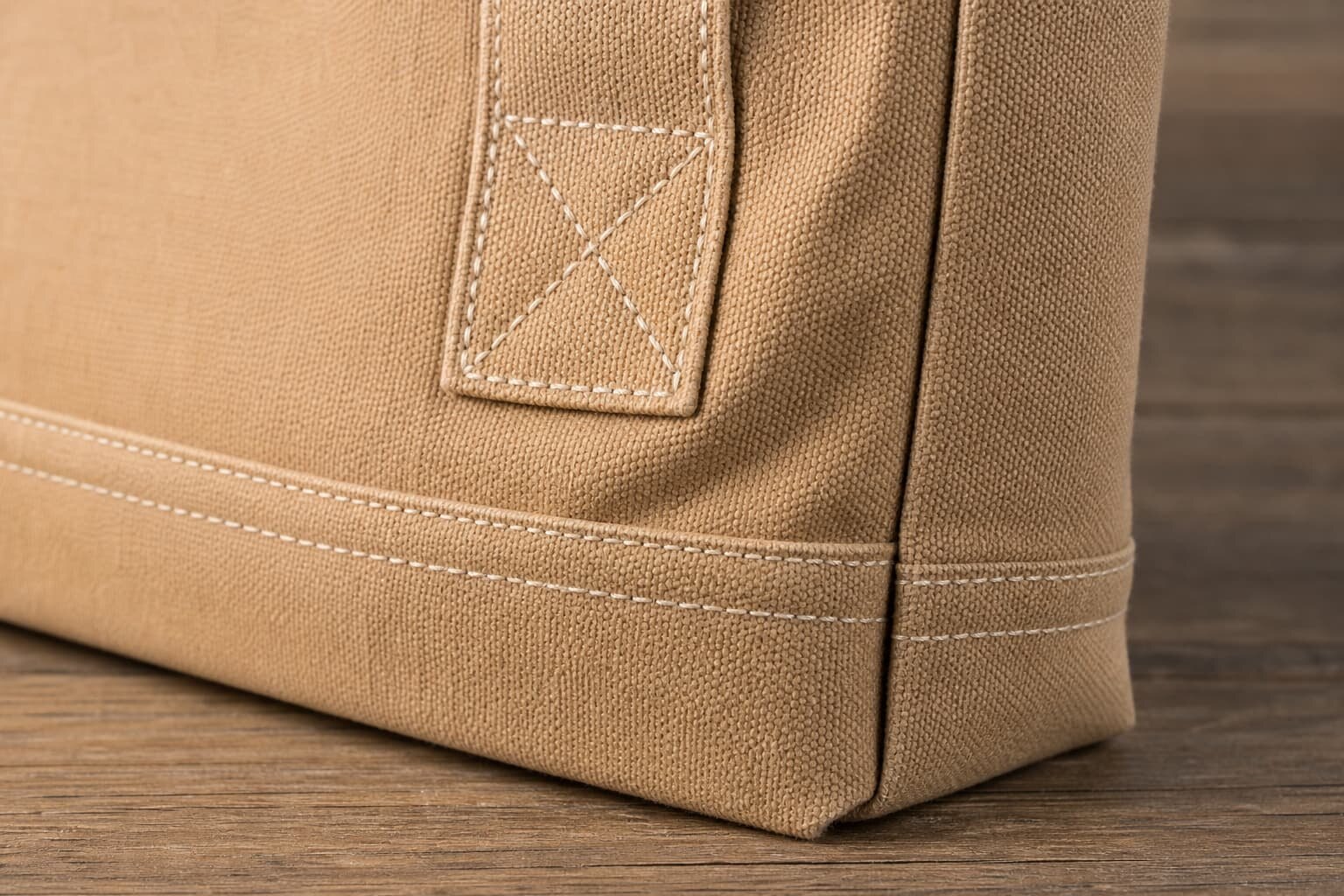
Why Handle Seam Variance Matters
Handle seam variance is not a cosmetic issue. On a canvas tote bag, the handle anchor is the part that takes load every time the customer lifts the bag, sets it down, or hangs it on a hook. If the left and right seams do not match, or if one lot has tighter stitch spacing than another, the bag may still pass a quick visual check while quietly creating a return risk, a complaint risk, or a failure in use. That is why the buyer needs a tracker, not just a photo approval.
The problem gets worse when the tote is sold as a retail item instead of a free promo bag. A 220-260 GSM canvas tote can work for light promotional use, but it needs very clear seam controls if the buyer expects repeat use. A 280-340 GSM tote can carry more weight, but only if the seam allowance, reinforcement, and stitch pattern stay stable. The tracker helps you connect the visible seam details to the real commercial risk.
- A small seam shift can turn into a handle pull-out risk after repeated use.
- Visual approval alone does not prove the seam is stable across a full lot.
- Variance matters most when the tote will be sold, not just handed out once.
Define The Seam Spec Before You Ask For Price
A buyer should not ask for a canvas tote quote without defining the handle seam package. State the handle material, finished handle width, handle drop, seam location from the top edge, stitch pattern, bartack or box-X size, thread type, and reinforcement patch dimensions. If the factory has to guess any of those items, the quote will not be comparable and the bulk result will not match the sample. A good RFQ reads like a sewing instruction, not a style note.
Fabric weight also changes the seam decision. For example, 280 GSM canvas may work well for a simple retail tote with a clean print and moderate contents, while 340 GSM canvas can support a more structured bag with a stronger look and higher carry load. If you use screen print near the handle seam, the print deposit and cure can stiffen the fabric and change how the seam lies. That is why the RFQ should state both the textile spec and the print method together.
- Write the seam spec in millimeters, not as a vague reference to a sample.
- State whether the artwork may cross or approach the handle anchor zone.
- Ask for the same seam construction in sample and bulk, with no hidden substitution.
Build A Tracker That Purchases Can Actually Use
A useful variance tracker is simple enough for a factory to fill out and specific enough for a buyer to compare lots. At minimum, it should record the style code, fabric GSM, handle material, handle length, seam position, bartack size, stitch count or SPI range, thread type, reinforcement patch size, and the operator or line number that made the lot. Add a photo slot for front, back, side, and close-up views so the record is not just a table with no evidence. If the supplier cannot fill this out, the spec is probably still too loose.
The tracker should also capture sample timing. Ask for the first sample, the pre-production sample, and the inline production checkpoints to be logged separately. For a normal canvas tote program, sample lead time is often 5-10 working days, pre-production approval 7-14 days after sample comments, and bulk 25-45 days depending on fabric availability, print count, and packing complexity. Those ranges are not promises; they are a practical way to pressure-test the factory's schedule before you issue the PO.
- Record actual measurements from the bag, not only the factory's description.
- Separate sample, pre-production, and bulk records so one good sample does not hide a weak line.
- Keep the tracker tied to the lot number and carton code for later claims review.
Set Acceptance Bands Before The First Sample
The fastest way to lose control of seam quality is to say the bag must be okay or neat without writing the tolerance. Decide the acceptable band for the handle anchor position, the left-right handle symmetry, the bartack length, the seam allowance, and the stitch density. For many tote programs, a practical starting point is around +/- 2 to 3 mm on placement and symmetry, with stitch density held within a narrow agreed range. If the bag is highly structured or the logo sits very close to the seam, tighten the band before sample approval.
Do not mix appearance tolerance with structural tolerance. A hand-finished canvas bag may allow small cosmetic differences, but the stress point still needs consistent construction. If the factory wants to widen the seam allowance, change the stitch pattern, or move the reinforcement patch, that is not a minor adjustment; it is a spec change that should trigger a fresh approval. The tracker should make those differences visible so procurement can tell the difference between acceptable variation and unauthorized drift.
- Set one band for appearance and one band for structural function.
- Approve only after measuring both handles and both seam points, not just one side.
- Require written signoff if the factory proposes any change to seam placement or stitch density.
Compare Supplier Quotes On The Same Seam Standard
A low quote means very little if the suppliers are not quoting the same seam build. One factory may price a 280 GSM canvas tote with a simple bartack, while another includes a box-X, reinforcement patch, better thread, and extra inspection. Those are not equivalent offers. The buyer should insist that each quote lists the same fabric weight, handle material, seam construction, print method, packaging method, and inspection level so the final comparison is commercially fair.
This is where a quote data sheet matters. Ask each supplier to show the exact GSM, handle width, thread ticket, stitching method, artwork placement, carton pack, sample rounds, and MOQ logic. If a factory says the price depends on order quantity, that is normal. What is not acceptable is hiding a narrower seam allowance, lighter thread, or a smaller patch behind the lower price. The seam tracker gives procurement a way to compare apples to apples instead of comparing vague promises.
- Treat missing quote data as an exclusion, not as a free extra.
- Compare material, sewing, print, packing, and inspection as separate cost buckets.
- Ask whether the MOQ changes if you change handle color, logo method, or carton pack.
Use The Sample To Prove Strength, Not Just Shape
A pre-production sample should be treated as a function test, not a display item. Check whether the handles hang level, whether the bag body sits square, and whether the seam line stays flat after pressing. Then load the tote with a realistic test weight for the intended use and look at the handle anchor, not just the body fabric. A clean-looking sample that twists after load is a warning sign that the seam geometry is unstable.
If the tote includes screen print, embroidery, woven label, embossing, or heat transfer near the seam, inspect the backside as well as the front. Artwork can create stiffness, shrinkage, or thickness that changes how the seam lays. Ask the supplier to photo-document the exact logo placement, stitch path, and seam intersection before you approve the sample. If the first sample is made on a different fabric lot or with a different thread lot, treat it as a reference only, not as bulk approval.
- Check both load behavior and visual symmetry.
- Review front, back, side, and backside seam photos before signoff.
- Do not approve a sample unless the factory confirms the same construction will be used in bulk.
Control Bulk Production At The Line Level
Handle seam drift usually appears first at the line, not in the final carton. That is why the buyer should ask the factory to inspect the first few pieces after machine setup, then sample again after any machine adjustment, thread change, or operator change. A practical control pattern is to check the first 5 pieces after start-up, a mid-run sample, and the last pieces before carton close. If one line starts to show seam shift or thread breakage, the factory should quarantine the last confirmed-good bundle instead of waiting for the end-of-line audit.
The sewing setup matters more than many buyers realize. Needle size, thread tension, guide marks, and the bartack template all affect the handle anchor. On 280-340 GSM canvas, a weak needle-thread match can produce puckering or skipped stitches; on lighter canvas, the same setup can distort the seam allowance. Ask the factory what machine and thread batch will be used, and require a recheck if either one changes. A variance tracker only works if the line uses the same setup that was approved on the sample.
- Check after start-up, after any change, and before carton close.
- Track operator and line number so seam drift can be traced quickly.
- Reapprove the first article if the machine, needle, or thread batch changes.
Packing Choices Can Create Seam Damage After Sewing
A tote can leave the sewing room in good shape and arrive with damaged handle seams because of packing. Tight folding, hard compression, and careless nesting can crush the reinforcement area, especially on thicker canvas or printed bags. If the handle seam is folded directly onto a sharp crease, the stitch line may weaken before the customer ever uses the product. Buyers should include packing in the seam tracker because shipping damage often looks like a manufacturing defect when it reaches the destination warehouse.
Packing instructions should name the fold direction, polybag thickness if used, carton pack count, moisture control, and whether handles are allowed to sit inside the body or must remain flat. For retail-ready programs, ask the supplier to show a packed sample before bulk starts. For export cartons, confirm how many layers are stacked, how much compression is used, and whether the carton structure keeps the seam area from being crushed. The cost of a bad pack is usually hidden until arrival, which makes it expensive to trace later.
- Write packing rules that protect the handle anchor, not just the tote shape.
- Ask for a packed sample before bulk if the style is new or tightly packed.
- Check whether carton compression leaves a permanent crease on the seam line.
Common Buyer Mistakes That Make Seam Problems Hard To Recover From
The most common mistake is approving a beautiful sample and assuming bulk will follow automatically. In practice, the sample may be made by the best operator, on a better machine, with a more careful setting than bulk production gets. Another common mistake is accepting a phrase like within tolerance without writing the tolerance. If the supplier never sees a numeric limit, you will have a hard time proving a defect later. The tracker solves both problems by forcing the factory to record actual data instead of relying on general language.
Another trap is comparing styles that do not share the same stress profile. A flat promotional tote, a gusseted shopping bag, and a heavy retail canvas tote should not be judged by the same unspoken standard. A wide gusset, long handle drop, or large print area can change the load path and make seam consistency more important. If the style is changing, the buyer should expect the seam spec and the risk profile to change too.
- Do not approve by sample appearance alone.
- Do not rely on vague terms like good, strong, or same as before.
- Do not compare different tote structures as if they have the same seam load.
Turn The Tracker Into An RFQ And Approval Workflow
The strongest RFQs are built around the problem you want the factory to solve. For a canvas tote bag handle seam variance tracker, that means attaching the tech pack, approved sample photos, seam measurement sheet, packaging spec, and inspection method to the RFQ itself. Ask the factory to return a filled tracker for the first sample, the pre-production sample, and the bulk lot. That way, you are not only buying a tote; you are buying a repeatable construction process with measurable checkpoints.
The buyer should also define rejection language before production begins. For example, reject if the left and right handle anchors differ beyond the agreed millimeter limit, if the bartack misses the reinforcement patch, if skipped stitches appear in the seam area, or if the print cracks where it folds near the handle. This kind of language shortens supplier back-and-forth and makes quote comparison easier. It also protects procurement when a shipment arrives with a look that is acceptable at a distance but not acceptable at receiving inspection.
- Attach the tracker, not just the artwork, to the RFQ.
- Tell the supplier what to reject before production starts.
- Require photo evidence for sample approval and for the first bulk lot.
Specification comparison for buyers
| Spec decision | Recommended option | When it fits | Buyer risk to check |
|---|---|---|---|
| Handle seam construction | Box-X with double bartack | Retail totes, heavier contents, repeat orders | Check bartack size, symmetry, and whether the reinforcement patch is fully covered |
| Fabric weight | 280-340 GSM canvas | Mid-market and premium canvas totes that must hold shape | Confirm shrinkage, stiffness, and whether the seam puckers after sewing |
| Handle material | 25-38 mm cotton webbing or self-fabric handle with patch | Brand-led styles and carry comfort requirements | Check edge fray, hand feel, and whether the width matches the sewing guide |
| Print method near seam | Screen print with a no-print buffer around the seam area | Simple logo programs and color-controlled bulk runs | Check cracking, bleed, and distortion where the tote folds near the handle |
| Sample control | Pre-production sample with a filled seam tracker and photo set | New factory, new style, or new handle construction | Confirm the sample uses the same fabric lot, thread lot, and seam method as bulk |
| Packing method | Flat fold with seam protection and limited compression | Export cartons and retail-ready packed totes | Check that handles and reinforcements are not crushed or creased in transit |
Buyer checklist before sampling
- Confirm the handle seam type, seam location from the top edge, and reinforcement patch size in millimeters.
- Lock the fabric weight, weave, and finished handfeel target before asking for price.
- Define the acceptable variance for handle length, left-right symmetry, bartack size, and seam position.
- Specify the print method and a no-print zone if the artwork approaches the handle seam.
- Request a pre-production sample made on the same fabric and thread that will be used in bulk.
- Ask the factory to return a filled seam variance tracker with photos for each approval stage.
- State the packing fold direction, carton pack count, and whether handles may be nested or must remain flat.
- Require a quote that separates material, sewing, print, packaging, and inspection assumptions.
Factory quote questions to send
- What exact handle seam construction are you quoting: box-X, bartack only, double needle, or a hybrid method?
- What fabric GSM, weave type, and finished width are included in the quote?
- What stitch density, thread type, and needle setup will be used at the handle anchor?
- What is the reinforcement patch size, placement, and material if a patch is included?
- What is the print method, and what clearance do you keep between the artwork and the seam area?
- How many samples are included, and what is the sample timing for the first sample and the pre-production sample?
- What are the MOQ rules by color, print version, handle color, or packaging variation?
- What inspection record will you provide for seam symmetry, stitch count, and carton pack verification?
- What is the lead time for sample, pre-production approval, and bulk production under current fabric conditions?
- Which costs are excluded from the quote, such as lab dips, extra sample rounds, revised artwork, or special packing?
Quality-control points to confirm
- Left and right handle anchor positions stay within the agreed millimeter tolerance.
- Bartack or box-X is centered on the reinforcement area and fully covers the stress point.
- Stitch density stays within the approved range across the full lot.
- No skipped stitches, broken thread, or loose tails are visible at the seam line.
- Seam allowance is consistent and does not twist the handle after sewing.
- Handle length and drop remain symmetrical after pressing and packing.
- Printed areas near the seam do not crack, bleed, or distort after folding.
- Thread shade and topstitch appearance match the approved sample under normal light.
- No edge fray, seam ripple, or puckering exceeds the agreed visual limit.
- Carton compression does not deform the handle seam or create permanent crease marks.