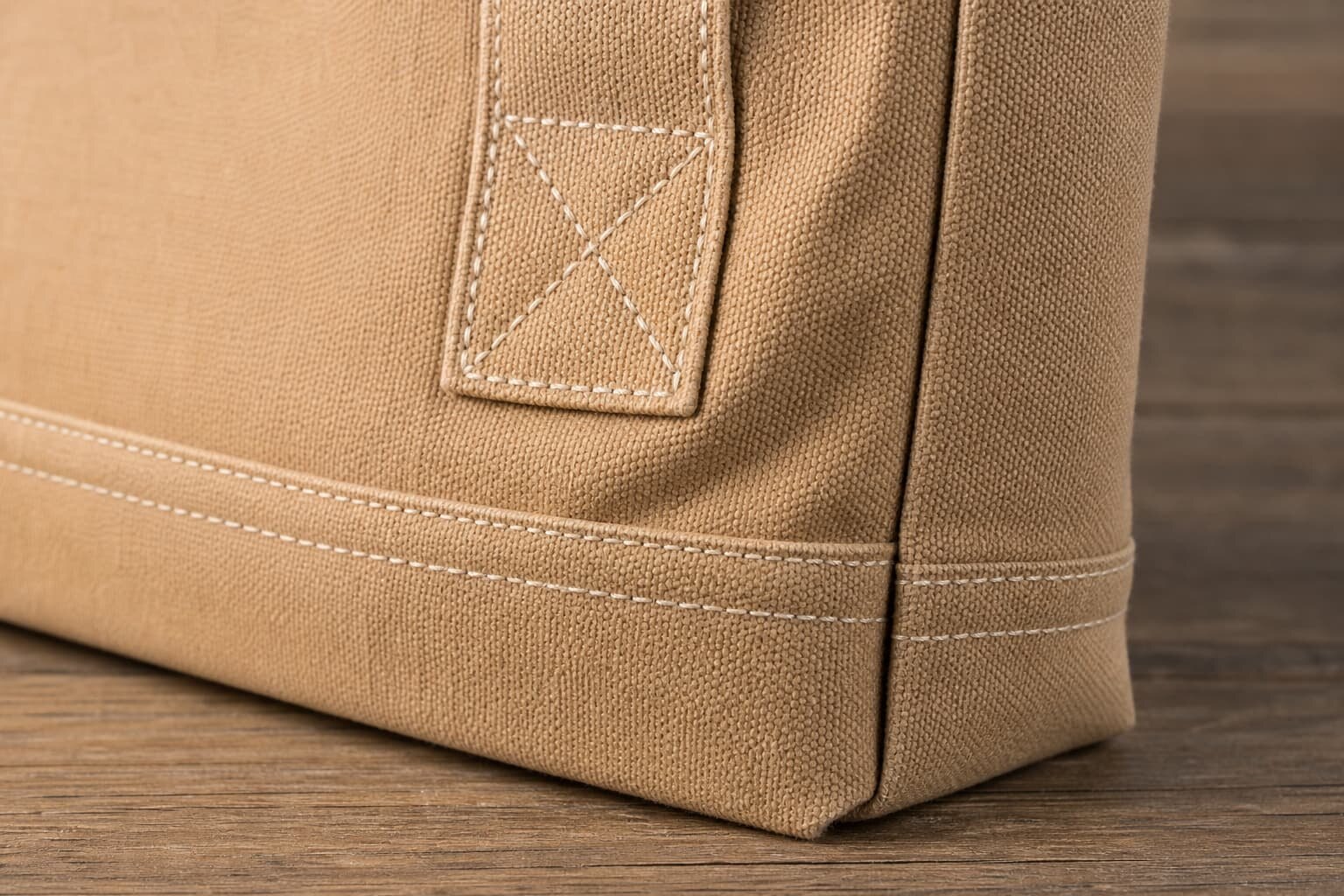
Why the Handle Load Memo Exists
A handle load test memo is not just a QC note. For a canvas tote bag program, it is the document that keeps procurement, sampling, and production aligned on one question: how much real use the bag must survive before the buyer signs off. If the memo is weak, the factory can still quote a bag that looks correct but fails in the first quarter of use because the handle attachment, seam construction, or print treatment was never tied to a measurable load target.
Buyers usually discover this problem after they compare two quotes that look similar on paper but perform very differently in the hand. One supplier may use 10 oz canvas with cotton webbing and a box-x plus bar-tack. Another may use the same fabric weight but a narrower handle, shorter stitch length, and light reinforcement. The memo turns those differences into a clear approval tool, so the quote comparison is about construction and risk, not just unit price.
- Use the memo to define what the tote must carry, not just what it must look like.
- Tie the load target to the end use: retail carry, event giveaway, grocery use, or branded resale.
- Treat the memo as a release document, so later substitutions cannot be approved by memory alone.
Lock the Construction Before You Talk Load
The load test number means very little if the bag build is not fixed first. Canvas tote performance starts with the body fabric, and fabric weight is only the first filter. A 8 oz / 280 gsm bag may work for light promotional use, while 10 oz / 340 gsm is a more common retail starting point, and 12 oz / 400 gsm or heavier makes sense when the buyer wants a firmer hand and better resistance to seam distortion. Still, the same gsm can behave differently if the weave is loose, the finishing is heavy, or the fabric relaxes after cutting and sewing.
Handles matter just as much. Self-fabric handles give a clean brand look and often lower material cost, but cotton webbing can be more comfortable on the shoulder and polyester webbing can resist abrasion better. The buyer should specify not only the handle material but the width, edge finish, handle drop, and the exact attachment style. If the bag is printed near the top edge, note that too: decoration around the handle join can change how the fabric folds and how stress moves across the seam.
- State the finished fabric weight and ask the factory to confirm it on bulk material.
- Call out handle width and drop in the RFQ so every quote uses the same carry geometry.
- Identify whether the bag is hand-carry or shoulder-carry, because the load path is different.
Use a Test That Matches Real Carrying
A useful handle load test should reflect how the tote will actually be used, not a generic lab number. For many canvas tote programs, a static hang test is the simplest starting point: load the bag to a target weight, hang it by the handles, and hold it for a defined period while checking for seam movement, thread break, or shape change. If the bag will be lifted repeatedly, add a cycle test that simulates picking it up and setting it down several times. If the bag is meant for shoulder carry, check whether the handle cuts into the body or twists under load.
The sample should be tested in the same construction state that will go to bulk. That means the same fabric weight, handle width, decoration method, and reinforcement pattern. If the factory is going to quote a load test memo, ask them to document how the sample was filled, what weight was used, how long the load was held, and what failure looked like. A tote can survive one hang test and still be a bad bulk choice if the handle creeps, the print cracks, or the seam allowance opens under repeated motion.
- Use a static hang test for baseline strength and a repeat-lift test for carry fatigue.
- Test more than one piece, because one strong sample does not prove a stable production lot.
- Record the failure mode: stitch break, seam creep, handle stretch, fabric tear, or print damage.
Set Acceptance Criteria the Factory Can Quote Against
The factory cannot price risk correctly if the pass/fail rules are vague. A memo that says the tote must be strong enough is not actionable. A memo that states the target load, duration, cycle count, and acceptable deformation gives the supplier something real to quote against. For example, a buyer might ask for a 5 kg to 8 kg static carry benchmark on a 10 oz / 340 gsm bag for standard retail use, then increase the requirement for a heavier program. The key is not the exact number alone; it is the fact that the number is tied to a use case and written into the approval note.
Acceptance criteria should also cover workmanship, not only strength. Define whether a small amount of stitch pull is acceptable, whether the handles may lengthen slightly under load, and whether the bag can show minor shape change after testing. Then lock the visual standard: no skipped stitches, no broken bar-tacks, no seam puckering at the handle join, and no print cracking across the fold zone. If the supplier says the decoration method changes the load result, that is a sign the print specification was never isolated from the construction spec.
- Write the load target, test duration, and cycle count in the same memo line.
- Add a visual workmanship standard so strength does not hide poor sewing.
- Ask the factory to confirm the test method before you approve the sample.
Read Quotes by Build Cost, Not Just Unit Price
A clean quote should separate the cost drivers that affect handle performance. If the factory gives you one flat number for the tote without listing fabric gsm, handle material, reinforcement, print method, and packing, you cannot compare suppliers fairly. One factory may include a box-x plus bar-tack and another may only include straight stitching. One may be quoting cotton webbing; another may be quoting self-fabric handles with a different amount of cutting waste. The unit price can look better while the actual bag is weaker.
Ask for quote data that makes the tradeoff visible. The most useful comparison is the one that shows the construction line by line: fabric, handle, reinforcement, decoration, finishing, packaging, and sample charges if relevant. That also helps you understand MOQ logic. A design with three print colors, custom handle length, and special packing may trigger a higher MOQ or a higher setup cost than a plain one-color tote. If the supplier will not split the data, ask for at least a written spec summary attached to the quotation.
- Compare quote line items for fabric, handle, stitch reinforcement, decoration, and packing.
- Ask where the MOQ changes: by color, by print design, or by decoration method.
- Request the extra cost for revised samples so change control is visible before approval.
Packing and Lead Time Can Change the Result
Handle testing does not end when the sample passes in the factory room. Packing can change how the tote behaves before the buyer ever opens the carton. If the bag is tightly folded, over-compressed, or packed with a hard insert against the handles, the fold line can set sharply and the print may crack where the bag bends. That matters even more for heavy ink coverage, embroidery, or thick decoration near the top edge. Ask the supplier to explain the packing sequence, carton count, polybag size, and whether the handles are laid flat or tucked in a way that forces a sharp crease.
Lead time should also be broken into real steps instead of one vague promise. Sampling, material confirmation, print approval, bulk cutting, sewing, in-line inspection, final QC, and booking all take time. A load-sensitive tote may need an extra sample round if the handle attachment or print position changes after the first review. Buyers who only ask for a ship date often miss the time needed for re-approval, which is exactly when the weak handle gets pushed into production because nobody wants to delay the order.
- Confirm how the bag is folded and whether the handle is protected from crease stress.
- Ask for the time split between sample approval, bulk production, and final inspection.
- Build buffer for one revision if the handle or print zone needs a construction adjustment.
Sample Checks That Catch Weak Handles Early
The sample stage is where buyers can still fix the bag cheaply. Start by checking the finished dimensions, then measure the handle drop, handle width, seam allowance, and stitch length against the approved drawing. Look closely at the top seam where the handle joins the body. That area tells you whether the supplier has enough stitch density, whether the bar-tack is long enough, and whether the fabric is puckering before any load is applied. If the sample feels right in the hand but the details are off, the bag is already at risk.
When the print method is part of the bag's structure, request both an undecorated sample and a production-decorated sample if possible. Screen print, heat transfer, or embroidery can all change the way the fabric bends near the handle attachment. A thick print layer may make the fold stiffer, while embroidery may pull the fabric tighter around the stitch field. A buyer who compares both samples can see whether the load behavior comes from the fabric alone or from the combined effect of decoration and construction.
- Measure width, height, gusset, handle drop, and seam allowance on the approval sample.
- Inspect the handle join from both inside and outside the bag.
- Keep an undecorated sample for structure and a decorated sample for real-use behavior.
The Failure Modes Buyers Miss Most Often
Most handle failures are not dramatic and they are not mysterious. The common problem is under-specification. A narrow handle on a dense canvas body concentrates load in one line and becomes uncomfortable before it becomes visibly damaged. Short bar-tacks leave the edge of the attachment zone exposed, so the seam starts to creep even when the bag has not torn. Heavy ink or a thick transfer can also stiffen the fold line and create a crack point right where the handle flexes every time the bag is lifted.
Another common mistake is trusting one good sample to stand in for a full production run. A well-made proto can hide a weaker fabric lot, a different thread, or a sewing operator who does not match the sample room method. If the tote is meant to carry bottles, sample with the intended load shape, not just loose weight. Bottles and boxed goods create point pressure, which moves stress into the handles and the bottom seam. When buyers ignore the bottom seam, they sometimes blame the handle for a failure that actually started elsewhere in the bag.
- Watch for narrow handles, short reinforcement, and decoration that stiffens the fold line.
- Do not approve production from one perfect sample if the bulk materials may change.
- Test with realistic item shapes, not only loose weight, when the bag will carry rigid goods.
What Belongs in the Final Release Memo
The final release memo should make the approved tote easy to reproduce and easy to audit. Include the exact fabric weight, handle construction, reinforcement pattern, decoration method, packing format, and the test result that allowed the bag to pass. If the supplier later proposes a material swap or a stitch change, the buyer should be able to compare that request against the memo line by line. That protects procurement from casual substitutions and keeps production from drifting away from the sample that was actually tested.
Keep the memo practical. The best release note is short enough for sourcing, quality, and factory teams to use without guessing. It should list the approved sample ID, the load test method, the pass/fail outcome, and any acceptable variation. It should also state what cannot change without re-approval: fabric gsm, handle length, stitch pattern, print position, packing count, and carton arrangement. That final line is often what saves a bulk order when the factory tries to simplify the build after quote acceptance.
- Write the approved sample ID and attach the photo set to the memo.
- Lock the construction details that affect load performance and repeatability.
- Require re-approval for any material, stitch, print, or packing change.
Specification comparison for buyers
| Spec decision | Recommended option | When it fits | Buyer risk to check |
|---|---|---|---|
| Canvas body weight | 10 oz / 340 gsm for standard retail carry; 12 oz / 400 gsm if the bag must feel firmer | General merchandise, event retail, bookstore, and light grocery use | Do not accept a gsm claim without finished fabric confirmation; weave density and finish can change real strength |
| Handle material | Cotton webbing for a soft hand feel; self-fabric handles for a clean look; polyester webbing for abrasion resistance | Brand programs that care about comfort, price, or durability in different ways | Check handle width and edge finish; a narrow handle can cut into the hand and concentrate stress at the seam |
| Reinforcement method | Box-x plus bar-tack at the top join; add a second pass if the bag carries heavy loads | Totes that need repeat use, shoulder carry, or heavier contents | A clean-looking stitch is not enough; ask for stitch count, bar-tack length, and thread type |
| Print method | Water-based screen print for soft hand feel; embroidery or woven label for small logos; heat transfer only when approved for low abrasion use | Programs where handle folds, print hand feel, or decoration durability matter | Heavy print near the top edge can crack on the fold line and hide seam issues |
| Packing style | Flat-fold with tissue or insert board, then polybag and master carton count control | Retail and e-commerce programs that need shape retention and clean presentation | Tight packing can crease handles and stress print zones before the buyer ever opens the carton |
Buyer checklist before sampling
- State the intended use, expected load, and carry style: hand carry, shoulder carry, or both.
- Lock the finished fabric weight, weave, and any coating or wash finish before asking for quotes.
- Specify handle width, handle drop, attachment method, and whether the handle is self-fabric or webbing.
- Ask the factory to quote the exact reinforcement pattern at the handle join, not just the bag body.
- Request a sample load test memo with the test method, target weight, cycle count, and failure criteria.
- Review one unprinted sample and one production-decorated sample if print or embroidery affects the seam area.
- Confirm packing method, carton count, and whether any folding or compression could mark the handles.
- Keep a change-control rule in the approval memo so any fabric, stitch, or print change needs re-approval.
Factory quote questions to send
- What is the finished fabric weight in gsm and the actual fabric spec you will use for bulk?
- What handle material, width, and length will you quote, and how is the handle edge finished?
- What reinforcement pattern do you use at the top handle join, and how many stitches or bar-tacks are included?
- What load test method do you use in-house, and what is the exact pass/fail standard?
- What is the MOQ by color, print design, and decoration method?
- What sample stages do you provide before bulk, and how long does each stage take?
- What packing format and carton count are included in the quote?
- Which details can change the unit price if we revise the spec after sampling?
Quality-control points to confirm
- Check finished fabric weight, weave tightness, and any coating or wash finish against the approved sample.
- Measure handle width, handle drop, and attachment position on multiple finished bags, not just one.
- Inspect stitch density, bar-tack length, thread type, and seam allowance at the handle join.
- Run a static hang or lift test on a small lot and note any seam creep, thread break, or deformation.
- Check whether print, embroidery, or heat transfer crosses the fold line or sits too close to the seam.
- Verify that the decorated sample matches the undecorated construction and does not hide weak stitching.
- Confirm packing count, folding method, polybag size, and carton compression do not distort handles.
- Record the approved sample ID, production lot, and any deviation notes so substitutions cannot slip through quietly.