Why a Correction Worksheet Matters Before Bulk Approval
A canvas tote bag factory correction worksheet is not just a comment sheet for a sample. It is the bridge between what the buyer noticed and what the sewing, printing, packing, and costing teams must change before bulk production. Many tote bag disputes start because the buyer writes broad feedback such as "make handle stronger" or "logo too low," while the factory reads it as a minor visual preference. The result is a second sample that still misses the commercial requirement, or worse, a bulk order that follows the wrong interpretation.
For procurement teams, the worksheet should convert every correction into measurable production language. Instead of saying the bag feels thin, state the target canvas weight, acceptable tolerance, and whether the factory must change fabric or simply confirm the quoted material. Instead of saying the logo is off-center, state the print size, placement from the top edge and side seam, and whether the measurement is taken before or after sewing. This makes the worksheet useful for RFQ comparison, sample approval, pre-production meetings, and final inspection.
- Use the worksheet when first sample comments could affect price, lead time, MOQ, or production method.
- Separate visual preference from technical nonconformity so the factory knows what must be corrected.
- Ask the factory to confirm each correction in writing before making the revised sample.
- Keep the correction worksheet attached to the final PO and inspection checklist.
Define the Buying Problem in One Sentence
The most useful correction worksheet starts with a single buying problem: what must be fixed before the canvas tote bag is safe to quote, approve, or produce. For example, the problem may be that the sample matches the artwork but fails the load expectation, or that the bag size is correct but the fabric handfeel is too light for a retail price point. If the worksheet tries to solve fabric, branding, packing, barcode data, sustainability claims, and freight optimization at the same time, the factory will often fix the easiest points and miss the costly ones.
Write the problem in commercial terms. A distributor may need a tote that can hold catalogs without handle tearing. A brand owner may need clean logo placement across a natural canvas surface with visible slub. A retailer may need the bag to pass receiving rules with carton marks, barcode labels, and no plastic if their packaging policy requires it. The worksheet should help the supplier quote the same product you intend to buy, not a cheaper version that only looks similar in photos.
- State whether the order is for retail resale, brand packaging, events, ecommerce kits, or distributor stock.
- Identify the main risk: fabric weight, print accuracy, handle strength, size tolerance, packing compliance, or delivery date.
- Mark which corrections are mandatory for approval and which are optional improvements.
- Do not release bulk production until mandatory corrections are closed.
Fabric Weight and Canvas Specification Corrections
Canvas tote bag quotes can look competitive until the fabric specification is checked. A sample described as 12 oz may feel close to 10 oz if the supplier uses a different conversion, a looser weave, or a finishing process that changes handfeel. Buyers should record both oz and GSM where possible. As a working reference, 8 oz canvas is often used for lighter promotional totes, 10 oz is common for reusable retail totes, and 12 oz or heavier suits premium totes, book bags, and higher load expectations. These are not universal rules, but they help prevent a factory from quoting a lighter fabric than the buyer expects.
The worksheet should also state fabric color and finish. Natural canvas may have cotton seed flecks and shade variation. Bleached canvas gives a cleaner print background but can feel different. Dyed canvas may require higher MOQ and longer lead time because fabric dyeing is not the same as cutting from available stock. If the first sample uses available fabric, ask whether bulk will use the same lot or a new production lot. Otherwise, the approved sample may not represent the fabric actually used in mass production.
- Record fabric weight as, for example, 10 oz / 280-300 GSM with tolerance agreed by buyer and factory.
- Ask whether the canvas is natural, bleached, dyed, washed, enzyme washed, organic cotton, recycled cotton, or blended.
- Require a fabric swatch approval if bulk fabric will not come from the same lot as the sample.
- Check whether heavier canvas changes sewing needle choice, seam bulk, carton weight, and freight cost.
- Do not accept only "thick canvas" or "premium cotton" as a fabric specification.
Size, Pattern, Gusset, and Handle Corrections
Canvas tote bag dimensions are easy to misunderstand because buyers and factories may measure different points. A flat tote without gusset is usually measured by width and height. A gusseted tote needs width, height, bottom gusset, side gusset if applicable, and finished seam position. Handle drop must be measured from the top edge of the bag to the highest inside point of the handle when the bag is flat. If the buyer says "longer handles" without a target drop, the factory may increase total handle length but not improve shoulder comfort.
Pattern changes can affect cost more than buyers expect. Increasing bag height may increase fabric consumption. Changing a flat tote to a bottom gusset can require a new sewing process. Wider handles can improve comfort but use more fabric and may require different folding or stitching. A correction worksheet should make each pattern change explicit and ask the factory whether the revised dimensions remain within the quoted price and MOQ. This prevents a supplier from quietly absorbing a change in the sample stage and then raising cost after approval.
- Specify finished size, not only cutting size, because sewing allowance affects final dimensions.
- Set tolerances such as plus or minus 0.5 cm or 1 cm depending on construction and buyer requirement.
- Define handle width, handle drop, handle material, and reinforcement stitch pattern.
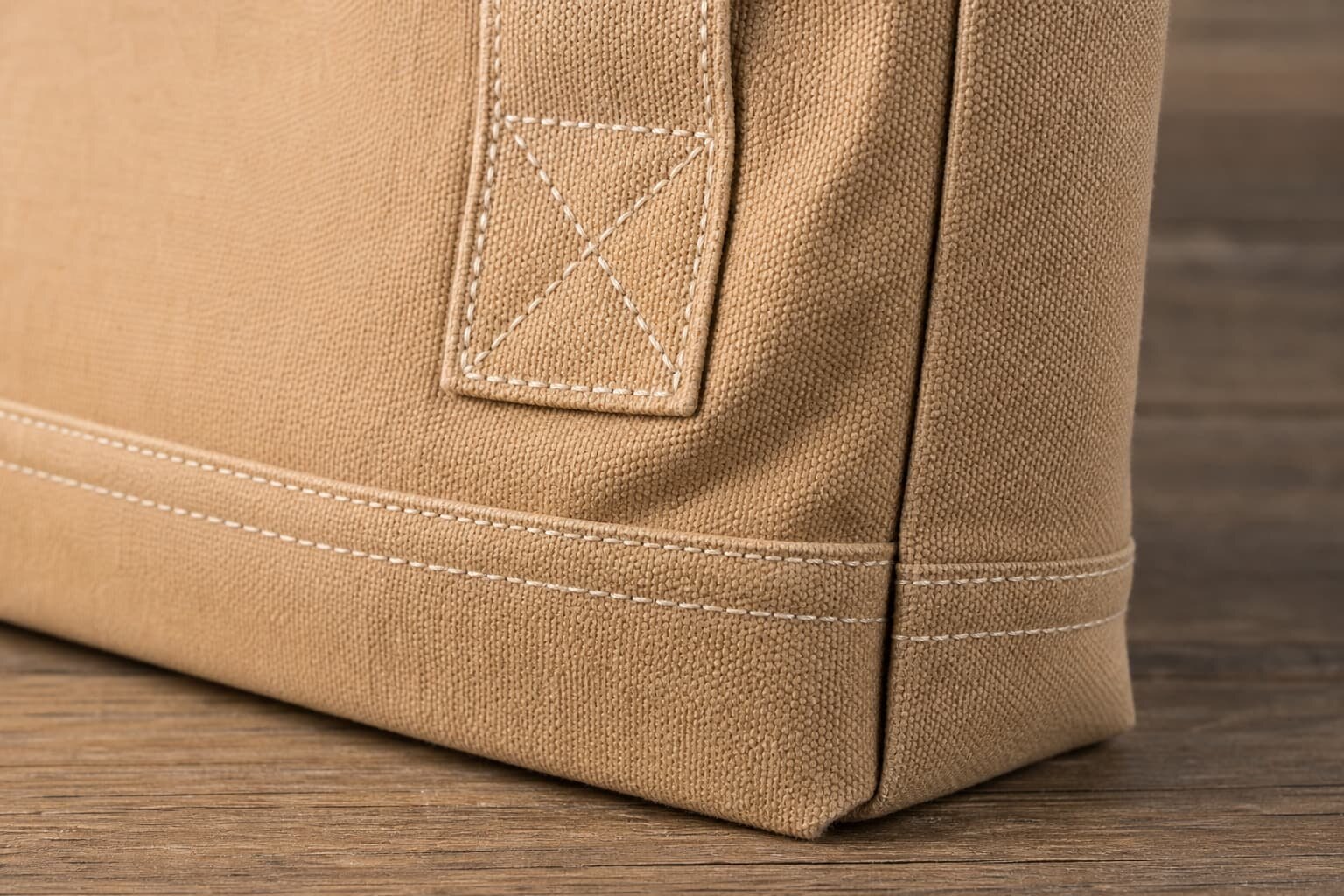
- Request X-box stitching or bar tack details when the tote must carry heavier contents.
- Check that the front print position still works after any pattern or gusset adjustment.
Print Method Corrections That Affect Cost and Approval
Print corrections are one of the main reasons canvas tote bag samples cycle too many times. Screen printing is usually efficient for simple one-color or two-color logos, especially at higher quantities. It can produce strong opacity, but the result depends on mesh, ink, curing, fabric surface, and artwork thickness. Heat transfer or digital print may fit multi-color artwork, gradients, or lower MOQs, but buyers must check handfeel, film edge, wash resistance, and whether the print looks too glossy for a natural canvas bag.
The correction worksheet should not only say that the color is wrong. It should identify the artwork file, print size, print placement, color reference, and approval sample needed. Pantone references help, but cotton canvas is not coated paper, so exact matching may not be possible without a strike-off. Natural canvas can warm up white ink, dull bright colors, and show slub through fine details. If the tote will be sold at retail, buyers should check print sharpness, edge bleeding, opacity, and rubbing resistance before approving bulk.
- Record print method: screen print, heat transfer, digital print, embroidery, woven label, or another process.
- Measure print placement from fixed bag edges, not from a photo or visual center only.
- Ask for a strike-off on real production canvas when color accuracy matters.
- Confirm whether print is done before or after sewing because this affects placement tolerance.
- Check curing, rub resistance, ink smell, cracking, and color migration before bulk release.
MOQ Logic and Quote Changes After Corrections
Many buyers ask for the lowest MOQ first, then add custom fabric weight, dyed canvas, large printing, inside labels, retail packing, and barcode stickers. The factory may accept the inquiry but quote in a way that hides setup cost or assumes stock materials. A correction worksheet helps reveal which changes push the order from a simple stock-based tote into a private-label production run. MOQ is usually driven by fabric sourcing, dyeing minimums, printing setup, cutting efficiency, and sewing line scheduling, not only the number of finished bags.
When corrections affect material or process, the buyer should ask for an updated quote rather than assuming the first quote still applies. A heavier GSM fabric, wider handle, larger screen print, custom dyed body, or individual retail packing can change unit price, sample cost, lead time, carton size, and freight estimate. A supplier that keeps the same price after several technical upgrades may be planning to reduce something else, such as fabric weight, stitch density, packing quality, or inspection time.
- Ask what MOQ applies to available canvas versus custom dyed or custom woven canvas.
- Separate bag sewing cost, fabric cost, print cost, label cost, packing cost, and export carton cost where possible.
- Request a revised quotation after any correction that changes fabric, size, print area, handle, label, or packing.
- Check whether sample cost is refundable, separate, or included in bulk order value.
- Confirm quote validity date because cotton fabric and freight-related costs can change.
Sample Review: What to Mark on the Worksheet
A good sample review does not rely on general approval photos. The buyer should mark the physical sample or use clear photos with arrows and measurements. For a canvas tote bag, review front panel, back panel, side seams, bottom seam, gusset corners, handle attachment, top hem, inside seam finishing, print surface, label position, and packing fold. If the sample is used for retail presentation, check how it looks after folding and unpacking, because deep creases across the logo can create store complaints even when the bag itself is technically correct.
Every correction should have an owner and a closing method. Some corrections require a revised sample, such as wrong fabric weight, incorrect handle drop, or unacceptable print color. Other corrections can be closed with factory confirmation or production photos, such as trimming loose threads or changing carton mark wording. The worksheet should state which items must be resubmitted before bulk and which can be checked during pre-production or inline inspection. This avoids unnecessary sample rounds while still controlling real risks.
- Use clear defect categories: fabric, cutting, sewing, print, label, packing, carton, documentation.
- Mark whether each item requires new sample, photo confirmation, revised quote, or inspection checkpoint.
- Keep one approved master sample at the buyer side and one at the factory side if possible.
- Do not approve bulk based only on a digital photo when fabric weight, handfeel, or print texture is disputed.
- Date and version-control each sample so the factory does not follow an outdated comment file.
Packing and Carton Corrections Before Shipment Trouble Starts
Packing is often treated as a final detail, but it can create receiving failures, warehouse delays, and customer complaints. A canvas tote bag may be folded flat, folded in half, packed with paper band, packed in individual polybag, or grouped by inner carton. The correction worksheet should specify the packing format early because it can affect labor cost, carton size, barcode placement, and sustainability compliance. If the buyer has plastic reduction rules, this must be stated in the RFQ instead of corrected after production.
Carton details also matter for importers and distributors. Too many heavy canvas totes in one carton can cause carton rupture and difficult handling. Too few bags per carton may raise freight and warehouse cost. The worksheet should request carton quantity, carton dimensions, gross weight, net weight, carton mark format, PO number, SKU, color, size, and destination information. For retail or ecommerce programs, barcode stickers and item labels should be checked before final packing, not after cartons are sealed.
- Define individual packing, bundle packing, paper band, hangtag, barcode sticker, and carton quantity.
- Ask for a packing trial photo before mass packing starts.
- Confirm whether print surfaces need tissue, interleaving, or a drying/curing wait time before folding.
- Set a practical maximum carton gross weight for warehouse handling.
- Check carton marks against PO and shipping documents before final inspection.
Lead Time Control After Factory Corrections
Corrections can quietly consume the lead time that buyers thought they had secured. A typical sequence may include artwork confirmation, fabric sourcing, print strike-off, revised sample, buyer approval, material purchase, cutting, printing, sewing, trimming, inspection, packing, and export handover. If a correction changes fabric or print method, the schedule should be recalculated from the point of new approval. Buyers should avoid approving a revised sample and assuming the original ship date still stands unless the factory confirms capacity and material availability.
A useful worksheet includes dates for buyer action as well as factory action. Delayed artwork files, late barcode data, uncertain label copy, or slow sample comments can push production just as much as factory delays. For seasonal retail, event programs, or distributor replenishment, mark the latest acceptable sample approval date and latest shipment handover date. Ask the factory which correction items are on the critical path and which can run in parallel. This helps procurement teams decide whether to simplify a spec instead of chasing an unrealistic delivery date.
- Record sample request date, sample dispatch date, buyer comment date, revised sample date, and final approval date.
- Ask whether fabric, printing screens, labels, and packing materials can be prepared before final sample approval.
- Confirm if public holidays, factory peak season, or subcontracted printing affect the schedule.
- Do not count bulk lead time from first inquiry; count from final approval, deposit, and complete production data.
- Use the worksheet to decide whether a correction is worth delaying shipment.
Acceptance Criteria for Bulk Production
The final value of a canvas tote bag factory correction worksheet is that it becomes the basis for acceptance criteria. Without measurable criteria, final inspection becomes a negotiation. Buyers should define what will be accepted, what will be rejected, and what can be repaired. For example, minor cotton flecks on natural canvas may be acceptable, while oil stains, broken stitches, twisted handles, severe print smears, and wrong barcode labels should not be. For print placement, state a tolerance rather than requiring impossible perfect alignment on soft fabric.
Acceptance criteria should match the bag's commercial use. A low-cost event tote may allow slightly wider appearance tolerance than a premium retail tote. A heavy book tote should have stricter handle strength requirements than a lightweight giveaway. A private-label retail order should check labels, hangtags, SKU stickers, and carton data as carefully as sewing. The worksheet should travel from merchandising to quality control so inspectors check the same risks that the buyer corrected during sampling.
- Set dimension tolerances for width, height, gusset, and handle drop before inspection.
- Define unacceptable defects such as holes, dirty marks, broken seams, incorrect logo, missing labels, and wrong carton marks.
- Agree on inspection level, sample size, and defect classification if using third-party inspection.
- Require factory self-inspection records for fabric, printing, sewing, and packing stages.
- Keep approved sample, worksheet, PO, artwork, and packing instruction together for final inspection reference.
Specification comparison for buyers
| Spec decision | Recommended option | When it fits | Buyer risk to check |
|---|---|---|---|
| Fabric weight for standard retail tote | 10 oz / about 280-300 GSM cotton canvas | Reusable shopping bags, bookstore totes, event merchandise, moderate daily use | Confirm finished bag weight, shrinkage after washing if relevant, and whether quote uses greige, bleached, dyed, or natural fabric |
| Fabric weight for premium brand tote | 12 oz / about 340-360 GSM cotton canvas | Lifestyle retail, apparel brand packaging, heavier giveaways, bags expected to hold catalogs or products | Check handle reinforcement and carton weight; thicker fabric can increase freight and sewing time |
| Print method for solid one or two color logo | Screen print with approved ink color and print size | Simple logos, larger quantities, strong cost control, good opacity on natural canvas | Ask for strike-off on real production fabric; ink color shifts on natural canvas compared with white paper |
| Print method for multi-color artwork | Heat transfer or digital print depending on artwork area and handfeel requirement | Gradients, small runs, photo-style graphics, tight color separation not suited to screen printing | Check wash/rub resistance, film edge, handfeel, and whether the factory is outsourcing the process |
| Handle construction | Self-fabric handles with X-box stitching at attachment points | Most retail and promotional canvas tote bags where appearance and load strength matter | Specify handle width, drop length, stitch pattern, thread color, and minimum load test target |
| MOQ logic for custom canvas tote | MOQ based on fabric dyeing, print setup, and sewing line efficiency, not only bag quantity | Private label orders with custom size, dyed fabric, printed logo, or retail packing | Low MOQ may use available fabric and higher unit cost; custom dye or wide print area usually raises MOQ |
| Packing format | Flat packed by inner polybag or paper band, then export carton with carton marks | Retail buyers, distributors, ecommerce kitting, warehouse receiving control | Confirm folded size, barcode position, carton quantity, carton strength, and whether plastic reduction rules apply |
Buyer checklist before sampling
- Attach the latest approved sample photos and mark whether each correction applies to fabric, size, handle, print, sewing, label, packing, or carton.
- Record target fabric weight in oz and GSM, plus tolerance range and whether the fabric is natural, bleached, dyed, washed, organic, recycled, or blended.
- List finished bag dimensions with measuring method: width, height, gusset, handle width, handle drop, seam allowance, and acceptable tolerance.
- Confirm print method, artwork file name, print size, placement from bag edges, Pantone or LAB reference, ink type, and approval sample requirement.
- State handle reinforcement standard, such as X-box stitch, bar tack, stitch density, thread color, and requested load test weight.
- Separate sample correction approval from bulk production approval so the factory does not treat informal comments as final release.
- Ask the factory to confirm whether corrections change unit price, MOQ, tooling, sample charge, lead time, packing volume, or carton weight.
- Require pre-production sample approval if corrections affect fabric, pattern, print color, print position, or retail packaging.
- Define acceptable and unacceptable defects for print smudges, loose threads, crooked seams, shade variation, oil marks, odor, and packing damage.
- Check final quote includes bag unit price, printing cost, label cost, packing cost, sample cost, mold or screen cost, export carton details, payment terms, and validity date.
Factory quote questions to send
- Which fabric construction are you quoting: yarn count, weave, oz/GSM, width, shrinkage allowance, and natural or dyed finish?
- Is the quoted MOQ based on available stock canvas, custom woven fabric, custom dyed fabric, print setup, or full production line minimum?
- Which print method is included in the unit price, and what is the maximum print size before the price changes?
- Will you provide a printed strike-off on the actual production canvas before the pre-production sample?
- What size tolerance do you apply after sewing for width, height, gusset, and handle drop?
- How will you reinforce the handle attachment, and what load test weight and test duration can you support?
- Are labels, hangtags, barcode stickers, care labels, and retail bands included or quoted separately?
- What is the sample timeline after artwork and fabric confirmation, and what is the bulk lead time after sample approval and deposit?
- How many bags per inner pack and export carton, what are the estimated carton dimensions, and what is the estimated gross weight?
- Which corrections may change the price or delivery date after first sample review?
Quality-control points to confirm
- Measure finished bag dimensions on flat, un-stretched samples using the same method agreed in the worksheet.
- Verify fabric GSM with cutter or weight calculation and compare against the approved swatch and purchase specification.
- Check print placement from top edge and side seams, not by eye, especially when bags are sewn after printing.
- Rub test the print after curing and check for ink cracking, tackiness, migration, or uneven opacity on natural canvas.
- Inspect handle attachment for correct stitch pattern, no skipped stitches, no loose thread ends, and no seam tearing under load.
- Compare bulk fabric shade under consistent light against the approved swatch, allowing only the agreed commercial tolerance.
- Check inside seams, bottom corners, gusset alignment, and stitch density because these areas often fail before front panels look defective.
- Confirm labels, hangtags, barcode stickers, and carton marks match the buyer's packing instruction and PO data.
- Open export cartons after packing trial to check folding, odor, moisture, compression marks, and whether print surfaces are protected.
- Record all deviations with photos, quantity affected, proposed factory correction, buyer decision, and re-inspection requirement.