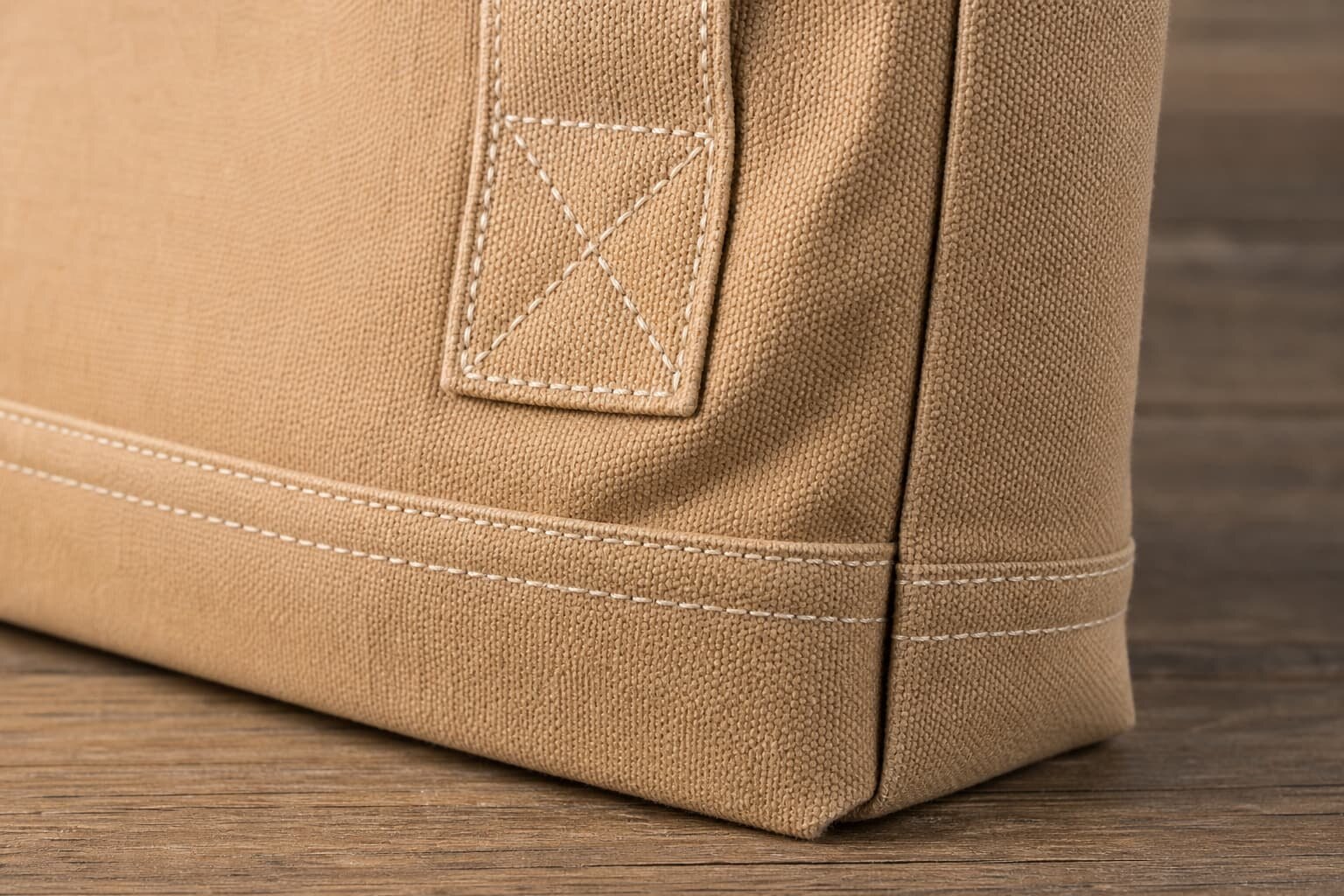
Why Shrink Testing Belongs in the RFQ
A canvas tote bag fabric shrink test memo is not paperwork for the quality department only. It is a buying control document. If shrinkage is not defined before quotation, two suppliers can quote the same size tote bag while planning very different fabrics, cutting allowances, and finishing steps. The cheaper quote may simply be using untreated canvas with no shrink control.
The problem usually appears after sampling or after the first shipment. A 380 mm wide tote may become 365 mm after washing, the printed logo may sit closer to the side seam, and the handle drop may feel shorter. If the bag is sold online with a fixed size claim, or packed with a rigid insert, this creates a commercial issue rather than a small technical defect.
- Use the memo when the tote bag is washable, reusable, or sold as a durable retail product.
- Use it when the artwork has fixed placement from seams, gusset lines, or pocket edges.
- Use it when the buyer compares quotes from factories using different canvas sources.
- Use it when the bag size is part of the product value, such as grocery, bookstore, or merchandise totes.
What Shrinkage Means on a Canvas Tote
Canvas shrinkage is the reduction of fabric dimension after moisture, heat, washing, drying, steam, or mechanical relaxation. In a tote bag, shrinkage does not only reduce width and height. It can pull seams inward, twist handles, change gusset depth, and make a flat print look slightly warped. Heavier canvas often looks stable, but it can still relax after washing if the yarn and fabric finishing were not controlled.
Buyers should ask for shrinkage in two directions. Warp direction normally follows the fabric length, and weft direction follows the fabric width. Depending on how the pattern is placed on the fabric, one direction may affect tote height and the other may affect tote width. If the report only says shrinkage is 3 percent, it is not enough for a production decision.
- Warp shrinkage can reduce bag height or handle length depending on cutting layout.
- Weft shrinkage can reduce bag width, gusset depth, or front print panel width.
- Steam pressing may temporarily change dimensions even before consumer washing.
- Dyed, washed, or enzyme-treated canvas can behave differently from natural raw canvas.
Set the Fabric Weight Before Comparing Quotes
A shrink test memo should start with the fabric specification. Canvas tote buyers often request 8 oz, 10 oz, 12 oz, or 16 oz fabric, but suppliers may convert these numbers differently. Some quote by ounces per square yard, some by GSM, and some use a local trade description that is not exact. For RFQ comparison, ask for GSM and oz together, and ask whether the value is before or after finishing.
For many promotional and retail canvas totes, 10 oz to 12 oz cotton canvas, roughly 280 to 340 GSM, is a practical middle range. Lighter 6 oz to 8 oz fabrics are easier for low-cost campaign bags but may wrinkle more and show seam stress sooner. Heavier 14 oz to 16 oz fabrics can feel premium, but they raise sewing difficulty, freight weight, needle requirements, and sometimes MOQ because the mill may not keep all colors in stock.
- For economy campaigns, check 6 oz to 8 oz canvas and accept more size movement.
- For mainstream retail totes, check 10 oz to 12 oz canvas with controlled shrinkage.
- For premium structured totes, check 14 oz to 16 oz canvas and confirm machine capability.
- For dyed canvas, confirm whether dyeing and washing change the final GSM and hand feel.
Define the Test Method, Not Just the Tolerance
A tolerance without a method creates arguments. One factory may test in cold water and air dry. Another may wash warm and tumble dry. The second result will usually show higher shrinkage. Before approving a quote, define the wash temperature, washing time or cycle, detergent use, drying method, number of cycles, and measurement condition. A simple one-wash air-dry test is often enough for a tote bag RFQ, but it must be written.
Measurement should be done on a relaxed flat bag. The operator should not stretch the bag to hit the target size. For a real production memo, ask for photos before and after wash with a tape measure visible. The report should show width, height, gusset, handle drop, and print position. This is more useful than a laboratory-style percentage with no product photos.
- Example wash condition: 30 degrees Celsius water, mild detergent, normal cycle, flat air dry.
- Example stricter condition: 40 degrees Celsius water, normal cycle, low tumble dry if consumer use requires it.
- Measure after the bag is fully dry and conditioned, not while damp.
- Keep the same measurement points before and after washing.
Connect Shrinkage to Print Approval
Print approval and shrink approval should not be separated when the logo is large, dense, or placed near seams. Screen print, pigment print, discharge print, heat transfer, embroidery patch application, and woven label attachment all react differently when the base canvas shrinks. A print that looks square on the unwashed sample may look slightly bowed after washing if the fabric moves more in one direction.
Screen printing is common for canvas totes because it is cost-effective at volume and works well on natural or dyed cotton canvas. However, thick ink layers and large solid areas can stiffen the panel and restrict fabric movement. Heat transfer can produce sharp artwork, but buyers should check edge lifting, cracking, and hand feel after washing. Embroidery adds needle holes and thread tension, so the panel must be tested for puckering.
- For screen print, check logo width, height, ink cracking, and edge sharpness after wash.
- For heat transfer, check lifting at corners, surface cracks, and color change after wash.
- For embroidery, check puckering, backing stability, and distortion around dense stitches.
- For woven labels, check label shrinkage against canvas shrinkage to avoid curling.
MOQ and Cost Logic Behind Shrink Control
Shrink control can change the minimum order quantity. If the buyer wants a standard natural canvas tote with simple screen print, the factory may use in-stock fabric and accept a lower MOQ. If the buyer requires pre-shrunk canvas, custom dyed canvas, special washing, or a full test report by fabric lot, the factory may need to purchase mill-run fabric, run a separate treatment process, and reserve more production time.
This does not mean buyers should avoid shrink testing on smaller orders. It means the RFQ should separate mandatory requirements from nice-to-have controls. For a short event campaign, a simple sample wash test may be enough. For a retail program with repeat orders, size claims, and packaging inserts, pre-shrunk fabric and documented bulk lot testing are usually worth discussing even if unit cost increases.
- Lower MOQ is easier when using stock natural canvas and standard size patterns.
- Higher MOQ may apply for custom dyed canvas, pre-shrunk fabric, or special washed effects.
- Testing cost may be built into the unit price for larger orders but quoted separately for small runs.
- Lead time may extend when the factory must test fabric before cutting bulk panels.
Sample Checks That Prevent Bulk Disputes
A salesman sample proves appearance, but it may not prove bulk shrinkage. The sample may be sewn from leftover fabric, hand pressed more carefully than production, or printed with a different ink batch. For a serious canvas tote order, request a pre-production sample made from the actual or confirmed bulk fabric quality. If the exact bulk lot is not ready, the factory should still state what fabric source and treatment the sample represents.
The buyer should keep two approved references: one unwashed sample and one washed sample. The unwashed sample controls shipment appearance, packing, print color, and sewing workmanship. The washed sample controls post-wash dimension, seam stability, and print durability. If there is a later dispute, both sides can compare against the same physical standard instead of relying only on email descriptions.
- Check bag width at top edge and at lower body because shrink and sewing tension may differ.
- Check height from top edge to bottom seam, not including handle unless specified.
- Check handle drop after washing because shorter drop changes carrying comfort.
- Check bottom gusset and side gusset because shrinkage can make the bag less boxy.
- Check print placement from side seam and top edge after washing.
Packing and Lead Time Effects Buyers Often Miss
Shrink testing also affects packing. Washed or pre-shrunk canvas may be softer, thicker, or more wrinkled than untreated canvas. If the bag is folded into a small polybag, inserted into a retail belly band, or packed with a barcode sticker on a fixed panel, the changed hand feel matters. A bag that passes size tolerance can still fail packing expectations if it does not fold cleanly or if steam pressing changes dimensions before carton closure.
Lead time should include the time needed for fabric sourcing, test cutting, sewing, washing, drying, measurement, photo reporting, buyer approval, and bulk cutting. Many delays happen because shrink testing is requested after artwork approval or after fabric arrives. Put the memo into the first RFQ so the supplier can quote a realistic schedule. If production is split across fabric lots, ask whether each lot will be tested or only the first lot.
- Allow extra time before cutting if fabric lot shrinkage must be checked first.
- Confirm whether final bags are pressed, steamed, or packed directly after sewing.
- Check folded size if the tote goes into a retail sleeve, insert card, or polybag.
- Ask whether the carton quantity changes when using heavier or washed canvas.
- Keep moisture control in mind for long ocean shipments and warehouse storage.
Quote Data That Should Appear in the Supplier Offer
A useful quote should not only show unit price and delivery date. For a canvas tote with shrinkage requirements, the supplier offer should identify fabric weight, fiber composition, fabric treatment, expected shrinkage, print method, size tolerance, sample charge if any, MOQ, lead time, packing method, and whether shrink testing is included. This lets the procurement team compare offers on the same technical basis.
If one supplier quotes 12 oz canvas with pre-shrink treatment and another quotes regular 10 oz canvas without testing, the lower price is not automatically a better offer. It may be a different product. The memo helps buyers normalize quotes and decide whether to pay for a stronger fabric control or accept a wider tolerance for a simpler order.
- Fabric: cotton content, GSM, oz, color, treatment, and expected shrink rate.
- Construction: finished size, seam type, handle size, gusset, reinforcement, and tolerance.
- Decoration: print method, print size, colors, curing method, and wash test requirement.
- Sampling: sample type, sample lead time, sample cost, and whether wash report is included.
- Bulk terms: MOQ, bulk lead time, packing quantity, carton size, and quote validity.
Practical Acceptance Criteria for the Memo
The acceptance criteria should be realistic for the product grade. A natural cotton canvas tote is not a molded plastic item. Some movement is normal, especially after washing. The goal is to define what is commercially acceptable before production starts. For many buyer programs, a target such as under 3 percent shrinkage in both directions after one agreed wash is workable when the correct fabric is chosen, but this should be confirmed with the supplier against the actual fabric.
Do not write only one pass or fail rule. Include finished size tolerance before washing, shrink tolerance after washing, print placement tolerance, and visual workmanship requirements after washing. A bag may pass shrink percentage but fail because the logo cracks or the handles twist. The memo should make these conditions part of the same approval.
- Before wash: finished width, height, gusset, and handle drop within agreed tolerance.
- After wash: shrinkage within agreed warp and weft limits based on the test method.
- Print: no unacceptable cracking, peeling, heavy distortion, or color bleeding.
- Sewing: no open seams, broken stitches, severe puckering, or twisted handles.
- Appearance: acceptable wrinkling level based on the approved washed sample.
Specification comparison for buyers
| Spec decision | Recommended option | When it fits | Buyer risk to check |
|---|---|---|---|
| Canvas weight before shrink test | 10 oz to 12 oz cotton canvas, about 280 to 340 GSM | Retail totes, campaign bags, bookstore bags, and moderate load use | Supplier quotes may use grey fabric GSM, finished GSM, or oz per square yard without saying which one |
| Shrink test method | Measure before wash, wash at agreed temperature, air dry flat, then measure again | Most branded canvas tote RFQs where end users may wash the bag | Tumble drying creates higher shrinkage and must be specified if it is part of expected consumer use |
| Acceptance tolerance | Common working target: under 3 percent warp and under 3 percent weft after one wash, if fabric and washing are controlled | Buyers who need stable print placement and finished size | Natural cotton canvas without pre-shrink treatment may exceed this, especially in heavier constructions |
| Fabric treatment | Pre-shrunk or sanforized canvas when finished dimensions are critical | Retail programs, repeat orders, e-commerce listings with fixed size claims | Higher fabric cost and longer material preparation time may affect MOQ and lead time |
| Print method after shrink risk review | Screen print or heat transfer tested on the same washed and unwashed fabric | Logo totes, conference bags, and private label retail | Print may crack, distort, or shift visually if shrinkage is tested only on blank fabric |
| Sample approval stage | Approve one pre-production sample with measured dimensions before and after wash | Orders with custom size, gusset, long handles, or dense print coverage | A nice looking salesman sample does not prove bulk fabric shrink behavior |
| Packing decision | Pack after final pressing and stable moisture condition, not immediately after heavy steam | Export cartons, retail polybag packing, or barcode sticker programs | Moisture recovery can change hand feel, folded size, and carton fit during storage |
Buyer checklist before sampling
- State whether finished bag dimensions are measured before washing, after washing, or both.
- Ask the supplier to identify canvas weight by GSM and by oz if both are used in the quote.
- Confirm if the quoted fabric is raw canvas, washed canvas, pre-shrunk canvas, or treated canvas.
- Define the wash test method: water temperature, cycle type, detergent use, drying method, and number of cycles.
- Request shrinkage results in both warp direction and weft direction, not only one total percentage.
- Require a sample report with photos of the bag measured flat before and after wash.
- Check whether handles, gusset, seams, and print panel are measured separately after washing.
- Approve print only after shrink testing on the same fabric weight and color planned for bulk.
- Confirm bulk cutting allowance if the supplier compensates for shrinkage in pattern making.
- Ask how fabric lot changes will be controlled if production is split across multiple rolls or dye lots.
Factory quote questions to send
- What is the quoted canvas fabric weight in GSM, and is that grey fabric weight or finished fabric weight?
- Is the canvas supplied raw, washed, pre-shrunk, sanforized, dyed, or enzyme washed before cutting?
- What shrinkage percentage do you expect in warp and weft after one standard wash and air dry?
- Can you test the actual bulk fabric lot before cutting and send measurement photos with a ruler or tape?
- Will the bag pattern include shrink allowance, or will finished size be controlled only by fabric selection?
- How much size tolerance do you quote for width, height, gusset, and handle drop before washing?
- Does the quoted price include shrink test sampling, or is it charged separately for low MOQ orders?
- If the print is screen printed, will you test print adhesion and distortion after the same wash cycle?
- If the bag uses dyed canvas, will you also check color bleeding, crocking, and shade change after wash?
- What is the minimum order quantity for pre-shrunk canvas compared with regular canvas?
Quality-control points to confirm
- Record fabric roll number, GSM, color, and treatment status before cutting starts.
- Measure the sample bag flat with seams relaxed, not stretched by hand to meet the size.
- Check width, height, gusset depth, handle drop, handle width, and print position before and after wash.
- Measure shrinkage separately in warp and weft because canvas may not shrink evenly in both directions.
- Inspect seam puckering, handle twisting, bottom corner distortion, and print cracking after washing.
- Compare washed sample color against approved lab dip or bulk fabric standard under consistent lighting.
- Confirm that the same fabric lot used for testing is the lot released for bulk cutting.
- Keep one unwashed approved sample and one washed approved sample for final inspection reference.
- Check carton packing after pressing because washed or softer canvas may fold differently.
- Include shrink test results in the shipment file when the order has strict finished size requirements.