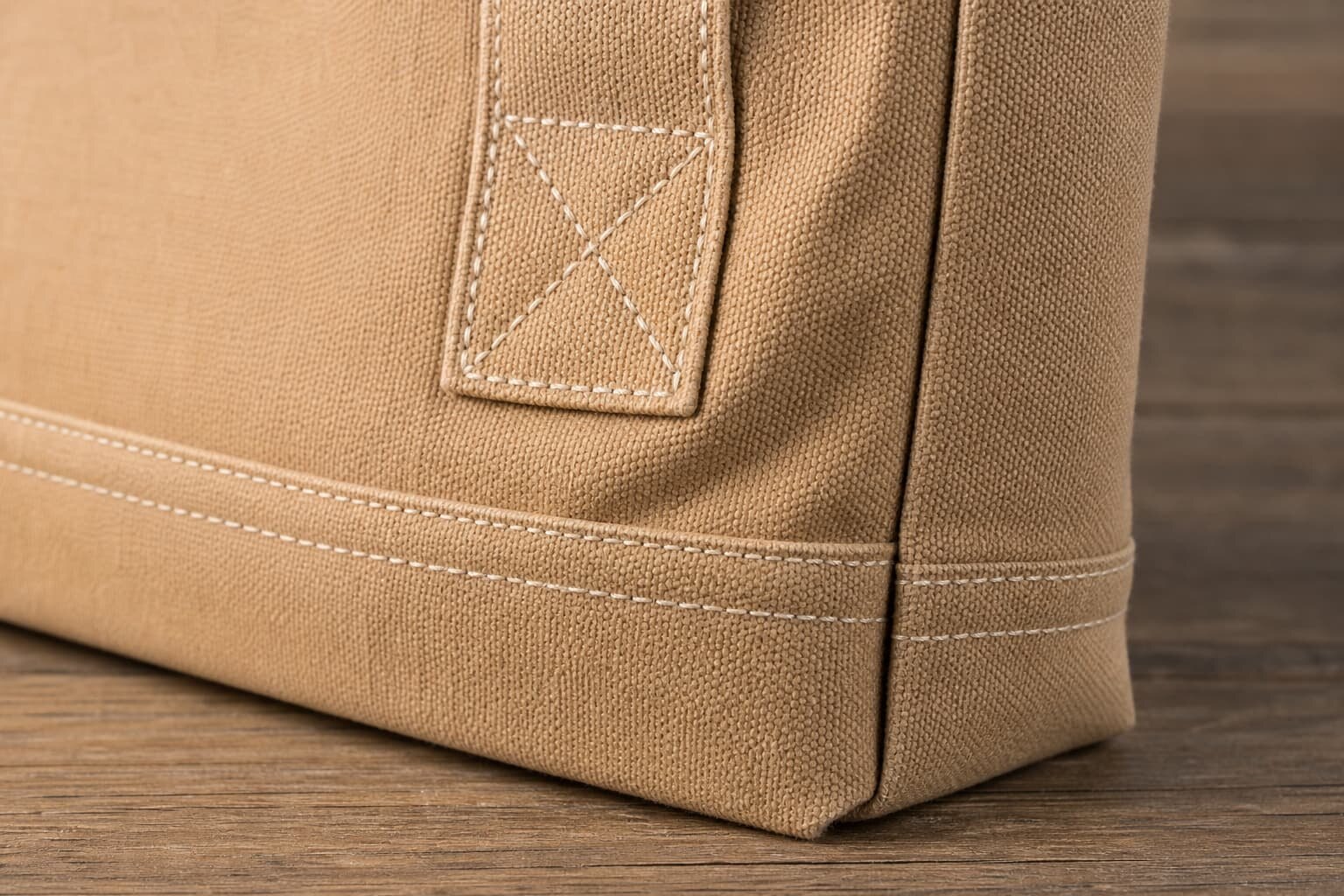
Why shade signoff fails on canvas tote orders
A canvas tote bag fabric shade signoff goes wrong when the buyer treats color as a single yes-or-no decision instead of a controlled production step. On canvas, the same named color can look different because of fiber source, yarn twist, loom density, bleaching strength, dye class, and finishing. A beige that looks clean in a showroom can read warmer on a heavier weave, while the same green can look duller once the fabric is washed and sewn into a larger panel.
The commercial risk is simple: if shade is not locked before bulk fabric is cut, you can end up with mixed cartons, uneven reorders, and a shipment that looks inconsistent on the shelf. Buyers should sign off the base fabric first, then confirm how the print, lining, handles, and packing will behave on that exact shade. For canvas totes, the color approval is part of the production spec, not a cosmetic afterthought.
- Treat shade approval as a release gate before cutting, not as a design preference.
- Lock the exact fabric state: greige, bleached, dyed, washed, or coated.
- Use one physical reference sample so the factory has a repeatable target.
Define the fabric before you judge the color
The same shade name can behave differently across 10 oz, 12 oz, and 14 oz canvas because heavier fabric usually looks denser and absorbs dye differently. In buyer language, a 10 oz canvas around 340 GSM often reads lighter and more open, while a 12 oz or 14 oz canvas around 380 to 420 GSM tends to look deeper, more opaque, and more premium. If your RFQ only says "natural canvas" or "colored canvas," the factory will fill in the blanks with its own assumptions.
Write the fabric spec as if you are buying process control, not just cloth. State the target GSM, the weave type, whether the fabric is pre-shrunk, brushed, bleached, washed, or coated, and whether you care more about color stability or hand feel. If the tote is meant for retail or brand use, ask the supplier to quote the same shade on the exact GSM you want, because a lower-weight sample often makes a color look brighter than the bulk lot.
- 10 oz / about 340 GSM: common for promotional and everyday carry totes.
- 12 oz / about 340 to 380 GSM: a balanced option for retail and wholesale programs.
- 14 oz / about 380 to 420 GSM: better for premium, structured, and heavier-use bags.
Build a reference standard the factory can repeat
A workable shade signoff starts with a physical master, not a screenshot. Ask the factory to send a lab dip or bulk swatch cut from the same fabric route it plans to use in production, then mark it with the color code, fabric code, date, and approval name. Store that reference in a flat sleeve, away from light and dust, so the same sample can be used for reorder comparisons months later. If your company has multiple approvers, name one final decision-maker so the factory does not receive conflicting instructions.
The right reference also needs the right viewing condition. Canvas shade should be judged under daylight or a standard light booth, then checked again after the sample has rested, because freshly dyed fabric can look different once moisture is gone. If the tote includes print, embroidery, or a woven label, approve those elements on the approved shade, not on a separate neutral sample. Otherwise the bag can pass on paper and fail once the real material is in hand.
- Keep one buyer-side retained swatch and one factory-side retained swatch.
- Mark the approval version clearly if you revise color, finish, or print method.
- Review the sample under the same light source each time to avoid false approvals.
Compare the main approval methods before you choose one
Buyers often say they want a shade match, but not every approval method solves the same problem. A lab dip works best when the bag is dyed after weaving and the exact target tone matters. A strike-off is more useful when the fabric carries print or a coated finish that changes how the shade reads. A bulk swatch cut from the real production roll is the strongest signoff for repeat orders because it shows the actual lot, not a theory of the lot.
If the order is natural or only lightly finished canvas, the approval may be more about base-fabric tone than dye color. In that case, your risk is not "color mismatch" in the usual sense; it is a change in creaminess, brightness, or fiber fleck from one lot to the next. The right answer is to match the approval method to the production route, not to force every bag through the same paperwork.
- Use lab dips for dyed canvas when the shade target is exact and repeatable.
- Use strike-offs when the print sits on top of the fabric color and contrast matters.
- Use bulk swatches for reorder business when the buyer wants the closest proof of actual output.
What to ask for in a quotation
A useful quote should separate the cost of fabric, dyeing, cutting and sewing, printing, packing, and inspection. If the supplier gives only one lump sum, you cannot tell whether a shade problem comes from the mill, the dye house, or the sewing floor. For canvas totes, the dye route is often the hidden cost driver. Reactive dye on cotton usually needs tighter process control and more lead time than a simple stock-color or surface-dyed option, and that difference should be visible in the quote.
Ask the factory to name the fabric weight, roll width, dye lot size, and print method in the quotation, because those four items often determine whether the shade can be repeated later. If the tote is screen printed, ask whether the base shade affects ink opacity and whether the factory will do a print test on the approved fabric. If the bag uses embroidery or woven labels, you still need the fabric shade approved first so the branding does not look too sharp or too weak against the body color.
- Request separate lines for fabric, dyeing, print, sewing, packing, and testing.
- Ask for the exact fabric code and dye route, not just the color name.
- Make the supplier confirm whether MOQ changes by color, finish, or lot size.
MOQ logic and lead time live inside the shade decision
Shade signoff affects MOQ more than many buyers expect. A factory may be able to sew 5,000 tote bags in total, but only if the order sits within the mill's dye batch size or the factory's cut order plan. If you request four colors, the supplier may need a minimum quantity per shade to avoid waste or leftover fabric. That is why one color can be cheap while two or three colors from the same program can raise the unit cost without changing the bag construction at all.
Lead time follows the same logic. A supplier may need time for lab dips, approval rounds, dyeing, drying, inspection, and then cutting. A simple stock-color canvas order can move faster than a custom shade that needs two revisions and a fresh bulk lot. For that reason, buyers should ask the factory to show the full calendar in the quote: sample timing, approval deadline, fabric production window, and bulk sewing start date. A schedule without those checkpoints usually hides delay risk.
- Ask whether MOQ is per color, per fabric lot, or per full PO.
- Ask how many days the factory needs for each approval stage.
- Plan for extra time if the first sample is only a lab dip and not a bulk swatch.
Packing and lot control prevent mixed-shade cartons
Even when the fabric is approved, mixed shade can reappear at packing. This happens when rolls are cut in a flexible sequence, when overage fabric is pulled from a different lot, or when cartons are filled from multiple production batches without clear labeling. For canvas totes, that creates a shelf problem because the same SKU can arrive with visibly different body tones in the same carton. Retail buyers notice it quickly, and distributors end up sorting bags manually before sale.
The fix is not complicated, but it has to be written into the PO. Require lot numbers on roll tags, bundle labels, and carton marks. Ask the factory to pack by shade lot whenever practical and to keep any mixed or overage pieces separate and identified. If your order is large enough to cover more than one lot, ask the supplier to map which cartons belong to which lot so future claims can be traced instead of guessed.
- Keep the approved shade code on the carton label and on the inner bundle tag.
- Do not allow unmarked overage pieces to enter the main shipment.
- Separate any test pieces or replacement pieces from saleable stock.
Sample checks and acceptance criteria that actually catch problems
A shade sample should be checked under the same lighting that the buyer will use for final approval, then handled the way the tote will be handled in real use. Compare the front panel, side panel, handle tape, and any lining or facing material against the master swatch. If the tote is printed, look at how the ink sits on the shade: a dark body can bury a logo, while a light body can make the same print look harsher than expected. The goal is not only color accuracy but also visual balance.
Write acceptance criteria that a production team can follow without guessing. A good rule is to define what counts as a visible mismatch, what counts as a fabric defect, and what counts as a packaging error. If your company uses a numeric color standard, include it in the PO; if not, use a physical yes-or-no approval against the retained swatch. Either way, the factory should know whether a minor tone shift is acceptable, whether seam-facing color matters, and whether the buyer will reject a mixed lot even if the bags are individually well made.
- Check color under daylight or a standard light booth, not warehouse mixed light.
- Inspect how the shade looks on all panels, not only the front face.
- Test rub and wash resistance if the color is deep, dark, or heavily handled.
Final buyer workflow before bulk approval
The cleanest workflow is simple: RFQ, sample, approval, pilot lot, bulk release. The RFQ should define the canvas weight, color route, print method, and packing logic. The sample stage should end with one signed physical swatch and one retained record. The pilot lot should prove that the factory can hold the shade across actual production rolls, not just in a small hand sample. Only then should the buyer release the bulk order and ask for packing based on the approved lot map.
For repeat business, keep the approval file easy to reopen. Save the swatch code, fabric source, dye lot, print spec, carton photo, and approval date in one folder tied to the PO number. That way, when the next reorder comes in, the buyer can ask for the same target instead of re-explaining it from zero. On canvas totes, that single habit prevents a lot of small mistakes that become expensive after sewing and packing are already complete.
- Use one approval document that names the exact fabric, shade, and print method.
- Require a pilot lot before the factory cuts the full order.
- Keep the approval file linked to the PO for reorder control.
Specification comparison for buyers
| Spec decision | Recommended option | When it fits | Buyer risk to check |
|---|---|---|---|
| Base fabric shade | Approve a physical master swatch for the exact canvas lot | Natural, ecru, bleached, or dyed canvas orders where the bag body color must repeat | Photo-only approval can hide tone drift, brightness changes, and fiber specks |
| Color route | Reactive-dyed cotton canvas for stable brand color | Retail tote programs, licensed programs, and repeat orders with strict color control | Higher MOQ, longer lead time, and more process steps than stock greige |
| Low-cost color route | Pigment-dyed or surface-colored canvas | Short runs, promo programs, and washed or vintage looks | Crocking, uneven shade, and weaker wash performance if the finish is not controlled |
| Approval method | Lab dip plus physical bulk swatch under daylight booth | Any order where shade is a release condition before cutting starts | Approving from a phone screen creates disputes when light and camera shift the color |
| Production control | Keep one dye lot per PO whenever possible | Orders that need consistent cartons, reorders, or retail replenishment | Mixed lots inside the same shipment make claims hard to prove and harder to fix |
Buyer checklist before sampling
- Confirm the canvas weight in both ounces and GSM, plus the finish applied after dyeing or bleaching.
- Approve one physical master swatch under daylight or a light box before bulk fabric is released.
- State the acceptable shade tolerance in writing, including what counts as a reject.
- Ask whether the bag will use greige, bleached, pigment-dyed, reactive-dyed, or yarn-dyed canvas.
- Tie the shade approval to the exact print method, because screen print, heat transfer, and embroidery react differently on each base color.
- Request fabric roll numbers, dye lot numbers, and carton labels on the bulk packing list.
- Ask for a pre-production sample made from actual bulk fabric, not a showroom substitute.
- Confirm whether the factory will pack by shade lot, by size, or by customer PO.
- Keep buyer-side photos, a retained swatch, and the signed approval date with the PO record.
- Ask for rub, wash, and visual inspection results if the color is deep or the bag will be handled heavily in retail.
Factory quote questions to send
- What exact canvas construction will you use, including yarn count, weave, weight in oz, and target GSM?
- Is the shade based on a lab dip, strike-off, bulk swatch, or existing stock fabric?
- How many shade approval rounds are included before the order is delayed or re-quoted?
- What dye route will you use, and does it change the MOQ or lead time?
- Will the printed logo be approved on the same shade lot as the bulk fabric?
- Can you separate the quote into fabric, dyeing, printing, sewing, packing, and inspection?
- What is the minimum order quantity per color and per dye lot?
- How do you prevent mixed shade cartons during bulk packing and final shipment?
- What sample types can you send first, and what is the typical lead time for each one?
- What documents will you send with approval, including swatch code, lot code, and approval date?
Quality-control points to confirm
- Check the approved swatch against the first bulk roll before cutting starts.
- Inspect shade under daylight or a standard light booth, not only in warehouse lighting.
- Verify that all bulk rolls match the same tone, brightness, and surface finish.
- Confirm that front panel, side panel, handles, and gussets are cut from compatible shade lots.
- Review how the logo print looks on the approved fabric color, especially contrast and edge sharpness.
- Test dry rub and wet rub for deeper shades that may crock onto packing materials or clothing.
- Check for visible banding, speckling, streaking, or center-to-edge shade change across the roll.
- Confirm that sewn seams do not expose a different underlayer color in high-stress areas.
- Inspect carton labels, bundle tags, and lot codes to keep shade lots separated through packing.
- Retain one signed sample and one production swatch for reorder reference.