1. Start Inspection at RFQ Stage, Not After Production
A canvas tote bag for an event is a branded product and an operations item. It may be unpacked by temporary staff, filled with catalogues or samples, photographed on the show floor, carried for hours, and delivered against a fixed date. If handles fail, the logo color is wrong, or cartons arrive mixed by city, the buyer usually has little time to recover.
The inspection plan should begin before suppliers quote. A clear RFQ should state finished size, fabric weight, handle construction, decoration method, packing format, inspection standard, delivery deadline, and rework responsibility. This lets each factory price the same bag instead of using its own definition of "standard canvas tote."
Most event tote problems come from small specification gaps. A quotation says canvas but not GSM. A drawing shows a shoulder handle but no handle length. A digital proof looks sharp but the printed logo loses detail on textured fabric. Packing is listed as bulk but not separated by sponsor or destination. A measurable procurement specification closes these gaps before production starts.
- Issue one controlled technical specification with version number and approval date.
- Use finished product measurements, not only artwork mockups or cut-panel dimensions.
- Keep one sealed approved sample for production comparison and dispute handling.
- Require supplier acceptance of inspection criteria before deposit or production release.
- Avoid vague wording such as "good quality," "normal packing," or "standard handle" unless supported by measurable details.
2. Define the Event Use Case and Load Requirement
The first buyer question is what the bag must carry. A tote for a badge, notebook, and folded flyer can be lighter than a tote holding catalogues, bottles, hardware samples, boxed cosmetics, or apparel. If the tote is part of a paid conference kit, VIP package, or retail-style promotion, appearance standards also need to be higher than for a simple giveaway.
List the expected contents and estimate weight. For example, a 400 g catalogue, 300 g water bottle, 250 g notebook, badge materials, and sponsor inserts can easily approach 1.5-2 kg. Add a safety margin because visitors may add personal items during the event. The supplier should know this before recommending fabric, handle width, and reinforcement.
The use case also determines packing. A booth handout may need bundles of 25 or 50 so staff can count quickly. A VIP gift may need individual bags, tissue, or hangtags. A multi-city roadshow needs carton marks by city and delivery wave. These choices affect labor, carton count, inspection time, and landed cost, so they belong in the quotation, not as an afterthought.
- Light flyer giveaways: 8-10 oz may be acceptable only if load expectations are low.
- General conferences and trade shows: 10-12 oz canvas is usually a safer procurement range.
- Heavy kits or premium gifts: consider 12 oz canvas, stronger handles, and stricter load checks.
- Multi-sponsor events: control design separation, carton marks, and version count from the start.
- Venue handout programs: choose packing that speeds distribution, not just the lowest factory packing cost.
3. Specify Fabric Weight, Canvas Type, and Material Tolerances
Canvas descriptions vary. Similar-looking quotes may list 10 oz canvas, 12 oz canvas, 280 GSM cotton, natural cotton, recycled cotton, or promotional cotton bag. These are not automatically equivalent. For comparable quotations, ask suppliers to state both ounces and approximate GSM, plus tolerance. A typical 10 oz canvas may be around 280 GSM, while 12 oz may be around 340 GSM, subject to mill variation.
Define the fabric type. Natural cotton canvas may show seed specks and mild shade variation; that can be acceptable for an eco-style event if approved in advance. Bleached or dyed canvas should have tighter shade control. Recycled or organic cotton claims may require documentation if the claim appears in marketing, packaging, or sponsor materials. Do not rely on verbal sustainability claims for public-facing campaigns.
Material inspection should start before cutting when possible. Factory QC or the inspector should compare bulk fabric with the approved swatch and check roll shade, width, odor, holes, slubs, weaving defects, oil marks, mildew, and hand feel. At final inspection, finished bags should still be checked for panel shade mismatch, stains, excessive specks outside the approved range, and fabric that feels lighter than the reference sample.
- State material, weave, color, weight in oz, approximate GSM, and acceptable tolerance.
- Confirm whether fabric is greige, natural, bleached, dyed, washed, recycled, organic, or blended.
- For dyed canvas, approve lab dip or bulk shade before cutting if brand color matters.
- For natural canvas, define which specks, slubs, and shade variations are acceptable.
- Do not approve mass production from a small fabric chip if the bulk lot may be different.
4. Control Finished Size, Gusset, Handles, and Load Test
Event buyers should specify finished dimensions after sewing. A tote listed as 38 cm W x 42 cm H x 10 cm gusset must be measured the same way by the factory, buyer, and inspector. State whether width is measured at the opening or body, how gusset depth is opened for measurement, and whether height includes the bottom seam allowance. Otherwise, a technically usable bag may fail inspection because the measurement method was unclear.
Reasonable tolerances depend on design and capability, but sewn canvas totes often use about ±1 cm for width, height, and gusset and about ±1.5 cm for total handle length. Print position may need tighter control, often ±0.5-1 cm depending on artwork. These tolerances should be in the purchase order and inspection checklist.
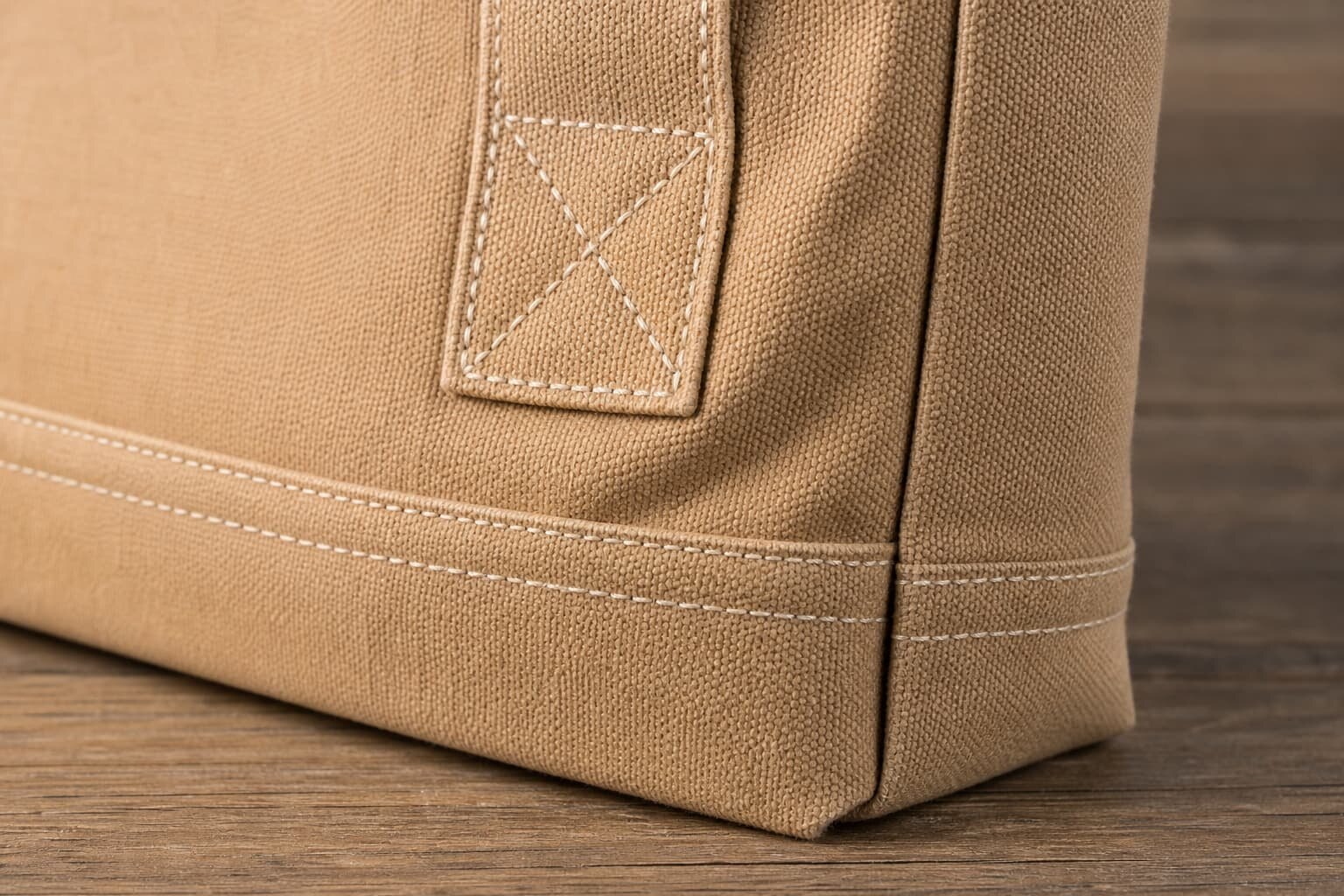
Handle strength is a high-risk functional point. Specify handle material, width, total length, drop, stitch pattern, reinforcement, and placement. For practical event inspection, define a load check: fill the bag with the agreed test weight or event-equivalent contents, hold or hang it by the handles for 1-2 minutes, and check for seam opening, fabric tearing, broken stitches, or permanent distortion. This is not a laboratory certification, but it catches weak construction before shipment.
- Measure multiple random bags, not only one sample from the top carton.
- Check handle drop on both sides; uneven handles look poor and carry badly.
- Inspect box stitch, cross-stitch, bar tack, or extra reinforcement for skipped stitches and broken threads.
- Use realistic event load plus a safety margin instead of accepting "strong handle" claims.
- Record test weight, duration, sampled quantity, result, and photos in the inspection report.
5. Inspect Logo Printing and Decoration on Canvas
Canvas is textured, so print approval should be based on a physical sample. A logo that looks perfect in a digital proof may lose sharp edges on rough fabric. Screen printing is often the best balance for one to three solid colors, sponsor logos, and event marks. It is efficient at volume, but it still requires checks for opacity, registration, edge quality, curing, and color consistency.
For detailed artwork, another method may be better. Heat transfer can support gradients and small details but should be checked for adhesion, cracking after folding, edge lift, gloss level, and hand feel. Digital print should be checked for banding, pretreatment marks, color accuracy, and rub resistance. Embroidery should be checked for puckering, thread breaks, backing, and reverse-side finish. Labels and patches need checks for position, orientation, sewing strength, and sponsor approval accuracy.
The purchase order should lock logo position with measurements from the top edge, side edge, or center line. It should also state final print size, number of colors, Pantone or CMYK reference, acceptable color tolerance, and whether canvas texture show-through is allowed. For multi-sponsor layouts, review small text at actual size before approving production.
- Screen print: inspect opacity, pinholes, registration, edge sharpness, curing, and ink transfer.
- Heat transfer: inspect adhesion, cracking after folding, edge lift, gloss, and plastic hand feel.
- Digital print: inspect color, banding, pretreatment marks, and rub resistance if required.
- Embroidery: inspect puckering, stitch density, backing, loose threads, and reverse-side comfort.
- Labels and patches: inspect placement, orientation, sewing strength, color, and sponsor accuracy.
6. Approve Samples With Clear Production Authority
A hand sample can confirm shape, size, and workmanship, but it may not represent bulk production. It may use available fabric, a substitute handle, or a different print process. Label approvals carefully. If a sample is only for construction, say so. If it is a true pre-production sample, it should use the intended bulk fabric, handle, thread, logo process, label, and packing method.
The approved pre-production sample becomes the reference for final inspection. Tag it with version number, date, fabric specification, print method, artwork file name, and approval status. One sample should remain with the buyer or sourcing team, and one should remain sealed at the factory. Photos help, but physical comparison is better for fabric hand feel, ink opacity, handle stiffness, and sewing finish.
Before mass production, confirm whether anything changed after approval. Common changes include substitute fabric, revised webbing, different print size, altered logo color, changed carton quantity, or removed inner packing. Any change should be documented and approved. If not, the inspector may reject goods that the factory believed were acceptable.
- Approve construction, fabric, print, label, and packing together or as clearly separate stages.
- Photograph measurement points so factory QC and third-party inspectors measure the same way.
- Fold and pack the sample as production will be packed to check print creasing or transfer risk.
- Review inside seams, trimming, odor, handle comfort, and back panel, not only the front logo.
- Do not release bulk cutting if fabric, artwork, handle, or packing details are still provisional.
7. Compare Quotes by Total Commercial Risk, Not Unit Price Alone
MOQ for canvas tote bags is driven by fabric roll quantity, dyeing minimums, screen setup, label production, cutting efficiency, packing materials, and carton planning. A natural canvas tote with one-color print may have flexible MOQ, while dyed canvas, several sponsor versions, and retail packing can raise the practical minimum.
Compare quotes line by line. Ask what is included: fabric, screen setup, color matching, sample cost, labels, hangtags, inner packing, export cartons, testing, inspection support, and freight. A supplier with a slightly higher unit price may be cheaper landed if carton volume is lower, packing is controlled, and rework risk is reduced.
Clarify overrun and underrun tolerance. For an event, a shortage can be worse than a small overrun. If the buyer needs 5,000 usable bags, state whether the supplier may ship 2-3% over or under, or whether extra production allowance is needed for inspection rejects. Also define what happens if inspection fails: sorting deadline, replacement quantity, reinspection cost, air freight responsibility, and payment hold.
- Request price breaks at realistic quantities such as 1,000, 3,000, 5,000, and 10,000 pieces.
- Separate costs for bag, print setup, labels, packing, testing, inspection, freight, and destination splitting.
- Confirm whether MOQ applies per fabric color, design, logo version, label, or shipment destination.
- Ask how many extra pieces the factory plans for production loss and inspection replacement.
- Include a written dispute process covering defects, rework, reinspection, shipment delay, and shortage.
8. Use AQL Sampling With Tote-Specific Defect Classes
AQL inspection is useful only when the buyer defines the sampling plan and defect rules. Many consumer goods inspections use ANSI/ASQ Z1.4 or ISO 2859-1 sampling tables. The lot size determines a sample-size code letter, and the inspection level determines how many units are checked. General Inspection Level II is commonly used for final random inspection; Special Inspection Levels may be used for time-consuming, destructive, or measurement-heavy checks.
For example, if a shipment has 5,000 finished tote bags and the buyer uses General Inspection Level II, the sample size may be around 200 pieces depending on the selected table and inspection service. The AQL limits then define how many defects can be accepted. Many buyers set critical defects at 0, major defects around 2.5, and minor defects around 4.0, but the exact accept and reject numbers must come from the selected AQL table.
Defect classification should be specific to event canvas tote bags. Critical defects make the product unsafe, illegal, or unusable. Major defects affect function, brand appearance, packing accuracy, or event usability. Minor defects are small workmanship issues that do not affect normal use. Without examples, factories and inspectors may disagree about stains, loose threads, print flaws, or fabric marks.
If inspection fails, do not ship first and negotiate later unless the event date leaves no alternative and the buyer accepts the risk. The normal sequence is sort, repair, replace, repack, and reinspect. Reinspection should focus on corrected defects and also verify that rework did not create new problems such as dirty fabric, wrong counts, or mixed cartons.
- Critical defects: mold, severe chemical odor, sharp contamination, needle fragments, unsafe foreign matter, wrong event name, or unusable product.
- Major defects: broken handle stitching, seam opening, wrong fabric weight beyond tolerance, wrong dimensions, peeling print, heavy stain, severe misregistration, missing required label, mixed design, or carton shortage.
- Minor defects: small loose threads, slight cotton specks within approved range, minor trim marks, small shade variation within tolerance, or slight print texture matching the approved sample.
- Sampling rule: draw cartons randomly across the shipment and sample from top, middle, and bottom layers.
- Inspection record: list sample size, defect counts, AQL level, accept/reject decision, photos, carton numbers, rework action, and reinspection requirement.
9. Inspect Packing, Carton Count, and Venue Distribution Controls
Packing is where many acceptable tote orders become event problems. Bulk packing is economical, but only if bundle and carton counts are controlled. Individual polybags can improve cleanliness and presentation, but they add cost, plastic use, carton volume, and unpacking time. For many events, inner bundles of 25 or 50 inside export cartons are a practical balance.
The packing specification should state pieces per inner bundle, pieces per master carton, carton dimensions, gross weight, carton numbering, and shipping marks. If there are multiple logos, colors, cities, booths, or sponsor versions, they should be packed separately with clear labels. Mixed cartons may save factory time but can create venue delays and inventory disputes.
Inspectors should verify carton count against the packing list. Count sealed cartons by design or destination, open random cartons, confirm inner bundle count, count pieces in selected bundles, and reconcile partial cartons. If the order is 10,000 pieces at 100 pieces per carton, the shipment should normally show 100 cartons unless partials, samples, or overruns are documented.
Carton condition also matters. Wet, crushed, weak, or over-heavy cartons increase the risk of stained bags and handling damage. Prints should be fully cured before folding. Large prints should not be compressed face-to-face if ink transfer is possible. If bags will be stored before the event, ask about moisture protection and avoid sealing damp canvas in plastic.
- Specify inner bundle quantity, master carton quantity, carton size, gross weight, carton numbering, and carton marks.
- Require separate packing for each design, color, sponsor logo, city, booth, or delivery wave.
- Check cured print before folding and confirm compression does not cause sticking, transfer, or heavy creases.
- Use shipping marks that match the event distribution plan, not only the factory invoice number.
- Verify carton math: carton quantity × pieces per carton plus documented partial cartons should equal shipped units.
- Photograph carton marks, open-carton layout, bundle count, partial cartons, damaged cartons, and moisture concerns.
10. Work Backward From the Fixed Event Date
Canvas tote lead time is a chain of approvals and operations, not one production number. Sampling, artwork adjustment, fabric purchasing, fabric approval, cutting, printing, curing, sewing, trimming, internal QC, packing, final inspection, rework, export booking, customs, domestic delivery, and venue receiving all need time. A factory may quote 25 production days, but that usually starts only after deposit, final artwork, fabric confirmation, and sample approval.
Build the schedule backward from the required venue date. If the venue needs bags one week before opening, domestic delivery takes three days, customs and freight take two to four weeks, final inspection and possible rework need several days, and production takes four weeks, sample approval cannot wait until the last minute. For fixed events, final inspection should happen before balance payment or shipment release where commercial terms allow.
Logistics control should include export documents and destination splitting. Confirm commercial invoice, packing list, HS code, certificate or material documents if required, shipping marks, and consignee details before shipment. For split destinations, each carton should map to a destination line so the forwarder, warehouse, and venue team can receive without resorting on site.
If inspection fails close to the event date, decide based on severity and deadline. Critical safety or wrong-event-name defects should not ship. Major defects may require sorting, rework, replacement, or partial acceptance only with buyer approval. Air freight can recover some delays, but it is expensive and should be treated as an emergency option, not a substitute for early inspection booking.
- RFQ stage: send finished size, fabric weight, logo file, print method, handle spec, packing plan, inspection level, and delivery deadline.
- Sample stage: approve physical construction, fabric, logo, color, label, and packing before bulk production.
- Inline stage: check early output for fabric, print position, sewing, and handle strength while correction is still possible.
- Final stage: inspect packed goods using agreed AQL, carton count, measurements, print checks, and load test.
- Shipment stage: release only after defects, shortages, carton marks, documents, and delivery plan are closed.
- Receiving stage: compare arrived cartons with packing list and report shortage, damage, or wet cartons immediately with photos.
Specification comparison for buyers
| Spec decision | Recommended option | When it fits | Buyer risk to check |
|---|---|---|---|
| Fabric weight | 10 oz to 12 oz canvas, about 280-340 GSM, with written tolerance | Most conferences, trade shows, delegate kits, staff packs, sponsor bags, and branded giveaways needing a durable hand feel without excessive carton volume | Some quotes use ounces loosely or substitute lighter cotton; require GSM range, swatch approval, and bulk fabric verification before cutting |
| Bag construction | Side seams with bottom gusset, reinforced handle attachment, and neat inside finishing | Event bags carrying brochures, catalogues, apparel, bottles, boxed samples, or multiple sponsor inserts | Flat bags reduce capacity; inspect gusset depth, seam allowance, handle alignment, and bottom corner stress |
| Handle specification | 2.5-3 cm wide cotton webbing or strong self-fabric handles, typically 55-65 cm total length for shoulder carry | Visitors walking through venues, commuting after the event, or carrying kits for several hours | Short handles reduce usability; thin handles may fail if reinforcement and stitch density are not controlled |
| Logo print | Screen print for solid 1-3 color artwork, approved by physical sample | Most event logos, sponsor marks, booth bags, and simple brand graphics | Canvas texture can soften edges; check ink opacity, Pantone tolerance, registration, curing, and setup charges |
| Detailed artwork | Heat transfer, digital print, embroidery, woven label, or patch after method-specific testing | Gradients, small text, photographic artwork, multi-sponsor layouts, premium merchandise, or low-volume personalization | Transfers may crack, digital print may need pretreatment, embroidery may pucker; require rub, fold, adhesion, and appearance checks |
| Packing format | Bulk packed with controlled inner bundles, or individual polybag only when hygiene or retail presentation requires it | High-volume venue distribution where carton efficiency and fast unpacking matter | Loose bulk packing can create count disputes and print creasing; specify bundle count, carton quantity, design separation, and shipping marks |
| Inspection approach | Final random AQL inspection plus inline check for complex, new, or time-critical orders | New suppliers, orders above a few thousand pieces, multiple designs, split destinations, or fixed event dates | Factory QC alone is not enough; define critical, major, and minor defects, sample plan, measurement method, and rework rules |
| Delivery control | Backward schedule from event date with sample approval, production, inspection, export, customs, and venue delivery buffers | Conferences, exhibitions, roadshows, product launches, retail pop-ups, and campaigns with fixed dates | A low unit price loses value if cartons arrive late or mixed; confirm inspection timing, carton count, documents, and dispute process before shipment |
Buyer checklist before sampling
- Define the event use case: expected contents, approximate load, distribution method, venue handling, and whether the tote is a giveaway, delegate kit, staff item, or premium gift.
- Confirm finished bag size, not cut panel size, including width, height, gusset, handle length, handle drop, print size, and measurement tolerances.
- Specify canvas weight in both ounces and approximate GSM, plus fabric type: natural, bleached, dyed, recycled, organic, washed, unwashed, or blended.
- Ask for a physical pre-production sample using the correct bulk fabric, handle, thread, print method, logo size, label, and packing method wherever schedule allows.
- Set acceptance tolerances before production: commonly about ±1 cm for body dimensions, ±1.5 cm for handle length, and agreed limits for print position and color.
- Define handle reinforcement type, stitch density expectation, seam allowance, and a load-check method based on actual event contents rather than vague strength claims.
- Approve artwork by final print size, print position from bag edges or center line, Pantone or CMYK reference, number of colors, curing requirement, and acceptable color variation.
- Classify defects as critical, major, and minor before inspection so quality disputes are based on written criteria rather than subjective opinions.
- Confirm MOQ by fabric color, print design, label, packing style, split destination, and shipment plan; ask how costs change when designs or destinations are divided.
- Request carton size, pieces per carton, gross weight, inner bundle count, barcode or shipping mark format, pallet restrictions, and carton handling concerns if applicable.
Factory quote questions to send
- What exact fabric are you quoting: canvas weight in oz and GSM, weave type, color process, shrinkage range, fabric weight tolerance, and whether bulk fabric will match the submitted swatch?
- Is the quoted size measured after sewing and finishing? What tolerance do you apply for width, height, gusset, handle length, handle drop, and print position?
- What handle material, width, length, and reinforcement method are included in the price: self-fabric, cotton webbing, cross-stitch, bar tack, box stitch, or extra row stitching?
- Which print method is included, how many colors, what print area, what ink or transfer type, and are screen setup, Pantone matching, artwork adjustment, or remake fees included?
- Can the pre-production sample be made with bulk fabric and the actual bulk print process, or is it only a hand sample for shape and layout approval?
- What is the MOQ by fabric color, print design, sponsor logo, label, and packing style, and what cost changes if the order is split by destination or delivery date?
- What AQL level and inspection standard can you accept, and will you agree to buyer-defined critical, major, and minor defect classifications in the purchase order?
- How do you perform internal QC for fabric inspection, print curing, sewing, trimming, measurement, load check, counting, and carton sealing before third-party inspection?
- How many calendar days are needed for sampling, sample shipment, material preparation, printing, sewing, internal QC, final inspection, packing, and shipment booking after deposit and artwork approval?
- What carton packing details are included: pieces per bundle, pieces per carton, carton dimensions, gross weight, moisture protection, desiccant if needed, shipping marks, and carton numbering?
Quality-control points to confirm
- Bulk fabric weight, hand feel, weave density, and shade should match the approved swatch within agreed tolerance; no unexpected thinning, holes, oil marks, mildew, strong odor, or severe color variation.
- Finished dimensions should stay within written tolerance, especially bag opening width, height, bottom gusset, handle length, handle drop, and print position, because small changes affect kit packing and comfort.
- Handles should be aligned, evenly spaced, straight, and reinforced consistently; no skipped stitches, broken threads, loose corners, twisting, or weak attachment points.
- Seams should be straight with adequate seam allowance; inside edges should follow the approved finish, and bottom corners should not pucker, split, or show stress under moderate load.
- A practical load check should use the agreed event load or a defined test weight, held for a defined time, with no handle tearing, seam opening, or permanent distortion beyond the agreed limit.
- Logo print should match approved size, position, color, registration, opacity, edge sharpness, and curing standard under normal viewing distance; no peeling, cracking, heavy pinholes, ink transfer, or stains.
- Rub, scratch, fold, and odor checks should be performed on printed areas before packing, especially for dark ink, large coverage, heat transfers, or prints folded face-to-face.
- Labels, hangtags, barcodes, sponsor marks, inserts, carton marks, and destination details should match the purchase order and latest artwork approval file.
- Packing count should be controlled by inner bundle and master carton; no mixed designs, missing units, wet cartons, crushed corners, unclear shipping marks, or excessive compression.
- Random carton checks should compare top, middle, and bottom layers so the inspector does not evaluate only factory-selected top-layer goods.