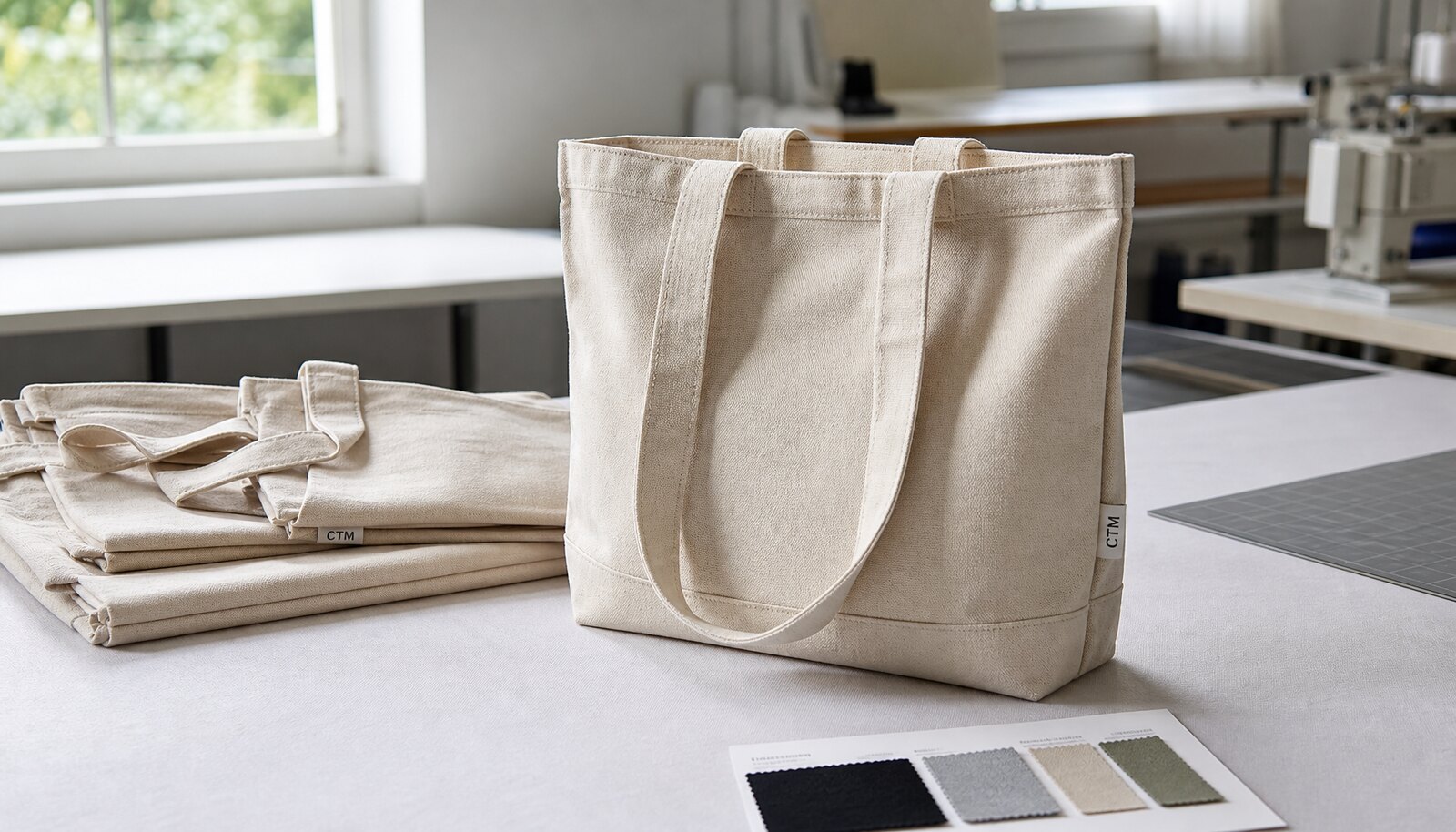
Start With the Reorder Problem, Not the Bag
A canvas tote bag reorder goes wrong when the buyer starts with a target unit price and only later asks how the bag was built. For retail procurement, the key question is not simply whether a supplier can make a tote. The question is whether the supplier can make the same tote again, in the same fabric weight, with the same hand feel, print result, handle strength, folding method, labels, and carton configuration. That repeatability is what protects margin on a second, third, or seasonal reorder.
A good canvas tote bag for retail buyers bulk reorder plan treats the bag as a controlled production item. The buyer defines the intended retail channel, likely load, display method, shelf presentation, packaging, and replenishment rhythm before requesting quotes. A bookstore tote, grocery tote, museum-shop tote, and fashion merchandise tote may look similar in a line sheet, but they can require different fabric weights, handle drops, reinforcement, and print durability.
The biggest reorder risk is silent spec drift. A supplier may use a slightly lighter canvas, change thread, adjust the handle length, fold the bag differently, or pack more units per carton to save space. None of those changes may look serious in a quick photo, but they can affect store presentation, customer feel, freight cost, or defect rate. Procurement teams should therefore build the reorder file around a written spec sheet, approved sample, artwork file, packing instruction, and documented tolerance list.
Before the first PO is placed, decide what must remain identical on future orders and what can change. For example, the base bag construction may stay fixed while artwork rotates seasonally. Or the fabric and print may stay fixed while hangtags change by retailer. This distinction helps suppliers quote correctly and helps buyers avoid a full resampling cycle for every small retail update.
- Define the finished bag size, gusset, handle drop, and intended load before asking for price.
- State whether the tote is for light promotional use, retail resale, heavy daily carry, or premium brand merchandise.
- Keep the approved sample, artwork, spec sheet, and packing instruction as the control file for all repeat orders.
- Separate fixed construction details from seasonal artwork or packaging details so reorders can move faster.
- Require written approval for any supplier substitution in fabric, thread, ink, label, packing, or carton specification.
Choose Fabric Weight by Channel, Not by Habit
Fabric weight is one of the most important cost and quality decisions in a canvas tote bag program. It affects hand feel, print appearance, sewing difficulty, carton weight, freight cost, and customer perception. A lightweight 8 oz bag may be acceptable for a simple giveaway or low-price promotional retail item, but it may feel too soft for a paid retail product. A 14 oz canvas may look premium and structured, but it can raise material cost, increase bulk, reduce carton quantity, and create higher freight cost.
For many retail reorder programs, 10 oz to 12 oz finished canvas is the practical starting point. It has enough body to look credible on a retail shelf, enough surface stability for screen printing, and enough durability for common shopping loads. That does not mean it is always correct. A high-volume grocery program may prioritize cost and pack efficiency. A museum, bookstore, or lifestyle brand may prefer a heavier fabric because the tote itself is part of the merchandise experience.
Procurement buyers should ask exactly how fabric weight is measured. Some suppliers quote greige fabric weight before finishing, while others quote finished canvas weight after dyeing, washing, or shrinking. A bag described as 12 oz by one supplier may not feel the same as a 12 oz bag from another if the measurement basis, weave, finish, or shrinkage is different. The safest approach is to request both GSM and oz, ask whether it is finished fabric, and compare physical swatches where the program has meaningful volume.
Also consider fabric finishing. Natural canvas may show seeds or slubs, which can be acceptable for a natural retail look but problematic for a clean logo print. Dyed canvas introduces shade control and lot-to-lot matching issues. Washed canvas can feel softer and more premium, but shrinkage must be managed. If the reorder must match a previous season, the buyer should keep a fabric swatch or cut panel from the approved order, not only a photo.
- 8 oz to 9 oz: useful for light promotional programs, cost-sensitive retail, and lower load expectations.
- 10 oz to 12 oz: common retail balance for repeat orders, good print surface, and moderate structure.
- 14 oz and above: better for premium feel or heavier carry, but check sewing cost, carton cube, and freight impact.
- Natural canvas: attractive for many brands, but confirm acceptable slubs, seed marks, and shade range.
- Dyed or washed canvas: stronger visual control may be possible, but require clear shade standards and shrinkage tolerances.
Print Method, Artwork Control, and Brand Repeatability
Print method matters more on a reorder than on the first sample because the second order must match the first without long explanations. Screen printing remains the most common choice for simple one to three color artwork on canvas totes. It can offer strong opacity, clean edges, and efficient repeat cost once the screen and placement are controlled. For large retail quantities with stable artwork, it is often the most practical method.
That said, not every design belongs on a screen print. Heat transfer may be useful for smaller runs, gradient artwork, or complex images, but buyers should test cracking, peeling, and fold durability. Digital printing can support multi-color artwork, but buyers need to confirm color consistency on textured canvas. Embroidery can add perceived value for premium programs, but it changes fabric behavior and may create puckering if the logo is large or the canvas is too light.
For procurement, the print approval should include more than a PDF mockup. The buyer should approve artwork size, placement from top edge and side seam, Pantone references, acceptable color tolerance, ink type, and curing method. If the tote will be folded for packing, ask the supplier to fold the printed area during sample review and check whether the ink cracks or transfers. If the bag is likely to be rubbed during use, request a simple rub test standard or at least a documented internal test.
Reorders also require artwork version control. Many problems happen when an old logo file, outdated Pantone callout, or revised seasonal slogan is used without a clear file name. Procurement teams should issue final artwork in locked format, identify the active revision, and archive superseded versions. The factory should confirm the artwork file name, print size, color count, and placement in the proforma invoice or production sheet.
- Use screen print for bold repeat artwork where unit cost and opacity matter.
- Use heat transfer or digital print when artwork complexity is more important than classic canvas print feel.
- Use embroidery for smaller premium logos, but check backing, puckering, and needle density.
- Approve physical print color against a standard, not only against a screen image.
- Control file names, artwork revision dates, print dimensions, and placement measurements on every reorder.
Construction Choices That Affect Use, Returns, and Sell-Through
Retail customers judge a tote quickly. They feel the handle, open the bag, look at the print, and decide whether it seems worth the selling price. For that reason, procurement buyers should not treat handle and seam decisions as minor technical details. Handle drop determines whether the bag is comfortable in hand, over the arm, or on the shoulder. Handle width affects comfort under load. Reinforcement affects whether the bag survives real use after purchase.
A common mistake is approving a tote based on front appearance only. The side gusset, bottom fold, top hem, and handle attachment are just as important. A flat tote can be efficient and inexpensive, but a gusseted tote may sell better when customers expect volume for books, groceries, apparel, or gift shop merchandise. A reinforced bottom can add cost, but it may improve structure and perceived value. A zipper, liner, or inner pocket can move the tote into a higher retail price point, but each addition changes MOQ, production time, defect risk, and inspection scope.
Construction needs should be tied to channel. A lightweight checkout tote may only need basic stitching and simple handles. A bookstore tote should be reviewed for corner stress and handle strength because books create concentrated load. A brand merchandise tote may need cleaner seam presentation and label placement because the customer is buying the bag as a product, not just using it as packaging.
Ask the supplier to define stitch density, thread type, reinforcement method, and seam allowance. If the supplier says the handle is reinforced, ask what that means: cross-stitch, box stitch, bar-tack, additional patch, or only extra rows of stitching. The answer affects both strength and appearance. For retail buyers, the sample should be opened, loaded, carried, folded, and inspected like a real product before approval.
- Confirm handle drop for the intended carry style: hand carry, arm carry, or shoulder carry.
- Specify self-fabric handles, webbing handles, or contrast handles rather than leaving it to supplier choice.
- Require clear reinforcement details at handle joins and stress points.
- Check gusset corners, bottom fold, and top hem for consistency and clean finishing.
- Quote optional features separately: zipper, liner, inner pocket, hang loop, reinforced base, or special label.
MOQ Logic: Build Reorders Around the Base Bag
MOQ is rarely a single number, even when it is presented that way in a quick quote. A canvas tote program can have a fabric MOQ, dye lot MOQ, cutting minimum, print setup minimum, embroidery minimum, label MOQ, packing MOQ, and shipment minimum. If procurement only asks, “What is your MOQ?” the supplier may answer with a simplified number that hides the real cost drivers.
The smartest reorder strategy is often to standardize the base bag and vary only the elements that need to change. For example, a retailer may use one 12 oz natural canvas body with the same handles and gusset, then rotate screen-printed artwork by season. Another buyer may keep the same body but use different hangtags or barcode labels for wholesale accounts. When the base construction stays stable, the factory can plan material, cutting, and sewing more efficiently, while the buyer reduces sampling and inspection risk.
Buyers should also ask whether multiple artworks can be combined under one base-bag order. If three designs use the same fabric, size, handle, and packing, the factory may be able to cut and sew the base bags together, then separate them at printing or finishing. This can improve feasibility for smaller retail replenishments. However, print setup charges and color changes may still apply, so the quote should show the cost by artwork.
For repeat orders, request both first-run pricing and repeat-run pricing. First orders may include sample development, screen setup, artwork adjustment, and factory learning time. Those charges should not automatically be buried in every future unit price. At the same time, a very small reorder may cost more per unit because setup is spread over fewer bags. A transparent quote helps the buyer choose between one larger seasonal buy, smaller monthly replenishments, or a combined multi-SKU production run.
- Ask for MOQ by base bag, fabric color, artwork, label, packing method, and shipment release.
- Standardize the body and rotate artwork where possible to reduce reorder complexity.
- Request first-order price, repeat-order price, and small top-up price as separate scenarios.
- Confirm whether screens, patterns, and cutting templates are retained for repeat runs.
- Check whether mixing SKUs improves MOQ or creates extra sorting and packing labor.
Sampling, Approval, and Documentation Control
The pre-production sample is the most useful risk-control tool in a canvas tote reorder, but only if it reflects real bulk production. A showroom sample made from available fabric, with approximate handles and a substitute print method, may be helpful for concept review but should not be treated as production approval. For a commercial order, the buyer needs a sample made with the intended fabric, thread, print method, reinforcement, label, and packing format.
A strong sample approval process has three layers. First, the buyer checks measurable specifications: width, height, gusset depth, handle drop, handle width, print size, print location, label position, and tolerances. Second, the buyer checks functional quality: handle comfort, seam strength, print adhesion, fabric hand, odor, and folding behavior. Third, the buyer checks retail presentation: how the tote looks after unpacking, whether the fold lines are acceptable, and whether labels or barcodes are store-ready.
For repeat orders, keep two physical references. One sealed reference sample should remain untouched for disputes and future comparison. One working sample can be used by the buyer’s warehouse, QC team, or inspector. The sample should be dated, signed if required, and linked to the spec revision and PO number. If the next order changes fabric, artwork, packing, or construction, the buyer should decide whether a fresh pre-production sample is required.
Documentation control prevents small mistakes from becoming expensive. Each approved change should update the spec sheet, not live only in an email thread. If handle drop changes from 58 cm to 62 cm, that change should appear in the revised spec with a date. If the carton pack changes from 100 pieces to 80 pieces, the packing instruction should be updated before the quote is confirmed. A disciplined file reduces misunderstandings when staff change, factories change, or the reorder is placed months later.
- Measure the sample against the written spec and record any approved deviation.
- Approve physical color, print placement, handle feel, and packing presentation before bulk production.
- Keep one sealed reference sample and one working sample for inspection.
- Link every sample to a PO number, spec revision, artwork file, and approval date.
- Do not rely on photo approval alone when texture, color, handle feel, or print opacity matters.
Packing, Cartons, and Retail Receiving Requirements
Packing is often treated as an operational detail, but for retail buyers it directly affects cost, receiving speed, presentation, and damage risk. A tote packed flat in bulk is not the same commercial product as a tote individually polybagged with a barcode sticker and hangtag. The unit price may look similar until labor, packing material, carton cube, and DC requirements are added.
Start by deciding how the store or warehouse receives the product. If the tote is sold as a retail item, it may need a hangtag, care label, barcode, price sticker, or branded side label. If it is used as shopping packaging, bulk packing may be sufficient. If it ships to a marketplace or wholesale account, inner polybags or carton labeling may be mandatory. These requirements should be in the RFQ and purchase order, not added after production starts.
Carton planning matters for freight and warehouse handling. A very dense carton can compress the bags and create heavy cartons that are awkward to handle. A loose carton may protect appearance but increase freight volume. Procurement should ask for carton dimensions, gross weight, net weight, unit count per carton, and carton marks before final quote comparison. These details allow a more realistic landed-cost estimate.
Moisture protection is another practical concern for canvas. Natural fiber bags can absorb odor or moisture during storage and transit. Buyers should discuss inner polybag use, master carton liner, desiccant if appropriate, and warehouse dryness. The goal is not to overpackage every order, but to match packing to route, storage time, and retail presentation.
- Define fold method, inner pack quantity, outer carton quantity, and carton dimensions before final quote.
- Confirm whether individual polybags, tissue, hangtags, barcode labels, or care labels are included.
- Check carton gross weight so handling remains practical for receiving teams.
- Require carton marks that match the PO, SKU, artwork, quantity, and destination needs.
- Consider moisture protection for long transit, humid seasons, or extended warehouse storage.
Lead-Time Planning and Reorder Trigger Formulas
A useful reorder plan works backward from the stock-out risk, not forward from the date someone remembers to place a PO. Canvas tote bags may involve fabric booking, fabric arrival, cutting, printing, curing, sewing, trimming, inspection, packing, export handling, transit, customs, receiving, and allocation to stores. If a supplier gives one lead-time number, procurement should ask for the step-by-step breakdown.
A simple reorder trigger formula is: reorder point equals average weekly sales multiplied by total replenishment lead time in weeks, plus safety stock. Total replenishment lead time should include supplier production time, sample or approval time if needed, transit time, customs or port time if relevant, warehouse receiving time, and any internal allocation time. Safety stock should reflect sales variability, seasonal risk, transit uncertainty, and the cost of being out of stock.
For example, if a tote sells 300 units per week, the confirmed replenishment timeline is 8 weeks, and the buyer wants 2 weeks of safety stock, the reorder point is 300 x 8 plus 600, or 3,000 units. That means the next PO should be released when available inventory plus confirmed inbound inventory drops near 3,000 units, not when the warehouse reaches the last few cartons. If the same item spikes during holidays, the buyer may calculate using peak weekly sales instead of average annual sales.
A more conservative formula is: reorder trigger equals forecast demand during lead time plus safety stock minus confirmed inbound stock. This helps when a purchase order is already in production or on the water. If there are 1,500 units inbound, the buyer does not need to panic at the same inventory level, but should still account for the actual arrival date and receiving time.
Timeline scenarios should be agreed with the supplier. A stable repeat order may require no new development and can move faster. A new artwork color, changed fabric, or new retail label may add sample approval time. A holiday order may need earlier booking because other buyers are competing for fabric, printing, sewing, and vessel space. The reorder calendar should identify the last safe PO date, last artwork approval date, inspection date, ship date, and required warehouse arrival date.
- Basic reorder point: average weekly sales x total lead time in weeks + safety stock.
- Safety stock: at least the number of weeks needed to cover demand variation, transit delay, and internal receiving risk.
- Use peak-season sales for holiday or campaign reorders, not only annual average sales.
- Subtract reliable inbound stock only when the shipment has a realistic arrival and receiving date.
- Set calendar milestones for PO release, artwork approval, sample approval, production finish, inspection, dispatch, and warehouse receipt.
How to Compare Factory Quotes Without False Savings
Two canvas tote bag quotes can show the same product name and still describe very different goods. One quote may include 12 oz finished canvas, reinforced handles, screen printing, individual barcode labels, and a controlled carton pack. Another may assume lighter fabric, basic stitching, bulk packing, and no setup charges shown separately. If procurement compares only the unit price, the cheaper quote may become more expensive after corrections.
Normalize the quote before making a decision. Every supplier should answer the same specification: finished size, fabric weight basis, canvas color, print method, number of colors, print size, handle construction, gusset, labels, packing, carton count, sample requirement, lead time, and payment terms. If any supplier uses a substitute material or alternate packing method, that quote should be marked as an alternate, not compared as equal.
A proper quote comparison separates one-time costs from recurring costs. Screen charges, artwork cleanup, sample fees, and template development may not repeat. Unit sewing cost, fabric cost, print cost, label cost, packing material, and carton cost usually repeat. Inland freight, export documentation, inspection, and destination charges may depend on shipment term and route. Without this separation, a buyer cannot accurately evaluate repeat-order economics.
Supplier evaluation should include capability, not only price. Ask whether the supplier has experience with similar canvas tote constructions, whether they can provide pre-production and production samples, whether inspection is internal or third-party, how they document defects, and how they handle claims. A supplier that communicates clearly, controls samples, and documents changes may reduce reorder risk even if the unit price is not the lowest.
- Compare quotes only after fabric, print, construction, packing, and carton details are aligned.
- Separate first-run setup charges from repeat-order unit costs.
- Ask for alternate quotes when testing heavier fabric, reinforced bottom, zipper, liner, or individual packaging.
- Review lead time, inspection access, documentation quality, and defect handling before choosing a supplier.
- Question any unusually low quote until the supplier confirms exactly what is included and excluded.
Inspection Plan, Defect Handling, and Reorder Learning
Quality control for canvas totes should be specific enough for a factory, inspector, and buyer to make the same decision. General wording such as “good quality” is not enough. The inspection plan should define critical, major, and minor defects. Critical defects may include broken needles, unsafe contamination, severe mildew, wrong artwork, or unusable construction. Major defects may include incorrect size beyond tolerance, weak handle attachment, poor print cure, wrong packing, or visible stains. Minor defects may include small loose threads or slight cosmetic variation within the accepted range.
Inspection should happen before shipment, not after the goods are already committed to stores. Depending on order size and buyer policy, this may be an internal factory inspection, buyer inspection, or third-party inspection. The plan should check fabric, measurements, print, stitching, labels, packing, and carton marks. Random load tests and fold tests are useful for tote bags because many defects only appear when the product is used, not when it is lying flat on a table.
Defect handling should be agreed before production. If a shipment fails inspection, who sorts the goods, who pays for rework, how quickly can replacements be made, and what documentation is required? If the defect is limited to a small lot, can the supplier segregate and ship accepted goods? If the problem is artwork or print cure, can it be repaired or must it be remade? These questions are easier to resolve when they are written into the order terms.
Each reorder should improve the control file. After goods arrive, procurement should record actual lead time, defect rate, carton condition, store feedback, sell-through, and any supplier communication issues. If the handle drop was too short, revise the spec before the next PO. If cartons were too heavy, adjust the pack count. If print color was acceptable but slightly darker, update the color tolerance note. A reorder plan is not only a buying calendar; it is a learning system that prevents repeated mistakes.
- Define critical, major, and minor defects before production starts.
- Inspect measurements, print, stitching, handle strength, fabric defects, labels, packing, and carton marks.
- Document inspection results with photos, counts, lot references, and clear disposition.
- Agree sorting, repair, remake, credit, or replacement terms before shipment.
- Update the spec sheet after each reorder based on actual defects, sell-through, and receiving feedback.
Specification comparison for buyers
| Spec decision | Recommended option | When it fits | Buyer risk to check |
|---|---|---|---|
| Fabric weight | 10 oz to 12 oz finished canvas for most retail reorders; 14 oz only when premium structure or heavier load is required | Best balance for bookstore, museum shop, grocery, lifestyle, and brand merchandise programs that need repeatable hand feel and a reliable print surface | Confirm whether the quoted weight is finished fabric or greige fabric, request GSM/oz conversion, and check whether washing, dyeing, or shrinkage changes the final weight |
| Print method | Screen print for simple one to three color artwork; embroidery or transfer only when the design, positioning, or order size justifies it | Works well when artwork repeats across seasons, the logo is bold, and the buyer wants stable unit cost after the first setup | Check Pantone target, ink opacity, cure, rub resistance, print placement tolerance, and whether setup charges are repeated on each reorder |
| MOQ structure | Negotiate MOQ by base bag, fabric color, artwork, packing method, and shipment release instead of accepting one blanket number | Useful when multiple SKUs share the same canvas body but rotate prints, labels, or retail packaging | Ask if mixed artwork can share a base-bag MOQ, whether color changes create new MOQs, and how smaller repeat runs affect unit price |
| Sampling control | Approve a pre-production sample made with bulk fabric, real thread, real print process, and final packing method | Essential for first production, artwork changes, fabric changes, new supplier onboarding, or any retail program with strict brand standards | Do not approve by photo only when color, texture, or handle feel matters; keep a sealed reference sample and a working sample for inspection |
| Construction | Self-fabric or webbing handles with boxed reinforcement, bar-tacks where needed, controlled stitch density, and clean top hem | Needed for bags that carry books, grocery items, apparel, gift shop products, or heavier impulse purchases | Verify handle drop, handle width, seam allowance, stitch count, load expectation, and whether reinforcement is included in the quoted unit price |
| Packing method | Flat pack or controlled fold with defined inner pack, master carton count, carton dimensions, carton marks, barcode labels, and moisture protection | Best for retail distribution centers, wholesale shipments, marketplace prep, and stores that need fast receiving | Packing can change labor, carton cube, freight cost, and store presentation; compare quotes using the same packing instruction |
| Lead-time planning | Build a timeline by material sourcing, sample approval, printing, sewing, inspection, packing, export handling, and transit | Useful for seasonal retail, monthly replenishment, holiday programs, and stores with predictable sell-through | Ask which steps are fixed and which can be compressed; do not assume a shorter sewing time solves fabric, printing, inspection, or shipping delays |
| Quote comparison | Compare total repeat cost: unit price, setup, sampling, screens, labels, cartons, inland charges, inspection, and freight impact | Procurement teams comparing two or more suppliers, or reviewing whether to reorder from the incumbent factory | A lower unit price may hide lighter fabric, weaker handles, bulk packing, missing labels, or one-time charges that return later |
| Reorder trigger | Use average weekly sales, supplier lead time, transit time, internal receiving time, and safety stock to set a purchase order trigger | Retail buyers managing recurring demand, wholesale sell-in, or seasonal top-up orders | If the trigger is based only on current warehouse quantity, the PO may be late; calculate stock cover and approve the reorder before the last buying window |
Buyer checklist before sampling
- Confirm finished bag width, height, gusset depth, handle drop, handle width, seam allowance, and measurement tolerances in writing.
- State fabric weight in GSM or oz and ask whether it is finished fabric weight, greige cloth weight, or post-wash weight.
- Define canvas color, dye method if relevant, shrinkage expectation, and whether the next order must match a previous fabric lot.
- Approve print method, number of colors, Pantone references, artwork size, placement, opacity requirement, and color match tolerance.
- Ask for stitch details at handles, top hem, side seams, bottom corners, gusset folds, and any stress points.
- Lock packing format, fold method, inner pack quantity, polybag requirement, carton count, carton dimensions, carton marks, barcode labels, and retail hangtag placement before comparing quotes.
- Request a pre-production sample using bulk materials and keep one sealed reference sample plus one working sample for future incoming inspection.
- Separate recurring unit price from setup, screens, artwork adjustment, sample cost, label cost, carton cost, inland freight, inspection, and export documentation charges.
- Ask whether repeat-order pricing changes after first-run setup and whether screens, patterns, or cutting templates are retained.
- Build a reorder trigger using average weekly sales, confirmed lead time, receiving time, and safety stock instead of waiting until inventory looks low.
Factory quote questions to send
- Is the quoted fabric weight based on finished canvas, greige cloth, or fabric after dyeing, washing, or shrinking?
- Can you quote the same bag at 8 oz, 10 oz, 12 oz, and 14 oz so we can compare cost, carton weight, and retail hand feel?
- How many print screens, plates, embroidery programs, or setup charges are included for this artwork?
- Are setup charges one-time charges, or will they repeat on each reorder?
- What Pantone or color standard will you use for print matching, and what tolerance do you consider acceptable in bulk?
- What are the exact stitch details at the handles, top hem, gusset corners, side seams, and bottom reinforcement?
- What size tolerance do you hold on width, height, gusset depth, handle drop, and print placement?
- Can you provide a pre-production sample with the same fabric, thread, print method, reinforcement, label, and packing method intended for bulk production?
- What is the MOQ for the base bag, fabric color, print design, label, hangtag, individual packing, and master carton configuration?
- Can different artworks or retail SKUs share the same base-bag MOQ if the fabric and construction are identical?
Quality-control points to confirm
- Fabric weight, weave density, hand feel, and canvas color match the approved sample within agreed tolerance.
- Finished bag dimensions, gusset depth, handle drop, handle width, and print placement match the signed spec sheet.
- Color consistency is checked across panels, handles, side seams, labels, and print areas, especially when fabric lots differ.
- Stitch count, seam straightness, top hem alignment, and reinforcement at handle joins are checked with no skipped stitches at stress points.
- Handle strength, handle symmetry, bar-tacks, boxed reinforcement, and load performance are tested against the retail use case.
- Print registration, edge sharpness, ink opacity, cure quality, cracking after folding, and dry or wet rub resistance are checked before packing.
- Bag opening, gusset shape, bottom fold, bottom support, and standing profile match the approved construction sample.
- No oil stains, mildew odor, needle damage, broken threads, loose threads, dirty marks, fabric slubs beyond tolerance, or damaged corners are accepted.
- Labels, hangtags, barcode stickers, care labels, and side labels are placed correctly and match the approved artwork file.
- Carton count, inner packing, fold method, carton dimensions, gross weight, net weight, and shipping marks match the PO and packing instruction.